KDLG - Dillingham

KDLG is our partner station in Dillingham. KTOO collaborates with partners across the state to cover important news and to share stories with our audiences.

Pebble forms advisory committee to help with range of issues

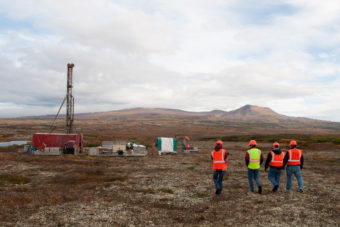
Members of the media walking to an exploratory drill rig. Photo by Jason Sear, KDLG – Dillingham
Members of the media walking to an exploratory drill rig at the Pebble Mine Exploratory site. (File photo by Jason Sear/KDLG)

The Pebble Partnership announced Thursday that is has officially formed a new advisory committee in an effort to expand its engagement with stakeholders. The company noted the commitments of five founding members: Willie Hensley, Kimberly Williams, Jim Maddy, General Joseph Ralston and Terrence ‘Rock’ Salt. Mike Heatwole is a spokesman for Pebble Mine.

“We’re putting together an advisory committee to help advise us on a range of issues regarding Pebble, everything from engineering to environmental design to community benefits and concerns,” Heatwole said.

Jim Maddy is a former president of the League of Conservation Voters and the National Park Foundation. Terrence ‘Rock’ Salt is a former deputy assistant secretary of the U.S. Army Corps of Engineers. General Joe Ralston is a former vice chairman of the Joint Chiefs of Staff. Kim Williams is a former executive director of Nunamta Aulukestai and a chief with the Curyung Tribe. And Willie Hensley is longtime Alaska leader who served in both the state House and Senate:

“Willie certainly has a great reputation and level of experience in Alaska,” Heatwole said. “He’s very respected in the Alaska Native community, and also has done a lot of work with the development community, and kind of bridges a lot of different stakeholder groups and interests.”

One of the first tasks the advisory committee will have is to recruit additional members to finalize a 10-12 member group, Heatwole said. Members can receive a small amount of pay to compensate for their time, travel and expense but can also decline that if they wish.

Pebble said the participants will not be bound by confidentiality agreements or any other limitation on their rights of public expression, including to speak in opposition to the controversial project.

“We wanted to make sure that we had a range of views, from maybe proponent to neutral and process focused, to opponents, so that we’re getting critical input and advice,” Heatwole said.

Last week the EPA agreed to back down from a proposed preemptive veto, and Pebble agreed to put a project into the permitting phase within two and a half years. Pebble said they have a smaller, modern mine plan in the works and a number of initiatives they want to talk about soon with the region. Heatwole said the Advisory Committee will get to review these plans and offer feedback.

“Their advice will be shared with the company, and we’re simply going to try to take as much of that onboard as we can,” Heatwole said. “And really a pretty wide open in terms of what they can look at and the types of things they can comment to us about.”

Heatwole said Pebble hopes to get the committee members together for the first time this summer for a full project overview and trip out to the site north of Iliamna.

After that the committee will meet formally two to three times a year, and more often by phone or video conference.

Pebble has agreed to make the committee’s work and comments public, including any recommendations the company does not adopt.

Cannery worker’s body found on Twin Hills beach

A body was found on a Twin Hills beach Thursday evening. James Schneider, a 56-year-old man from Oregon, worked at the Togiak Fisheries Cannery.

His co-workers began searching for him when they noticed his absence earlier in the day, Alaska State Troopers said. He was found face down in the mud. It was apparent to Schneider’s co-workers that he had fallen 15 feet from the cannery dock during low tide.

When troopers arrived on scene, the body had been moved because the tide was rising.

No foul play is suspected at this time. Bystanders told troopers that Schneider “was not known to be in the best of health.”

Schneider’s next of kin has been notified and his remains were flown to Anchorage for autopsy.

Igiugig School graduates class of one

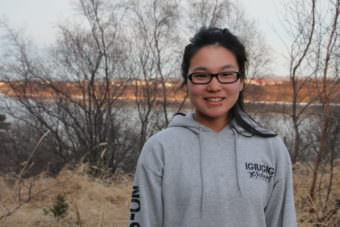
Igiugig School's only senior, 17-year-old Dolly Zharoff, graduates this week. In the fall, she will attend the University of Alaska. (Photo by Avery Lill/KDLG)

Igiugig School’s only senior, 17-year-old Dolly Zharoff, graduates this week. In the fall, she will attend the University of Alaska. (Photo by Avery Lill/KDLG)

Dolly Zharoff will have the stage to herself as she graduates from Igiugig School.

She will head to the University of Alaska Anchorage in August for a two-year culinary arts program.

In recent years the village has taken trips to New Zealand and Arizona for cultural exchange with native communities in those areas. Fundraising for these trips piqued her interest in baking.

“Throughout the school year and on my free time I bake a lot and cook,” Zharoff said. “For fundraising to go to New Zealand and Arizona we hosted dinners and movie nights, and we cooked and baked a lot for that. That got me interested more to do culinary arts.”

The village of about 70 people has 17 students in school this year.

In the five years that head teacher Tate Gooden has taught at the school, Zharoff is his fifth graduate.

“We’ll definitely be losing our leader,” Gooden said. “She’s one of those students who volunteers for everything, a proactive student. She sees something that needs to be done, and then she does it, and then she moves onto the next thing that needs to be done.”

This summer, between graduation and starting classes at UAA, Zharoff will work at Igiugig Lodge.

Ancient speartip leads to recognition for Round Island

Round Island
Round Island. (Photo courtesy U.S. National Park Service)

Round Island is one of the craggy coastal islands that make up the Walrus Islands State Game Sanctuary near Togiak. In 2004, a small spear-tip found on the island was tested and found to be over 6,000 years old.

Prior to this discovery, it was thought that human habitation on the islands dated back only 2,500 years. The available evidence showed that hunters were drawn there by the summer haul out of walrus, but also for the seals, sea lions, seabirds, and saltwater fish available to harvest.

Jeanne Schaaf, now retired, was the chief of cultural resources at Lake Clark National Park in 2004. At that time, the U.S. National Park Service and the Alaska Department of Fish and Game were working together to identify and protect cultural resources in the state. During a trip to Round Island as part of that collaboration, Schaaf uncovered the very old spear tip, which was a “significant” find from the excavations.

“Up until that time we knew that villages started to appear 2,500 years ago on that island,” she said. “We had no idea that people were there before that.”

This significant finding led Schaaf to co-author a proposal for the sanctuary to be declared a National Historic Landmark (NHL), a proposal that was approved in January of this year. The sanctuary had already been declared a National Natural Landmark (NNL) in the late 1960s, recognizing the unique biodiversity of the islands. It is one of only a handful of places to be awarded dual NHL and NNL status.

“Being named a National Historic Landmark site means that it is the best of the best, not just in Alaska but across the USA,” said archaeologist Rhea Hood with the National Register of Historic Landmarks in Anchorage.

The finding raised a lot of questions about the type of people who lived on the islands all those centuries ago.

“Did they follow walrus and is that what brought them to these islands?” Schaaf asked.

Schaaf believes it is possible that there were earlier occupations at Round Island when the island stood at the edge of the exposed Bering Land Bridge plain.

“I think we know that people traveled quite a bit and people were good mariners. Around 2500 years ago people definitely had semi- subterranean winter houses and we might find out that people wintered there even earlier,” she said.

Schaaf hopes future collaborative research will shed light on the occupants of Round Island. She also hopes that the new designation will prevent vandalism and unauthorized excavations that have damaged other sites.

For her part, Hood thinks the discovery is just another layer on the rich tapestry of Bristol Bay history.

“Everything that has happened in Bristol Bay, from the arrival of the Russians to the recent history of the United States, is all a continuation of the archaeological record,” she said.

“It is part of the story of how we got here today and the context of our current events. We should always be aware that we are walking in the land of our ancestors and should try and honor that.”

Awarding NHL status should make it easier for research grants to be given out to promote further research into the islands, according to Hood.


Dillingham poised to raise landfill rates to offset trash problems

Public Works Director Ken Morton stands next to the incinerator. "It's a pretty clean operation," he said about the machine. (Photo by KDLG)
Public Works Director Ken Morton stands next to the incinerator. “It’s a pretty clean operation,” he said about the machine. (Photo by Lawrence Hamilton/KDLG)

The City of Dillingham continues to look for the best way to manage its some three million pounds of annual trash.

Space to bury it is limited, and the fill to cover it is expensive.
The incinerator reduces most garbage to a fine ash, but glass and metals are clogging the machine, adding to the fuel bill.

One of Ken Morton’s jobs is to manage the roughly 3 million pounds of trash that arrive at the Dillingham landfill each year.

As the city’s public works director, Morton has been crunching numbers and comparing the two main options: burn or bury.

Earlier this year he submitted a report to the city on the future of the landfill’s operations, including a proposal for a new landfill area, known as a “cell.”

Morton said the “active cell” (the area of the landfill currently being filled with trash) will probably be full by the end of this year.

The active cell contains ash from the landfill’s incinerator operation, as well as trash that is not able to be run through the incinerator.

Once the trash is dumped in the cell, it is compacted down and covered with fill to prevent the contents from being dispersed.

The active cell is surrounded by berms that extend its operational life.

This is where Morton’s plan for a new cell comes in.

Morton and his staff are preparing to do the work needed over the summer.

“The new cell is to have three phases and should last 45 years,” Morton said.

This projection is dependent on continued optimal operation of the landfill’s Penram incinerator, and the incinerator is not without its problems.

Trash that is not properly sorted before being fed into the incinerator can make an already costly operation even more expensive and frustrating.

If a blockage in the incinerator cannot be easily reached, the incinerator must be stopped and allowed to cool before the offending item can be removed.

“A small piece of pipe can shut the incinerator for up to three days,” said Morton, noting that this has happened in the past.

But is the everyday glass and cans in unsorted trash that create the biggest challenge.

“Glass and metal creates problems operationally with the incinerator,” he said. “It reduces its efficiency and it requires us to embank more when it’s down and increases operation costs.”

For the most part the incinerator operates well, though it is currently eating almost three times as much oil as originally planned.

Even so, Morton believes it is an indispensable piece of the puzzle.

“It costs about the same per year if we buried everything instead of burning in the incinerator and burying the other third,” he said. “The challenge, though, is the available space that we have goes away much quicker.”

Trash problems in rural Alaska are not new, of course, but communities have had to evolve their solutions to meet changing regulations.

In 1996, the Department of Environmental Conservation banned the practice of open burning of general trash. It was this regulation, when ADEC stopped granting Dillingham exceptions, that led to the purchase of the incinerator in 2015.

“DEC worked on the larger landfills first, and as they brought those landfills into compliance they stretched their gaze further out,” Morton said.

Dillingham city manager Rose Loera said while the regulations and required testing are costly, it has been a welcome improvement to rid the city of the great plumes of blue smoke which rose from open burning at the landfill, “which isn’t good for the neighbors.”

“We’re monthly doing our testing and it’s very expensive, about $80,000 a year, and that is just one of the tests,” Loera said of monitoring the wells in the incinerator. “We (also) have to do methane testing, and we have to test the ash coming out of the incinerator.”

No matter what the city does, the costs of dealing with trash will likely increase.

Current projections estimate operating costs of roughly $750,000 this year, most of which is subsidized by the general fund.

Burying more trash will take more staff and fill costs.

Burning more at higher efficiencies will take staff hours to sort the garbage that goes into the incinerator or to burn it through longer cycles with less cool downs.

Morton has recommended the city increase its landfill fees closer to other comparable cities, and perhaps discount those who give a “scout’s honor” that glass and metal have been sorted out.

The city has also taken away this year’s “free dump days” normally associated with the community cleanup in May.

Left unraveled yet is how to sort the large percentage of garbage picked up by a local refuse company, which compacts all of the garbage before delivering it to the landfill.

State funding cuts to University of Alaska could deeply impact rural campuses

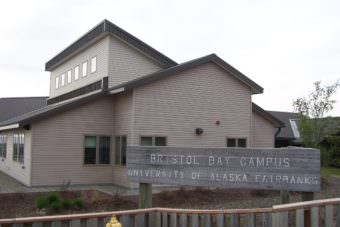
University of Alaska's community campuses, such as University of Alaska Fairbanks' Bristol Bay Campus in Dillingham, Alaska, could face dramatic changes as the university faces further funding cuts from the state. (Creative Commons photo by <a href="https://www.flickr.com/photos/jstephenconn/3633752706/in/photolist-6x6W5J-exCjS">J. Stephen Conn/Flickr</a>)
University of Alaska’s community campuses, such as University of Alaska Fairbanks’ Bristol Bay Campus in Dillingham, Alaska, could face dramatic changes as the university faces further funding cuts from the state. (Creative Commons photo by J. Stephen Conn/Flickr)

University of Alaska campuses are bracing for change as the university system faces up to $22 million in cuts from the state.

University administration are entertaining several different long-term options to reduce the costs, which it is calling Strategic Pathways.

Some of the options could have profound effects on higher education in rural Alaska.

“The purpose of Strategic Pathways is to give the president options of how to proceed with the budget cuts that are coming,” said Vivian Viar, the assistant director of the Bristol Bay Campus in Dillingham. “There are six avenues that Strategic Pathways lists. The community campuses are leaning toward option six, which is just increased collaboration among the other community colleges in Alaska. However, the president is leaning toward the learning center option unfortunately.”

That option would decrease education opportunities in the region dramatically Viar said. Learning centers provide computers, internet and tutoring in some cases. On-campus classes, however, would be outside of their scope.

“It would be devastating,” Viar said. “We service so many villages, flying students in, flying instructors out, providing student service support, offering classes. All of that would pretty much go away.”

In addition to decreased state funding, community campuses such as Bristol Bay’s would no longer be eligible for the significant federal grant funds that they receive.

“Currently we have approximately $7 million in federal funding that serves our villages and the Aleutian-Pribilof region,” Viar said. “The state funding would drop dramatically as we would not have the staff and the resources that we needed that is paid for by the state funding.”

University President Jim Johnsen held a mid-April news conference  after a special meeting with the Board of Regents to discuss contingency plans and preparations for Fiscal Year 2018.

Johnsen discussed both e-learning and increased collaboration as possible immediate contingency options for rural campuses.

“I think more e-learning, more online technology will be part of the solution there in our community campuses,” Johnsen said. “Another thing that I think is a real opportunity is sharing among the community campuses. The directors of our community campuses meet regularly. They work together on new program development.”

The Board of Regents’ will meet in May for an update on how the state budget will affect the university’s budget and again in June to discuss Strategic Pathways and the school budget for the next fiscal year.

Correction: A previous version of this story reported that University President Jim Johnsen held a mid-March news conference. This version has been corrected.

Site notifications
Update notification options
Subscribe to notifications