KDLG - Dillingham

KDLG is our partner station in Dillingham. KTOO collaborates with partners across the state to cover important news and to share stories with our audiences.
Ekwok Natives Limited cuts ties with Nunamta Aulukestai

Ekwok Natives Limited announced Friday that it is no longer intends to be a member of Nunamta Aulukestai, a non-profit association of 10 Bristol Bay village corporations.

Ekwok Natives passed the resolution at board of directors meeting by a 4-1 vote.

Recently elected president of the board Jimmy Hurley Sr. said the decision to cease affiliation was made to protect shareholders from the potential cost of litigation related to the proposed Pebble Mine.

“In the long term, we’re looking at the safety of a small corporation like us,” Hurley said. “To have risks with litigation, especially with what’s going on in Washington D.C. now with a new president and possibly with the Pebble Mine, we’ve got to look at the long run for shareholders. I think Trustees of Alaska and Nunamta should explain to all the other native corporations what’s the risk in losing. If you don’t know that, you might be putting your corporation at risk.”

Nunamta was among several who sued to challenge the public noticing of the state’s permits for Pebble’s exploratory work.

They lost that challenge in a 2011 Superior Court ruling, but the Alaska Supreme Court overturned the decision in 2015.

The court also found in favor of the challengers who might have been liable to the state and Pebble for legal fees.

Nunamta Aulukestai’s executive director Kim Williams said that since winning that case, the organization has not been involved in lawsuits with Pebble.

“We have no litigation against Pebble at this time. Nothing,” Williams said.

Williams also said that if they bring a lawsuit forward in the future, the member village corporations would not be held financially liable for an opponent’s legal fees if the plaintiffs lose and the court orders them to pay.

She explained that the decision to file a lawsuit rests with Nunamta’s board of directors.

“It doesn’t go all the way back to the village corporations or tribal governments, so it would remain isolated within Nunamta Aulukestai if there ever was another future court case,” Williams said.

Hurley is out of the state, and Williams said she has been unable to reach him by phone since Ekwok Natives Limited made the announcement.

Williams hopes, however, that the corporation will reconsider its decision.

“I am more than willing to go up and talk to their new leadership to say, ‘These are the things that are happening with Nunamta Aulukestai, and we hope you would not depart and leave our organization,’” Williams said.

Ekwok Natives Limited also announced that they are also disassociating themselves with Trout Unlimited and Trustees of Alaska.

Hurley said he has long opposed the Pebble project, but also believes that it may soon provide work opportunities for young people in the village.

“We need jobs in this area,” Hurley said. “We’ve had a lot of people who worked on the mine over there, and everybody’s afraid. I’ve seen some young guys from Stuyahok or here. They get shunned you know, and that’s not right for people who need jobs, who need money. They have families.”

“You’ve got to look at the environment, and if there’s money out there to be made, they’ll come home, and they’ll provide,” he said. “It’s better than waiting for a welfare check or food stamps if you have a job. So that’s what you have to look at on the long run for your people.”

House Resouces hears from United Tribes of Bristol Bay about Pebble

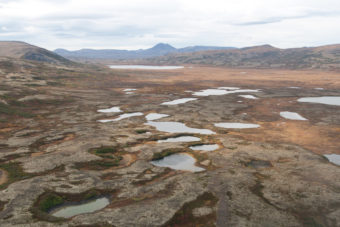
The proposed Pebble Mine site looking northwest. (Photo by Jason Sear)
The proposed Pebble Mine site looking northwest. (Photo by Jason Sear/ KDLG)

The United Tribes of Bristol Bay was invited to testify Monday before the Alaska House Resources Committee in Juneau.

At issue was United Tribes’ allegation that Pebble has left a mess from exploration work at their mining claims northwest of Iliamna.
Anchorage Democrat Andy Josephson invited UTBB to share findings of their 2016 report to the committee members.

Josephson has been leading the charge against Pebble in the state Legislature, and now has a bigger voice as co-chair of House Resources.

“This is one of the most significant environmental issues of my lifetime, fifty-two year resident of the state of Alaska,” he said. “Critically important to the state, very divisive issue, strikes me as mandatory that we would have a hearing like this.”

Last summer geophysicist David Chambers was contracted by United Tribes to conduct on the ground surveys of 107 of more than 1,300 test holes dug on the Pebble claims.

Chambers summed up the problems he identified into four general groups.

“First of all, we found that 17 sites that we looked at had acidic soils, that’s the sort of orange colored soil,” Chambers said, using a slideshow presentation to highlight the visuals from the fieldwork. “We also found artesian drill holes … and at those holes we found that there were elevated levels of sulfate, copper, and other heavy metals in the water.”

“We also found a few locations with petroleum contamination which we documented in the laboratory,” he said.

The last problem he documented was that some metal well casings still stand above the surface, posing a potential hazard to winter travelers.

The sites were not randomly chosen, said Chambers, but were picked based on issues documented during prior inspections.

United Tribes of Bristol Bay executive director Alannah Hurley told the House Resources Committee that Pebble’s exploration activities have already impacted the ecosystem.

“This report has verified the concerns of our people that they have held for the last decade,” Hurley said. “Our elders have noticed less fish in the upper river systems of the Nushagak and Kvichak Rivers.”

“Our local hunters have seen our game pushed further and further away from their communities and normal patterns, due to exploration activities,” she said. “These concerns come from our people and our communities, who are seeing real impacts to our way of life.”

The United Tribes report was filed as a public comment to the state’s Department of Natural Resources, which is reviewing a land use permit renewal request from Pebble.

The tribal consortium asked that if DNR does renew the permit, it limit it to just one year, and require Pebble to provide a reclamation bond to cover clean-up costs in the event the company folds.

The assertions against DNR’s oversight and Pebble’s stewardship were strong enough that several committee members asked why neither had been invited to testify themselves.

It was “unfortunate” they didn’t get the chance, Pebble spokesman Mike Heatwole said.

“We’ve said regarding the UTBB report that the allegations are demonstrably false … there’s a lot of problems with the report,” he said after the hearing. “We run a very compliant program that’s been subject to 55 separate state inspections over the course of our time out there, and we’ve repeatedly been found in compliance with the requirements for an exploration project such as ours.”

DNR did delay renewing Pebble’s land use permit while it reviews the large number of public comments received.

Pebble was granted a temporary extension through the end of March.

The Pebble claims are being operated under “care and maintenance” status, but Pebble has raised some $37 million to continue exploration work, which could get back underway this summer after a three year hiatus.

Josephson said House Resources may consider supporting UTBB’s requests that DNR add more stringent oversight of Pebble’s exploration and site reclamation.

He said Monday’s hearing was mostly for informational purposes.

United Tribes of Bristol Bay is a political advocacy group representing 14 area tribal councils. A contingent of its staff and board traveled to Juneau for the 30-minute presentation.

House Science Committee asks EPA to drop Pebble Mine veto

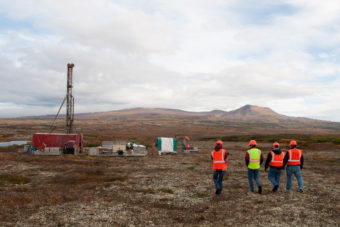
Members of the media walking to an exploratory drill rig. Photo by Jason Sear, KDLG – Dillingham
Members of the media walking to an exploratory drill rig at the Pebble Mine Exploratory site. (Photo by Jason Sear/KDLG)

In a letter Wednesday to new Environmental Protection Agency Administrator Scott Pruitt, the chairman of the House Science Committee asked that the agency rescind its 2014 veto of the Pebble Mine.
EPA proposed the preemptive Clean Water Act restrictions based on findings from its Bristol Bay Watershed Assessment, and did so with the support of many area tribes, fishermen and environmental groups.

Others say EPA has created an unfair regulatory process not based on rule of law, and are likely to find a receptive audience with the new administration.

Texas Republican Rep. Lamar Smith has made the agency’s work in Bristol Bay a top priority of the oversight committee he chairs.

Over the past several years, House Science held a number of meetings, deposed witnesses, and reviewed hundreds of pages of documents and emails, leaving Smith with the firm opinion that the agency acted improperly.

“In the course of the committee’s investigation, we discovered that EPA employees colluded with third-party Pebble Mine opponents,” Smith said last April. “They sought to deliberately establish a record that pointed to one outcome: that Pebble Mine will be excluded from the regular permitting process and should be stopped.”

In his letter to Pruitt, Smith called EPA’s 2014 preemptive veto “unprecedented,” “biased” and based on “questionable” science.

Smith wrote that allowing it to stand will create a “dangerous precedent of expansive federal agency powers.”

“This Committee should support due process, protect the permitting process, and insist that EPA actions be based on objective science,” Smith said during April hearing. “The EPA violated all of these tenets in its evaluation of the Pebble Mine. The Committee should not allow EPA to stop projects before they even apply for a permit. This would be contrary to the rule of law and the principles of scientific analysis.”

Smith called on Pruitt to rescind the restrictions, which have not yet been finalized.

A federal judge put a hold on the agency’s work surrounding Pebble and the Bristol Bay Watershed Assessment while one of Pebble’s several lawsuits against EPA is litigated.

Scott Pruitt is the former Attorney General of Oklahoma, and made a name for himself as a fierce critic of EPA.

In a speech to his new staff Tuesday he laid out three principles he intends to lead the agency towards: following the rule of law, keeping the regulatory process fair, and working better with states.

“I read those things with a happy heart, and I think that they bode well for a decision that will reverse what the existing EPA has done, and allow us to go into permitting,” Pebble CEO Tom Collier said recently of Pruitt’s previously stated principles. “Some people think that this dispute we’ve been having with EPA is over whether or not we can build the project. I can’t emphasize enough that it is simply over whether or not we can file a permit application.”

But Pruitt has also stressed he intends to lead by listening, and wants to encourage rigorous debate on contentious environmental issues.

“We ought to be able to get together and wrestle through some very difficult issues, and do so in a civil manner,” Pruitt said in his speech Tuesday. “We ought to be able to be thoughtful, and exchange ideas, and engage in debate, and make sure that we do find answers to these problems. But do so with civility.”

Bristol Bay and Pebble opponents have long and loudly voiced concerns, drawing growing attention to the potential threat to one of the world’s last great salmon habitats. Since launching its watershed assessment six or seven years ago, top EPA officials have held more than two dozen public hearings in Bristol Bay, around Alaska, and in Seattle and Washington D.C., and taken in a mountain of public comments. Most of the testimony heard and comments received have been supportive of the agency’s work.

Tom Tilden and Ralph Andersen flank former EPA Administrator Gina McCarthy at a public hearing in Dillingham in 2013. (Misty Nielsen)
Kim Williams, the director Nunamta Aulukestai, said Pebble’s opposition will make sure the new administration hears the same message Obama did.

“We’ll continue to speak out to President Trump and the Administrator, to reaffirm that this project will need a permit, and this region is opposed to any kind of dredge and fill material entering our salmon streams,” Williams said.

EPA has not responded to the House Science recommendation it toss the agency’s watershed assessment and proposed preemptive Pebble veto. The agency has also not yet named a Region 10 administrator to replace Dennis McLerran, who guided the unique but perhaps fragile work in Bristol Bay.

Emperor goose hunt proposed for the first time in decades

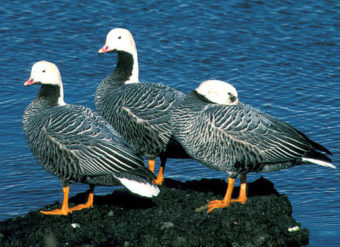
Emperor geese at Adak Island.
Emperor geese at Adak Island. (Public Domain photo courtesy U.S. Fish and Wildlife Service)

A subsistence harvest for Emperor Geese has been proposed this spring for the first time in 30 years. The population declined in the early 1980s. The last subsistence hunt took place in 1987. Jason Schamber, who is a wildlife biologist with Alaska Department of Fish and Game, says that the decades of conservation have paid off.

“Over the last 30 years the population has grown slowly at about three percent per year,” says Schamber. “In 2015, it finally reached the level where managers felt that the population could sustain a harvest.”

The Alaska Migratory Birds Co-Management Council developed a management plan for the spring, summer subsistence hunt, and agreed to adopt it for an initial three-year trial period beginning this year. The approved plan is a customary and traditional hunt, meaning that there will be no bag limit.

Still, the population remains susceptible to overhunting. Gayla Hoseth represents Bristol Bay on the AMBCC. She says that education will be key, along with monitoring and potential restrictions, if this trial run is to lead to a sustainable annual hunt.

“In Bristol Bay, we have our Yaquillrit Keutisti Council, and it’s also known as Keeper of the Birds, meeting. We’re going to be having a meeting here before April to talk about these kind of things, education outreach,” Hoseth says. “We don’t want to overharvest.”

Education outreach will include presentations on conservation in some villages that hunt emperor geese and informational mailers.

In addition to the subsistence hunt, there will also be a fall and winter sport hunt. There will be an unrestricted number of permits, but there will be a limit of 1000 birds taken statewide. The specific limit for the Bristol Bay region is 150. The subsistence harvest is scheduled to open April 2 and run through August 31. The fall hunt is set to begin in September.

Proposed changes are open for public comment until March 13.

Dillingham drone sighting raises questions about privacy

(Photo by Avery Lill/KDLG)

Michael Paisley of Dillingham was outside with his dog, when he realized that he was in the presence of an unwelcome visitor.

“We were just standing there in the woods waiting for her to do her business when I heard a weird hum.”
Paisley looked up to see a solid red light with green flashing lights around it.

“I instantly realized it was a drone,” he said. “I watched it zip over our heads and buzz around the second-floor windows of our apartment complex, all the way around the whole house, and then back over the woods where we were standing, and then around the neighbor’s house around their windows and then back where it came from.”

Paisley didn’t call the police, but he did take to the Facebook to alert the neighbors.

“I just posted. I said, ‘peeping drone alert’ because, I mean, why else would you be flying around at 11, 11:15 at night, looking around people’s windows or over people’s property unless you’re up to no good?” he said. “I just wanted let the neighborhood know that there’s somebody out peeping.”

Paisley said that others who live in the area also have noticed a drone flying around the neighborhoods between the Vitus gas station and Waskey Road.

As flying drones becomes an increasingly popular hobby, the relatively new technology raises questions about privacy and legality.

Drones flying through people’s yards around near windows at night, might make some uncomfortable. But that in itself is not technically illegal, Dillingham Police Chief Dan Pasquerello said.

“The airspace in America is controlled by the FAA, so the airspace above your house, above your property is not your own. It’s public property,” Pasquerello said.

Even if it is not illegal to fly over someone’s yard, there are variations on that theme that could be a crime.

“If a drone is annoying you that violates the Alaska law of harassment. You could contact the police. We’ll investigate it and, if appropriate, file the applicable charge,” Pasquerello said. “A worst case scenario is there’s a crime of indecent viewing or photography. That may be what people’s main fear is of drones spying in your window at night. In that case, that is a more serious offence, a felony offence that we could charge.”

Then there’s the question of vigilante justice.

As Dillingham’s residents discussed the drone sighting, some suggested it should be shot down. Pasquerello said, however, that to do so would be illegal.

“If you shoot down a drone you’re destroying another person’s property,” he said. “You could be charged with the Alaska statute of criminal mischief. Plus, discharging a firearm within city limits carries its own municipal ordinance violation of a $75 fine.”

State Sen. Shelley Hughes, who has co-chaired a legislative task force on the issue since 2013, reiterated that point in an interview two years ago.

“No, you cannot they’re aircraft,” she said in response the question of whether or not property owners can shoot a drone flying above their land.

Hughes adds, “We have to realize that although some of these may be under a $100 in the hobby store. If they’re a commercial user, they can be up to $100,000, and from the ground they can look the same. So it’s someone else’s property.”

“If they are hovering over your private property and you feel like your privacy is being invaded, that’s when you call your local law enforcement,” she said.

The task force published guidelines for safety and privacy.

It clarifies that Alaska’s Constitution protects individual’s privacy. It also reiterates that, by the U.S. Constitution’s Fourth Amendment, law enforcement must obtain a warrant before search and seizure. This standard also applies to search by drone.

A 2014 state law established specific training and protocol required for police drone use.

Federal laws largely pertain to the safety of airways, like requiring drones to fly below 400 feet and to avoid operating near airports.

Some states, such as California, Florida, Texas, Mississippi have laws that specifically address private citizens capturing images or video by drone.

For now though, law enforcement in Alaska uses existing privacy law to address those issues.

Skeleton of orca that died in the Nushagak River printed in 3-D

3-D printer at the UAF Bristol Bay campus.
3-D printer at the UAF Bristol Bay campus. (Photo courtesy KDLG)

A machine the size of a mini-fridge sits on the counter of a college science lab. Three half-constructed plastic models of fetal orca bones are visible through the glass front. The 3-D printer’s extruder moves across the models, adding plastic layer by layer. It whirs, hums, and beeps like a “Star Wars” droid.

In September of 2011, three killer whales puzzled biologists by traveling about 70 miles up the Nushagak River. Orca’s natural habitat is saltwater. Sometimes they swim up the freshwater river for salmon, but not that far. By October all three whales had died. That raised the question of what to do with the bodies, which led to an unusual science project. Bristol Bay area scientists, students, and educators have been working to make a plastic model of the fetal orca’s skeleton.

One orca was pulled ashore, and NOAA scientists performed a necropsy. When they discovered the whale was pregnant, they saved both her skeleton and the skeleton of the fetus. But preserving the fetus was complicated because its bones hadn’t ossified and fused together yet.

Kent Winship teaches construction and runs the fabrication laboratory at the University of Alaska Fairbanks Bristol Bay Campus. He has helped oversee work on the solution to that problem.

“It was basically a bag of bones with skin on it, just like a big trash bag full of partially formed cartilage, and not all the way meshed together bones,” says Winship. “This is all cartilage, so it’s going to decay. What they decided to do was 3-D scan them.”

So the Nushagak Orca Articulation Project was born. The Dillingham City School District, Bristol Bay Campus and Nunamta Aulukestai have worked in partnership to clean, categorize, scan, and print the fetal skeleton’s hundreds of bones.

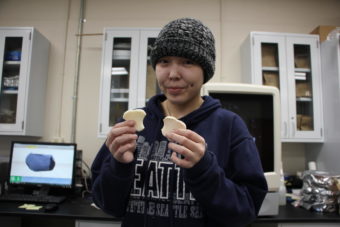
Cheyenne Roehl holds both a fetal orca bone and a plastic model. She has worked at the UAF Bristol Bay Campus for two years, scanning and printing the majority of the orca's skeleton.
Cheyenne Roehl holds both a fetal orca bone and a plastic model. She has worked at the UAF Bristol Bay Campus for two years, scanning and printing the majority of the orca’s skeleton. (Photo by Avery Lill/KDLG)

The project brought high school student Cheyenne Roehl onboard two years ago to scan bones. She works in the campus lab three hours every weekday. A few other people have been involved in scanning over the years, but Winship says that Roehl has done the bulk of the work.

Her job is to create 3-D digital models of the bones in a computer aided drafting program.

“I get one of the bones, and I put it on the scanner,” she says, explaining her process. “We have to get multiple scans, and then align them together. And then we make sure that it looks like the bone, and then we get a finalized watertight model…I’m making it sound a lot more simple than it actually is.

It’s time-consuming work. If a bone has a lot of holes, protrusions, or facets, it can take numerous scans to capture all the angles. Each scan takes about 20 minutes.

Roehl pulls a piece of the orca’s skull from one of tall cabinets where bones are stored in jars and paper bags.

She holds it, turning it over and running her fingers along its different angles.

“I see a lot of holes and places that scanned very well to have a lot more detail for the scan because we use a laser, and if it’s slanted a little bit, the scanner won’t be able to pick up that data.”

When she has the scans, Roehl joins the images to form one 3-D model. Then she prints it and organizes it with the other printed bones.

The project reached an important milestone this week. Roehl finished scanning, and she’s about to finish printing the last of the roughly 300 whalebones.

Then it will be time for the jigsaw phase of this project. Project leaders with the university, school district, and Nunamta Aulukestai are developing plans to begin constructing the skeleton out of the model bones. They aim to involve students in this stage of the work as well. Fully assembled the killer whale fetus will be about 6-feet long.

Roehl reflects on the hundreds of hours she and other students have put in over the years. She says that it’s the idea of seeing this orca skeleton completed is what keeps up the momentum.

“It’s really exciting because you know that they’re going to be turned into a 3-D model skeleton, and that will be beautiful.”

Site notifications
Update notification options
Subscribe to notifications