KDLG - Dillingham

KDLG is our partner station in Dillingham. KTOO collaborates with partners across the state to cover important news and to share stories with our audiences.
Mushing, a tradition on the fritz in Bristol Bay

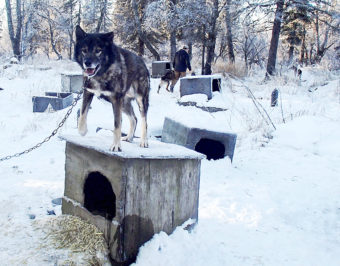
John Hanson Jr. is one of four mushers in New Stuyahok. (Photo by Avery Lill/acKDLG)

Dozens of canines howl in John Hanson Jr.’s dog yard, excited by the sound of a snow machine pulling up to the kennel.

Hanson is one of a handful of dog mushers in New Stuyahok, probably the most active mushing community in a region that has watched participation in the tradition dwindle.

“These other mushers are elderly mushers, and they were in it for 40, 50, 60 years or more,” Hanson said. “I don’t see any other young mushers around in the Bristol Bay region getting involved in dog mushing.”

Part of the reason, Hanson said, is that dogs are a lot of work.

Hanson collects food scraps from neighbors every day.

The aroma of fish and moose guts in the steel drum where he cooks the dog’s food is pungent.

When there’s snow, he runs the dogs on a sled.

When there isn’t, the dogs pull him on a four-wheeler.

For Hanson, caring for dogs is a full-time job.

He lives on money from sponsors and dividend checks from the state’s Permanent Fund and the native corporation.

But it’s an uncertain income, and local sponsors have been hard to come by lately.

It’s been a few years since weather has allowed a race in Bristol Bay, and he’s not optimistic that this year will be any better.

Without races, people and businesses close to home are less interested in sponsoring their local mushers.

Hanson looks elsewhere for sponsors, like to the Yukon-Kuskokwim Delta, so his team can fly to races.

He said there are plenty of races in the Kuskokwim, adding that he believes interest in the sport there is growing, not declining.

Dillingham musher Kyle Belleque has given away or sold most of his sled dogs. (Photo by Avery Lill/KDLG)

Kyle Belleque keeps three older sled dogs in Dillingham.

His dogs might be 12-years-old, but they still love to pull.

As they cut their way across the frosty tundra one recent afternoon, Belleque said he feels at home with his dogs, outside of a snow-machine’s bubble of noise and exhaust.

Belleque has run a few races, but started mushing more for its connection to days gone by. He likes the idea that before it was a sport, many families in the area kept dogs as draft animals.

“That’s how they hauled wood,” Belleque said. “That’s how they went hunting. That’s how they traveled. That’s how they did everything. When I was growing up here in the ’70s, ’80s and ’90s, there were dog yards all over the place.”

Better roads and more snow machines turned dog sledding into more of a hobby than a necessity.

Belleque also believes the decline can be attributed to a time in the ’70s when people first began importing dogs for racing.

“They imported all the other things that came with dogs, and among that was disease,” Belleque said. “There were massive die-offs in the villages. Some guys lost their entire genetic line to parvo and distemper.”

Then came the recent years without snow.

“In the last three years it was darn near treacherous,” Belleque said. “And this year it’s not that bad. Although, I fell in some creeks back here behind the house a couple of weeks ago.”

Belleque has kept dogs for his entire adult life.

Despite his love of mushing and his passion for its history, the empty wooden kennels in his dog yard show that even he has sold or given away most of his team.

“What happened to mushing? You know, it’s what happens to a lot of old things. They just get replaced,” Belleque said, scratching his dog’s head as it noses his hand. “I think the weather has been kind of the nail in the coffin, at least in Bristol Bay.”

Alaska Native healthcare leader Sally Smith dies at 70

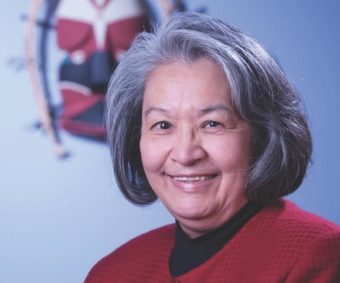
H. Sally Smith of Dillingham passed away Tuesday at the age of 70. (Photo by Michael Dinneen/Alaska Nativ Health Consortium Board of Directors)
H. Sally Smith of Dillingham passed away Tuesday at the age of 70.
(Photo by Michael Dinneen/Alaska Native Health Consortium Board of Directors)

The longtime chairman of the Bristol Bay Area Health Corporation board of directors has died.

H. Sally Smith, 70, of Dillingham died Tuesday in Seattle from complications with leukemia.

Over her long career, she served on a long list of boards, commissions, and committees, always advocating for the health challenges and sharing the success stories of Alaska Native people.

Sally Smith was a leader in Indian and tribal health care in Alaska like few others.

It was a field she worked in for close to five decades, and along the way she received many awards.

Those awards include the National Indian Health Board’s highest recognition, The Jake White Crow Award; the Alaska Federation of Native’s Shirley Demientieff Award; the YWCA Woman of Achievement Award; and she was honored by the members of the Alaska State Legislature after receiving the 2014 Legacy and Leadership Award presented by the Healthy Alaska Natives Foundation.

Attention, however, was something Smith never sought, and was always a little embarrassed by, said her son, Jacques Smith.

“My mother worked very hard, but she was a very modest person. Nothing she did was ever to receive an award, and that’s a very Native Alaskan way of being,” he said. “She did everything to help Native Americans throughout the country, and not many people know the story. She would actually be very happy with that, because she was doing it just purely to help people with cancer, and diabetes, alcoholism … everything she did in her life she did to help others.”

She was raised in Clark’s Point and lived in Dillingham. She has been on the board of the Bristol Bay Area Health Corporation for 30 years, serving as its chair for 22 years.

There is a long list of other titles she held, including chairman of the National Indian Health Board, vice chairman of the Alaska Native Tribal Health Consortium and chairman of the Alaska Native Medical Center.

Smith is spoken of in warm, fond terms by friends and colleagues, and is recognized for bringing good judgment and sound leadership to the BBAHC board.

“Gov. Parnell gave my mother an award a couple years ago at AFN,” Jacques Smith said. “He said something interesting about my mom. He had seen her, others had seen her also … little old Native women would come up to my mother, and they had an unspoken bond, an unspoken language, and they would look at each other smile. And they would understand things that only Native Americans can really understand. That level of thanks meant more than any of the awards.”

In 2014, the Healthy Alaska Natives Foundation presented Smith with its Legacy and Leadership award.

In a video on that occasion, current Alaska Department of Health and Social Services Commissioner Valerie Davidson was one of several who paid tribute.

“Sally is one of those rare individuals who really was the architect of the Alaska tribal health system that we know today,” Davidson said. “When she speaks, you stop what you’re doing and you turn and you listen, because what she says is important and what she says matters.”

Smith battled leukemia for several years, splitting time between Anchorage and Seattle for treatment, but continued to work until the last few months.

Condolences have been coming in from all over the world, including a call from the White House, Jacques Smith said.

A funeral service is planned on Jan. 20 in Anchorage , and a second service in Dillingham on Jan. 22.

Outbreak of HIV cases reported in one Bristol Bay village

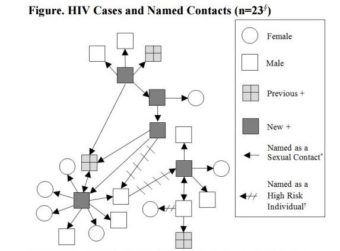
This diagram depicts sexual relationships of HIV-positive and at-risk individuals in one village in Bristol Bay that has seen an outbreak of five new cases of HIV. (Graphic courtesy of Alaska Department of Health and Social Services)
This diagram depicts sexual relationships of HIV-positive and at-risk individuals in one village in Bristol Bay that has seen an outbreak of five new cases of HIV. (Graphic courtesy of Alaska Department of Health and Social Services)

Five new cases of HIV in one Bristol Bay area village have been reported to health officials.

The small outbreak, or cluster, began with one individual who tested positive in February 2016. Two more were reported in October and November, and two additional people tested positive as officials began investigating.

Concerns surfaced that the HIV might be tied to needle sharing from the epidemic of opioid drug use.

Dr. Cathy Hyndman from the Kanakanak Hospital in Dillingham said health officials have determined unprotected sex, not needle sharing, allowed transmission of the virus.

“HIV is spread through sharing of blood and body fluids,” she said. “It could be happening by drug use, but it does not appear to be so in this particular group of cases. This particular group of cases seems to be associated with sexually transmitted vectors.”

According to a state report, all five of the HIV cases in this cluster involve men who have sex with men.

Needle sharing was not reported as a risk factor, but alcohol and drug use did likely lead to unprotected sexual activity.

“When a person is intoxicated by alcohol, they make more poor choices,” Hyndman said. “Or, unfortunately, in some cases their choice is taken away from them by the alcohol. They may be passed out and not even know that someone is having sex with them.”

HIV is treatable, and Hyndman recommends people at risk get tested often and begin treatment quickly if diagnosed with HIV.

Transmitting the virus also is preventable.

“Use protection. The only protection that is available for sexually transmitted cases is wear condoms,” she said. “Every time. Every time.”

State health officials said limited access to health care and health education, as well as patient concerns about stigma and confidentiality, can be barriers to routine testing in rural Alaska.

Over the past five years, an average of 28 newly diagnosed cases of HIV were reported in Alaska.

A majority, 54 percent, involve men who have sex with men, most of whom live in urban areas of the state.

Three people stranded on trail to Levelock returned safely

A search and rescue wrapped up Tuesday morning with three people returned safely to Levelock.

Danielle Dobkins, Ivon Washington, and Paul Chukwak, all in their 40s, had made a trip to Naknek by four-wheeler Sunday morning, and had broken down on the return trip on Sunday evening.
They were stranded near Coffee Creek, and called for help Monday when they realized no one else would be coming by.

When contact with authorities by cell phone was lost, the trio decided to begin hiking the remaining distance to Levelock.

Chukwak had been unable to continue the hike after a few miles, but Dobkins and Washington continued on, leaving Chukwak behind with a bottle of vodka, Alaska State Troopers said.

Dobkins and Washington took shelter in an abandoned cabin, and volunteer searchers from Levelock found them there at about 1 a.m. Tuesday.

At first light Tuesday, a state wildlife trooper from King Salmon flew in search of Chukwak, finding him alive and in fair shape.

Chukwak was picked up in the Super Cub and flown to Levelock.

The three were making a booze run to Naknek, and attribute some of the problems encountered on the trail to alcohol, troopers said.

Fukushima radiation yet, and unlikely, to affect Alaska seafood

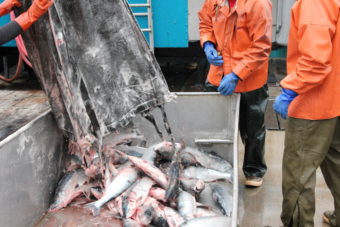
Sockeye salmon delivered in Bristol Bay. (File photo by KDLG)

Alaskan seafood remains free of detectable Fukushima-related radiation, according to the Alaska Department of Environmental Conservation.

The department along with other state, federal and international agencies has been testing Alaskan seafood since 2013.

After the 2011 Fukushima nuclear disaster in Japan, food safety authorities, including the FDA, reported it would be highly unlikely that radiation would affect Pacific seafood in the U.S.

Marlena Brewer, the spokeswoman for the Department of Environmental Conservation, said there was still significant public concern in Alaska.

“Fishing is such a huge part of our lives here, so I think that there was this overwhelming concern,” Brewer said. “They wanted to see Alaska specific data.”

Food safety inspectors were already collecting samples around Alaska as a part of normal food safety operations.

In 2013, they began collecting additional samples to send to the FDA lab in Massachusetts to test for Fukushima-related radiation. Species tested include king, chum, sockeye and pink salmon; halibut; pollock; sable fish; herring; and Pacific cod.

In 2016, Alaska was selected as the first state test site for implementation of a field deployable gamma-ray analysis system to analyze fish for radionuclides. The system is housed in Anchorage.

The FDA continues to analyze the results, but now the samples are tested in-state.

“The idea is that, in the unfortunate event that there’s another incident like Fukushima, the FDA would be able to deploy these instruments to other states so that they could get the real-time monitoring data instead of kind of scrambling after the fact and trying to coordinate these sampling efforts like we have,” Brewer said.

Brewer said that they will continue to test Alaska seafood specifically for Fukushima-related radiation for at least one more year. None has been detected since testing began.

New city dock in Chignik Bay nearly complete

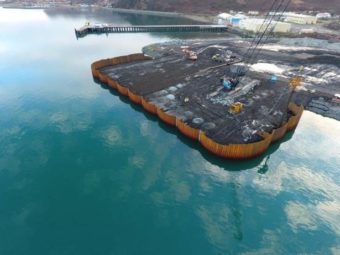
Construction is continuing on the new city dock in Chignik Bay. The roughly $11 million project has been the top capital improvement project for the Lake and Peninsula Borough, and should be ready in plenty of time to receive the Ferry Vessel Tustamena when it starts the Aleutian run in May.

For years the “Trusty Tusty” has tied up at the privately owned Trident Seafoods dock in Chignik Bay.

That dock was in need of repairs, some of which the city and borough agreed to pay for, but they were just band aid fixes.

Borough manager Nathan Hill says there was no guarantee the ferry route would continue to include the Chigniks without the new dock.

“The communities of Chignik Bay, Chignik Lake, and Lagoon, and Perryville, have all depended on the Alaska Marine Highway System now for a couple decades, and it’s a great resource,” he said.

The Lake and Pen Borough and city of Chignik Bay contributed a combined $4 million, and the state covered another $7 million to see the dock built.

The project went out to bid late in 2015, construction started last fall, and Hill said it’s being built mostly on time and near budget.

“We were anticipating the project to be complete by Christmas and ran into some conditions that prevented that, but we’re not too far off track,” he said. “I’d say a good estimate on completion would be the end of January, beginning of February.”

The only setback to date, he says, was that material that was to be used to fill in the dock did not work out as intended. Hill briefed the borough assembly on that in November.

“The weather conditions and the material they had available just wasn’t working out very well,” he said. “There was a lot of standing water in the material so they couldn’t compact it. Long story short, they will be hauling a substantial amount of fill in from elsewhere with the barge.”

He said the new material came with a price tag of a little over a million dollars, a tenth of which the city and the borough were required to pick up.

Don Bumpus, a now retired fisherman from Chignik Lagoon, said he has been pushing to see this much-needed dock built for years.

“I think we were the last community on the Alaska Peninsula to get a city dock,” Bumpus said. “We’ve always used the two processing docks that were there, and they’re in pretty bad shape now. One of them is really bad. Just to see that thing as far along as it is now is just really impressive.”

Beyond getting the ferry in and out during the summer months, there’s hope the new dock will encourage economic growth around the area’s lucrative fisheries and resource extraction.

Site notifications
Update notification options
Subscribe to notifications