KDLG - Dillingham

KDLG is our partner station in Dillingham. KTOO collaborates with partners across the state to cover important news and to share stories with our audiences.
Doctor: Late winter flu increase possible

flu shot
(Creative Commons photo by WFIU Public Radio)

The flu season in Alaska appears to be mild so far, but Alaska’s Chief Medical Officer warns that cases could peak later this winter.

This year’s flu season is off to a mild start, though there was an uptick of cases reported nationwide and in Alaska during the last two weeks of the year.

Dr. Jay Butler is Alaska’s Chief Medical Officer.

“It’s not been a terrible year for flu,” Butler said. “We began to see an increase in influenza-like illness in October. Now, at the same time, there are other respiratory viruses that are circulating, so there’s no lack of coughs out in the community. But, so far it’s been fairly mild for influenza.”

For the past two seasons, the flu vaccine has not proven as effective as health officials would like, but Dr. Butler said this year’s vaccine seems to be doing a better job.

“The vaccine has a good match this year with the isolates that have been obtained in the United States so we’re much more optimistic that we’ll have a good vaccine effectiveness this year,” Butler said.

Last year’s flu peaked late in the U.S., including in Alaska, with the highest number of cases reported in March and early April.

Dr. Butler said it’s not too late to get vaccinated this season.

“Because of the remote location, sometimes influenza can reach our villages a little later than other parts of Alaska or the Lower 48,” Butler said. “So it’s important to keep in mind that sometimes, flu activity doesn’t peak until fairly late in the winter.”

The U.S. Centers for Disease Control recommends everyone over the age of 6 months get a flu shot.

The nasal spray flu vaccine used last year is no longer recommended; the nasal vaccine ended up offering no protection for children aged two to 17 years old, though the CDC said it’s not yet sure why.

Each year millions of Americans catch the flu, hundreds of thousands are hospitalized, and thousands will die from it.

Don Young files new bill for a road to Cold Bay

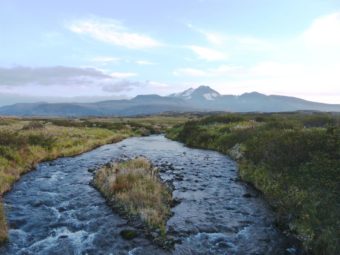
Frosty Creek, Izembek National Wildlife Refuge.
Frosty Creek, Izembek National Wildlife Refuge. (Public Domain photo by Kristine Sowl/ Alaska Region U.S. Fish and Wildlife Service.)

When Alaska Congressman Don Young was sworn in for his 23rd term in the House of Representatives Tuesday, he quickly introduced 38 pieces of legislation. Among them is a bill to build the King Cove road.

For decades, the village of King Cove on the Alaska Peninsula has sought to build an 11-mile road to an all-weather airstrip in Cold Bay. It would cut through the Izembek National Wildlife Refuge, ecologically sensitive habitat protected by the Fish & Wildlife Service. The Obama Administration denied a land swap proposed in 2013. With a new administration and the backing of Alaska’s Congressional Delegation, King Cove has renewed hope they’ll get their road.

After talking to President-elect’s Trump new Interior Secretary pick, Montana Representative Ryan Zinke, Young said that he thinks the road can be approved administratively. But, in case it is not, he also has introduced a bill.

Della Trumble, a spokesperson for the King Cove Corporation, lists key reasons proponents of have fought so long for the road.

“First and foremost is safe access in times of emergencies,” she says. “And in this case, it’s normally medical emergencies. And other than that, it’s on a day-to-day basis safe access between the communities of King Cove and Cold Bay.”

When weather is extreme, planes can’t get in or out of King Cove. In the past year, 17 people were medically evacuated, three by the U.S. Coast Guard.

Opponents of the land swap and road construction say it would damage sensitive wildlife habitat. They say that a road through the congressionally delegated Izembek National Wildlife Refuge could harm species such as Pacific brant, emperor geese, Steller’s eiders, tundra swans, and sea lions.

What King Cove’s lobbying strategy with a new Interior Secretary will be, Trumble won’t yet say. She does say, though, that the village is optimistic and that decades into this fight, they don’t plan to give up anytime soon.

Homeless Dillingham man lives tough life — on his own terms

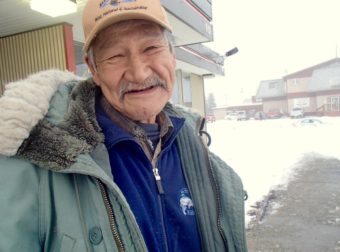
Matfie McCarr has been homeless since 2002, one of just a few in town who call the streets home. It's been his choice to live this way, he says, though he's not always proud of how he got here. (Photo by Avery Lill/KDLG)
Matfie McCarr has been homeless since 2002, one of just a few in town who call the streets home. It’s been his choice to live this way, he says, though he’s not always proud of how he got here. (Photo by Avery Lill/KDLG)
Christmas lights are up and a chilly wind is blowing on a snowy December day in downtown Dillingham.

A gentle, smiling 61-year-old man hanging out near the grocery store finishes off a cigarette butt he rescued from the trash.

Then Matfie McCarr pulls out a harmonica with crushed metal sides that changes its tone and blows a few notes. He’s thankful for the company his music keeps during lonely hours at his camp.

“That’s really helped my thoughts,” he said.

McCarr is homeless, one of just a few in Dillingham during the winter.

A long road brought him here, but it’s a road he says he has chosen to follow.

Born in Old Koliganek in 1955, McCarr remembers moving to Dillingham after the Great Alaskan earthquake of 1964.

He went to boarding school, then to the Sheldon Jackson College in Sitka where he studied religion and land management.

In Sitka, he married, started a family, and worked a variety of jobs — everything from construction to teaching to fishing.

Drugs and alcohol took their toll, and he spent some time in prison.

In 2002, McCarr moved back to Dillingham, and has been homeless mostly ever since.

His camp is an abandoned shipping container that offers a little protection from the elements, though he admits it gets cold and wet.

Thoughts of his children and family punctuate the isolation.

“I don’t have a radio,” he said. “The only thing I have is a harmonica and a Bible, of course.”

When his neck is warm, he sleeps better.

Sometimes he has to choose between sleeping with his socks on his feet and wearing them like a scarf. Other nights, it’s just too cold to sleep.

“I would wake up certain hours early in the morning and, you know, just wondering about time because I don’t wear a watch. But I get up when I start feeling my muscles start jerking or getting cramped.”

When that happens, he gathers his things and walks through town to keep his blood circulating.

Normally, he can count on one meal a day from the senior center, and sometimes people give him food.

Other times he digs scraps out of the Dumpster, and says one can learn to “read” food from the garbage to avoid getting sick.

But health is a concern.

About a month ago, McCarr says, he had an operation to remove his colon.

Now he’s on a lot of medication, and it’s been hard to keep up his weight.

That’s important when you’re living outdoors and need the insulation and energy.

As McCarr reflects on being homeless, the word he uses most often is choice. Choices that he has made in the past and the ones he makes every day.

“Everybody goes through different things in lifestyle,” he said. “We don’t know what it holds for each person. It’s their own choosing what they want, and this was my own choosing what I wanted.”

Yet, for all his pleasant pride in living life on his own terms, McCarr acknowledges that some of his choices were not good ones, nor easy.

Thinking on the circumstances that brought him to a life on the streets does bother him.

“It’s been eating me inside, which I never talk about for a long time,” he says. “It do involve alcohol, and it involves drugs. It involves losing jobs and marriage, so I can’t go back to those things every day like I want to, and I have to make that choice for myself.”

McCarr says there are things he chooses not to worry much about, like whether he will ask a relative for a place to stay for the night, or when he will look for work. Nor does he spend much time worrying over the past.

“I learned not to think backwards,” he said. “That’s the most important thing in life. You can’t look at yesterday. You can look at today, but you can’t look at tomorrow.”

Today has enough choices to make, like when to get up and move to beat the cold, where to look for a bite to eat, and how to stay clear of drugs and alcohol.

Winning these battles won’t fix the past and won’t lead to a better future. But they have kept this amiable elder going into his 60s, including the last 14 years on the streets.

Life isn’t great, but with his harmonica and a song to sing, Matfie McCarr says it really isn’t all that bad either.

Department of Natural Resources delays renewal of Pebble land use permit

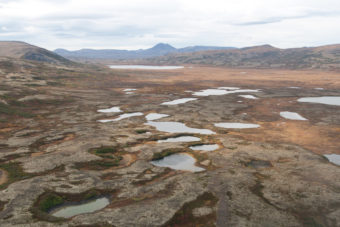
The proposed Pebble Mine site looking northwest. (Photo by Jason Sear)
The proposed Pebble Mine site looking northwest. (Photo by Jason Sear/KDLG)

Alaska’s Department of Natural Resources has delayed renewing a two-year land use permit for the Pebble Limited Partnership to give state regulators more time to review an “extensive” number of public comments.

The state issued miscellaneous land use permit will allow Pebble to continue exploration activities at its claims northwest of Iliamna.

The company acknowledges little is planned for the upcoming field season and little has occurred there since losing the financial backing of partner Anglo American in 2013.

Pebble said it is operating the claims under “care and maintenance” status, but still needs to the land use permit to do so.

While it’s considered a routine renewal of a permit that does not allow for any large scale mining, Pebble is a uniquely controversial project, and critics took a public comment period to raise “substantive” issues.

“Normally we don’t have the number of comments come in for a permit application that came in for this one,” said Marty Lentz, the mining section chief within DNR’s Division of Mining, Land and Water. “The timeframe of those comments, and the importance of the project, require us to give substantial time to review and thoroughly examine the comments and consider how important they are to implement any opportunities within the permit for those suggestions.”

DNR sent a letter to Pebble explaining the extension of the current permit in order to delay action on the full two-year renewal request.

The department “received many substantive comments on some complex issues,” the letter said, and the delay will allow staff to “comprehensively consider the breadth and scope of the complex issues raised” during the public process.

Lentz said his office is still logging all of the input, and offered no comment on any specific concerns raised.

Many public comments were sent in regarding a report commissioned by the United Tribes of Bristol Bay and conducted by geophysicist Dave Chambers.

Last summer, Chambers traveled around the Pebble claims to survey a portion of the exploratory well sites.

His report was critical of drill cuttings left exposed on the tundra, well casings left sticking above the surface, and some drill holes that were allowing water to flow out.

Chambers believe some of those issues, specifically the drill cuttings, have not been as concerning to state and federal regulators as they should be.

“I’ve reviewed the report by Mr. Chambers, and there will be opportunities in the upcoming field season during our inspection to answer the accuracy of the statements in that report,” Lentz said.

The public comment period on the permit renewal was open for 30 days in November. That, says Lentz, is also unique, tied to a lawsuit brought by Nunamta Aulukestai against DNR.

“The Nunamta court case required a 30-day comment period on permit applications period (be given) to the plaintiffs in that court case. Our standard practice for these permits has been a courtesy public notice for 14 days, but we’ve granted that (30-day) comment period to the public as well as the plaintiffs in that court case.”

DNR extended Pebble’s current miscellaneous land use permit for three months while it reviews the public comments.

Pebble is still seeking the full two-year renewal for 2017-2018 activities.

PLP says it maintains a “clean and compliant” mineral exploration site, something the state regulators at DNR tend to agree with.

They inspect the site every year, and in their most recent report from the 2016 season say “overall, the Pebble Limited Partnership operation is in good condition and is consistent with industry standards.”

Overdue Manokotak man back safe, state troopers say

A ground-based search-and-rescue was spun up Thursday morning looking for a man reported missing from Manokotak, but state troopers reported before noon that Marcus Wyagon, 25, had been found.

State troopers in Dillingham said they were notified late Wednesday afternoon that Wyagon was considered overdue, and may have started walking to Dillingham up to 48 hours prior.

Alaska State Troopers Sgt. Luis Nieves said authorities were concerned because no one was certain if he was prepared for the trip.

“No one in the village at this point is aware of any particularly clothing that he was wearing that will help us determine whether he’s dressed for the weather or not,” he said Thursday morning, before Wyagone returned. “He has reportedly walked this route several years in prior years, and is also reported to be an avid outdoorsman.”

Troopers were notified about 11:30 a.m. that Wyagon had walked back into Manokotak and was being treated for cold exposure at the clinic.

Fog grounded an air search Thursday morning, but troopers coordinated two teams of volunteers to check the main trail by snowmachine, one from Dillingham and one from Manokotak.

SB 91’s reforms off to shaky start, retiring judge says

The overhaul of the state’s criminal justice system, known as Senate Bill 91, has been in effect since the summer.

State Sen. John Coghill, R-Fairbanks, backed the reform bill, which incorporated recommendations from the Alaska Criminal Justice Commission.

Gov. Bill Walker signs Senate Bill 91, a criminal justice reform bill, on July 11, 2016, at Haven House transitional housing in Juneau. (Photo courtesy Alaska Governor's Office)
Gov. Bill Walker signs Senate Bill 91, a criminal justice reform bill, on July 11, 2016, at Haven House transitional housing in Juneau. (Photo courtesy Alaska Governor’s Office)

The underlying goal of the reforms is to reduce recidivism and the cost of incarcerating criminals, seeking treatment and supervised release solutions instead.

Superior Court Judge Pat Douglass retired in November.

Before she left, she spoke about SB 91, which she had had a front row seat to watch roll out over the past few months.

“The theory behind this bill is wonderful,” Douglass said. “The theory is, and I’m wholeheartedly … you won’t find anybody against the idea of it … is we don’t need to warehouse people. That doesn’t do anything except make people worse in their behaviors. So we need to offer people rehabilitation resources.”

One of the main problems so far is that many of those rehabilitation resources aren’t available to everyone in the state, she said.

“In Anchorage we have drug courts and therapeutic courts and mental health courts, none of which exist in the Bush because we don’t have the personnel and the resources to support those kind of courts.”

The gap between the services offered in the bigger cities versus the Bush has made for a rocky start for this major set of reforms, Douglass said. But that may be obvious mainly to those involved in the process, certainly those interacting from the wrong end of the law.

For the general public, Judge Douglass has seen three main areas where SB 91’s changes have made for some confusion: bail, probation and sentencings.

As for bail, the standard amounts have gone down, and also don’t necessarily keep people in jail for a night.

“A lot of crimes before, including violent crimes, that would have held somebody in jail, made them go before a magistrate before they were released on a bail, are now being released on their own recognizance,” she said. “People need to understand because if you see your neighbor in a big fight with his brother and the cops come and get him, and two hours later he’s back home, you’re going to wonder why. Well, that’s SB 91.”

The idea of supervised release is to play a larger role in sentencings, sometimes replacing actual jail time entirely.

Douglass is concerned that it may overload the adult probation office, and that the way the conditions are now structured will take some time for the public to understand.

“People are used to, you know, they come back and they’re not supposed to drink and so they drink and get a violation and go to court, and maybe they have to do 10 days or maybe they’re just put back on probation with a warning,” she said. “But I think we’re going to see less of that happening, again, as a direct result of the probation conditions that are being changed in the bill.”

With sentencing, the goal of the reforms is to focus less on jail time and more on treatment or supervised release.

“The ranges have decreased, and a lot of crimes that used to be felonies are now misdemeanors. Crimes that were misdemeanors are now just offenses or violations. Felonies that used to be immediately you’d have at least some jail time, are now mandated for no jail time. Drug possession, a class C felony, that’s going to be one of them. I think people, unless they’ve read this bill and understand what the changes are, I think they’re going to have a hard time understanding some of the sentences and some of the results they see coming out of the courthouse.”

Douglass said the state-mandated changes to bail, probation and sentencings have left the public uncomfortable with the way some cases are handled now.

That, she says, should improve when more people become accustomed to SB 91.

What she’s concerned about is that the philosophical move towards rehabilitation and treatment rather than warehousing people in jail hasn’t been followed through all the way.

“SB 91 was the first part of that. You know we’re not going to just put people in jail and leave them there. We want them out,” she said. “The reason they want them to be out is to give them opportunities for therapy, treatment, job training, education, whatever they need to succeed and not be a recidivist. That’s the part that we haven’t put in place yet.”

Site notifications
Update notification options
Subscribe to notifications