KDLG is our partner station in Dillingham. KTOO collaborates with partners across the state to cover important news and to share stories with our audiences.
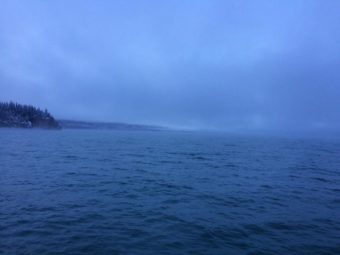
A 68-year old-man was rescued Tuesday after abandoning his homestead near the mouth of the Snake River west of Dillingham.
Mike Branson, originally of Texas, had hiked through the night and reached the East Creek Lodge at the boat launch, but was suffering from cold exposure when he got there.
A distress call went out early and was relayed to local authorities.
“At 4:58 in the morning, we got contacted by the Rescue Coordination Center, which is located at JBER (Joint Base Elmendorf-Richardson), and they advised us that a personal locator beacon had been activated in the vicinity of Snake Lake,” Alaska State Trooper Sgt. Luis Nieves said Wednesday.
Troopers were able to determine that the beacon, which have unique identification numbers, belonged to Branson.
Friends of Branson expressed concern that his homestead site hadn’t been fully finished before the winter, and that he might be trying to walk back to Dillingham.
Troopers and volunteers searched by snowmachine at first light Tuesday morning.
“We went to the residence and couldn’t find him,” Nieves said. “Eventually we received a Skype call from the caretaker at the lodge that is located right by the boat ramp at Snake Lake, and were advised that Mr. Branson was currently at the lodge being provided temporary shelter.”
The lodge is several miles away and across the Snake River from Branson’s homestead site.
The low cloud ceiling prevented aircraft from flying to the lodge about noon Tuesday.
An emergency vehicle was able to drive down Snake Lake Road early afternoon to get to the lodge and reach Branson.
Branson was suffering from exposure and had an injury to his face from falling on the ice, Nieves said.
He had gotten cold and wet during the long trek out through the night, and had not been able to signal for help until he triggered the beacon.
“Mr. Branson reported to us that he had been wandering around for 12 hours, and out of desperation after firing off several rounds from his firearm, running out of ammunition, activated his PLB,” Nieves said.
Branson was hospitalized for his injuries.
He’s been working on the homestead site on the south end of Snake Lake since summer 2012.
Husband Scott Blom and the two youngest Blom children, Zach and Katilyn, were lost last week when their plane went down, apparently in Lake Clark. (Photo courtesy the Blom family)
Boat operations have been suspended and aircraft grounded by bad weather with no more signs of a single-engine plane presumed to have crashed in southwest Alaska.
Efforts have stalled in Lake Clark as poor weather is preventing aircraft from continuing the search for the Piper PA-28 Cherokee.
“We are dealing with persistent ice fog off of Lake Clark, and that is hampering the air search,” said Megan Richotte, a spokeswoman with Lake Clark National Park and Preserve on Monday. “Alaska State Troopers arrived on Saturday, and they were able to fly with their helicopter less than an hour over the lake.”
The plane left Port Alsworth at 10:30 a.m. Wednesday but never arrived in Anchorage.
Authorities believe it went down in Lake Clark, killing the four onboard.
Troopers did not see any new debris in the presumed vicinity of the crash.
A boater found items Thursday belonging to occupants on the plane, and on Friday the co-pilot seat and all three wheels were found on the lake, about 11 miles northeast of Port Alsworth.
Presumed dead in the crash are pilot Kyle Longerbeam, 25, passengers Scott Blom, 45, Kaitlyn Blom, 14, and Zach Blom, 13.
Searchers have been grounded since the trooper flight Saturday, Richotte said.
“No one, community members or park aircraft, have been able to fly yesterday or today,” she said.
She said the bay around Port Alsworth is frozen, so searching by boat had been limited to 18-foot Lunds. On Saturday the park service suspended boat operations because of the cold temperatures and ice fog.
Fundraising efforts for travel and funeral expenses for the two families involved collected more than $30,000 in donations this weekend.
A second day of search efforts are underway for a plane that went missing Wednesday between Port Alsworth and Anchorage.
Four people from Port Alsworth were onboard.
The missing single engine Piper PA-28 Cherokee is owned by Lake Clark Air, but is used as a rental or training aircraft.
The renting pilot, a passenger and his two children left Port Alsworth Wednesday morning. It was unclear early Thursday what their exact flight plan had been, but it was believed they were heading to Anchorage and were reported overdue early afternoon.
“The plane took off approximately 10:30 from Port Alsworth, and was scheduled to get to Merrill Field in Anchorage at about noon,” said Alaska Air National Guard spokesman Staff Sgt. Edward Eagerton. “The plane was supposed to be taking a route through Lake Clark Pass. The plane didn’t show up, so the gears of the rescue mission spooled up.”
An extensive search and rescue effort was launched Wednesday afternoon, with two fixed wing aircraft flying the route with rescuers onboard.
An HH-60 Pave Hawk helicopter joined the search later.
Thick ice fog and the early sunset hampered efforts.
“There was a lot of fog in the pass, so their search area was pretty limited, between that and darkness,” Eagerton said. “They flew the area around Port Alsworth, the north and south shore, and then on the other end of the pass on the Peninsula, and hadn’t found them yet.”
He pointed out that pilots could use night vision equipment to fly into the evening, but the fog was the limiting factor.
There was no emergency locator beacon transmitting from the area.
The Cherokee is equipped with an ELT that should go off in the event of a crash, or can be manually activated after an unexpected landing.
The second day of the search started early Thursday, according to Eagerton.
“Five planes from the Civil Air Patrol are going to assist in the search,” he said about 8 a.m. “As well they’re going to be launching the HH-60 and one of the C-130’s a little before first light so they’re going to be on station as the light comes up, and resume the search.”
By 1 p.m. Thursday, the search had produced no updates. Glen Alsworth Sr., whose company owns the Cherokee, said the small, tight-knit community was prayerfully waiting for news.
“We’re so thankful that the assets that are put on the search effort are so incredible,” he said. “The military side, numerous wonderful assets on the search. Civil Air Patrol is out searching, private aircraft are out searching, and I just heard a little bit ago that a number of boats have launched at Lake Clark and are searching the shoreline as well. We’re very fortunate that so many folks are putting so much effort, and we’re all praying for a very quick and good resolution to it. We appreciate everyone’s thoughts and prayers.”
The weather through Lake Clark Pass was reported as less than ideal Wednesday, with some flights staying grounded on account of the thick ice fog.
Lake Clark Pass is the main route for small aircraft traveling from Anchorage or Kenai in and out of southwest Alaska.
A little over a month ago, David McRae, 55, was killed in a crash while flying solo from Anchorage to Lake Clark through Merrill Pass, an accident still under investigation.
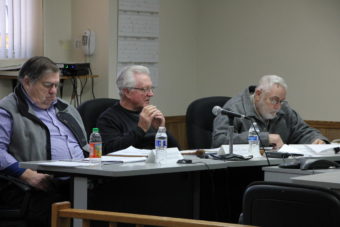
Commissioners Darroll Hargraves, Lynn Chrystal, and Lavell Wilson were present for three days of public hearings in the Bristol Bay region. Pictured here in Dillingham Tuesday. (Photo by the KDLG News Department)
In a rare move, the five members of Alaska’s Local Boundary Commission voted directly against staff recommendations and approved two competing annexation petitions. Both Dillingham and Manokotak cleared a big hurdle Thursday and were granted the LBC’s blessing to take large tracts of the Nushagak commercial fishing district within their city boundaries to collect a tax on the salmon harvest. Beaches along the eastern shore north and south of Clark’s Point were excluded.
Following three long days of public testimony, the LBC returned to Anchorage to make up their minds on the best way to divide the waters of the Nushagak Bay, if at all.
Though the commissioners had seemed open to arguments offered by the public and witnesses for the interested parties, it was never clear they would reject entirely a staff report that had recommended strongly against both annexation petitions.
The commissioners first took up the Manokotak petition, voting three-to-two to approve it as written. They then turned to Dillingham’s petition, voting unanimously to approve it with amendments. Though Dillingham had sought to annex all the waters of the Nushagak district, the boundaries were cut back to exclude the Igushik section and the eastern set net beaches from Nushagak Point through Ekuk Beach.
The amendments reflected the LBC’s attempt to please both petitioners and the leading opposition. Manokotak and Dillingham both sought to lay claim to the waters of the Igushik section, but the LBC ruled in Manokotak’s favor in order to keep the new tracts at the mouths of the Weary and Igushik Rivers “contiguous.” Opposition to any annexation of the Nushagak Bay was led by the Ekuk tribal council. This week Ekuk asked the LBC that if it approved the annexation, to at least exempt the beaches from Nushagak Point through Ekuk from the plan, which the LBC agreed to do.
Not all commissioners were pleased with the end result of Thursday’s votes.
“I think we made serious mistakes today,” Commissioner John Harrington of Ketchikan said at the end of the hearing. “First of all we dealt with a regional resource, in fact in my sense it’s a state resource, and we delegated it to several individual places, which I have some problems with. And ever since we did this initially I have come around to believe that this whole annexation of huge sections of water is best left to boroughs.”
The idea that the Dillingham Census Area should be, or could operate better, as a borough was argued at length this week. A task force under the Bristol Bay Native Association is studying the matter again presently, though all past studies have failed to show a workable feasibility or sufficient local interest. The city of Dillingham has argued that annexation and borough formation need not be mutually exclusive, an idea some on the LBC agreed with.
“Even though we allocated resources, or bodies of water that contain resources, those actions do not preclude the formation of a borough sometime in the probably distant future,” said Commissioner Robert Harcharek of Barrow.
Commissioner Darroll Hargraves from Wasilla had been the most vocal and inquisitive through the three days of public hearings. He said on numerous occasions that he would prefer to see the area form a borough to collect and share the tax on salmon, but voted to pass both petitions. He was not pleased about voting on the amended boundaries that exempted the eastern beaches without vetting the specific coordinates, which staff were directed to fill in later.
“We passed a motion here today that turns over without exact numbers and places and so forth, where those bounds are. It’s not clear to me that those bounds are going to come back to us the way we visualized it. We didn’t put the parameters into place, which is what we’re supposed to do,” Hargraves said.
Commissioner Darroll Hargraves seemed disappointed by the outcome of the LBC vote. Hargraves said he would prefer to see a borough formed, and did not like new boundary lines from exempted beaches left unclear. (Photo by KDLG News)
Commissioner Lavell Wilson was supportive of the concepts behind the annexation requests, but voted against Manokotak’s due to the large territory contained in “tract B.” Otherwise, he said he disagreed with Hargraves and Harrington on a couple of points.
“One is that this is setting a precedent. I don’t see that at all,” Wilson said. “You look at other towns and cities that have annexed water for a fish tax, so I think that’s a moot argument. As far as the boundaries, looks like they’re pretty well described to me. That’s my opinion.”
The chairman, Lynn Chrystal of Wasilla, was generally supportive of both proposals, steering them through the lengthy checklists of criteria that at times other commissioners disagreed with. In his comments, Chrystal made clear he felt the proposals were in the best interests of the state, and would allow the cities to provide more services to their residents and the fishery.
Dillingham Mayor Alice Ruby offered a measured reaction Thursday, calling it a positive outcome after a lengthy process.
“I think the LBC did what they could to try and give both communities something for the future,” she said. “I think the fact that they approved our petition, even with amendments, demonstrated that they saw the merits of Dillingham’s need to grow and the fact that we’re providing services, and so on.”
Dillingham Mayor Alice Ruby, seated next to attorney Brooks Chandler, made the case to the LBC that the city provides services to the region and the Nushagak district fishery. The city asked again to annex the Nushagak waters to levy a tax on the fish harvest, which the LBC granted in part. (Photo by KDLG News)
Based on recent averages, the city said its annexation plan would raise around $750,000 annually if the entire district was subject to the 2.5 percent raw fish tax. Back-of-the-envelope calculations led Dillingham officials to estimate the LBC’s amendments would result in upwards of $100,000 less revenue, maybe twice that.
Still unsettled are the boundary lines for the exceptions around Clarks Point, and how Dillingham and Manokotak will sort out where some drift net fish are caught when the entire district is open to fishing.
“We’ll have to work with Manokotak on how we’ll implement the tax with that boundary line running down the district. But, we’ve worked with Manokotak on other issues and we certainly will be able to do it in this case,” said Ruby. “I haven’t had as much time to think about that set net exclusion because that just came up during this LBC hearing, so I think it’s just all a matter of implementation, we’ll just have to figure out how it works.”
The commissioners have tasked staff with filling in the blanks on the new boundaries, including the carve out for all of the set net beaches around Clarks Point and Ekuk. A final written version will still need to be voted on again later this month before the petitions are submitted to the Legislature for review.
If the Legislature does not disapprove the petitions next session, each city could begin, or in Dillingham’s case resume, collecting raw fish tax by next season. They will also become two of the biggest little cities in the state of Alaska.
A seismograph at Mission San Juan Bautista in San Juan Bautista, California, on Feb. 23, 2012. The mission is located along the San Andreas fault. (Creative Commons photo by Ray Bouknight)
Earthquakes have rattled through Port Heiden more often than usual this year.
Michael West is the state seismologist with the Alaska Earthquake Center.
“If we look back over the past 15 years or so at earthquake activity in the area of Port Heiden that’s shallow in the earth, what we can say is that the vast majority of those, meaning more than half of them, have occurred thus far in 2016,” West said.
West explains how some earthquakes propagate.
“Sometimes a fault will rupture in a single significant earthquake. But other times, faults will rupture in a lot of smaller earthquakes,” West said.
He calls these quakes near Port Heiden “a swarm.”
“You can think of it as like a little cluster of earthquakes that, added together, might be sort of equivalent to a single, larger earthquake.”
This swarm, West said, began abruptly on April 2 with a magnitude 6.2 earthquake.
“Following that, there was a rather normal, expected sequence of aftershocks. That is hundreds of smaller earthquakes, maybe magnitude 3s, a few magnitude 4s, in response, in response to that earthquake. But the earthquakes in that area have continued over the recent months and kind of peaked again in the summer and are continuing on into today, though at a somewhat lesser rate than in the summer.”
Sometimes swarms stop abruptly, West notes, but more often they fade away. And while the earthquakes in the Port Heiden area seem to have been decreasing since August, it’s also possible that they could pick up again. It’s tricky to know where the swarms are headed.
Alaska has the highest rate of forcible rape in the United States according to the 2015 FBI statistics.
Researcher and author Jeremy Braithwaite conducted research on sexual assault in Bristol Bay last year for his dissertation.
He returned last week to present that research in Dillingham.
Braithwaite interviewed 18 survivors of sexual assault in seven different Bristol Bay communities for his doctoral thesis in criminology from the University of California Irvine.
He found that, especially in native communities, historical context is important for understanding sexual violence that occurs today.
“When I came here and began talking with women and hearing their stories, I realized that in many cases it seemed that the issues that they were experiencing could be traced back to issues that have happened at the structural level in the community, dating back to 30 years ago, 40 years ago, and in some cases hundreds of years ago,” Braithwaite said.
Braithwaite noted that limited entry fishing has led to an out migration of locally owned permits. Since the 1970s, he said, local and native participation in fishing in Bristol Bay has dramatically decreased.
“I found that when women talked about perhaps their families selling off permits, it was common for them to talk about violence that they encountered shortly thereafter in their families,” Braithwaite said. “It was also common to hear issues of addiction that developed when a family member would sell a permit. The cash would come in. The cash would go out relatively quickly.”
“Women would describe family members lives spiraling out of control into a cycle of addiction, treatment, recovery and eventual relapse.”
Lisa Haggblom is the sexual assault response team coordinator at SAFE, or Safe and Fear-free Environment. She assisted Braithwaite with his project. That historical perspective, she said, is helpful.
“For me as an advocate, I actually have more to offer people when I am speaking with them about looking at it kind of more in a broader social scale, which hopefully will be helpful,” she said.
Braithwaite plans to continue his research in other parts of rural Alaska.
He hopes that his findings will assist survivors and advocates with healing and prevention.
Close
Update notification options
Subscribe to notifications
Subscribe
Get notifications about news related to the topics you care about. You can unsubscribe anytime.