KDLG - Dillingham

KDLG is our partner station in Dillingham. KTOO collaborates with partners across the state to cover important news and to share stories with our audiences.
The Egegik fishery employs thousands, but very few live in it’s city

Paul and Nattie Boskoffsky have lived in Egegik for many years. (Photo by Nick Ciolino/KDLG)

The city of Egegik lies on the south bank near the mouth of the Egegik River, one of the most productive water sheds for sockeye salmon in Bristol Bay.

Those who call Egegik home are becoming fewer, but there are still some who can tell of the area’s history, and others moving in to see what the future holds.

The Egegik fishing district was closed for the day, and fisherman from a gillnet group were gathered outside a local tea hut to sit around listen to and play live music.

Earlier that morning at the docks, tenders were delivering the sockeye catch to workers who process the fish into fillets.

These are the sounds of Egegik when the sockeye run is just getting under way.

“I am thoroughly impressed that the fisheries has been managed as well as it has,” said Laurie Bonwell, the office manager at Alaska General Seafoods in Egegik. “There are people here that were here when I first came, and they were fathers and sons that have fished here, and of course, the fathers have retired, and their sons have taken over and now their sons are fishing.”

Bonwell has worked at Alaska General Seafoods for 37 fishing seasons, and while she has seen the enduring sustainability of the Bristol Bay fisheries bring thousands of workers like her to the bay each year, she also has seen the year-round population of the city of Egegik diminish to less than 30 people.

Bonwell said she does not expect the city will make a comeback.

“Part of the reason that so many people left was because they got away from that subsistence life that they had actually grown up with, and I have friends, you know, that are my age — which is in the 60s — and so, when they were kids, there were a lot of people here or quite a few people here, and they had a school, and they had a little theater. They had things and they did community things.”

The school was closed two years ago when the population of children in Egegik dropped below 10 — the minimum required for state funded education.

Soon afterward the only store left in town closed as well.

The two main entities operating year round in Egegik are the city government and the Egegik Tribal Council.

“We’re having trouble getting a full council together,” said Ricky Alto, the second chief of the Egegik Tribal Council. “The ones we have in there just leave.”

His wife, Bunny Alto, is tribal secretary and liaison to Bristol Bay Economic Development Corporation.

She said when the store in Egegik closed, she began ordering food for the people in the village, and now runs a store out of the tribal council building.

“I started ordering the basics like bread, eggs, butter, milk, cereal, just things people could use, but by the time we get it in it’s wiped out pretty fast.”

Paul Boskoffsky has lived in Egegik most of his life. The fisherman and author said the fishery is the driving force sustaining what is left of the year- round population of Egegik, and adds the industry brings together the year-round residents and those who arrive each year for the fishing season.

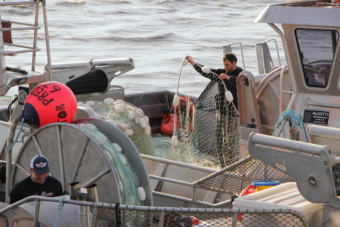
Fishermen at AGS in Egegik. (Photo by Nick Ciolino/KDLG)

“Fishing is the key income for our village here in Egegik, and in Bristol Bay. Of the 52 years that I’ve been fishing here we have some close friends—people that come in. And every year we look forward to meeting them, so that’s a positive.”

Egegik will have a new city administrator this winter when Don Strand retires after 10 years on the job.

His replacement, Bill Yost, is moving his family of four to the village.

The Yosts are expected to raise the winter population of Egegik this year.

Dillingham family farm pivots, selling produce to subscribers instead of grocery stores

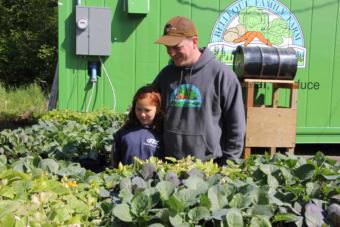
Kyle Belleque and his daughter, Amy, are in the midst of planting these greens. Some will go in the garden in their yard. Others will be replanted in their hydroponic growing system. (Photo by Avery Lill/KDLG)

Water rushes through the pipes and fans whir inside the hydroponic growing system that Belleque Family Farms has set up inside a converted shipping container.

Kyle Belleque crouches low to inspect the spinach plant on the bottom shelf of his garden.

“Makes me want to have a spinach sandwich,” he says as he picks a deep green leaf and munches on it.

This Dillingham farm is making a concerted effort to provide fresh greens year-round. They grow everything from butterhead lettuce and chard to basil and mountain mint on floor to ceiling shelves that run the length of the container.
Belleque points out a new product on a shelf across the narrow aisle.

“We’ve got our new experiment here. We’ve got bare root strawberry plants. We’re just going to start with a row, and then if they work we’ll plant more.”

Belleque Family Farms is something of an experiment itself.

They are mastering hydroponic technology, testing different plant varieties, and now they’re trying out a new business model.

In November, they began selling to grocery stores in Dillingham, but Belleque said that after a few months it became clear that model wasn’t sustainable for his produce.

“It’s not as fibrous, so the stalks break a little easier, and the leaves are a little thinner. It is ultra-fresh, but you sort of have to take care of it in certain ways to keep it fresh,” Belleque said. “I think that was somewhat of a challenge in the stores. They’re looking to get stuff in there and keep it out until it sells. And if it doesn’t sell for a while it becomes hard to maintain.”

When the grocery stores stopped buying their greens, they decided to try something new.

“I guess we started out with kind of the mindset that we would be replacing the produce in the stores,” Belleque said. “That’s not how I look at it anymore. The way I look at it is we’re providing a whole new line of produce. So we’re developing that market for our new produce.”

Last week, Belleque Family Farms began selling shares of their harvest.

A share of 10 units a week costs $40. An ounce of basil or a head of greens each count as a unit.

Subscribers can visit the farm twice a week to pick out their greens.

“If you want a head of lettuce, you point at the one you want,” Belleque said. “If you want some spinach, we’ll snip it off for you and bag it up. If you want some herbs, we’ll cut it right there. Essentially what we’re trying to offer people is year-round, fresh, custom-grown produce.”

Initially, they are offering five subscriptions. Four people have signed on so far.

Once the new system is established, Belleque anticipates that their growing capacity will allow them to sell 20 or 30 shares.

They also want to continue providing fresh greens to the Dillingham City School District during the school year.

In a place where many people already eat off the land, collecting and preserving fish, game and berries, Belleque sees this hydroponic farm as one more opportunity to eat locally year-round.

Sisters from Washington have grown up fishing Bristol Bay’s salmon fishery

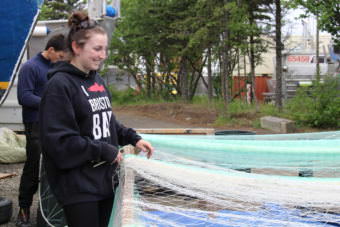
Maddy Marinkovich learned to stitch nets from her father. (Photo by Caitlin Tan/KDLG)

Maddy and Sophia Marinkovich are mending net for their dad among a sea of men preparing for the salmon season.

Both are in their early 20’s and consider fishing their lifestyle.

“It’s not as much of a make it work – that’s the thing we need to get over,” Sophia said. “It’s like girls can be girls and fish at the same time.”

They are from Washington but have been fishing in Bristol Bay for years. Maddy has come since she was 11 years old, and Sophia has come for four years. However, this is their first year working together on the same boat.
“I have never been more excited honestly,” Maddy said. “I love my crew this year. We are going to kill it.”

Maddy said she spent one summer away from fishing and realized the boat is where she belongs.

“I wanted the year off and I had it and it was amazing. But it was weird, I know this is where I belong,” she said.

She added that over the years she has become increasingly aware of the lack of women in commercial fishing; however, this year she said she has noticed more of a female presence.

“It was weird growing up and being surrounded by men and learning how to be a fisherman in Alaska and also be a girl,” Maddy said. “In the past it’s been a little confusing what my role is as a female on a boat and if that’s even okay. But, this year I’m stoked about it.”

Matt Marinkovich, Sophia and Maddy’s father and captain of the “Sandman,” said there is no other crew he would rather have than his girls. If anything, he said having women on board helps stabilize emotions.

“Their my girls and their coming up with me, and we are going fishing,” Matt said. “It’s not a relative question because that’s just what it is.”

The Marinkovich family stitches up their net to prepare for water. (Photo by Caitlin Tan/KDLG)

Sophia said it has been an experience to see her dad as a captain in Bristol Bay, rather than just a father at home.

It has brought them closer together, she added.

“It’s a completely different experience,” she said. “He really knows what he’s doing and that part really shines fishing, but not so much at home. I like being a part of both lives.”

Both girls use their fishing money to put themselves through college at Western Washington University. They also have a 12-year-old sister who will eventually join them in Bristol Bay.

But for now, they are focused on mending nets for the season ahead.

“I’m just going to be the girliest girl and catch a million fish,” Maddy said.

They will fish for Silver Bay Seafoods and plan to be in the water this week.

Naknek’s Fishy Fabrications takes on skiff building this spring

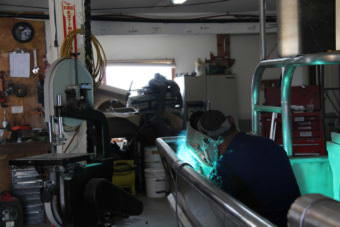
George Wilson puts the finishing touches on the second skiff Fishy Fabrications has built this spring. (Photo by KDLG)

Bristol Bay has a big fishery but not a big marine services industry, beyond the seasonal shops that show up in the summer.

This spring a local fabricator in Naknek expanded their business to try building a few set net skiffs from the ground up.

Fishy Fabrications, a local business in Naknek, has started building skiffs from the ground up, something only a few other local businesses do in Bristol Bay.

George Wilson and Robert Hill are working long hours these days to finish building skiffs before the salmon season takes off: Often 10 hours a day, seven days a week.

“That’s with two dads we both have kid duties during the week,” Wilson said. “This is just a good off-season job for both of us from commercial fishing – we do this in the winter and spring.”

Wilson is the owner of Fishy Fabrications and Hill is his right-hand man.

Since 2013, the business was more of a repair shop, but this March it shifted to a skiff-building operation.

Wilson and Hill have built two set net skiffs since then.

Wilson is native to Naknek. He has been building and repairing boats since the mid-1990’s, but he said opening a shop in his hometown for local customers is fulfilling.

“Very proud and honored a lot – they could have easily gotten these built in Washington,” Wilson said. “I think that’s pretty cool.”

The set net skiff Wilson and Hill are working on now is 23 feet long by 9 feet wide. The average turn-around time is four weeks with a cost of $24,000, not including freight.

Bristol Bay customers are looking for shallow drafts in their set net skiffs, Hill said, adding that they want more room for fish handling, as well.

This is the second skiff Fishy Fabrications has produced from the ground up. (Photo by KDLG)

Fishy Fabrication skiffs have false bottoms to keep fish cooler for longer.

“These ones have a false bottom built into them so even if you’re using a bin instead of an insulated tote, it’s still going to keep the fish significantly colder,” Hill said.

The false bottom also helps prevent sinking if people forget to put the deck plugs in, Hill added.

Wilson and Hill said part of their niche in the skiff building industry is that they are fishermen too.

“Probably in two weeks, I’ll put my welding hood up and put my fishing hat on,” Wilson said.

Wilson said his experience helps him know what to add to the boat to make it functional and safe. Ultimately, the boat is custom made for the buyer.

“Just having someone local that you can come in daily and have input on the build of your skiff, I think that’s huge,” he said. “You get exactly what you want.”

It isn’t just about Fishy Fabrications. Wilson said he sees a lot of potential talent in the Naknek area for other boat and part builders.

“I think there’s a lot of local talent,” he said. “Whether it’s welding or refrigeration or just about anything, there’s a lot of room for growth.”

Wilson said he plans to continue building skiffs in the winter, as he has two orders lined up.

For now, he will wrap up this skiff and head out to do what he’s always done – fishing.

Three Alaska Peninsula volcanoes are restless

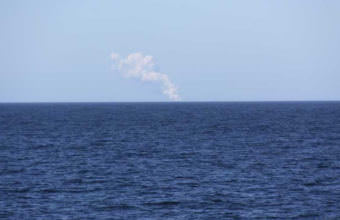
A volcanic plume bellows from Bogoslof on June 5, 2017. (Photo courtesy of U.S. Fish & Wildlife Service, Research Vessel Tiglax)

Over the last week there has been quite a bit of volcanic activity along the Alaska Peninsula.

The Bogoslof, Cleveland and Pavlof volcanoes all are showing signs of unrest.

Most recently, the Bogoslof volcano erupted briefly about 9:30 p.m. Wednesday.

“Bogoslof has been continuing its eruptive activity that started in December 2016 with a series of small activities,” said Jessica Larsen, a geologist with the Alaska Volcano Observatory. “Now we have new evidence that there’s a lava dome growing at the Bogoslof Island.”

A lava dome is a mound of lava that has been extruded from the volcano, a characteristic of previous Bogoslof explosive periods.

“In the past, it’s formed toward the end of the eruptions. We don’t know exactly if this is happening now or if the Bogoslof volcano is going to stick with the lava dome and quiet down,” Larsen said. “It could just keep continuing to have its punctuated explosions as well.”

The observatory’s alert level for Bogoslof remains at “watch,” and the aviation alert is at its second highest level.

The Cleveland volcano also is at the “watch” alert level.

“Cleveland has been in sort of a prolonged periodic phase of eruptive activity that includes extrusion of lava in a summit crater and then periodic explosions that tend to destroy the lava and put up ash cloud,” Larsen said.

Pavlof volcano, located on the southwestern end of the Alaska Peninsula, was raised from normal alert level to “advisory” Wednesday.

The observatory notes that there has been “an increase in low-frequency earthquake activity at Pavlof,” and such increases sometimes precede eruptions.

Survey investigates Alaskan’s attitudes towards wildlife

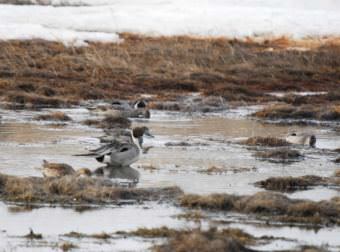
Northern Pintail (Photo courtesy U.S. Fish and WIldlife Service)
A survey conducted by Colorado State University hopes to measure Alaskans’ attitudes toward wildlife, such as these northern pintail ducks. (Photo courtesy U.S. Fish and Wildlife Service)

Colorado State University is conducting a survey of Alaska residents to measure their attitudes toward wildlife.

It is part of a nationwide study that began in 2005.

Mark Burch, a wildlife biologist for Alaska Department of Fish and Game, said Alaska residents’ views differ from those in other states.

“In Alaska as you might expect people do tend to be a little more utilitarian,” he said. “They utilize wildlife for food and clothing and, and that way a little more than people in say some of the more urban areas that may perceive wildlife differently.”

The survey hopes to measure not only attitudes but trends over time. Burch says the survey will help Fish and Game better meet public needs.

“In Alaska, we’re looking at some of the barriers people face as they pursue hunting as well,” he said. “That’s one of the specific interests that, that we’re delving into a little bit deeper.”

The survey is being conducted primarily by mail, though it is also available online.

Researchers hope for a sample size of at least a thousand Alaska residents.

Site notifications
Update notification options
Subscribe to notifications