KDLG is our partner station in Dillingham. KTOO collaborates with partners across the state to cover important news and to share stories with our audiences.
The Marine Environmental Protection committee met in London the first week in July. (Photo courtesy International Maritime Organization)
The International Maritime Organization’s Marine Environment Protection Committee took up the issue of heavy fuel oil at its meeting earlier this month.
The IMO is the United Nations agency charged with regulating international shipping.
Heavy fuel oil is especially viscous fuel oil used mainly in large shipping vessels.
Environmental groups are generally opposed to heavy fuel oil use.
Dillingham’s Verner Wilson III attended the MEPC meeting with environmental activist group Friends of the Earth.
“This heavy fuel oil could have huge impacts to the marine environment if it’s spilled,” Wilson said. “It’s the most viscous fuel oil, and it is potentially damaging to the arctic environment because it takes a long time to break down. It affects marine mammals and fisheries. Bristol Bay is south of the Arctic Ocean, but our marine mammals travel to the Arctic Ocean, and whatever happens in the Bering Strait affects us ultimately in our subsistence way of life.”
At this meeting the committee adopted a proposal to work toward reducing the risks of using and carrying heavy fuel oil in Arctic waters.
In concrete terms, that means governments and international organizations will submit proposals that will be discussed at MEPC next meeting in April.
Proposals could range from non-mandatory guidelines to a complete ban on heavy fuel oil use.
Heavy fuel oil is already banned in Antarctic waters. That ban took full effect in 2016.
Doug Cooper sits in his cabin on Nushagak Point. (Photo by Nick Ciolino/KDLG)
Every year there are many who return to the cabins at Nushagak Point to spend the season fishing set-netting sites in the district.
When the salmon are running, the rows of small cabins lining the beach are peopled with everyone from greenhorns fishing their first season, to family members supporting the fisherman, to those who have been fishing the Nushagak district for more than 50 years.
This season, some fisherman from the set-netting community at Nushagak Point have fished the all-time largest run of sockeye to ever swim past their cabins.
The pilings of a long since closed down salmon cannery stand erect on the rocky beach. You can see the roof of Doug Cooper’s cabin, just beyond, peering over the tall grass.
Cooper has been fishing his set net site at Nushagak Point since 1951.
“When I started here there were just three or four of us set-netting at Nushagak Point, and now the set nets start here at the marker and go all the way for — whatever it is — 20 miles clear to the outer marker out on the cape without any breaks hardly. It’s just wall to wall setnets now.”
Over the years, Cooper has seen people come and go.
He has seen the two canneries on the point close down.
He remembers the fire that burnt down the Russian Orthodox Church at the top of the hill.
But he says he has never seen a run to match this year’s.
“I’ve never seen it like this, where the fish started June — well, we started June 21 — they actually went by in huge numbers before the opening,” Cooper said. “They must’ve started maybe the 17th or so, going by in huge numbers here, and then they have been present ever since in large numbers, which is totally unique.”
The run has been substantial enough to overwhelm the processor, Peter Pan Seafoods, which has been forced to place Nushagak setnetters on daily limits.
While many fisherman express frustration with the limits, Cooper says the restrictions have made fishing easier.
“It’s not a popular thing to say, but the closures by the cannery actually help us on some level, because nobody’s fishing for a while; the fish move up to where we are, and then when we put our nets out and they’re there for us, instead of being filtered out by being open 24 hours a day.”
Cooper’s neighbor on Nushagak Point, Tom Rollman, manages a large operation of a couple dozen crew members fishing multiple permits.
He said when the fishing is wide open he deploys his crew in shifts, but the limits have changed that strategy.
“When we catch the 2,000 pounds per permit we’re finished for that 24-hour period,” Rollman said. “We just send the whole crew up until they get our quota and then they come back. Where normally they would be twelve on twelve off — two different crews.”
Curtis Olson, better known as “Ole,” is the self-proclaimed mayor of Nushagak Point and has fished in the district for 37 years.
He was medevaced out when his gall bladder turned septic during last year’s season and considered retirement.
He’s glad he continued to fish, because he was able to participate in what he calls “the greatest run ever in the history of the Nushagak district.”
“This has been a sight to see. I mean, the greatest migration ever of salmon ever to the Nushagak district and I lived to see it,” he said. “It’s kind of a wonderful thing”
On July 11, the Nushagak salmon run surpassed the previous record of 15,738,332 fish set back in 2006 … and it’s still going.
Floyd Jay Mann, 55, from Puyallup, Washington, pleaded guilty Wednesday to all counts against him in the case of a massive scam of money out of more than a dozen people, mostly from Dillingham.
Mann is likely to remain free on bail till his sentencing in December despite several requests by the federal prosecutor that he be remanded to custody.
“On Friday his wife was sentenced on Social Security fraud in Seattle, and today (Wednesday) Floyd Jay Mann plead guilty to 19 counts of wire fraud and money laundering in district court here in Anchorage,” assistant U.S. attorney in Anchorage Aunnie Steward the said after the hearing.
The case against Mann was pieced together by the FBI, IRS, Social Security Administration and even local Dillingham Police.
“He falsely told his victims that he had a multi-million dollar pharmaceutical lawsuit coming his way, and if they helped him pay his medical bills and get healthy, then he would share the proceeds from that settlement with them,” Steward said. “There was no settlement, and he took their money and spent it at a casino and also on his narcotic, drug addiction habit.”
Jay and Cheryl Mann pulled slots at the Emerald Queen Casino night after night for four years, racking up at least $1 million in winnings as they gambled away $3 million of money he scammed out of his victims.
Mann connected to Dillingham through two of his earliest victims, John and Clara “Tookie” Wren, longtime Dillingham residents who had moved to Puyallup.
The brother and sister forked over at least $100,000, missed their own mortgage payments and lost their house.
John Wren actually had cancer, unlike his neighbor Jay Mann, and the prosecutor believes Wren stopped paying for his own treatments and died.
Friends in Dillingham the Wrens connected to Jay Mann lost enormous sums of money between 2012 and 2016.
Some lost their homes, businesses, property and jobs, all believing they were days away from collecting millions alongside Jay Mann.
Steward offered no deal and Mann pleaded to all counts. He now faces a maximum of 20 years.
“He is definitely looking at a sentence that will include incarceration, and there is always hope for restitution as long as he is able to work,” she said.
Mann told the court he has been doing some roofing, which would also seem to contradict his own years and years of collecting welfare benefits for an alleged disability that prevented him from working.
Still, there is little hope that he’ll be able to pay back the millions he took from his victims and gambled away while he and his wife briefly lived the high life in Puyallup.
Cheryl Mann defrauded the Social Security Administration out of $81,000.
U.S. District Court Judge Ronald Leighton sentenced her to three years of probation rather than the at least four months in jail the U.S. attorney had recommended.
Jay Mann was released on bail almost immediately after he was indicted on the 19 federal charges last fall.
Steward spent hours Wednesday arguing that Mann begin his sentence immediately, citing his repeated violations of release conditions and the angst from the victims that their perpetrator is still a free man.
“I have sought remand on several occasions, most recently today following his entry of guilty pleas,” she said. “The court has allowed him to remain on release pending his sentencing on December 11.”
Magistrate Deborah Smith in Anchorage made that ruling, to let Jay Mann stay out of custody after he pleaded to all 19 counts involved with scamming $3 million dollars out of some 15 victims.
The court then footed the bill to fly Mann back to his Puyallup home, where neighbors say Jay and Cheryl Mann’s life goes on as usual.
The Nushagak River is having a near record return of sockeye salmon.
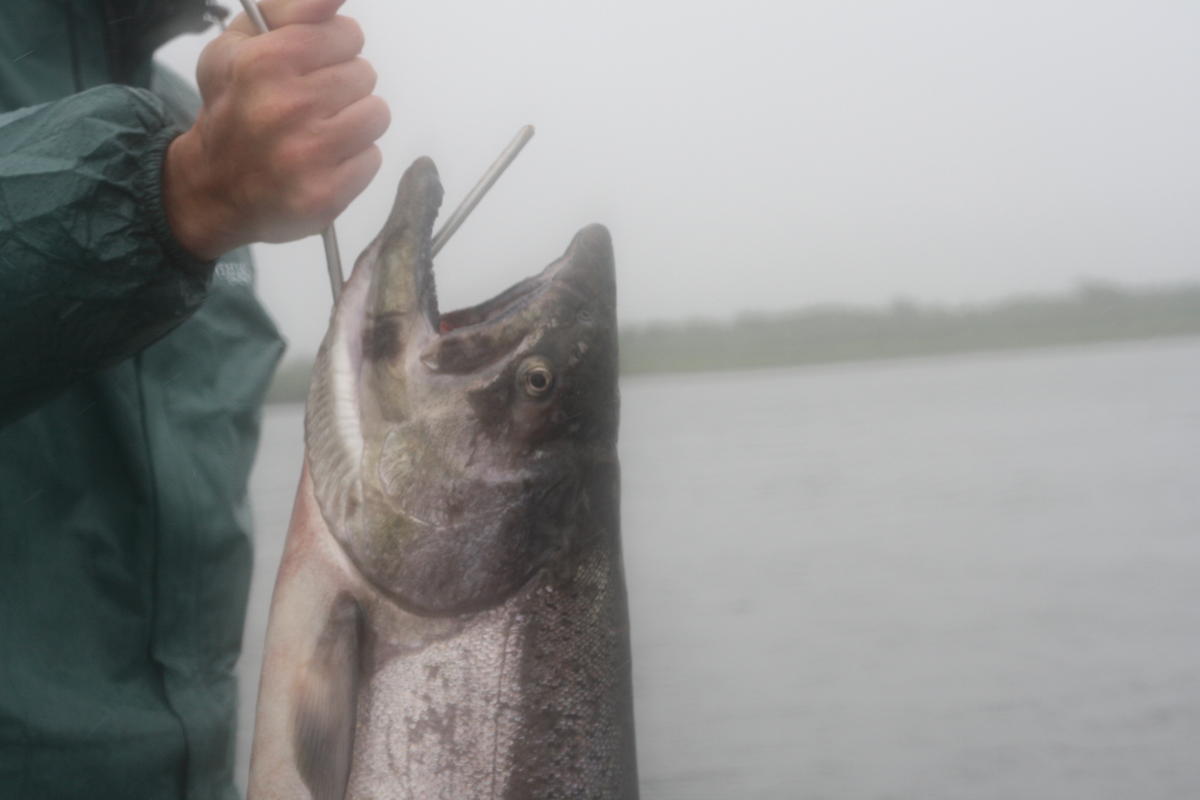
Normally, the river is more famous for the strength of its king return, where many other Alaska rivers have struggled.
This year, though the king run has struggled or at least run late, to the frustration of the anglers who line the river’s banks in June and July.
Some sportfish operators say they would like to see some changes in the commercial sockeye fishery downstream to help protect the kings.
There is no formal forecast issued for Nushagak kings anymore, but going into the season, state biologists felt it would be another good year.
But the season got off to an achingly slow start, just as anglers showed up to fish the famous waters. On June 21, sportsfishing guide Chris Carr lent voice to how few kings had gotten upstream thus far:
“Two days ago we set the net, let it sit overnight,” Carr said. “That was a mistake. It took my daughter and all everything we had to pull that thing up. So we took another nice brand new net, set it on this morning’s tide, let it sit for six hours, and same thing: not one fish and every web covered in the green algae.”
The kings trickled in, but not on an escapement “curve” that suggested it would make its 95,000 in-river goal.
Early on the numbers of kings counted at the Portage Creek sonar site showed something was off.
Alaska Sportsman’s Lodge King Camp Manager Jeff Pfaender said his repeat clients could tell, too.
“Like I said before it’s our clients that have been here and know that and it’s a slow day when you’re out there watching the tip of the road and you’re knowing ‘God, normally I can catch 20 a day and I’m struggling to get my four or five out of the day,’” he said. “I know that the client is sitting there thinking the same thing too.”
Anglers know that fishing is fishing, and there are few guarantees when booking any trip tied to Alaska salmon.
However, Pfaender, who has 23 years of experience with this river, has been frustrated by what he sees as a chance to place a greater priority on protecting kings.
“The biologists that manage this area, I know they have mandates and management plans in place,” Pfaender said. “It’s upsetting that they won’t take initiative, even though those mandates are there to see how hard the things are being hit this year.”
The upriver anglers are about the last in line to get a chance at the kings, after the commercial sockeye fishermen net up tens of thousands and subsistence fishing around Dillingham harvests around 12,000 too.
This frustrates the clients of Bob Toman, the founder of Toman’s King Camp on the Nushagak.
“It’s the last one to get the fish,” Toman said. “The first ones are caught out in the ocean by, you know like salmon, by trollers and stuff. And then they get closer and gillnetters get them and then the sports guys get them. So if any of those over harvest, there’s not enough left for us, and then for the Fish and Game to meet their quotas for the specific river.”
Jeff Pfaender said repeatedly that he doesn’t see this as an issue of sport versus commercial, which breeds some of the ugliest fish politics from other Alaska fisheries.
However, he does hope that perhaps the commercial fleet could pause to help out the king numbers.
“I’d like to see at least every other tide be un-netted and allowed to come in the river,” Pfaender said. “And it may only take one or two days to jump us above our minimum escapement goals on kings.”
But while the kings have lagged, the Nushagak sockeye are returning in some of the highest numbers ever recorded.
Pausing the commercial fishing downstream would only allow more “over” escapement, something area management biologist Tim Sands doesn’t see as an option.
“Our system is so dynamic,” Sands said. “We have these huge masses of sockeye coming in. Taking a tide off is catastrophic potentially.”
The Nushagak-Mulchatna King Salmon Management Plan governs decisions on the sport, subsistence, and commercial fishing of this species. Former Fish and Game sportfish biologist Dan Dunaway helped draft those rules, which he believes have largely been successful.
“There’s been a lot of dissatisfaction expressed by some sport folks over the way the plan worked out, but it’s what was politically viable at the time in front of the Board of Fish and with the local users of all groups,” Dunaway said.
Dunaway added that he would be interested to see parts of the plan reviewed.
“It would be interesting to gather up the available data to look at sport harvest, sport impact,” Dunaway said. “Also possibly, I seem to recall that there’s been a potential for a growth in the subsistence harvest, especially the subsistence impact in the Dillingham locale. And this is something else that can get kind of tricky. Upriver villages I would say are truly a lot more dependent on that king run.”
The king run continues to build slowly, creeping towards the lower end of its goal. It’s possible they are just running late this year, perhaps due to the low water or lack of windy days that normally push fish. If the run comes in on size, likely most concerns will be calmed, but if the numbers stay low proposals may emerge to change the management plan.
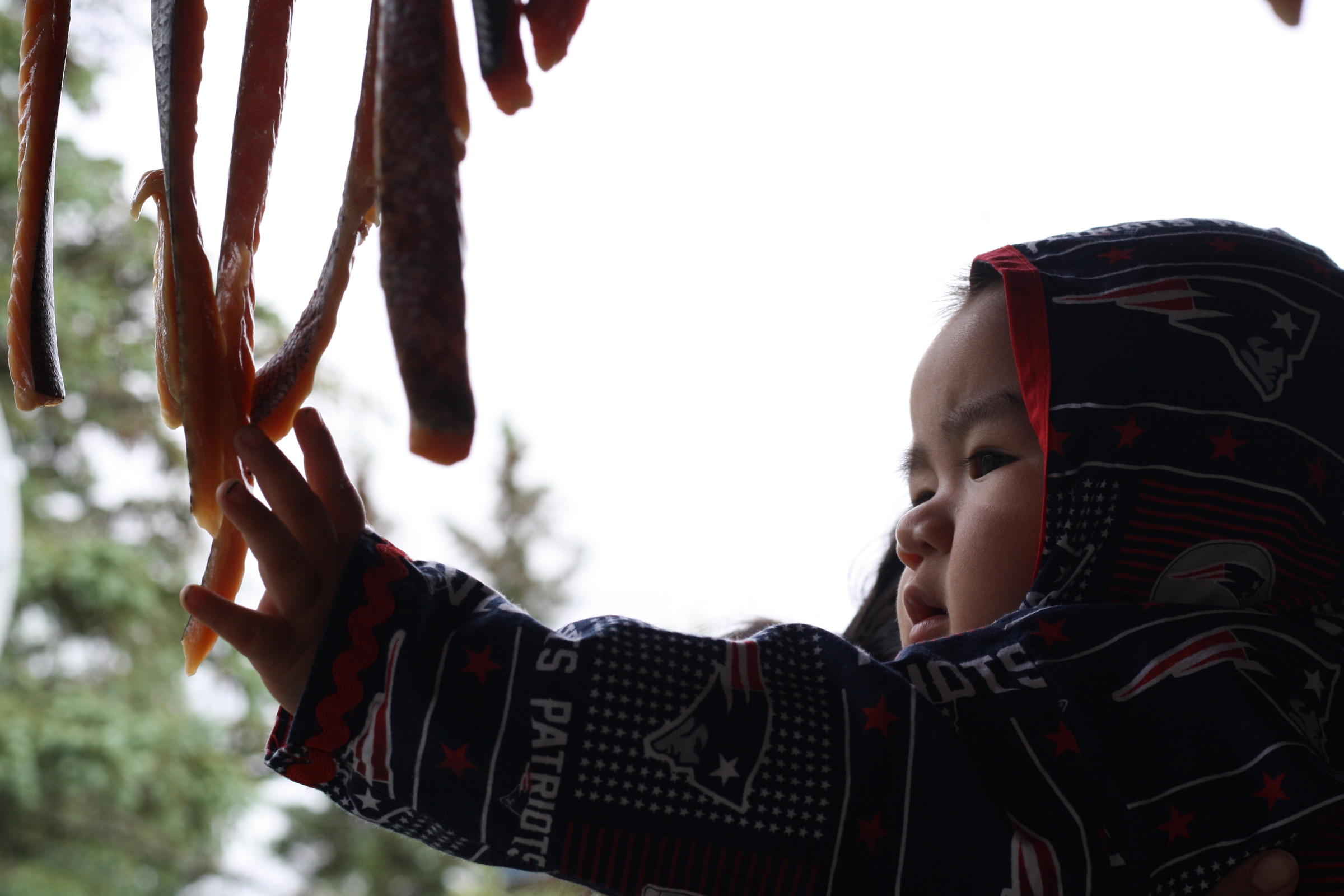
Christian Mulipola reaches for king salmon strips his grandmother, Diane Ishnook, has hung up to dry. Her king salmon were caught far downriver from Koliganek. (Photo by Avery Lill/KDLG)
More than 2.5 million sockeye have returned to spawn in the Nushagak River this year, one of the highest counts on record.
They have filled pools and creeks, jumping and swimming their way to their spawning grounds.
“I’ve seen a lot of red salmon this year. There was so much salmon in the river,” said Frances Nelson of Koliganek, the uppermost village on the Nushagak River. Koliganek is about 61 miles northeast of Dillingham. “Usually we get our kings first, but my dad brought home over a hundred reds the first time I cut fish.”
King salmon are conspicuously missing from the nets in the village.
Local families have had to travel to places like New Stuyahok and Lewis Point to catch them.
While many in Koliganek do that every year to get an earlier start on processing fish, this year even families who usually get their kings near their village went downriver.
George Nelson usually catches 100 to 150 kings in a season at Koliganek. This year he has caught six or seven. (Photo by Avery Lill/KDLG)
Local elder George Nelson usually catches 100 to 150 kings at Koliganek in a season. After setting his net for a month, he has only caught six or seven.
Diane Ishnook has lived in Koliganek since she was a child. She and her family set their nets off Tuumartuli, Cranberry Creek.
In three weeks, she caught one king. Her sister got two in two weeks.
“Normally we could catch up to 30 or 40 a day, like 18 in the morning or 15 at night. We’d have to check it twice a day,” Ishnook said.
Ishnook said that people are puzzled as to why the kings have not arrived yet. She also has another theory.
“We were thinking that maybe there are so many reds that they’re pushing the kings out the middle of the river,” she said.
If that is the case, king salmon may simply be escaping the nets set for them.
Diane Ishnook dries her fish briefly in the open air before smoking it. (Photo by Avery Lill/KDLG)
Frances Nelson also is from Koliganek. She stands in the doorway of her smokehouse.
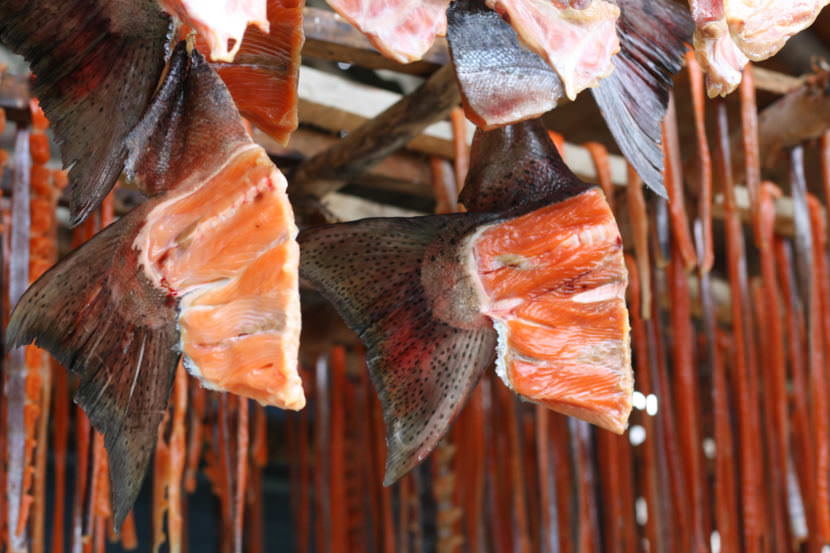
It smells sharply of cottonwood smoke and salmon, which hangs in from wooden racks.
The small wooden structure is full of both kings and reds.
The kings she has cut into long strips. The sockeye are split in half with only the base of the tail joined so that each fish can be hung over the rack to dry.
Her kings were caught downriver, but she is sure that there are king salmon near Koliganek as well.
“I think there were lots of kings in the river. I don’t ever want to say there’s a shortage of kings in this river. That’s just talk,” Frances Nelson said. “If those downriver people harvested all their kings that they did down at the mouth of the Nushagak River in Dillingham and Clark’s Point, you know there were a lot of kings coming up this river.”
Sport fishing provides another perspective on the unusually low king catches in set nets.
Katrina Merlino, the village Indian Environmental General Assistance Program coordinator, said that people who sport fish for a full day are catching upwards of six kings.
“Usually the nets catch a lot more than we do rod and reel,” Merlino said. “I really think that the kings are coming up in the middle channel and riding along the banks because right where all the rod and reel fishers are, they go right where there’s still water and right in the current and they leave their line right there, it seems like that’s where they’re catching the most kings.”
While no one in Koliganek can do more than hypothesize about why the kings are hitting the nets so sparsely, there seems to be little concern.
Freezers are full, and most people have already smoked as many fish as they will need for the year.
Nelson takes a no nonsense attitude toward the whole situation.
“People all along this river have gotten their king salmon. It’s just a different year, a different season,” she said. “As Alaska Natives we always know how to adjust to change. There’s always different changes in our ecosystem, and we learn to adjust to those changes.”
The coming years will tell whether this year’s run is an anomaly or whether it is indicative of a long term shift in the way salmon run up the Nushagak.
Frances Nelson’s smokehouse is full of kings and reds. (Photo by Avery Lill/KDLG)
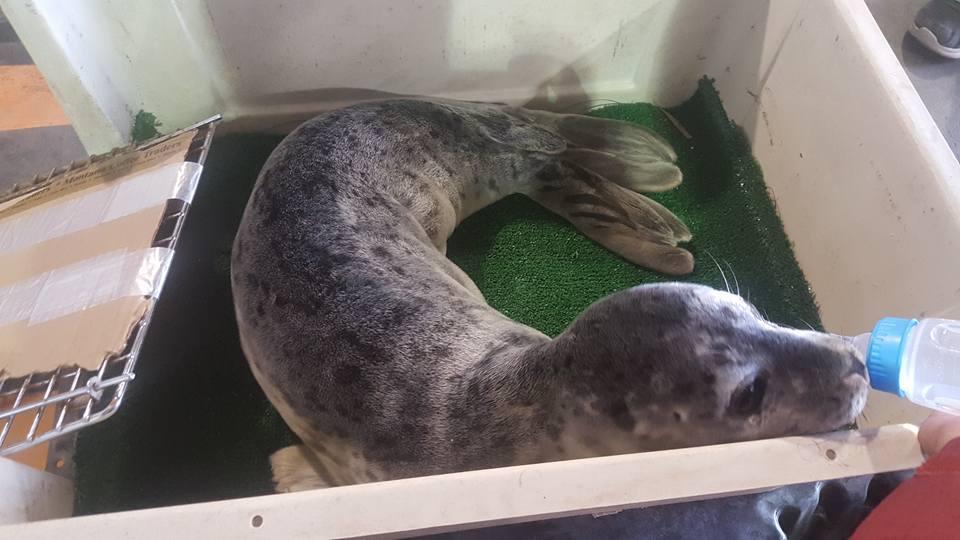
An orphan harbor seal found near Egegik is progressing well. The seal was found at the end of June and was very dehydrated and underweight.
She also had an infection at her umbilical cord site. The seal’s mother was found dying on the beach.
Hallee Warner, an animal care specialist with the Alaska Sealife Center, said the seal will eventually be released.
“Going forward our ultimate goal is always to release harbor seals whenever we possibly can,” Warner said. “We’re going to keep giving her the nutrition that she needs, any medications that she needs to overcome infections or any other problems she may have that we don’t know about yet. And once she grows stronger and is able to eat fish on her own we’ll start socializing her with other seals in preparation for release.”
The seal will soon be old enough to survive in the wild without her mother, Warner said.
“They actually wean from their mother at four to six weeks of age so she actually is near that age already,” Warner said. “We’re going to start weaning her in probably a couple weeks’ time. Once she starts putting on enough weight and becomes healthy, is clear of her infections, then we can start thinking about releasing her. Usually it’s at the end of the summer that we release the seals.”
The Sea Life Center maintains a 24-hour hotline for calls about marine mammals found in distress.
Close
Update notification options
Subscribe to notifications
Subscribe
Get notifications about news related to the topics you care about. You can unsubscribe anytime.