KRBD - Ketchikan

KRBD is our partner station in Ketchikan. KTOO collaborates with partners across the state to cover important news and to share stories with our audiences.
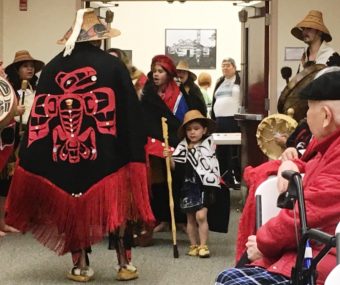
Ketchikan School Board discusses pilot Native language class

Kevin Clevenger displays his regalia as the New Path Dancers enter the Saxman Community Hall on Wednesday. (Photo by Leila Kheiry/KRBD)

The Ketchikan School Board celebrated Native American Heritage Month during its Wednesday meeting.

It’s become traditional for the Ketchikan School Board to hold its November meeting in the Native village of Saxman, and to use that meeting to focus on concerns specific to the Ketchikan Gateway Borough’s Alaska Native population.

This year, the board talked about implementing a new Native language program at the high school in cooperation with Ketchikan Indian Community.

During public comment, board members heard from many people who support that proposed program.

Tsimshian elder John Reese was one of the first to speak to the school board.

“I am the last one in Ketchikan that can talk fluent Shm’algyack,” he said. “So, I’m in full support of having the school district teach the Native languages.”

Reese, 94, has been teaching the Tsimshian language to a few others in Ketchikan, but he remains the only fully fluent speaker in the community.

One of his students, Terri Burr, told the board that it is the responsibility of the tribes and tribal members to make sure their languages and cultures continue, and a lot of preparatory work already has been done; they’re just asking for a little help.

“We are not going to ask you to teach the language, you to save our language,” she said. “We will do that. We will do the heavy lifting. We’ll do the work. We’re asking you to open the door and let us in.”

The proposal from Ketchikan Indian Community is to start with a Haida language program, see how that goes and then add classes for the other two Native groups indigenous to the area, Tlingit and Tsimshian.

Benjamin Young is a heritage-languages facilitator at Ketchikan Indian Community, and speaks Haida. He told the board that he first learned the language from his grandfather, and then went to school to learn how to teach.

He said that through his research, the Hawaiian model of revitalizing language and culture appears to be the most effective. It involves immersion schools, which have had the added benefits of improved graduation, obesity and suicide rates.

“I’m not asking for it to be a requirement, and I’m not asking for an immersion school – yet – but I do see an awesome opportunity here,” he said.

Young notes two fluent Haida elders — Phyllis Almquist and Delores Churchill — in town could help with the classes. And, he said, the proposed classes would be a great way for the school district to honor the Native culture of the area and help instill pride in its Native students.

Several others spoke during public comment in support of the program, including Sylvia Banie, vice president of the Organized Village of Saxman.

She presented a letter from the village in support of the proposed program.

Katie Parrott, education and training director with KIC, gave some details about the proposed pilot language program during board discussion of the topic.

Haida was chosen as the first heritage language to teach partly because they have Young available to teach the class, and partly because they have a curriculum ready to go, she said.

“What we can provide is a curriculum and instruction that completely mirrors the current world language offerings in French and Spanish,” she said. “We have that in terms of the curriculum available for the Haida language and the level of instruction that we are able to provide.”

Parrott added that Ketchikan is one of the few – maybe the only – school districts in Southeast that doesn’t offer some kind of Native language instruction.

Parrott said KIC could start the program at Ketchikan High School as early as next fall.

Board members expressed general support for the proposed pilot program, but wanted more details about how the partnership would work.

Superintendent Robert Boyle said his office will talk with KIC about what the school district would need to provide, and he’ll bring that information back to the board at a later meeting.

The school board also talked about restarting the Indian Policies and Procedures committee, which hasn’t met for several years.

Board member Misty Brown said that while the district no longer receives a grant that committee oversaw, the committee could address a variety of topics that affect Native students in the district.

Misty Brown and board member Glenn Brown agreed to talk about how to get the committee restarted, including recruiting representatives of the Native community.

Former UAS Ketchikan director gets new job

Former Ketchikan resident Cathy LeCompte has a new job. She’s been appointed as the director of Alaska Vocational Technical Center, or AVTEC, a state-operated post-secondary vocational school in Seward.

The news was announced Thursday by the Alaska Department of Labor and Workforce Development Commissioner.

LeCompte most recently worked as associate dean of academic affairs for the University of Alaska Anchorage’s Community and Technical College. Before that, she was campus director at UAS Ketchikan.

LeCompte will be the first woman to serve as director of AVTEC, which was founded in 1969.

According to the announcement, AVTEC offers training in maritime, culinary arts, industrial trades, welding, and information technology, among other fields.

Ketchikan man faces charges of driving under the influence of marijuana

A 21-year-old Ketchikan man faces charges of driving under the influence of marijuana after he was contacted by Alaska State Troopers just after midnight Saturday morning.

The man was parked in the lot of a closed business in Saxman when troopers contacted him, according to the online troopers dispatch.

He was arrested and later released.

A 16-year-old girl was in the vehicle, as well, and was passed out from drinking alcohol. According to troopers, she was taken to PeaceHealth Ketchikan Medical Center for treatment, and later was released to a guardian.

Troopers are investigating this incident, and have sent information to the District Attorney’s Office for review.

Ketchikan man faces possible pot-grow charges

A 51-year-old Ketchikan man faces possible charges of third-degree misconduct involving a controlled substance for an alleged marijuana-grow operation.

Rroopers initially went to the residence for a domestic violence investigation, and noticed evidence of a grow operation, according to an Alaska State Troopers online dispatch.

A search warrant was obtained, and troopers seized 38 plants and about 4 ounces of dried marijuana.

That exceeds the amount allowed for personal use under Alaska law.

According to troopers, criminal charges were forwarded to the Ketchikan District Attorney’s office for review.

Woman suffers traumatic leg injury after accidentally shooting herself

A Prince of Wales Island woman who accidentally shot herself Wednesday night suffered serious leg trauma and was expected to be medivaced.

Alaska State Troopers were notified of the accident at about 10:30 p.m., according to the online troopers dispatch.

The 29-year-old woman had been removing a gun from the back seat of a vehicle when it accidentally fired and shot her in the leg.

She was taken by ambulance from the Sandy Beach area of Thorne Bay to the Alicia Roberts clinic in Klawock.

Troopers report that the woman likely would be transported off the island for further treatment.

Mental Health Trust officials hear concerns in Ketchikan and Saxman

Saxman residents look at maps before the Alaska Mental Health Trust meeting at the Saxman Community Center. (Photo by Leila Kheiry/KRBD)

Alaska Mental Health Trust and Trust Land Office representatives got an earful Tuesday during informational meetings in Saxman and Ketchikan regarding the decision to potentially log Deer Mountain.

The big question, though, is whether the public input will make any difference.

The message Alaska Mental Health Trust officials heard over and over and over again was: don’t log Deer Mountain.

The message those officials gave back was: we won’t unless we have to.

And by that, they mean they will log Deer Mountain if Alaska Mental Health Trust officials and the board of trustees decide logging Deer Mountain is the best way to make money. That’s what the trust does – it makes money for mental health services throughout the state.

That’s typically not controversial.

But when the board of trustees voted in August to move forward with a timber sale on Deer Mountain and a site in Petersburg if a federal land exchange isn’t approved by mid-January, there was a public outcry, and questions about the legality of the vote and the lack of public process.

So, the board is revisiting the issue, and scheduled these public information meetings before a Nov. 17 re-do of that vote.

Trustee Carlton Smith of Juneau was one of the Trust officials hosting the meetings in Saxman and Ketchikan.

There are two things he hopes local residents get from his part of the presentation.

“We get it. We understand how important Deer Mountain is to you. We understand your feelings about Deer Mountain,” he said. “And we also – and this is coming from me – apologize to you for not having this consultation earlier in this process.”

Smith and other presenters repeatedly said that they vastly prefer the land exchange, which would trade the controversial parcels, along with Mental Health-owned land in Sitka and Juneau, for remote parcels of federally owned land on Prince of Wales Island and in the Shelter Cove area.

The trust then would log those remote parcels.

Trust Land Office Deputy Director Wyn Menefee said that land trade, which U.S. Sen. Lisa Murkowski has introduced, can pass during the lame-duck session following the Nov. 8 election.

“It’s a viable bill. It’s our preferred option. We want the land exchange. I know we discussed proposed timber sales, but we want the land exchange. That is the best interest of the trust, and that’s what we’re pushing hard to do,” he said. “There is good precedent that, even in a lame-duck session, land-exchange bills do go through.”

And, Menefee said, this particular exchange package has been vetted and approved by a variety of stakeholders, including environmental groups.

Ketchikan is a logging town, and very few people attending the public meetings have any concerns about logging in general.

The vast majority vehemently oppose logging Deer Mountain. It’s not just the visual impact; many were worried about landslides, wildlife and, especially for Saxman, water.

That community’s primary water supply comes from Deer Mountain.

Trust Land Office Senior Resource Manager Paul Slenkamp told the Saxman group that the timber sale would be designed with that in mind, but that didn’t do much to allay concerns.

Here’s Joe Williams, a lifelong Saxman resident.

Joe Williams of Saxman speaks during the Alaska Mental Health Trust meeting at the Saxman Community Hall. (Photo by Leila Kheiry/KRBD)

“You can last seven days without water. Beyond that, you can’t,” he said. “I’m saying loud and clear that you’re encroaching on our water supply. And I’m appalled that this organization is, ‘Oh, by the way, now we should meet with Saxman.’”

There also was repeated concern expressed during both meetings about the way trustees made their decision.

Menefee noted that the trustees, acting as the Resource Management Committee, revisited the issue on Oct. 26, and recommended that the official board take another vote during the Nov. 17 meeting.

Public comment will be accepted on Nov. 16 by phone or in person, or earlier by mail or email.

Menefee also noted that the vote is not to log Deer Mountain – it’s to accept the staff’s recommendation that the Trust move forward with a timber sale if the exchange doesn’t pass.

Slenkamp repeatedly said that the timber sale hasn’t even been designed yet – although it would definitely be selective harvest by helicopter — and then there would need to be a “best interest” decision, followed by a 30-day public comment period.

But, the Trust’s comment process is different from what people might be used to. Menefee said comments will only make a difference if they address the Trust’s primary mission.

“What we do, we don’t actually ask, like you would if you were the Forest Service or the state, saying what you think is in the best interest of the public? That’s not actually by statute and regulation what we’re supposed to ask. We actually ask, ‘Is what we’re doing the correct thing for the Trust?’” he said. “If you can show something that’s better – better financially for the trust – or some other thing like that, that very well may change it.”

One potential concept that’s been suggested – and would be financially beneficial to the trust — is for the communities to purchase the land from the trust, or at least purchase the timber rights.

Ken Arriola notes that the Trust Land Office expects to make about $5 million by logging Deer Mountain and the site in Petersburg.

“This community has spent far more than $5 million on a lot of other stuff,” he said. “I don’t know if that’s an accurate figure or not, but we could buy this timber on Deer Mountain and it could be ours in perpetuity. So, governing bodies, citizens of Ketchikan, if this really means that much to you, let’s get with it.”

Menefee said the Trust Land Office is open to options, including a land sale. The price tag would be negotiable following an assessment.

Listen to the full audio from the two-hour-plus event at Ted Ferry Civic Center.

Editor’s note: KTOO’s building sits on land leased from the Alaska Mental Health Trust Authority. KTOO has also applied for and received occasional grants for special reporting projects from the authority.

Site notifications
Update notification options
Subscribe to notifications