
KRBD is our partner station in Ketchikan. KTOO collaborates with partners across the state to cover important news and to share stories with our audiences.
A Dodge pickup is totaled after it slid into an embankment Saturday morning on North Tongass Highway. No injuries were reported.
At about 6:30 a.m. A 1999 Dodge pickup driven by an 18-year-old Ketchikan man hit a patch of black ice on a curve near mile marker 17, according to the Alaska State Troopers online dispatch. The truck slid off the road and down the embankment, and came to rest on its side. No other passengers were in the truck.
The driver was wearing his seat belt at the time, the troopers report said. The truck was towed from the scene.
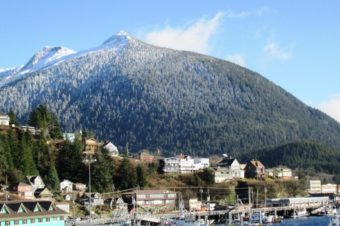
A springtime view of Deer Mountain. (File photo by Leila Kheiry/KRBD )
Alaska Mental Health Trust’s board of trustees voted Thursday in Anchorage to reconsider an August decision to potentially move forward with logging Deer Mountain and a section of land above homes in Petersburg, and then the board delayed a final decision until the end of January.

Since late August, many residents in Ketchikan, Saxman and Petersburg have had Jan. 15 on their minds, because that was the deadline the Alaska Mental Health Trust board set for Congress to approve a land exchange bill.
That exchange trades parts of Deer Mountain and land in Petersburg now owned by Mental Health for equivalent parcels of federally owned land on Prince of Wales Island and in the Shelter Cove area.
If the exchange failed to pass by Jan. 15, then that August vote called for Mental Health to move forward with logging the sites in Ketchikan and Petersburg.
That vote wasn’t well advertised, and came as a big surprise to many community members.
Groups organized in opposition to logging and to the process the Trust used leading to the vote.
The opposition, and a mountain-sized amount of public comment, inspired the board’s reconsideration.
Delaying the final decision wasn’t on the trustees’ meeting agenda, but Trust Land Office Executive Director John Morrison says there’s a lot of written public input for trustees to read.
“I think at this point, our recommendation is to potentially give the trustees a little more time to consider the comments you received recently before you decide which way you’d like to go on these two issues,” he said.
The trustees unanimously agreed to reconsider both the Deer Mountain and Petersburg logging votes, and then postpone final action until the next regular board of trustees meeting, which is Jan. 25 and 26.
Morrison told the board that his office is hearing “very optimistic” predictions that the land exchange will be approved by Congress in the upcoming session. In that case, there would be no need to take any action on logging the controversial sites.
In addition to the written comments that trustees received prior to the meeting, some Ketchikan and Petersburg residents chose to call in with comments on the first day of the board’s two-day meeting.
None spoke in favor of logging the parcels close to their homes.
Marta Poore in Ketchikan said there already have been landslides on Deer Mountain, and people who live near it are worried that logging would lead to more slides, and harming the water supply for the community of Saxman.
There’s also a popular trail on Deer Mountain.
“And I hike that trail weekly during the summer, as do many locals and tourists,” she said. “So, to do logging in there would devastate community mood, certainly quality of life.”
Suzanne Wood, co-founder of the Mitkof Island Homeowners Association, told the trustees that the group of 95 homeowners has actively supported the federal land exchange for the last 11 years, in order to avoid logging the site above their homes.
Group members are concerned about further destabilizing the steep hillside, she said.
“There have now been nine natural landslides above our homes on Mitkof Highway and the Tyee hydroelectric utility corridor, closing the highway to through traffic, damaging residential property and infrastructure; and disrupting residential utility service,” she said.
The association never wanted to litigate over this issue, but any action toward logging that site would lead to a lawsuit, Wood said.
Becky Knight in Petersburg said logging should be removed from consideration, whether it’s the sensitive parcels near communities or the exchange lands on Prince of Wales Island and in Shelter Cove. She saida federal buyout of the trust land is a preferable option.
Knight said that logging the controversial sites was never a serious threat. She says the trust already started negotiating with timber industry groups to log the exchange land.
“So why did they issue their threat? It appears that what (the AMHT) were really after was a stampede of support to seal the deal for their legislation,” she said.
Marvin Scott in Ketchikan said the timber sales in Petersburg and Ketchikan are not in the best financial interest of the Trust, because of the increased liability risk.
Scott said he understands Trust officials have said that a risk assessment has been completed, but, “I wonder if a geotechnical survey has been conducted, but even then one should realize that logging on steep slopes above residential development poses a very realistic liability. No one can guarantee landslides won’t occur on a steep slope, even if light selective logging occurs. The fact that trees would be taken, and a subsequent landslide happens, AMHT is then liable.”
Scott said a landslide could lead to damages exceeding $100 million, which makes the proposed $2 million profit from logging Deer Mountain not worth the risk.
Bob Weinstein in Ketchikan urged trustees to seriously consider a suggested amended motion that would add a land sale as an option to logging.
“Doing that will get the public in Ketchikan behind your goal of both the exchange legislation as your primary goal, and, secondary, an effort to retain Deer Mountain as it is,” he said. “It will also allow for the beginning of whatever processes need to take place regarding what the purchase process and related matters are.”
Because the trustees delayed a decision on logging, they didn’t vote on that motion, but it was briefly discussed.
Morrison told trustees that it was a way to officially affirm that the Trust Land Office would be open to options if the land exchange doesn’t pass.
Editor’s note: KTOO’s building sits on land leased from the Alaska Mental Health Trust Authority. KTOO has also applied for and received occasional grants for special reporting projects from the authority.
Harassment complaints in Alaska are on the rise, and the executive director of the Alaska State Commission for Human Rights said she expects that trend to continue, partly in light of the recent presidential elections.
“I do think there is somewhat, a lack of respect for opposing viewpoints that has come about because of this election,” commission Director Marti Buscaglia, said. “This is a total non-partisan viewpoint here, because it’s from all sides. I think that may increase some of these harassment complaints as we move forward.”
Buscaglia was in Ketchikan this week to provide information about the commission, its mission and how employers and others can avoid running afoul of state anti-discrimination regulations.
In a presentation to the Ketchikan Chamber of Commerce on Wednesday, Buscaglia said her agency has primarily focused on enforcement, but she’s hoping to do more outreach.
“And making sure that we have our business community knowing exactly what constitutes discrimination, because I believe that we’re better off preventing it than having to remediate after the fact,” she said.
The commission has a specific task: Enforce state laws that prohibit discrimination against employees, customers and potential renters who have been targeted because of race, religion, color, national origin, gender, disability, age, marital status, pregnancy or parenthood.
The state of Alaska currently does not include sexual orientation or gender identity among the protected groups, but Buscaglia said her agency is working on an amendment to add that to the state statute.
Most complaints her agency receives come from government employees. She believes that’s because government workers tend to have a greater understanding of the law.
Next highest is the food and beverage industry.
“I think part of that is because food and beverage is an industry where, oftentimes, you hire people for their looks,” she said. “You hire cocktail waitresses and you want them to be attractive and cute and young, and all those things are discriminatory. And sometimes you have bosses that think because they’re working with cute young things, it’s OK to ask them for special favors.”
Buscaglia said once the commission accepts a complaint, the investigation process begins.
The investigation is completely confidential – limited to the complainant and the employer – until and unless evidence is found to show the complaint should move into the court system, she said.
Employers can still avoid that step. Buscaglia said there is a settlement option that takes place after an investigation has found evidence; and a mediation option, which happens even before an investigation begins.
She said mediation is a great option for employers facing a discrimination complaint.
“Even if you don’t think it’s going to go anywhere because this happens before the investigation,” she said. “It’s an impartial process; it affords both parties an equal voice. We don’t tell you what you should offer the complainant and we don’t tell the complainant what they should accept. You two work it out together with a trained mediator.”
Buscaglia said it can be very expensive for an employer to settle a discrimination case.
The best way for business owners to protect themselves is to know the law, and make sure employees know the law, because, if an employee discriminates against someone, the business is liable.
The commission’s website has more information about what constitutes discrimination in Alaska.
A 23-year-old woman suffered minor injuries early Friday morning after she was reportedly pinned between two cars near Harriet Hunt Lake.
The lake is approximately 10 miles north-northeast of Ketchikan.
The woman was standing near a parked vehicle at about 3 a.m. Friday when another vehicle backed into her, pinning her between the two cars, according to the online Alaska State Troopers dispatch.
The driver of the vehicle was a Sitka woman, also 23.
Troopers say the driver left the scene.
Witnesses reported she was intoxicated at the time of the incident.
The driver later was contacted inside city limits, arrested and charged with driving under the influence.
Troopers say additional charges may follow.
The injured woman was treated at PeaceHealth Ketchikan Medical Center.
Alaska Mental Health Trust Authority’s board of trustees meets this week, and will vote on a “reconsideration” of an August decision to move forward with logging parts of Deer Mountain in Ketchikan and a parcel in Petersburg that sits above homes.
Trust officials visited Ketchikan and Petersburg earlier this month to talk about those plans. They said that, if logging does happen, it would be selective logging by helicopter, not clear cutting.
Trust officials have repeatedly said they vastly prefer a land exchange over logging the two controversial parcels.
The trustees’ August decision prompted groups in both affected communities to organize against any logging of those sites.
There also were questions about whether the vote was legal under the Open Meetings Act, which led the board to take another vote on the issue this week, following a Resource Management Committee recommendation last month.
The trustees’ meeting is scheduled for two days in Anchorage.
The vote on the issue is scheduled for Thursday, at about 1:15 p.m. People can call in to listen.
Here’s a link with information about how to comment by phone or by email. We also have earlier reports on the issue here and here.
Editor’s note: KTOO’s building sits on land leased from the Alaska Mental Health Trust Authority. KTOO has also applied for and received occasional grants for special reporting projects from the authority.
The state has officially handed over control of the Ketchikan Regional Youth Facility, which closed this fall, the city council learned Thursday night.
The detention facility was built to hold up to 10 juveniles.
It had been underutilized in recent years and with state budget cuts, the Division of Juvenile Justice decided to close it.
The building is on city of Ketchikan-owned property, and the terms of the lease stipulate that the property will revert to the city if the state stops operating the facility.
Knowing it would be getting the facility, the city solicited proposals for the building, and only received one.
Gateway-Akeela wants to use the building as a sobriety center and safe house for people who need to sober up, City Manager Karl Amylon told the Council on Thursday.
“Essentially, what Akeela wants to do it apply for a recently announced state grant that would be $1 million a year for a three-year period to implement this type of facility, which would serve not only as a safe house, but also as — my term is a portal — to more extended treatment,” he said.
Gateway-Akeela provides mental health and substance abuse services in Ketchikan.
The grant would allow them to run it as a detox facility, as a short-term residential substance abuse inpatient center, or as a “sobering” center, Gateway-Akeela Director Director Joel Jackson told the Council.
That third item is what they’re interested in implementing.
“What it is, is a place where, according to the proposal, they could be there for three to 14 hours,” Jackson said. “So, someone who is intoxicated – doesn’t have to be alcohol, it could be anything – could come in on their own, could be brought in by police, could come from the hospital, a family member. They would be monitored, assessed, and we hope to tie them into the services that we already have.”
Amylon told the Council that there would be a more detailed presentation about the proposal for the next meeting, which has been rescheduled from Nov. 17 to Nov. 21.
Also Thursday, the Council approved a motion to pay $2,500 for a borough-run shuttle that will bring people from downtown up to the Ted Ferry Civic Center during the Winter Arts Faire, set for Nov. 25 through the 27.
The Council also agreed to waive the rental fee for use of the Ted Ferry by Southeast Conference, which will meet in Ketchikan in fall of 2018.
Close
Update notification options
Subscribe to notifications
Subscribe
Get notifications about news related to the topics you care about. You can unsubscribe anytime.