KRBD is our partner station in Ketchikan. KTOO collaborates with partners across the state to cover important news and to share stories with our audiences.
The body of Ketchikan man who was overdue from a hunting trip was found Sunday morning in the water north of Bold Island in Southeastern Alaska.
John Wallace, 30, was reported overdue Saturday night from a hunting trip near the island.
The U.S. Coast Guard launched a search shortly after receiving the report.
The Coast Guard deployed a 45-foot response boat crew from Station Ketchikan and a helicopter crew from Air Station Sitka, Coast Guard Petty Officer Bill Colclough said.
Wallace’s overturned skiff was located near Bold Island, but they were unable to locate Wallace after an extensive search of the shoreline.
The search was suspended at 1:30 Sunday morning, and resumed at daylight.
Ketchikan Volunteer Rescue Squad was contacted by Alaska State Troopers at about 2 a.m. Sunday to assist in the search, said rescue squad member Jerry Kiffer.
“We stood up our command center in Ward Cove and at daylight we dispatched a rescue boat down to the area,” he said. “The intent was to start where the person was supposed to go and start doing shoreline searches in a northerly direction.”
Ketchikan Volunteer Rescue Squad found Wallace’s body at about 9 a.m. Sunday in the water north of Bold Island. He was not wearing a life jacket.
Next of kin and the State Medical Examiners Office were notified.
Alaska State Troopers are in charge of the investigation.
Two people suffered minor injuries Saturday in a single-vehicle accident in Ketchikan.
An 18-year-old man was driving a Chevy Blazer on South Tongass Highway about 7:30 p.m., when the vehicle hit some ice on the road, skidding into a creek on the other side of the road, according to the online Alaska State Troopers dispatch report.
The driver and one passenger suffered minor injuries.
They were taken to PeaceHealth Ketchikan Medical Center, where they were treated and released.
Two other passengers were not injured.
All occupants were reported as wearing seat belts.
The Blazer was heavily damaged and was towed from the scene.
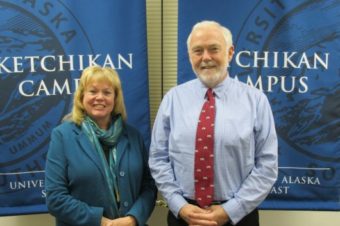
UAS Ketchikan Campus Director Priscuilla Schulte and UAS Chancellor Richard Caulfield. (Photo courtesy KRBD News)
University of Alaska Southeast Chancellor Richard Caulfield was in Ketchikan this week, visiting with staff, faculty and students. Caulfield and UAS Ketchikan Campus Director Priscilla Schulte spoke about financial issues facing the university system, and opportunities for the Ketchikan campus.
Caulfield has been chancellor since May of 2015. He was in the First City on a regular visit to the UAS Ketchikan campus.
Caulfield says earlier this year, University of Alaska President Jim Johnsen implemented “Strategic Pathways,” an initiative to streamline the university system statewide, reduce the budget, and improve opportunities for students. Caulfield says all academic and administrative programs are under review.
“And already, the first phase of ‘Strategic Pathways’ has focused on our School of Management and its offerings in Southeast, and business programs elsewhere in the state, and also teacher education. And those are two prominent ones that are on the radar screen right now.”
Caulfield says two online degree programs will continue, but under a different school based out of Juneau. He says this will eliminate one dean position and streamline costs. The degrees are Bachelor of Administration and Masters of Public Administration.
Caulfield says the Board of Regents is meeting mid-December to consider a proposal to have a single college of education, and a single dean, across the state. He believes the board will approve that proposal.
“The question has been, ‘Which University – Fairbanks, Anchorage or Southeast – would take the lead for the state in teacher education?’ And the president’s put forward a recommendation that it be in Fairbanks, even as we would still have faculty in Anchorage and in Juneau serving Southeast Alaska.”
Ketchikan Campus Director Priscilla Schulte says many UAS Ketchikan students pursuing bachelor degrees want to go into teaching. She hopes whatever changes are made, students can easily move from their bachelor’s program into teacher education.
“And we want to make sure that it’s a very streamlined process, as it is now at UAS. They can go from our bachelor’s programs into the Master of Arts in Teaching. We have quite a few students who do that.”
Caulfield says a focus of “Strategic Pathways” is teacher education and retention. He says about 900 teachers are hired in Alaska each year, but only about one-third are educated at the University of Alaska.
“Two-thirds are imported from out of state. Inevitably that’s a good thing. We’ll get some new ideas and so forth. But the president has said, in his mind, it would be great, by 2025, if, say, 90 percent of the teachers teaching in Alaska schools were educated here in the state – people who know and love the state. They know our communities. They know our kids.”
Caulfield says he wants Southeast students to have continued access to quality teaching programs so that goal can be achieved.
Caulfield says maritime and fisheries programs will continue to be important fields. The School of Fisheries and Ocean Sciences is based in Fairbanks. He says there are plans to expand undergraduate fisheries education in Southeast.
“And my hope is that we’ll see a steady stream of Southeast Alaska students wanting to enroll in our Fisheries and Ocean Sciences program. They can start here in Ketchikan. They can get their basic courses here or in Sitka. Some of that they could do online. But they would, in the end, need to go to Juneau, probably, to finish up their degree.”
Caulfield says other opportunities for growth are in the marine trades. He says the university has had good working relationships with various employers, including Vigor Industrial and the Alaska Marine Highway, and he wants to see those relationships continue and expand.
UAS will be upgrading the regional maritime training center in Ketchikan next year. Schulte says there will be a remodel of the building on Stedman Street. She says the welding and diesel labs will be upgraded, along with facilities for the marine simulator.
“We’ve upgraded it with new software, new computers, but we need more space to put them. All of this will allow us to develop our simulator lab for marine transportation. (It will be) much more upgraded, and some of our existing welding facilities were build 20 to 30 years ago.”
She says the bids will go out in January, and work should start in May. Schulte says the facility upgrades will allow the university to do more in the marine trades.
Caulfield’s visit to Ketchikan was brief. He says he periodically visits each campus and looks forward to attending the next commencement ceremony.
A Tongass National Forest clear-cut is visible in this aerial photo taken in 2014. (Photo by Ed Schoenfeld/CoastAlaska News)
The U.S. Forest Service on Friday announced a final decision on amending the Tongass Land Management Plan to transition toward second-growth harvest within 16 years.
The decision comes about five months after the draft decision was announced this summer.
There were some corrections, definitions and clarifications, but the main points remain the same. During the 16-year transition, the U.S. Forest Service will offer an average of 46 million board feet of timber on the Tongass National Forest per year.
For the first decade, that will include almost three times more old-growth logging than second-growth. In years 11 to 15, the ratio will flip, allowing more young growth harvest and limiting old growth.
By year 16, timber stands offered for logging will be about 90 percent young growth, with 5 million board feet of old growth for specialty products.
The main objection from some environmental groups is that the transition isn’t happening fast enough – they want to move away from old-growth logging within the next five years. Logging industry representatives, though, say the switch is too fast. They think the full transition should be closer to 30 years.
Earl Stewart is the Tongass National Forest supervisor. (Photo courtesy U.S. Forest Service)
In a Friday teleconference announcing his decision, Tongass Forest Supervisor Earl Stewart said objections were noted and considered, and the Forest Service chose to stick with a plan endorsed by the Tongass Advisory Committee, a group made up of representatives from conservation, logging and Alaska Native organizations.
He acknowledged that there will be a change of administration when President-elect Donald Trump assumes office. But, he notes that the Forest Service’s mission remains the same. Stewart read from a prepared statement:
“While the U.S. Department of Agriculture has a transition team in place to work with the new administration, our employees will continue on our mission of sustaining the health, diversity and productivity of the national forest and grassland to meet the needs of present and future generations,” he read. “Beyond that, I’m not able to or going to speculate further.”
There had been calls to delay the final decision until after the new administration assumes office and provides direction. However, Stewart says the Forest Service doesn’t base decisions on what might happen.
“And so, the team was working very deliberatively to work through the process they had in front of them,” he said. “Concurrently, anything that was directed by federal law, we would have followed completely.”
The amendment to phase out old-growth logging has been in the works since 2014. It takes effect in 30 days.
Correction: An earlier version of this story overstated the ratio of old-growth to young-growth logging that will be offered at the end of the transition period. The Tongass plan amendment calls for about 5 million board feet of old growth to be offered each year, about 11 percent of the total board feet offered.
The search continues for two people that went missing Tuesday night after they abandoned a sinking ship north of Unalaska Bay.
On Wednesday, Petty Officer Meredith Manning said a U.S. Coast Guard cutter and three volunteer vessels combed waters around the island, but they found no sign of the crewmembers missing from the M/V Exito.
“The Coast Guard cutter Alex Haley searched through the night,” she said. “Now, the plan is for the helicopter they have onboard to conduct a search.”
That search began Thursday at first light, focusing on the area around Priest Rock and into Constantine and Kalekta Bays.
Manning isn’t sure how long the Coast Guard will continue looking.
“That can depend on the temperatures outside and how long the crews can be out,” she said. “There are a lot of different factors that go into it. But right now, our primary concern is continuing to search until we’re able to find these guys and bring them back.”
The Coast Guard received reports that the vessel was taking on water
about 9:30 p.m. Tuesday.
Within the hour, Manning said a good Samaritan ship had rescued the Exito’s three other crewmembers, who were checked at the clinic and reported no injuries.
While it’s still unclear why the vessel went down, Manning said the Exito was making a cargo run between Unalaska and Akutan before it ultimately sank 4 nautical miles north of Priest Rock.
Records show the 117-foot steel ship was built in 1956.
The rescued crewmembers are in Anchorage now, along with vessel owner Tom Robinson of the Unalaska company Aleutian Endeavors LLC. According to officials with the Marine Safety Detachment Unit in Dutch Harbor, they’re there to handle business concerns following the sinking and meet with investigators at Coast Guard Sector Anchorage.
Ketchikan Senior Services is moving to a new location.
A lease agreement was signed with the Tlingit-Haida Regional Housing Authority on Nov. 18. Programs will move from the Water Street building to the Saxman Senior Center in mid-December.
“We had an opportunity to move to a brand-new, accessible facility with ample parking, and also to join in a partnership with the Organized Village of Saxman to provide additional funding for senior services,” said Marianne Mills, program director for Southeast Senior Services.
The new building has an elevator and is fully accessible, Mills said. It also includes a commercial kitchen, dining room and offices.
All of services currently available will continue at the new location.
“We operate the seniors’ meal program, and transportation and case management programs out of that facility, and so we’ll be moving those services out to Saxman,” she said.
Services are available to senior citizens, age 60 and older, living throughout the Ketchikan Gateway Borough.
Mills says there will be no interruption in transportation services, but the meal program will close Dec. 16 and reopen at the new facility Dec. 19.
She says they are also looking for help moving. Anyone interested in helping can contact site manager Emily Fuller at 225-6578.
Close
Update notification options
Subscribe to notifications
Subscribe
Get notifications about news related to the topics you care about. You can unsubscribe anytime.