KRBD - Ketchikan

KRBD is our partner station in Ketchikan. KTOO collaborates with partners across the state to cover important news and to share stories with our audiences.
Ketchikan borough manager calls for 10% overall budget cut, to start

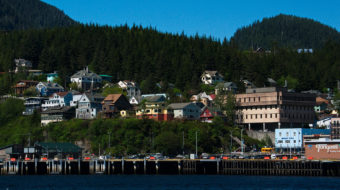
The Ketchikan skyline. Creative Commons Photo by Dave Bezaire)
The Ketchikan skyline. (Creative Commons photo by Dave Bezaire)

If the Ketchikan Gateway Borough maintains its current spending levels, it faces a projected $1 million deficit this year, and with no changes will pretty much run out of money by 2022.

New Borough Manager Ruben Duran told the Borough Assembly Friday that, with that in mind, he has directed borough departments to cut general fund spending by 10 percent, to see how much that affects services.

He says those cuts will be among a menu of options that borough staff will present to the Assembly during its second meeting in March.

“Also, and by the way, if you do the math it’s not enough, look at some of the revenues of what we’re collecting and how we’re collecting it, and the exemptions associated with that, and reviewing that also,” he said. “That’s also the type of thing we’ll be talking about in March.”

During the budget discussion, which kicked off the Assembly’s two-day policy planning session, Duran said his goal is to eliminate the deficit over several years.

In the meantime, the deficit can be covered by borough reserves.

Duran says they’ll work to keep cuts reasonable, but there likely will be some reductions that are unpopular.

“And they’re going to be difficult,” he said. “You’re going to hear some things that are going to reduce programs, where you’ll have folks back in this room in April going, ‘What are you doing?’”

Among the specific budget items, the Assembly talked about was the community agency grant program, which is funded through the borough’s economic development fund. That fund has been running low.

During public comment, former Assembly Member Bill Rotecki urged the Assembly to maintain grant funding for nonprofits, because of the valuable services they provide to the community. He argued that the grants are an investment that more than pay for themselves.

But, Assembly Member Glen Thompson says it’s inappropriate for the Assembly to provide some, if not all, of those grants, especially through the economic development fund.

“We are calling health and social welfare grants economic development, and I believe that’s inappropriate and have for many, many years,” he said. “Not that they’re not good programs, but we don’t really have the authority by the voters to do that. We’re able to call it economic development because anything this Assembly says is economic development is how it goes.”

Thompson and other Assembly members asked for more information about the economic impact of nonprofit agencies that receive borough grants. Borough Finance Director Cynna Gubatayao said she can gather that information for a later meeting.

The Assembly also discussed how best to allocate the borough’s share of the state cruise passenger head tax.

The Assembly made no decisions, but members indicated they would like more allocated to the airport and to emergency responders, and they would like more information about how much the recreation center is used by people related to the cruise industry – including crew members and seasonal workers.

Also on Friday’s work session, there was a discussion on local bidder preference, property tax exemptions, road development, planning and zoning enforcement and transportation.

Saturday’s half-day session is dedicated to school district funding and will include members of the Ketchikan School Board.

The meeting in Assembly Chambers at the White Cliff building starts at 9 a.m. Saturday. It is open to the public and can be watched on local public access channels and through the borough website’s live stream.

Southeast land exchange bill reintroduced in Congress

A springtime view of Deer Mountain.
A springtime view of Deer Mountain. (Photo by Leila Kheiry/KRBD)

With a new U.S. Congress convening, Alaska’s Congressional Delegation has reintroduced a bill that would trade federal land for land owned by Alaska Mental Health Trust – including Ketchikan’s Deer Mountain.

A joint statement Thursday from Sens. Lisa Murkowski and Dan Sullivan, and Rep. Don Young announced that companion bills to accelerate the exchange have been filed.

The House and Senate bills are pretty much identical, according to Matt Shuckerow of Rep. Young’s office. He said Sen. Murkowski, as the chair of the Senate Energy and Natural Resources Committee, is the main force behind the effort, which Rep. Young fully supports.

“This is something that’s been ongoing for a number of years and the Congressman has certainly been supportive of this effort,” Shuckerow said. “As has been detailed by others and the Congressman, this is an effort by all the stakeholders involved to come to some sort of resolution.”

The legislation would put Mental Health Trust land on Deer Mountain and above homes in Petersburg under U.S. Forest Service control. In exchange, the Trust would receive federal land on Prince of Wales Island and in Ketchikan’s Shelter Cove area for logging.

Last summer, the Alaska Mental Health Trust Land Office announced that it planned to move forward with logging Deer Mountain and the Petersburg site if the land exchange wasn’t approved by early this month. After public outcry and questions about the TLO’s decision-making process, a final decision on that plan was delayed.

Shuckerow said the legislation is the same bill that had been introduced in the previous Congress. He said the delegation hopes it will be approved fairly quickly.

“It is a model for governance where there is local support. It’s not a top-down approach; it’s really a bottom-up approach from the communities involved and the stakeholders involved,” he said. “That’s certainly a positive note in that regard, that it’s supported locally. That’s something we can relay to different members of Congress, that this is something that’s supported locally. Oftentimes that’s very helpful in moving legislation.”

Local governments in Ketchikan and Petersburg have approved resolutions in support of the land exchange, and there has been an effort to encourage individual residents to send letters of support.

In Thursday’s announcement, Murkowski states that the exchange will protect land that is valued by the communities while providing other land for timber harvest. She says logging the sites on POW and in Shelter Cove will assist the timber industry, and make money for mental health services in Alaska.

The U.S. Forest Service and the Trust already have agreed to the land exchange. The legislation would speed up the process.

The bill has just been introduced, which is the first step.

Entangled humpback whale rescued off Prince of Wales Island

A group of local good Samaritans banded together this week to help a humpback whale that had become tangled in a barge anchor cable off Prince of Wales Island.

A tangled humpback whale was rescued by a group of Ketchikan good Samaritans this week. (Photo by Oscar Hopps)

Oscar Hopps, of Ketchikan-based Alaska Commercial Divers, said the whale was discovered by Olsen Marine crew members on Wednesday.

“Apparently, what had happened is the humpback whale had been feeding in the Nutkwa Inlet for some time – a lot of krill around there,” Hopps said. “He must have been bubble feeding when he came up and bit down on this inch-and-a-quarter cable that was going to a 7,000-pound anchor.”

The whale must have spun, Hopps said, because the cable wrapped around the top half of the marine mammal’s head. The cable then twisted up on itself, forming almost a noose.

Hopps estimated the whale had been tangled for a few days before it was discovered. A rescue effort was organized quickly by Rick Olsen, bringing together Olsen Marine, Alaska Commercial Divers and Seawind Aviation crews.

They initially thought someone would have to dive down to remove the cable from the anchor. Hopps said they were able to use the cable to slowly coax the whale to the surface, next to the dive boat.

“We were able to get hold of the cable from underneath the whale and cut it,” he said. “Then from a small boat, we were able to slowly unwind the cable from itself and then using a system of pulleys, just kind of slowly pulled the cable off the whale.”

Hopps said the whale suffered minor wounds — the cable luckily missed its eyes. It seemed pretty tired after the ordeal, though, and stuck around for a while, resting on the surface.

Hopps said the whale seemed to understand that the crews were there to help.

“He was a little temperamental when we first started pulling him up, but as soon as he started feeling that slack of the cable, he sat there quietly and let us take care of him,” he said. “I’m really glad we were able to.”

Hopps says it was a meaningful experience for the rescue crews, too.

“It was a once-in-a-lifetime experience, for sure,” he said.

National Oceanic and Atmospheric Administration officials are aware of the rescue, and have asked for photographs of the whale so they can identify it, Hopps said.

According to the NOAA Fisheries website, entanglements are one of the leading causes of whale deaths. The agency has even produced a podcast giving tips on how to disentangle a whale — along with warnings about the potential danger of getting close to such a large animal.

Ketchikan Electric turns on diesel generators due to cold, dry weather

The City of Ketchikan's holiday light display came down early this year because of low lake levels and lack of hydroelectric power. (Photo by Leila Kheiry/KRBD)
The City of Ketchikan’s holiday light display came down early this year because of low lake levels and lack of hydroelectric power. (Photo by Leila Kheiry/KRBD)

Ketchikan residents are going to be paying for this cold, dry winter.

Ketchikan Public Utilities Electric Division started supplementing the community’s hydroelectric power with more expensive diesel about a week ago. With no rain or warmer temperatures expected anytime soon, KPU officials expect to continue running those generators into the foreseeable future.

The past few winters in Ketchikan have been mild and kinda soggy. So, the lakes stayed full, and hydroelectric power flowed.

This winter? Not so much. So, KPU has fired up its backup generators

“We started last week, just before the New Year’s break for four days,” said KPU Electric Division Manager Andy Donato.

There were some partial days on diesel, then the utility stayed on hydro through the New Year’s holiday weekend, “and temperatures were low and we sucked down a lot of water, and we resumed diesel generation Tuesday.”

This weather is a little unusual.

Ketchikan doesn’t usually get long stretches of truly cold weather.

It’s not that cold, compared with other parts of Alaska, Donato said, but, “It’s cold enough that it freezes up the hillsides, the precipitation is in the frozen format, we get no inflow in the lakes, our heat loads go up and the lakes start drafting really, really fast. So, to mitigate that, we have to supplement with diesel generation.”

So, is this a normal winter issue to deal with? Or something to worry about?

“A little bit of both,” Donato said. “We’re an electrical utility, so we’re always concerned.”

“Our responsibility is to keep the lights on, regardless of the weather,” he said. “Here I am looking at a stretch of weather where there’s no relief in sight. I don’t know how long this is going to last. We’re just very fortunate to have the diesel generation that we have and the facilities and the personnel to operate and more importantly maintain them.”

Donato said it looks like KPU will be on diesel for a while, and with cold temperatures expected to continue, the demand for electricity will be high – lots of people running their heaters to stay warm.

Sometimes, when demand is high in Ketchikan, KPU can take a little excess hydropower generated by the Tyee Lake facility near Petersburg. But, it’s been cold and dry up there, too, so there isn’t any excess hydro to take.

Donato stressed that Ketchikan has plenty of diesel to take care of the community’s electrical needs, but one casualty will be the city’s holiday lights.

“It didn’t make sense that, here we are running diesel and sometime around 3:30-4, the holiday lights come on with the street lights, so yesterday we made the decision to unplug and/or pull them down,” he said.

With the utility burning diesel, KPU customers will see a diesel surcharge on their electric bills.

Oil prices are low now, so it’s not as expensive as it could be, but diesel still costs about twice as much as hydro.

And for those wondering about Ketchikan’s drinking water supply: Donato said there isn’t a shortage at Ketchikan Lakes, but KPU has cut down electric generation there to the legal minimum in order to maintain those lake levels.

Ketchikan Council to consider DOT plans for downtown

The Ketchikan City Council will talk Thursday about the Alaska Department of Transportation’s proposed redesign of Front, Mill and Stedman streets, which make up the primary corridor running through Ketchikan’s downtown.

According to a memo from Assistant City Manager David Martin, two DOT representatives will attend Thursday’s regular Council meeting to answer questions and hear comments about the plan, which would reduce the overall road width along Front Street by 7 feet in some areas, and 3 feet in others.

That reduction would allow for a wider sidewalk, to accommodate the thousands of cruise passengers that crowd into Ketchikan’s downtown core each summer.

An earlier plan called for removing the middle lane on Front Street, except for a short left-turn lane for the Mission Street intersection. Now, the plan maintains a middle southbound lane until the Mission Street intersection.

After that, the road would have two lanes — one southbound and one northbound — as it rounds the curve and becomes Mill Street, although there would be a dedicated left turn lane from Mill onto Bawden Street.

The roadway on Mill Street also would be narrowed, but only by 2 feet. Again, that would allow for a wider sidewalk. The plan also would add Americans with Disabilities Act-compliant curb ramps, and would reduce overall parking along Front and Mill streets by three spaces.

Stedman Street’s overall configuration would not change.

Also Thursday, the City Council will consider a request from OceansAlaska for relief from electrical charges to the shellfish-seed facility totaling about $16,500.

An executive session at the end of the meeting has been scheduled for the Council to consider potential litigation related to the cruise ship Infinity’s June 3 collision with Berth 3.

Thursday’s meeting starts at 7 p.m. in City Council chambers.

Public comment will be heard at the start of the meeting.

Longtime Ketchikan pediatrician retires

Retiring Dr. David Johnson and his wife, Jenny, are seen at the PeaceHealth Ketchikan holiday party. (Photo by PeaceHealth)

Ketchikan pediatrician Dr. David Johnson has hung up his stethoscope as of Friday, Dec. 30, officially retiring about 46 years after he first arrived to practice medicine.

According to a PeaceHealth Ketchikan Medical Center announcement, Johnson came to Ketchikan in 1970 as an officer with the U.S. Public Health Service, and was assigned to the Indian Health Clinic. At the time, that clinic was inside Ketchikan General Hospital.

After a couple years at the Indian Health Clinic, Johnson left Ketchikan for a pediatrics residency in Seattle.

He returned in 1974 and worked for the privately owned Ketchikan Medical Clinic for 31 years.

Since 2005, Johnson worked part time for the Callisto Clinic, which later merged with and became part of PeaceHealth.

Johnson’s wife, Jenny, is a registered nurse and works in the Ketchikan hospital’s outpatient surgery.

According to the announcement, the Johnsons plan to “move south” by building a small waterfront home south of city limits.

Johnson says he plans to remain active on the hospital’s community and foundation boards.

Site notifications
Update notification options
Subscribe to notifications