KRBD is our partner station in Ketchikan. KTOO collaborates with partners across the state to cover important news and to share stories with our audiences.
A proposed new taxi company has applied for a certificate from the City of Ketchikan to operate up to six cabs, with at least half the fleet wheelchair accessible.
According to its application, filed Feb. 22 with the City Clerk’s office, Spirit Cab’s primary business goal is to provide accessible transportation to people with disabilities. The company also would accept Medicaid vouchers from people who need transportation for medical services.
The application letter states that all Spirit Cab drivers would be trained in CPR, wheelchairs, how to use the wheelchair lifts and how to secure wheelchairs inside the vans.
The letter states that the company does not plan to operate a tour business, but would provide some tours to visitors who need wheelchair-accessible transportation.
Angela Perez submitted the application, which states that the new company would provide 24-hour, on-call transportation for people with disabilities.
City code requires new cab services to be approved by the Ketchikan City Council through a certificate of public convenience and necessity. The Council will consider Spirit Cab’s application during its March 16 meeting.
At this week’s meeting – on Thursday – the City Council will vote on a related motion.
A proposed ordinance would amend city code to establish a special endorsement for taxi companies to operate wheelchair-accessible cabs.
That endorsement would allow a company to have one additional non-accessible cab for each wheelchair-accessible taxi that it has in service.
The city limits the number of taxi cabs in Ketchikan. But, the lack of accessible taxi service has been a point of discussion for quite some time.
One argument against requiring dedicated wheelchair cabs is that it could mean less revenue for a business because those vehicles wouldn’t be readily available for other services, such as tours.
The proposed ordinance also would require taxi companies to provide a response time of 30-minutes or less for customers who need a wheelchair cab.
Esther Kennedy of the Resource Protection Department collects water samples every week from Starrigavan. Along with six other tribes in Southeast, the group is working to create an early warning system to protect shellfish diggers from PSP. (Photo by Emily Kwong/KCAW)
Last summer, Ketchikan Indian Community began a phytoplankton and shellfish monitoring program in Ketchikan as part of the Southeast Alaska Tribal Toxins Program. KIC tests samples, and informs the public if dangerous levels of the toxin that causes paralytic shellfish poisoning are found in local clams and mussels.
Nicole Forbes is the environmental specialist at KIC in charge of collecting samples. She says it’s important for people to understand what paralytic shellfish poisoning is and how it is transmitted.
“Basically there are tiny, microscopic plants in the ocean called phytoplankton. Most of them are not harmful. In fact, they produce 50 percent of our oxygen. But there are a few harmful species and one of those is Alexandrium and it produces something called saxitoxin. When the shellfish filter-feed, it gets collected in the shellfish, and when people eat it, that’s what causes paralytic shellfish poisoning.”
PSP toxins cannot be cooked or cleaned out of shellfish, and freezing does not destroy the toxin. Consumption of the toxin can cause paralysis and death. Commercial shellfish is tested and considered safe. The Tribal Toxins Program targets recreational beaches.
Forbes says KIC is testing samples at popular beaches in the Ketchikan area so people will know if clams, mussels, and cockles are safe to harvest. Currently, testing is being done at Settlers Cove and Whipple Creek. Forbes says they plan to add Seaport Beach in Saxman soon. She says the program is in the beginning stages and they are working to identify other sample sites.
“We’re trying to figure out where most people harvest, so that we can get those results. The thing is you have to get results for each beach. Because you could go two or three miles down and it’s going to be completely different down there.”
Forbes says there are three steps to the collection process, which starts with weekly phytoplankton samples.
“Which involves me going out there with a phytoplankton net and wading in the water, and grabbing a sample. I bring that back to our local lab, and I put it under the microscope and look for those harmful phytoplankton species that I was talking about. If I see one, that’s the first warning sign that we need to get a shellfish sample out as soon as possible, because it’s possible that saxitoxin is in the shellfish.”
Forbes says suspect samples are sent to the Sitka Tribe of Alaska’s lab in Sitka. She says the turnaround time for testing is fairly quick.
“I send it out on Tuesday, gets there Wednesday, I get results Thursday or Friday.”
She says the third step of the process is filtration, which involves taking a water sample, filtering it, and then sending the filter to the lab, where phytoplankton species and quantities are identified, along with concentration of toxins.
Tony Gallegos, the cultural and natural resources director for KIC, says Alexandrium may be present, but not necessarily producing toxins.
“The scientific literature hasn’t come to clear conclusion on how you know whether they’re going to produce the toxins or not, what triggers that. That’s still unclear. We can see the algae, but we need to actually do an analysis of those algae to see if they actually have toxins in them.”
Forbes says phytoplankton aren’t as active in the winter because it is cold and dark, but she says no time of the year is safe to harvest without testing. She says they found high levels of toxins in butter clams at Whipple Creek this winter.
“Actually butter clams hold onto the toxins longer, and then during the winter the shellfish slow down their filter feeding, so they can actually hold on to those toxins for the whole winter.”
Forbes says she collects samples every two weeks, weather permitting, and if samples test positive, they are retested weekly. Results for all Southeast beaches being tested are posted in the data section of the Southeast Alaska Tribal Association Research website – www.seator.org. Information is also sent to local media.
KIC is interested in identifying other local sites for sampling.
If you have suggestions, you can contact Nicole Forbes at KIC. Forbes email is nforbes@kictribe.org. The phone number is 228-9365.
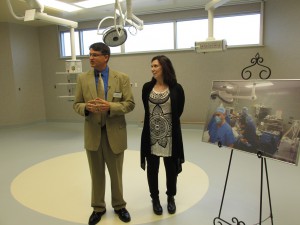
Hospital Foundation Director Matt Eisenhower and Surgery Manager Kimm Schwartz at the PeaceHealth Ketchikan Medical Center during an open house last summer. (Photo by Leila Kheiry/KRBD)
The Ketchikan City Council agreed Thursday to move forward with some recommended modifications to the new hospital surgery suite, at a cost of about a million dollars.
The modifications are the result of code changes that happened after the design work had been completed. City Manager Karl Amylon told the Council that even with the modifications; the project will be within budget.
Some Council members questioned why the design wasn’t modified before the surgery suite was constructed. Here’s Council Member Mark Flora, who started out quoting a memo from Amylon on the topic.
“‘The modifications agreed to by PeaceHealth and city staff are the result of various factors, including code revisions that occurred after the design was completed; improvements in technology making what was designed and installed out of date in terms of best practices,’” he read. “This is something that the public should know going forward as we vote on this. How do we build a new hospital and put obsolete stuff in it before we occupy it?”
Amylon says he understands the concerns of the Council, but at this point, the building needs to be completed so PeaceHealth can move into the surgery suite.
The hospital is owned by the City of Ketchikan; PeaceHealth is the service provider. In his memo, Amylon writes that PeaceHealth will pay for some other identified modifications to the surgery suite.
The motion passed 5-1 with Council Member Janalee Gage voting no. The new total cost to the city of the Phase 1 hospital expansion is about $53 million.
Also, Thursday, the Council chose to send the issue of community agency grants back to the committee, rather than increase the appropriation as recommended by that committee.
The original appropriation was $380,000. The committee wanted about $20,000 more to fully fund grants to 17 local nonprofit groups.
The Ted Ferry Civic Center is owned and operated by the City of Ketchikan. (Photo courtesy KRBD)
While it wasn’t on the agenda for this meeting, the topic of shuttles for events at the Ted Ferry Civic Center came up. Council Member Dave Kiffer, who was absent during the last meeting, says he was disappointed with the Council’s Jan. 19th decision to not fund a shuttle for this weekend’s Wearable Art Show.
Kiffer said the Council seems to “suffer from a severe case of institutional amnesia.”
He said the city chose to build its civic center at the top of a steep hill, on a site that has inadequate parking. The funicular, or tram, that is owned and operated by Cape Fox Lodge, helped alleviate the parking issues. But, Kiffer said, now the tram is old and needs repairs.
“So, the way I see it, we have three options here, folks: We can tear down the building and put it somewhere else. We don’t want to do that – that’s tens of millions of dollars we don’t want to spend. We can do what the company that runs the funicular wants us to do and give them a huge chunk of money to fix the thing or build a new one for several hundred thousand dollars plus. Or we can provide a couple thousand dollars now and again so the buses run up there. It doesn’t seem like it’s that hard of a decision,” he said.
Council Member Judy Zenge, who voted at the last against funding a shuttle bus to the Wearable Art Show, responded that Kiffer made some good points. She asked that the issue come back to the Council for discussion.
Two people were treated for minor injuries following a two-vehicle crash about 6 p.m. Tuesday on North Tongass Highway.
The accident took place at the intersection of North Tongass and Pond Reef Road, according to the online Alaska State Troopers dispatch report.
A 65-year-old Ketchikan woman in a Ford Escape was making a left turn onto Pond Reef, and crossed in front of a southbound Chevy pickup driven by a 62-year-old Ketchikan man.
The vehicles collided, and the Escape rolled over, ending up upside down in a ditch.
According to Troopers, both drivers were taken to PeaceHealth Ketchikan Medical Center for treatment of minor injuries, and later were released.
Both vehicles were totaled and towed from the scene.
A springtime view of Deer Mountain. (File photo by Leila Kheiry/KRBD)
The Alaska Mental Health Trust Authority’s Trust Land Office is no longer pursuing action toward timber sales on Deer Mountain or land in Petersburg.
The trust board meets next week – Jan. 25 and 26 – and in the meeting packet is a memo from Trust Land Office Executive Director John Morrison.
Morrison writes that while a federal land exchange deal wasn’t approved by Congress during its last session, he is confident that the reintroduced bill will pass this year.
Therefore, Morrison writes, Trust Land Office staff member are now focused on helping that bill make it through, and on introducing a complimentary bill in the state Legislature.
Last summer, the Trust Land Office announced that it planned to move forward with logging Deer Mountain and the Petersburg site if the land exchange wasn’t approved by earlier this month. After public outcry and questions about the Trust Land Office’s decision-making process, a final decision on that plan was delayed.
The federal legislation would put Mental Health Trust land on Deer Mountain and above homes in Petersburg under U.S. Forest Service control. In exchange, the Trust would receive federal land on Prince of Wales Island and in Ketchikan’s Shelter Cove area for logging.
The Trust Land Office’s decision to focus on the exchange and stop pursuing timber harvest on the controversial sites doesn’t mean it can’t happen. If the land trade is rejected or delayed by Congress, the state agency could still bring back the option of logging Deer Mountain.
Editor’s note: KTOO’s building sits on land leased from the Alaska Mental Health Trust Authority. KTOO has also applied for and received occasional grants for special reporting projects from the authority.
The Ketchikan Shipyard, operated by Alaska Ship & Drydock, is one of the more visible parts of Southeast’s “blue economy.” (Ed Schoenfeld/CoastAlaska News)
A proposal to charge the Ketchikan Shipyard property tax or an equivalent payment in lieu of taxes was postponed Monday by the Ketchikan Gateway Borough Assembly.
The proposal was submitted by Harlan Heaton, who spoke during public comment on Monday.
Vigor Industrial makes a lot of money from its various shipyards, and should pay property tax in the community, Heaton said.
Heaton said he pays property tax on commercial property that doesn’t yet make any money.
“I’m being told, with no uncertain terms that ‘You will pay that tax or we will come out and break your legs.’ They have no problem doing that,” he said. “It’s a common term: ‘Where is the hammer? Where is the hammer that we make the citizens behave?’ The hammer is, they come out and take my property.”
The Ketchikan Shipyard is owned by Alaska Industrial Development and Export Authority, and is managed by Vigor Industrial.
It’s exempt from property taxes because it’s owned by the state.
But, the State Assessor has determined that exemption is optional, and therefore has included the shipyard in the borough’s taxable property value, which affects how much the borough is required to provide for public schools.
Whether the property tax exemption is mandatory or optional is pending a court ruling. Because of that pending decision, Assembly Member Judith McQuerry made the motion to postpone until mid-May. That motion passed unanimously.
Also Monday, the Assembly spent a lot of time on a proposed ordinance that would have established regulations for natural resource extraction. Quite a few developers and logging industry representatives pointed out problems with some of the proposed regulations.
Planning Director Chris French told the Assembly that his office has requested the Assembly send the ordinance back to the Planning Commission for review.
Assembly member Mike Painter made a motion to indefinitely postpone the item, which means it won’t return for consideration unless an Assembly member specifically requests it.
Painter said there already are numerous regulations, state and federal, that cover resource extraction. He also suggested that such an ordinance would affect a pending federal land trade with Alaska Mental Health Trust Authority.
McQuerry, though, disagreed.
She argued that the people who spoke against the ordinance said they were willing to work with the borough to improve the language.
“I think that it would be a good idea to let everybody have a chance to work together on this rather than kill it outright,” she said. “And, Mr. Painter, I’m not sure if we refer it back to planning and zoning that that really will affect the land swap.”
McQuerry was in the minority.
The motion to postpone indefinitely passed 4-2 with McQuerry and Assembly member Felix Wong voting no.
The land trade would swap Alaska Mental Health Trust land, including Deer Mountain, for U.S. Forest Service land on Prince of Wales Island and in the Shelter Cove area.
Mental Health intends to use the land for timber harvest.
Editor’s note: KTOO’s building sits on land leased from the Alaska Mental Health Trust Authority. KTOO has also applied for and received occasional grants for special reporting projects from the authority.
Close
Update notification options
Subscribe to notifications
Subscribe
Get notifications about news related to the topics you care about. You can unsubscribe anytime.