KSTK - Wrangell

KSTK is our partner station in Wrangell. KTOO collaborates with partners across the state to cover important news and to share stories with our audiences.

Navy pledges no serious harm to Alaska marine life, environmentalists skeptical of claims

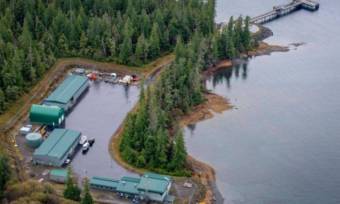
The Southeast Alaska Acoustic Measurement Facility in the Behm Canal, near Ketchikan.
(Photo courtesy Jennifer Kelso via KRBD)

The U.S. Navy says it doesn’t know how many marine mammals it actually disturbs or harms each year. But it predicts its exercises and maneuvers in Southeast Alaska waters won’t cause the death of any marine mammals, according to its updated environmental review for the next seven years for its Northwest Training on the West Coast.

John Mosher, an environmental planner for the Navy in charge of the project’s review, said it’s educated guesswork.

“The takes themselves, especially because they’re almost entirely behavioral disturbance, are very theoretical,” Mosher explained. “We model, we project what could occur if we conduct the full extent of these activities. In most cases, we’re never going to know if in fact, they really occurred.”

The environmental impact statement is a requirement of the National Marine Fisheries Service which regulates marine mammals and is charged with their protection from harm.

The study area includes the Navy’s Southeast Alaska Acoustic Measurement Facility, or SEAFAC, near Ketchikan’s Behm Canal.

SEAFAC measures the sound signatures of Navy vessels, specifically submarines, which need to remain as quiet as possible in the theater of war.

“The vast majority across the entire study area, across the entire EIS — over 99.9% of our authorizations for take are for behavioral disturbance,” Mosher said, explaining the breakdown of serious disturbances to lesser behavioral disturbances predicted by the EIS.

Mosher said that most of the effects Navy exercises have on marine mammals are non-lethal, the kind of disturbance that could stress an animal out but not cause permanent harm. Any instance of disturbance is called a “take.” A “take” can also mean the death of a marine mammal including dolphins, porpoises and whales.

The final EIS proposes no serious “takes” of marine mammals in Southeast Alaska waters in the next seven years. Mosher said that’s mostly because what the Navy does in Southeast is largely passive; SEAFAC is a listening station.

Still, the study increases the amount of projected behavioral disturbances to killer whales and Minke whales in the area compared to the Navy’s study five years ago. It also projects to increase thousands of behavioral “takes” for harbor seals in Alaska.

Those increases in proposed behavioral disturbance would happen despite the fact that the EIS also proposes lowering the number of yearly activities at SEAFAC.

The EIS also projects fewer “takes” for Alaska porpoises.

In a statement, a Navy spokesperson clarified that the changes are due to better modeling, updated marine mammal surveys and a better understanding of the animals thresholds for exposure to disturbances.

“Since the completion of the 2015 NWTT Final EIS/OEIS, new information has become available and is incorporated in this analysis,” the spokesperson said. “This includes updates to testing requirements, an updated acoustic effects model, updated marine mammal density data (number of animals per unit area), and updated criteria and thresholds which were derived from best available science. All of these factors have resulted in increased disturbances.”

Federal agencies are charged with evaluating the Navy’s plans. But they aren’t commenting. Both the Marine Mammal Commission and National Oceanic and Atmospheric Administration Fisheries referred questions back to the military.

The Navy does not have “take” allowances for mortality or behavioral disturbances on fish and smaller invertebrate creatures. Those animals aren’t protected in the same way by federal law.

There are concerns from some quarters. The Center for Biological Diversity said the Navy turns a blind eye to the fact that a lot of marine mammals it said won’t be harmed migrate in and out of Alaska. Steve Jones — a California-based spokesman for the nonprofit — said it’s not just the big animals that are affected — and they’re important too.

“We’re very concerned with Navy exercises, particularly the sonar and explosions,” Jones explained, “and the impact they have on marine mammal populations, particularly whales, right down to the zooplankton that are the basic building block of life in the oceans. There’s a 50% mortality rate when you hit them with undersea noise pollution, such as explosions or sonar. So we’re concerned about that. This plan certainly is going to impact salmon that are migrating to Alaska, and a number of other species.”

The Navy said it won’t be testing any weapons in Southeast Alaska waters. The EIS only proposes one to two sonar tests per year at SEAFAC near Ketchikan.

The final permit from NOAA is expected to be issued later this month. You can take a look at the proposed permit here.

Wrangell officials question school superintendent’s use of CARES Act funds for Juneau trip

Wrangell City Hall. (Photo by KSTK)

Wrangell’s superintendent of schools has apologized for what she called “a heinous and perhaps unforgivable mistake.” That’s following revelations that she chartered a plane for a trip to Juneau for herself and three subordinates.

The Wrangell Assembly responded by rescinding a quarter million dollars in federal pandemic relief funds for the schools and demanded better accounting and accountability from the district.

Wrangell schools superintendent Debbe Lancaster defended the overnight trip to Juneau. She told the school board during a hastily scheduled special meeting last Monday that the district desperately needed supplies for the upcoming semester. Lancaster says she and three unnamed district employees chartered a plane because commercial flights were booked. She says they booked seats on a private ferry home for the same reason.

“I really felt very distinctly when we left the Juneau harbor, and we were all sitting there going, ‘Oh, my gosh, this is so horrible, but it’s all worth it,'” she said.

But in the eyes of Wrangell’s elected officials, it wasn’t worth it. The school board, borough assembly and community have raised concerns about almost every aspect of the $5,800 trip.

For one, the trip broke a travel moratorium imposed to cut costs and COVID risk.

Precise details of purchases and travel expenses made on the trip haven’t been made public. Purchased items mentioned at the school board and borough assembly meetings include face masks, face shields, hand sanitizer, a cordless drill, a safe, a shed for gym equipment, food items for “welcome packets,” restaurant meals and a Costco membership. The school district hasn’t released invoices to KSTK, and a records request is still pending.

But as the school board disallowed the trip, the superintendent will have to use vacation days for the unauthorized leave and pay her portion of the trip’s travel and lodging expenses. It’s not clear whether food and lodging for her subordinates will have to be repaid.

What is clear is that the borough assembly took a dim view of the Juneau excursion. In fact, it rescinded $250,000 dollars in federal COVID-19 relief funds earmarked for the district earlier this summer.

Assembly member David Powell said Tuesday evening he feels like the school district superintendent violated the public’s trust.

“In the meeting where we gave this CARES act money to the superintendent, and I quote, ‘The money will be used wisely, and we need to be very thrifty with the money,'” Powell said. “I am sorry, but this is exactly what I was worried about, about this CARES Act money going frivolously away, us getting audited, and guess what, who’s on the hook? Us. My idea of this whole thing is to take this money back. Let them spend their own money, and then they can come back to us later on and ask for money for reimbursement.”

In other words, future federal funds could be available to the school district but with much tighter accounting and controls.

The timing of the trip was bad. Wrangell’s local government has just declared an economic emergency due to the double whammy of COVID-19 and poor salmon returns of all species.

Mayor Steve Prysunka says the school district’s administration can’t use the young people as an excuse when the city is in such dire financial straits.

“And I know it’s going to come back to, and you’re not going to like hearing this, but it’s going to come back to: ‘But it’s for the kids!’ Yeah, well so is sound fiscal management. That’s for the kids. So is water treatment, and sewage treatment; that’s for the kids. And so is providing infrastructure that allows power delivery. That’s for the kids, too. So it’s all for the kids,” he said.

Wrangell School Superintendent Debbe Lancaster declined to be interviewed. She says she’s occupied with catching up and preparing for the beginning of classes next month.

All four people on the trip reportedly tested negative for COVID after returning from Juneau and will be re-tested.

Open government expert says Wrangell is flouting Alaska law by holding a secret vote in plain sight

Wrangell City Hall. (Photo by KSTK)

Wrangell city leaders still won’t say how a 3-2 vote to fill an Assembly seat went this month.

Open government experts say the city is openly flouting Alaska law by holding a secret vote in plain sight.

On June 9, assembly members cast votes by text message to nominate special education teacher Ryan Howe to fill out the remainder of a vacant term. It was close: He beat out nurse practitioner Laura Ballou by a single vote.

The city clerk announced the 3-2 vote in Howe’s favor but not how individual assembly members voted. Nor is it reflected in the minutes of the meeting.

That’s a problem said media attorney John McKay, Alaska’s foremost expert on open meeting and public records laws. He said he can understand why public officials might want to shield their vote from each other — but they don’t have the right.

“Private citizens get secret ballots, but public officials don’t,” says McKay. “We elect them to do our business in public and sometimes that can be awkward, but this isn’t middle school.”

Alaska’s law is clear: “the vote shall be conducted in such a manner that the public may know the vote of each person entitled to vote.” A June 18 news article in the Wrangell Sentinel also raised questions about the appointment. The city manager defended the move saying it was her idea for members to cast votes by text message.

Two weeks after the vote, the city attorney followed up with a five-page memo. It says the text message votes were a nomination and not the vote which was unanimous in Howe’s favor.

McKay says that’s not what happened at all.

“They took a secret vote to decide who would fill the vacancy. Then they took a public roll call vote that just told the public the assembly was confirming their earlier secret vote and keeping it secret,” McKay says. “They screwed up, and I think they should have just admitted that and quickly fixed it. And they still should.”

The city attorney’s memo also notes that the nominating texts – the secret 3-2 vote – were preserved in the record. KSTK requested those messages under Alaska’s public records law. Wrangell’s city clerk said that request is pending and could take up to two weeks.

None of the five assembly members contacted for comment returned calls or would agree to disclose how they’d voted.

Alaska’s open meetings law doesn’t have an enforcement provision. It only says that actions taken in violation of the law can be overturned if successfully challenged in court.

Ryan Howe’s term expires in October when Wrangell next holds municipal elections.

Health officials in Wrangell confirm the island’s first COVID-19 case

Wrangell City Hall. (Photo by KSTK)

Health officials in Wrangell confirmed the island’s first COVID-19 case on Sunday. A statement from SEARHC which runs Wrangell’s hospital says a female resident tested positive and is currently isolating at home. The unidentified woman is reportedly asymptomatic — meaning she is not exhibiting symptoms — and state public health officials are investigating the source of the virus.

A COVID-19 test is available in Wrangell to anyone showing symptoms, regardless of potential exposure or recent travel.

Wrangell’s businesses — including bars and restaurants — gradually reopened in April after the state eased COVID-19 restrictions. The city also has a seafood processing plant that’s expecting more than two dozen seasonal workers from out of state.

The city agreed last week to provide $60,000 for regular testing for the fish plant’s workforce.

Wrangell doesn’t want cruise ships to dock until it knows port communities will be safe from COVID-19

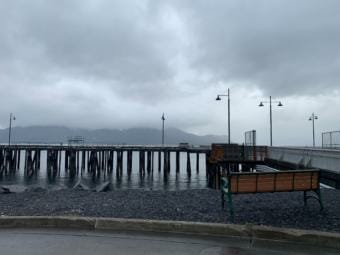
City Dock is in the heart of downtown Wrangell. Cruise ships dock here during the summer cruise season. (June Leffler/ KSTK)

The City of Wrangell does not want cruise ships to dock in town until it knows how the industry plans to prevent potentially bringing COVID-19 into the community. The Southeast Alaska city is coordinating with a regional effort seeking assurances from operators of small cruise ships seeking to sail this summer.
Large cruises are forbidden under the federal “no-sail” order that runs through late July. But smaller, boutique cruises carrying less than 250 passengers are exempt, with at least one cruise line scheduled to bring people to Southeast Alaska next month.

Coastal communities, working with the Alaska Municipal League, have drafted a letter asking these smaller ships not to visit until they can guarantee regular COVID-19 testing and limit their capacity.

The League’s Executive Director Nils Andreassen says killing off what’s left of the region’s cruise season is not what communities have in mind.

“The end goal is public health, the end goal is vibrant communities. And I think that’s where we’re at right now,” Andreassen said.

In Wrangell, Mayor Steve Prysunka says there are concerns about what would happen if an infected passenger or crew member stepped off a cruise ship.

“We learned along the way that it is not appropriate to take them back on the ship and just isolate them away. And we just don’t have the capacity in our community to be taking in COVID positive people, it just doesn’t work,” he said.

Assembly members like Julie Decker said they want specifics on what precautions cruise companies are taking to prevent that from happening.

“For ‘testing regularly,’ does that mean that if you’re going to be on a ship for a week that you get tested once? Anyway, there’s things that I feel like we need a little beefing up, in the sense of medical credibility,” Decker said.

The assembly voted unanimously to add their name to the Alaska Municipal League’s letter asking for clarity. It remains unclear if local governments could enforce a ban on cruise traffic, as most COVID-19 mandates issued by the state supersede local authority.

Tour operators are hurting from the lack of cruise ships. But Wrangell’s local tour guides say they understand where community leaders are coming from. Stikine River Jet Boat Association Director Caitlin Cardinell says she stands by the city’s efforts to protect the community from infection.

“We’re here and we’re ready to operate when the time is right,” Cardinell says. “I think it’s smart for the ships to work with the municipalities to have an established plan if one of their passengers were COVID positive.”

At least four cruise operators have been talking to Southeast Alaska community leaders. American Cruise Lines is bringing the first ship to Alaska waters, with its American Constellation ship for a round trip cruise from Juneau in late-June. Its website advertises port calls in Skagway, Haines, Petersburg, Ketchikan and Wrangell. Company spokeswoman Alexa Paolella said in a statement that it’s “gained a clearer understanding of individual community concerns and has been able to further tailor our risk mitigation strategy.”

American Cruise Lines’ COVID-19 plan is on its website.

Other small cruise operators including Uncruise, Linblad and Alaska Dream Cruises have suspended their June sailings. As of now, they’re scheduled to resume in July.

A Southeast Alaska tour operator is reviving a small regional ferry

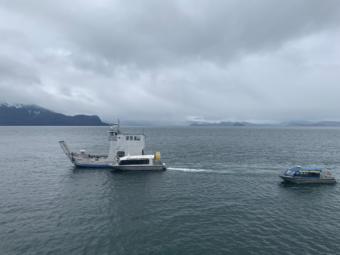
Owner Eric Yancey added the Rainforest Islander to his fleet. Two Breakaway jet boats assist in the Islander’s first test run in years. (Photo by June Leffler/KSTK)

A small, defunct ferry is back in service in Southeast Alaska, this time under private ownership.

The Rainforest Islander ferry once connected Wrangell, Coffman Cove and Mitkof Island near Petersburg. A veteran tour operator in Wrangell hopes to turnaround a ship that’s had years of bad luck.

In 2015, remote Southeast Alaskans were hopeful that the Rainforest Islander would connect small Southeast towns. The Coffman Cove-based North End Ferry Authority planned to sail the ship four times a week between Prince of Wales Island, Petersburg and Wrangell.

But with constant delays and mechanical issues, the ferry was shortly out of service. The ship had a major crack, so it went to Wrangell’s boatyard where it sat for three years.

But last March, the vessel moved out of the yard and was back in the water.

“Everybody has a weakness, buying boats is mine,” says Eric Yancey. He owns Breakaway Adventures, a 30-year-running tour company based in Wrangell. His crew takes tourists for sightseeing trips, to nearby glaciers and up the Stikine River. And in the winter he keeps himself busy transporting high school basketball teams through Southeast.

Yancey looks across the bottom deck of the 65-foot converted landing craft. There’s just open space, where Yancey would transport freight and vehicles.

“I’m guessing four or five cars,” he says. “Three, four, maybe trucks at one time.”

Upstairs is the passenger seating and viewing area. It can hold 30 passengers and crew.

Unlike his jet boats, the Rainforest Islander can move large freight, including vehicles and boat trailers. With ferry schedule cuts, he saw the need for that kind of transport.

“So there’s just these folks that have vehicles strung out throughout Southeast Alaska, wanting to get them home or get them to where they need to be,” Yancey says.

Brian Wilson is a businessman and council member in Coffman Cove. Wilson knows Yancey’s work well, especially getting school athletes to towns safely.

“I think he’s a great guy and he knows the water, I’m hoping he can make this work,” Wilson says.

He also sits on the board for another community effort to provide ferry service to Prince of Wales, the Inter-Island Ferry Authority. That authority offered the connection to Coffman Cove, Wrangell and South Mitkof over a decade ago. He says freight costs for his town have increased considerably over time. If Yancey can offset that, he thinks it would be great for the whole region.

“I can see a very good niche there, if he can hold on and stick it out and show that he’s serious about it,” Wilson says.

Work is already there for the new owner. Yancey’s hauling vehicles and equipment for the U.S. Forest Service to a nearby island, for its fieldwork.

He hopes to service the same towns on the inside passage the ferry was originally intended for. He doesn’t have a set schedule of sailings yet. But being a private owner, he can adjust that according to demand.

But the ship’s history of bad luck is rearing its head. He’s spent a lot of money on repairs and alterations, granted, with no unforeseen mechanical issues. But clearly, he chose an inopportune time to make such an investment.

“I felt like no risk until this coronavirus showed up, but unfortunately we were eye deep into it by the time that started to happen,” Yancey says.

He says last year, it felt like the right move, an exciting one. But now, it will be months or more before he knows if it was really worth it.

Site notifications
Update notification options
Subscribe to notifications