KSTK is our partner station in Wrangell. KTOO collaborates with partners across the state to cover important news and to share stories with our audiences.
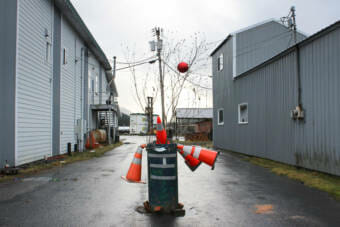
Wrangell’s impromptu Christmas Tree on Dec. 7, 2020. (Sage Smiley/KSTK)
After Wrangell canceled its holiday tree-lighting ceremony last week, some anonymous Wrangellites took it upon themselves to replace it.
Kind of.
Wrangell Municipal Light & Power usually takes care of installing the town’s public Christmas Tree. But with storms knocking down tree after tree and pole after pole last week, the crew just didn’t have the time to get a tree into the usual place of honor, between the Elks Lodge and the gas station.
Then something happened.
It’s not quite a Christmas miracle. In place of the typical towering conifer, a few bare branches stick out of the metal tree-holder. Four safety cones adorn it, three of them sticking haphazardly out of the sides.
For comparison, a previous year’s tree. (Shady Grove Oliver/KSTK)
“I definitely got a little chuckle out of it,” Wrangell’s public works director Tom Wetor said. “Especially after I saw somebody comment underneath that: ‘Well, pretty much sums up 2020.’ And I thought ‘Yup, that sounds about right.’”
He doesn’t know who’s responsible for its construction, he said. But despite its desultory appearance, the tree has sparked joy.
Andrew Scambler assisted Light & Power with some of last week’s outages. He said he stopped Sunday morning to take a photo — which eventually ended up on Facebook — and send it to the exhausted municipal power crew.
Scambler said he texted the crew, laughing: “I said: ‘Take the day off, guys, it’s all taken care of.’”
And that may be true: The Wrangell Chamber of Commerce hasn’t yet rescheduled its official tree-lighting ceremony.
Chamber director Stephanie Cook said she’s as mystified as anyone when it comes to who might be responsible for the well-meaning prank.
“I heard several people joking about it, but I don’t think that any of them did it,” Cook said Monday evening.
For now, as Wetor said, Wrangell’s holiday tree seems a bit poetic in a year like 2020. It’s small and it’s strange. But with a disposable blue mask and one large, red ball ornament for decorations, it’s brought a little light to its small island town.
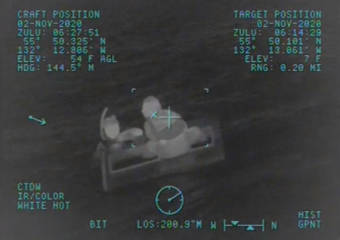
A screengrab from Coast Guard video shows rescue swimmer Grant Roberts (left) and survivor Kurt Brodersen (right), holding on to all that remains of Brodersen’s boat “Irony” — the hatch cover. (Courtesy U.S. Coast Guard)
When a retired Southeast Alaska fisherman found himself adrift after his boat suddenly sank in a storm, he didn’t expect to be rescued. But a gadget on board alerted the Coast Guard, saving the 70-year-old man’s life.
For more than two hours, four members of the U.S. Coast Guard traveled in an MH-60 Jayhawk helicopter, battling blistering, 50-mph headwinds.
In a Coast Guard video, crew members can be heard after spotting a lone figure clinging to a piece of debris: “We just need to get him out of there quick, the quicker the better.”
Union Bay, Alaska (via Google Maps)
Seas were rough in the expanse of water between Ketchikan and Wrangell. Waves as tall as houses made it difficult to keep eyes on the figure, protected by a survival suit.
“As we made our approach to the flashing light, we lost sight of the survivor in the water with our cameras,” said Coast Guard pilot Lieutenant Justin Neal, who was in charge of the mission.
“We were in high winds, seas were 10 to 12 feet, trying to maintain a stable hover, and trying to relocate the survivor in the water,” Neal said. “We knew he was very close to us. But there was a moment there — maybe five minutes — where we were frantically searching with our cameras to try to find him again.”
Once the crew spotted the man again, Petty Officer Grant Roberts was lowered into the water, where he spent about 20 minutes in the pitch-dark trying to reach the man, who was clinging to something in the rolling waves.
In a video released by the Coast Guard, Roberts reaches the floating debris. Roberts helps the man into the water, and lays behind him in a sort of ‘Jack and Rose at the bow of the Titanic’ pose.
https://www.youtube.com/watch?v=iDQwCw-Xl7o
The man was 70-year-old retired fisherman Kurt Brodersen.
“It never occurred to me anybody was gonna come and get me,” Brodersen said in an interview a couple of weeks after the sinking. He says when he saw his 42-foot boat — named “Irony” — taking on water, he donned his survival suit, planning to abandon ship in the skiff. By the time he got his suit on, the skiff had sunk too.
“The hatch cover was floating off, and I got on the hatch cover,” Brodersen narrated. “My plan was to just stay there until it took me wherever the weather was going to take me. But when I got about halfway across Union Bay, I saw this red light in the sky. And I remember thinking, I wonder what those guys are doing out in these miserable conditions. After a while, I realized they were looking for me.”
Although Brodersen says he hadn’t checked the batteries in the rescue beacon in a few years, his EPIRB — Emergency Position Indicating Radio Beacon — was still working. The device automatically transmits a radio signal that rescuers hone in on.
As it went down with the ship on November 1, the EPIRB started transmitting at precisely 4:46 p.m. The Sitka-based Coast Guard helicopter crew was in the air and on the hunt within half an hour.
The November 1 rescue team, from left to right: LTJG Jon Orthman, AST3 Grant Roberts, AET2 Jimmy Schwader, LT Justin Neal (Courtesy U.S. Coast Guard)
Jimmy Schwader was on the mission that night. Schwader was the flight mechanic, tasked with running the winch that would raise and lower a rescue swimmer, and a survivor, if they found one.
“It was probably the worst seas that I’ve ever hoisted in,” Schwader said.
After more than three hours in the frigid bay, Brodersen was lifted out of the water. As he and rescue swimmer Grant Roberts dangled from the hovering helicopter, Schwader spooled the two up.
Lt. Neal, the aircraft commander, has been an armed forces pilot for 14 years. He says the high winds, 10-to-12-foot waves and pitch black made for one of the toughest rescues he’s ever done.
“This is probably the most challenging conditions that I’ve flown in and is absolutely the most challenging rescue that I’ve been able to prosecute,” Neal said.
The weather conditions that night made transporting Brodersen to Ketchikan for medical treatment a mission of its own. The Coast Guard crew ended up having to spend the night in Ketchikan because of dangerous wind gusts and power outages around the city.
Brodersen, the survivor, was fortunate to get to Ketchikan’s PeaceHealth Medical Center when he did. He’d had a heart attack, and was suffering from hypothermia and cold-induced rhabdomyolysis — a kind of muscle death.
He’s since been released from the hospital, but he remains in town. Doctors want to keep him nearby for observation, especially since Brodersen has epilepsy. Brodersen says epilepsy has had a profound impact on his life. He’s even captained his boat during an episode, without remembering how.
But it was no accident that Brodersen had taken his boat into open water during a storm.
After retiring from commercial fishing, Brodersen lived full-time on the Irony. The property where he would usually anchor the boat is exposed; he calls the area “The Blowhole.”
“It [gets] really bad williwaws, which are dangerous winds. If I know it’s gonna blow, I get out of there. I go up into the head of Union Bay and anchor, which I thought was supposed to be safe. Before last week, it has been [safe],” Brodersen explained.
The veteran mariner isn’t sure what went wrong on board. The anchored, steel-hulled vessel would usually be fine in rough seas.
“It’ll lay over, but then right itself because of the buoyancy of the boat. And this time, it didn’t right itself. I don’t know what happened. After a few seconds, I thought, ‘I don’t know what to do, I’m gonna start the engine and put it in gear and get bow into the weather,’ and the engine wouldn’t start. It’s the first time it’s ever failed to start. Apparently, there was already water going up the engine.”
Brodersen says he lost everything in the shipwreck: “Everything. All my records, my tax stuff, and all my clothes, everything that I had. Which is, in a way, sort of liberating because I’m starting fresh. Just the clothes that I’m wearing. The problem that I’m having is, I don’t know, I don’t exactly have a goal for the rest of my life. But you know, maybe something will occur to me.”
The Coast Guard says there’s no trace of the Irony. The only sign of the boat was the hatch cover Brodersen had clung to, and the EPIRB signal. Just the signal — the Coast Guard never found the device.
A friend offered to pay to help Brodersen search for the fishing boat that had been his home for decades. But he’s not interested in salvaging it.
“I was afraid I’d find it, and then I’d have this unholy mess to try to clean up,” Brodersen explained.
The offer of help was appreciated, though. Brodersen was stunned by how many other offers there have been since the calamity.
“In some ways,” he said, “it was one of the best events in my life. For one thing, I don’t have to do all the maintenance on the boat anymore. And for another thing, so many people tried so hard to help me, offering me places to stay, and everything really. I mean, it’s been kind of a unique event in my life.”
Brodersen says he hasn’t decided what he’ll do next. He’s still getting medical treatment in Ketchikan, and working out his epilepsy treatment. Normally, this time of year, he’d be anchored in the Zimovia Strait, looking at Wrangell Island.
“Guess I won’t be doing that anymore,” he said, laughing.
Brodersen and the Coast Guard say the somewhat miraculous rescue is really thanks to the EPIRB.
“They’re not the cheapest thing to buy, but they save lives. They work,” said Jimmy Schwader, the flight mechanic.
If you’re going out on the water, they say, make sure your EPIRB is working. Fresh batteries might just save your life.
NOTE: Mr. Brodersen has asked to not be contacted by other media.
All of Alaska is under red alert due to rapidly rising case numbers across the state. In a recorded video address, Gov. Mike Dunleavy urged Alaskans to take extra precautions to slow the spread of COVID-19 including wearing a mask when maintaining six feet apart is not practical. The governor also urged people to work from home when feasible and suggested that businesses that serve food to switch to curbside pickup.
That includes City Hall, the Nolan Center, public library, parks and recreation facilities, and all utility buildings. The Public Safety building will remain open for police dispatch. Municipal employees will work remotely, where possible.
Events and movies, including the planned community market at the Nolan Center this weekend, are canceled. The library will offer curbside service.
The agenda states the Wrangell Assembly may also take action at the meeting. Wrangell currently encourages people to wear masks voluntarily.
The special Wrangell Assembly meeting at 4 p.m. will be broadcast on KSTK, available over telephone and streamed live on Facebook.
The Southeast Alaska Acoustic Measurement Facility in the Behm Canal, near Ketchikan. (Photo courtesy Jennifer Kelso via KRBD)
The U.S. Navy has received a green light from federal agencies for seven more years of training and testing up and down the West Coast.
NOAA Fisheries published a final permit Nov. 12 for the Navy’s testing and maneuvers from northern California to Southeast Alaska. In Alaska, the permit includes permission to behaviorally harass marine mammals more than 16,000 times over the next seven years.
Naval operations in Southeast Alaska consist mostly of acoustic measurement activities at the Southeast Alaska Acoustic Measurement Facility in the Behm Canal near Ketchikan.
Environmental groups have expressed concern that the Navy does not do enough to mitigate its impact on marine life — from larger marine mammals like whales and porpoises, down to fisheries and zooplankton.
Under the Marine Mammal Protection Act, the Navy must submit an environmental impact statement for its Northwest Training and Testing Area. The EIS includes projected impacts to marine life and some mitigation efforts. The Navy released the final supplement to its EIS in late September.
The federal agencies tasked with protecting marine mammals then evaluate the EIS and approve a permit for harm. The Navy is not permitted to physically harm or kill any marine mammals in Southeast Alaska over the next seven years, but is permitted thousands of what it calls behavioral disturbances. This can include disruption to feeding, interacting or traveling from place to place.
Calculation of disturbances to marine mammals and other ocean-dwellers is theoretical. The Navy does not keep track of actual harm done to marine mammals during the course of training exercises, instead using the number of training and testing activities as a proxy to estimate marine impacts.
Both the Marine Mammal Commission and NOAA Fisheries declined to comment, directing questions back to the Navy.
Boats in Reliance Harbor, Wrangell. 2020. (Sage Smiley / KSTK)
Southeast Alaska’s salmon harvest was less than half of last year’s haul. That’s according to a preliminary report from the Alaska Department of Fish and Game released on Monday.
Commercial fishermen in Southeast harvested just over 14.3 million salmon across the five species this year: almost 5 million chum salmon, 1.1 million coho, 8 million pinks, 373,000 sockeye and 200,000 chinook.
That’s a drop in harvest for every species except chinook, which increased by a few thousand fish this year. In other words, Southeast’s total salmon harvest was 19 million fewer fish than last year.
The preliminary ex-vessel value of Southeast’s 2020 salmon fishery was just over $50 million dollars. That’s less than half of 2019’s estimated value, and the third consecutive year that Southeast’s value paid to fishermen has dropped.
It wasn’t all doom and gloom. That’s because salmon prices paid to fishermen rose slightly for chinook, sockeye and coho compared to the year before. But prices dipped for pinks and chum salmon. Other areas in Alaska had similar slight shifts in per-pound preliminary prices, with the exception of Bristol Bay, which saw prices fall by nearly 50% compared to last year.
Fish and Game reports that 2020’s statewide salmon harvest was the 13th lowest on record. Adjusted for inflation, the initial salmon fishery value for 2020 is the lowest since 2006.
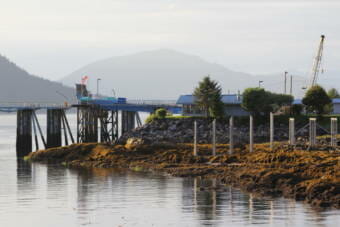
Wrangell’s state ferry terminal (Sage Smiley / KSTK)
A dwindling ferry schedule over the last 10 years has been a source of frustration for many coastal Alaska communities.
In Wrangell, that frustration has been taken to the next level this winter, as the state plans to repeatedly sail the blue and gold ferries within 20 miles of the island town — but only stop twice.
Wrangell’s ferry schedule this winter is sparse. One northbound ferry in November, one southbound ferry in January. No ferries at all in December. But they’ll be nearby.
“The ferry is just going to drive right by,” said Wrangell City Manager Lisa Von Bargen.
She and Wrangell’s Mayor Steve Prysunka are frustrated. For Prysunka, what gets his goat is that the ferries will be so tantalizingly close: sailing through the area at least eight times to and from Petersburg and Ketchikan.
“We’re talking about a 20 mile diversion,” Prysunka said. “We’re on the main line. It’s not like you have to go across the gulf, or zip to the outside to get to us and it takes 18 hours round trip. We’re talking 45 minutes to come over to Wrangell, dock, pick some folks up and move along.”
Wrangell’s city government recently put out an economic climate survey. City manager Lisa Von Bargen says there wasn’t a question about the Alaska Marine Highway System, but more than 40% of local businesses wrote that cuts to ferry service were hurting the local economy.
“The ferry service or the lack of ferry service is foremost in the minds of our businesses as a critical component to their success,” Von Bargen said.
She says she’s concerned that the state seems to be ignoring the plight of Southeast communities.
“There’s a disaster declaration from Wrangell — and many other communities — sitting on the desk of the governor right now,” she said. “And we’ve got a state agency who’s cutting service that is critical for our business success here.”
The Alaska Department of Transportation says funding cuts made worse by COVID-19 means less service to communities. DOT spokesperson Andy Mills wrote in a statement that delays caused by waiting for favorable tides in the Wrangell Narrows means the ferry will save money and time by bypassing Wrangell.
He also says commercial freight from barges and airline travel were factors in setting the winter schedule to Wrangell and other towns.
For Wrangell’s Mayor Steve Prysunka, that’s a poor explanation.
“Quite frankly, it’s B.S., their excuse that they can’t get through Wrangell Narrows because of the tide,” Prysunka said. “They’ve been navigating that forever. I’m willing to loan them a tide book, and I know a bunch of old timers that could help them figure it out.”
He sees the breakdown in ferry service as an unfair cut because communities on the road system wouldn’t leave roads completely impassable for months on end because of budget shortfalls.
“This is our highway,” Prysunka said. “That’s like going up and rolling up the blacktop between Wasilla and Anchorage and saying, ‘Yeah, now we’re gonna take that South with us.’ It just can’t happen. I really don’t think it’s unreasonable what the island communities are requesting: some basic service through the winter.”
Rep. Dan Ortiz has asked DOT for other options. The Ketchikan independent says he suggested another vessel could offer supplemental trips between Petersburg and Wrangell.
“They got back to me and said, they looked at it, not doable,” Ortiz reported Wednesday. He’s also written to the DOT commissioner about the lack of service.
Meanwhile, local officials like Prysunka and Von Bargen say the bypass feels like a slight.
“At some point, you start feeling like a second class community,” Van Bargen said.
State transportation data shows a 130% decline in ferry ridership to and from Wrangell between 2010 and 2019. But data analysis commissioned by Wrangell says there have been fewer sailings, so there were fewer ferries for people to ride.
Prysunka sees it as a bit of a self-fulfilling prophecy. “It’s literally the shopkeeper opening up for an hour a week and saying, I have no customers, you know, if you don’t have reliability and predictability, and I can know that if I go down at four o’clock in the afternoon that shop’s open, if I show up day after day, and it isn’t open, I stop showing up, it’s the same with the ferry system,” he said.
This year’s winter ferry schedule was released after only a week of public input. The state is taking bookings for the two sailings that will reach Wrangell on the Kennicott, which is running at a third of its almost 500-person capacity due to COVID-19 .
Close
Update notification options
Subscribe to notifications
Subscribe
Get notifications about news related to the topics you care about. You can unsubscribe anytime.