KSTK - Wrangell

KSTK is our partner station in Wrangell. KTOO collaborates with partners across the state to cover important news and to share stories with our audiences.
Smaller vessels are exempt from the federal no sail order, but is Alaska ready for a small ship cruise season?

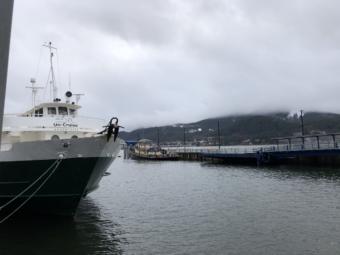
An Uncruise boat docked in Juneau on April 23, 2020. The cruise season has been gutted by travel restrictions related to the COVID-19 pandemic. (Jennifer Pemberton / KTOO)

This year’s cruise ship season has been gutted. More than 80% of sailings have been canceled. That’s due in large part to a federal no sail order that restricts large cruise ships from sailing until the end of July. But small cruise ships are exempted from the order, leaving local officials wondering whether they’re ready to welcome an influx of visitors as soon as next month.

Alaska Department of Health and Social Services Commissioner Adam Crum recently spoke with leaders of port communities during a meeting organized by the Alaska Municipal League. The topic was how to deal with a potential influx of small cruise ships later this year.

Ketchikan City Mayor Bob Sivertsen was on the call. He says he’s concerned that an influx of passengers could bring in coronavirus that could overwhelm local hospitals and clinics.

“We haven’t seen anything from the cruise industry yet as to what their precautionary measures are going to be to meet the mandates and health standards that have been set,” Sivertsen said.

Those on the call say this is just the beginning of talks to figure out an approach to mitigate the spread of COVID-19 that could come from small cruise ships. The state didn’t present any plans. Siversten says for his community, public health is the priority, but clearly Ketchikan relies on tourism dollars.

“The local governments are tasked with trying to wade through the process to see if they can safely bring a ship and passengers to a community,” he said.

As Crum and mayors of port communities just now begin to address that concern, the cruise lines themselves have no time to wait. They need to be sure the first sailing of their season has mitigation protocols in place, can comply with state mandates and is even worth it financially.

Related: Small, boutique cruise lines are still planning on a 2020 season in Southeast Alaska

In just the past two weeks smaller cruise lines have cancelled June sailings. Not coincidentally, these cancellations came in after the governor’s overhaul of the state health mandates last month. While local businesses are on the path to reopening, traveling to the state is still restricted.

“So until that 14-day quarantine goes away, I don’t see how it could work, that’s my personal opinion,” said Mark Jensen, Petersburg’s mayor.

His town set some restrictions on leisure boats coming to his town of 3,000 people. All boats with 25 or more passengers must get approval from city officials to dock. This mandate targets intra-state travel, but Jensen believes state mandates would do the job of curbing small cruise ships.

Small Cruise Lines like UnCruise and Alaska Dream Cruises recently cancelled their June sailings. Both of these companies operate ships that carry less than 100 passengers. Zak Kirkpatrick with Allen Marine Tours wrote in a statement it would be difficult for crew to abide by current state mandates.

Liz Galloway of UnCruise wrote that travelers own safety concerns will dictate booking numbers and the season.

Both are set to resume sailing in July.

Brenda Swartz-Yeger has been trying to keep up with the schedule changes. She runs a tour company and sells her own art out of her shop in Wrangell that depends on it.

“I think the cruise ship picture is becoming clearer and more bleak as days go on,” she says.

The Southeast town gets only a taste of Alaska’s cruise ship traffic. But for mom-and-pop operators like Schwartz-Yeager, it’s been a big boost. She says she’ll take 20 passengers out on the water on a good cruise day.

Small ships dock most days in the summer in Wrangell. Schwartz-Yeager can only expect four ships in May and June. And full season cancellations from those like Seabourn sting.

“Great high-end clientele that take a lot of tours and buy art in my shop and things like that cancelled their whole season,” she says.

For the players still in the game, they may pivot again when the state decides to reassess travel restrictions that are set to sunset on May 19.

Small, boutique cruise lines are still planning on a 2020 season in Southeast Alaska

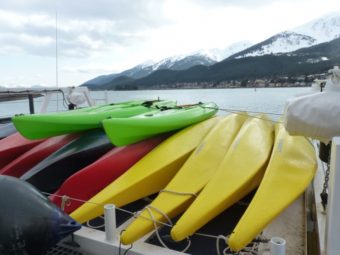
Kayaks are stacked up on the stern of the small cruise ship Wilderness Explorer, which makes trips in Southeast Alaska. (Photo by Ed Shoenfeld / CoastAlaska)

A ‘no sail order’ barring cruises on large ships is in effect until late July. But smaller vessels are exempt. And these smaller, boutique cruise lines are still taking bookings for Southeast Alaska.

The Centers for Disease Control and Prevention exempted vessels carrying less than 250 passengers from the general no sail order that’s keeping the big players like Carnival, Royal Carribean and Norwegian from bringing its ships to Alaska.

The Southeast Alaska town of Wrangell (pop. 2,500) only gets a sliver of Alaska’s total cruise ships passengers, so the cancellations from the big three cruise lines isn’t as big of a deal.

Wrangell’s Economic Development Director Carol Rushmore says the first small ships are tentatively scheduled for early June.

“Again, a lot of it’s going to be dependent on what’s going to happen statewide, what’s going to happen regionally. There’s still so many decisions being made” she said.

American Cruise Lines, Alaska Dream Cruise Lines, UnCruise and other small ships continue to market sailings for Southeast Alaska calling in Juneau, Sitka and Haines.

UnCruise markets itself an alternative to the mass-tourism cruise experience. Speaking on behalf of the company, Liz Galloway says crews plan to take extra precautions — extra on-board cleaning and screening crew and passengers for symptoms before they sail.

“As you know our groups are pretty small, 22 to 86 passengers in total, so we wouldn’t have to deal with as much as a megaship would.”

Galloway says the safety of port communities is as much a priority as that of the passengers and crew. But not much is set in stone. Operations for the cruise line are still hammering out protocol. The City of Wrangell says it hasn’t received COVID-19 protocol plans.

Wrangell City Manager Lisa Von Bargen is skeptical that even smaller cruise ships could operate under the current statewide mandate requiring out-of-state arrivals to quarantine for 14 days before mixing in a community.

“And what the likelihood of passengers being willing to do that, my guess is that is unlikely,” she said.

Galloway says UnCruise would comply with state health mandates. That means postponing sailings or requiring quarantine of its passengers ahead of sailings.

Von Bargen notes that even if travel restrictions were lifted, state and local social distancing mandates are still in place that ban gatherings of 10 or more people in Wrangell.

“And that’s certainly not something that is done,” she said. “Even on the small ships.”

The Petersburg Borough took some of its own steps to limit cruise ships coming to the town of less than 3,000 people. The city passed a measure saying all ships able to carry 25 or more people must receive approval from local officials.

But this declaration expires at the end of May, right when small ships are offering bookings. It remains to be seen whether there is a small cruise season. It will depend on market conditions – if enough people book berths and also whether state officials allow it.

Gov. Mike Dunleavy has said he wants to reopen parts of the economy. It’s not yet clear how that will impact the tourism sector.

State overrules Wrangell, says it can’t add its own COVID-19 restrictions

Wrangell as seen from Mount Dewey on July 24, 2014.
Wrangell as seen from Mount Dewey on July 24, 2014. (Creative Commons photo by James Brooks)

Wrangell’s proposed restrictions on people arriving at the island community have been shelved after the state said the Southeast city doesn’t have the authority. City leaders had wanted to coordinate the flow of commercial fishermen and fish plant workers expected to arrive for the season.

A state health mandate restricts all nonessential travel except to workers in critical industries. That mandate supersedes local restrictions. But it allows smaller, isolated towns with limited health care facilities to add restrictions to ward against an outbreak of COVID-19.

In Wrangell, commercial salmon fishing gets going in mid-June. Around that time more than 30 seasonal fish plant workers from out-of-state work in Wrangell’s sole fish processor. The plant manager says the workers will self-quarantine for 14 days before coming into town.

Elected officials wanted copies of mitigation plans that employers in critical industries – skippers and processors – have filed with the state to secure exemptions to travel restrictions. So far state public officials haven’t shared these plans with local authorities.

That doesn’t sit well with assembly member David Powell. He says a few infected people arriving in Wrangell could snowball.

“And then all of a sudden we could have 10 to 20 cases in here because we didn’t do something,” Powell says.

He wants to see these local mandates in place as soon as possible. But the city recently got word from the state that it lacks the authority to make its own rules.

On Wednesday, an email arrived from the state’s unified command stating that Wrangell Medical Center qualifies as a “hub” hospital as defined in the health mandate.

That frustrated Wrangell Mayor Steve Prysunka. Wrangell’s hospital is run by the tribal health organization SEARHC – whose regional hub hospital for COVID-19 cases is Mt. Edgecumbe Medical Center in Sitka.

But the mayor says — in the state’s eyes at least — his island town of 2,400 people is not a “small community” since it has a hub hospital.

“We just don’t meet that, and it doesn’t matter what SEARHC thinks it is, all that matters is what the state says it is,” Prysunka says.

The measure ultimately failed 5-2. The assembly did not want to move forward and risk legal action from the state or industries down the line. But Powell was among those that wanted to keep pushing.

“I still feel that this is still critical to the safety of our community and that there is no reason why we would not take action,” he says.

The Alaska Journal of Commerce reported this month that Cordova enacted restrictions similar to what Wrangell had proposed. And the two are very similar communities. Both are off the road system, have fewer than 3,000 residents and have health care facilities categorized as “critical access hospitals,” which the state classifies as hub hospitals.

The seafood industry has been watching this unfold in a number of fishing towns across Alaska.

United Fishermen of Alaska Executive Director Frances Leach says the industry isn’t taking its exemptions for granted. The fishing fleet is working to take steps to minimize any health risks.

“We respect and appreciate the communities for hosting us every summer, and we’re working diligently on letting the communities know it is a concern,” Leach says.

Suddenly at home with the kids all day? Here are some tips from a homeschooling pro.

14-year-old Jack Roberts reads in his home. His mom Jamie homeschools him and his 16-year-old sister Renee. (Courtesy of Jamie Roberts)

With schools closed statewide until at least May 1, many parents have been thrust into the unexpected role of being guiding their children’s day-to-day education. But parents who homeschool their kids have been doing this for years, fine-tuning the intricacies of the complex and important task.

Jamie Roberts, a mother of two, has some tips. Her biggest piece of advice? Let go of the wheel and be kinder to yourself.

Roberts has homeschooled her two kids for 11 years now. Along with working at the pool, she’s the full-time parent and teacher for her daughter and 14-year-old son Jack. When the oldest was ready for kindergarten, Roberts wondered how to get Renee to and from school. It would have been for just a few hours of instruction anyway. Plus, she still had a toddler at home.

“My philosophy was ‘I’m not waking a sleeping child’,” Roberts said.

So, staying at home made sense. And every year since, it’s still the best option for her family. She likes the flexibility, being able to travel and fit in different activities.

“It allows my kids to do extra things without being super sleep deprived,” she said. “So they can, you know, take music lessons; they can be swimmers and travel for swimming and not feeling like they’re stressed to fit it all in.”

But Roberts has worked out the kinks over the years. She feels for parents who are suddenly having to spend all hours with their kids and be in charge of their education. Knowing it’s an adjustment for the kids, makes it even more difficult.

“As a kid, it’s like, their whole schedule just got disrupted,” she said.

Staying home from school is one thing, but having the whole family cope with this COVID-19 pandemic is another.

“ I think about young kids, it’s like, how do you explain to them? Yes, sorry, you can’t go to school and no, you can’t go out and play on the playground. And if it’s your birthday, no, you can’t have friends over,” she said.

So yes, things are chaotic, on you and your kids. Roberts says give yourself and your kids some slack, everyone deserves it.

Start with letting go of control. Roberts admits she struggled with this. As a self-described recovering control freak, she says she believes if you’re too rigid, kids will be resistant to adapt.

“It usually doesn’t end well. Someone’s going to cry. Someone’s gonna say something they didn’t, you know, mean to say,” she said.

Instead, let the kids help decide on the schedule and activities. Roberts says they’ve figured out together that it’s best to have a snack before tackling math. Kids need to have their opinion heard and it lets them buy into that day’s goals.

Socializing is just what teens do. But now, 16-years-old Renee Roberts has few opportunities to connect with peers. She’s missing out on swim practice and youth group. She texts her friends to stay in touch.

But Roberts is not missing out on school as she knows it. She doesn’t walk the hallways of Wrangell High School and sit in classrooms. Her mom asks Renee’s advice for kids who might not be used to staying home as much.

“I think just to focus on the positive things,” Renee said. “Instead of focusing on the fact that you have to stay home and possibly missing out on things that you had planned.”

Roberts’ second tip: do not compare yourself to others. Maybe that’s other parents. For Roberts, it was the public school system.

“They go to school for a set number of hours a day. And I was thinking, ‘okay, that’s the number of hours we have to focus on doing work in our home.’ And if my kids got done with all of their work for the day, in two hours, I kind of felt like we’re not doing enough,” she said.

She reasons that teachers spend so much time corralling 20 to 30 students in one session. Of course, it’s going to take longer to meet individual needs in that setting, than it would at home.

Roberts also recommends a few resources. She loves this one podcast from producer Julia Bogart, who just released an episode titled “Suddenly-at-Home Schoolers.”

While it’s unclear just how long the current scholastic situation will continue, it’s likely to be a matter of months, not years. So Roberts says to remember that your success as a parent doesn’t really ride on the next few months, it’s also about what you’ve done over the years and what you will do in those to come.

Wrangell residents hope to question Dunleavy about ferry system cuts

Alaska Gov. Mike Dunleavy speaks to reporters at a news conference Friday, Jan. 10, 2020. (Photo by Nat Herz/Alaska Public Media)

Gov. Mike Dunleavy was planning a trip to Wrangell Tuesday, but he ultimately canceled because of poor weather conditions. The Southeast Alaska city overwhelmingly voted the Republican into office in 2018, but as the community prepared for a visit, some residents were ready to stress the importance of the state ferry system.

Not everyone had heard that the governor was planning on coming to town. But Don McConachie might be a bit more civically-minded than most in Wrangell. He did serve on the City and Borough of Wrangell Assembly and as mayor for many years.

“I have a question to ask him, too,” McConachie said. “I would ask him if he made reservations on the ferry.”

Dunleavy proposed a 75% cut to the Alaska Marine Highway System last year. After a compromise with the Legislature, the ferries lost $43 million in a single swoop. The cuts have been a burden for communities throughout Southeast Alaska.

Wrangell is a Republican town. Of those who cast a ballot in the gubernatorial race, 65% voted for Dunleavy. That’s 14 percentage points higher than statewide results.

McConachie voted for him in 2018, but he isn’t sure if Dunleavy will get his vote in 2022.

“That is yet to be determined,” McConachie said.

One Wrangell resident knows what it’s like to be in Dunleavy’s shoes.

“Well I’m a little disappointed,” said former Gov. Frank Murkowski. Like everyone else, the ferry is a priority for him. And he doesn’t believe a full PFD should be given out at the expense of critical infrastructure.

“Trying to maintain that when you have to cut services because your revenue is down, you have to, I think, prioritize just what’s important to the livelihood of southeastern Alaska,” Murkowski said.

A spokesperson for the governor’s office said he expected AMHS to be a hot topic in Wrangell. In a press release regarding his community visits, Dunleavy said “your input will be valuable in solving many of the issues our state is facing.”

As of Thursday, the governor had not yet rescheduled his trip to Wrangell.


On remote Alaska islands, victims of domestic violence rely on informal network of safe homes

Wrangell as seen from Mount Dewey on July 24, 2014.
Wrangell as seen from Mount Dewey on July 24, 2014. (Creative Commons photo by James Brooks)

Jennifer Bates has spent decades helping people escape domestic violence. Literally escape. She’d hole up in a clandestine apartment with a woman – or man – to keep them away from their abusive partner.

“When we did that kind of stuff, I didn’t sleep a wink. I was up for the whole 24 hours because it scared the daylights out of me,” Bates says.

She’s worked all over Alaska. On the Kenai Peninsula and in small the Southeast town of Wrangell. The client’s fear was her fear during those sleepless nights.

“We actually ended up carrying a personal gun on us, just to be safe,” she says.

Domestic violence exists everywhere in Alaska, but many small communities have no designated shelter.

“Unfortunately Wrangell doesn’t have an active shelter here,” says Jessica Whitaker. She’s a part of BRAVE, Wrangell’s fledgling domestic violence support network.

The island community for decades has built an informal network of safe homes instead. These are the personal homes of folks, mostly church-goers, willing to put up a survivor for a night or two.

“So there’s other resources that can become available if needed … but they’re not advertised resources. Because if people were to know where these safe homes are, then that kind of defeats the purpose of them being safe homes,” Whitaker says.

The setup is hush-hush. There’s no hotline or office to call. Referrals are word-of-mouth. It’s often through a church, hospital or the local police department.

“Fortunately, most of the domestic violence in Wrangell is relatively minor,” says Wrangell Police Lt. Bruce Smith. He has seen a lot of these cases. Some are drunken arguments. Others have been serious assaults — even murder.”

“I’ve responded to cases of strangulation. So serious cases of domestic violence do exist even in our small community,” Smith says.

Survivors of domestic violence have a right to be fearful. Studies show that violence often escalates. Researchers looked at reports of strangulation and found it’s often the prelude to murder.

By the numbers, the town of 2,500 logged 20 plus calls in 2019. Police made 10 arrests. But suspects often make bail and are back in the small fish bowl community.

“It’s like playing hide and go seek in a one bedroom house. There’s not that many places to hide,” says Pastor Kem Haggard. He is part of Wrangell’s safe home network, though he doesn’t house the clients himself.

The protocol looks like this: the police or someone escorts the client to the home. Once they’re there they can’t leave. No cellphones. No social media. They don’t let anyone know where they are for their own safety and the safety of those helping them.

“And so now all of a sudden my life, because I’m the victim, has changed. And I have to watch everything that I say and do and I can’t go out,” says Haggard.

But the isolation is just temporary. Haggard says about half of the women — and they’re almost always women — will find a family member to stay with, or end up reconciling with their partner. But others will travel on to larger communities with domestic violence shelters. These formal shelters, like Women in Safe Homes in Ketchikan, provide round-the-clock personnel who monitor a secured facility. Shelters aren’t secret, so clients can come and go without blowing some cover.

But leaving town is often not realistic.

“A lot of people have kids and pets and jobs and things that they just don’t really have the option of leaving behind,” says Maleah Wenzel, an advocate for BRAVE.

The local group and even WISH looked at potentially forming their own safe homes to meet Wrangell’s need. But the advocacy groups says that model is too risky for volunteers.

“Every single person who is in the home providing help to the victim can be in danger if it’s not done right. And we don’t have the capability to do it right, right now,” Wenzel says.

Nearby in Petersburg, WAVE or Working Against Violence for Everyone used to operate safe homes. Now, it doesn’t. But director Annette Wooten says liability wasn’t the pitfall. She says the strict lock-down keeps homes safe, but it keeps clients from living their lives.

“You can’t go to work. Kids can’t go to school, and there’s definitely reasons for that. But it really impacts a lot of people from being able to utilize that service,” Wooten says.

There haven’t been any reported attacks on safe home volunteers in Wrangell. But Haggard says the possibility is real, and no one lets their guard down.

“They know that that’s a risk. Because let’s just be honest, it’s a risk to love. It’s a risk to care. A lot of times, it’s a risk to stand up to a bully,” Haggard says.

Until small communities like Wrangell have designated shelters for survivors of domestic violence, the informal network is all there is.

This report is part of CoastAlaska’s Shelter series which examines short and long-term housing issues across Southeast Alaska.

Site notifications
Update notification options
Subscribe to notifications