KSTK - Wrangell

KSTK is our partner station in Wrangell. KTOO collaborates with partners across the state to cover important news and to share stories with our audiences.
With $500,000 in support from Sealaska, landless Alaska Native communities continue push for their own village corporations

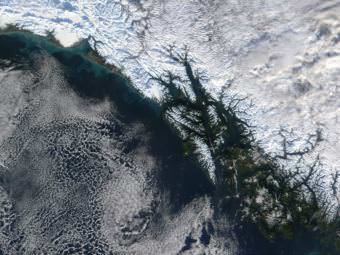
NASA satellite imagery shows Southeast Alaska in true color on Nov. 24, 2001.
NASA satellite imagery shows Southeast Alaska in true color on Nov. 24, 2001. (Public domain image
by Jacques Descloitres/MODIS Land Rapid Response Team, NASA/GSFC)

Southeast’s landless Alaska Native communities want to form five new village corporations out of 115,000 acres of Tongass National Forest. The effort has new cash and — it says — the right political climate in Washington to finally get it done.

The 1971 Alaska Native Claims Settlement Act allotted millions of acres of land to 13 regional Alaska Native corporations. But some Alaska Natives in Southeast were left out of the process.

That’s created a coalition of five landless communities in Southeast, advocating for land and their own corporations. It’s an issue that has simmered for decades. But a recent infusion of $500,000 from the regional corporation Sealaska has energized its efforts.

At a meeting in August in Wrangell, Sealaska board member Richard Rinehart recalls the early 1970s when 200 village corporations were created across Alaska.

“We all thought we were getting land just like everybody else and it was just a big surprise that we didn’t,” Rinehart said.

There’s no apparent reason certain communities were left out. Those include the five southeast communities of Ketchikan, Wrangell, Petersburg, Haines and Tenakee Springs. Together they are home to 4,400 Sealaska shareholders.

Over the years, four bills were introduced in Congress to cede federal land to the affected communities. The most recent was the ANSCA Improvement Act introduced by U.S. Sen. Lisa Murkowski in 2017. It didn’t get very far. Her office says there was a lot of opposition in Washington over parceling out a national forest.

Now, the Southeast Alaska Landless Corporation is crafting a fifth bill they hope Alaska’s delegation will support.  It will be different than previous efforts in that it contains specifics — and maps that are now being released as the landless corporation takes it message from community to community. The bill envisions 115,000 acres to be divided between the five landless Alaska Native communities.

Rinehart says the climate in Washington is right for reshaping public lands.

“Today, we have under the Trump administration new heads of the Forest Service and they are in support,” he said. “They will not fight us they will sit down and talk with us.”

USDA Forest Service Chief and Alaska’s Regional Forester met with some of the shareholders and Sealaska’s legal team last year. The Forest Service wrote in a statement that it had given advice over existing land designations in the Tongass, but hasn’t signaled whether it would support giving up management of any forest land.

Some conservation groups are wary about carving up the Tongass. But they say they’re aware it’s a complex issue that involves trying to right historic wrongs.

“It’s our hope that we can support them by working with them in partnership,” said Meredith Trainor, the executive director for the Southeast Alaska Conservation Council in Juneau.

She says she supports tribal sovereignty but not necessarily if it means public land is lost at the expense of subsistence users.

SEACC opposed past efforts. But she says there are ways a new village corporation could get its land and be good stewards of the forest.

“Such as being included in the carbon market and through carbon sequestration where communities would be paid not to log the lands,” she said.

Rinehart said that with the decline of the timber industry, carbon credits make sense. Sealaska is already in the carbon credit market.

But the landless group says nothing — including logging — would be off the table.

The campaign is traveling to all Southeast communities releasing specific maps as it goes. The five maps should be available once its tour is completed next week.

Wrangell aims to put itself on the (virtual) map

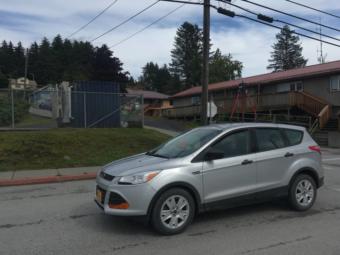
Tech company Truly360 drove around town taking panoramic shots of Wrangell’s streets. The shots will be used for Google Street View, a virtual tour platform on Google. (Photo by June Leffler/KSTK)

Wrangell’s local government recently Googled itself. And it didn’t like what it saw.

Carol Rushmore, Wrangell’s economic development director, typed the name of the city she works for into the world’s most popular search engine and found the results wanting.

“I just think the representation can be different,” Rushmore said.

For example, a Google search for Wrangell shows top destinations in town: Petroglyph Beach State Historic Park, a popular hiking trail and a park. Not bad. But then there’s the description: It’s just census data that looks like it was lifted from Wikipedia.

The information in the box is technical information,” Rushmore said. “Why can’t we provide some basic, fun information about the community?”

So the city hired a contractor that works closely with Google. The city will pay Truly360 about $1,500 a month to curate what could be many people’s first impression of the city.

“If they don’t like what they see on Google, they might not even get to your website, your Facebook, your Instagram,” said Eric Trautloff, a representative with Truly360.

He said the global search engine can be guided.

“Google’s taking information from wherever they can find it and putting it in, if you guys are not actively doing it yourself,” Trautloff said. “So that can be terrifying at the same time, because you don’t know what’s going up.”

To curate Wrangell’s Google presence, Trautloff started his trip driving around Wrangell’s humble 30 miles of road taking shots for Google Street View. Soon anyone with an internet connection will be able to take a virtual tour of Wrangell.

As part of the deal, Truly360 will advise the local tribe, the Wrangell Chamber of Commerce and local businesses on ways they can improve their digital footprint.

All of this is to attract more visitors to town. With summer coming to a close, Rushmore said now is the time to act.

“It’s actually good timing,” she said. “So we’ll have it in advance of people really searching for their next summer’s vacation.”

By that time, Rushmore said she’ll have counted clicks that show web traffic. Then she’ll be to see just how many more virtual visitors have dropped in to check out her town.

Across Alaska, homeless shelters and services are bracing for reduced funding

Brian Wilson, Executive Director of Alaska Coalition on Housing and Homelessness, addresses one of two town hall meetings he held in Sitka this week. About 55 people total attended. (Photo by Rachel Cassandra/KCAW)
Brian Wilson, executive director of Alaska Coalition on Housing and Homelessness, addresses one of two town hall meetings he held in Sitka last year. Wilson’s organization had urged lawmakers and the governor this year to spare social programs designed to keep people sheltered. He said he’s not optimistic about the coming winter. (Photo by Rachel Cassandra/KCAW)

Alaska organizations that keep people from living on the streets have been without partial funding since July. With a state capital budget passed, the Alaska Housing Finance Corp., or AHFC, said it will dole out checks to charities that have been trying to keep Alaskans off the streets. But those checks will only go so far.
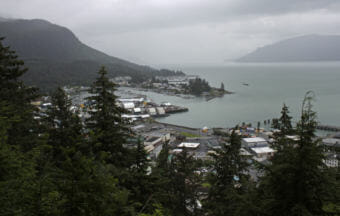
Wrangell, a small Southeast Alaska city of about 2,300, has no homeless shelter. So the local Salvation Army often steps in to offer assistance for people short on rent to keep folks off the street.

Last year, about 20 Wrangell families took advantage of this. But Jennifer Bates, who runs the local branch, said she’s been having to say no for the first time in four years.

“I know personally I’ve taken at least five phone calls where I wasn’t able to help people with utilities or rental,” she said. “I couldn’t even begin to tell you how many my husband has done.”

That’s because the funding was exhausted by April. They were expecting relief at the beginning of the fiscal year on July 1, but that didn’t happen.

Bates said she told her clients to make the rent — even if that meant cutting back on groceries.

“Decide to pay your rent, and we will try to help you feed your family, because that’s what we’re known for,” she said.

The reason the well remained dry after July was because of the state’s fiscal uncertainty. Gov. Mike Dunleavy had line-item vetoed around $400 million from the operating budget, and AHFC was in a holding pattern as the Alaska Legislature and the governor negotiated over the budget cuts.

Wrangell’s Salvation Army is one of dozens of providers of homeless services that receives funding through the Homeless Assistance Program. The governor eliminated $3.6 million — half of its overall state funding — through a line-item veto in the capital budget.

AHFC said that’ll translate to 20% less for homeless assistance grants received by organizations like Wrangell’s Salvation Army chapter.

It’s happening statewide. A Kenai Peninsula nonprofit, Love INC, said it’s already been stretched too thin. And now?

“I can say that that 20% reduction will definitely have an impact,” said Leslie Rohr, the executive director of the religious charity.

Rohr said that means instead of cash assistance for rent, they’ve already been handing out tents and sleeping bags.

“So that people have at least some shelter, but then (we) just say, ‘We don’t have the financial means right now for deposits, rent deposits,’” she said.

AHFC spokesperson Stacy Barnes said there’s $1.6 million less for its Homeless Assistance Program.

“Shelters will not be able to provide the same level of service that they could with a historic funding,” she said. “Nonetheless, the doors remain open,”

The Alaska Coalition on Housing and Homelessness had urged lawmakers and the governor to spare social programs designed to keep people sheltered. Executive Director Brian Wilson said he’s not optimistic about the coming winter.

“It’s just going to lead to increases of homelessness and have a negative effect for our most vulnerable populations,” he said.

He said while homelessness providers will still be mostly funded, homeless policy and support organizations like his will see much larger cuts. Wilson’s organization won’t see any money from the Homeless Assistance Program, which makes up nearly 65% of the nonprofit’s budget.

For the Soldotna-based Love INC charity, this grant money can’t come soon enough. And Rohr worries about how long it’ll last.

“I would suspect that next year, or even this coming year, we’ll be out of funds much earlier than (April or May),” she said. “And that will actually maybe still put us in that late winter cold season, that we will be running low on funds.”

Only 2% of Alaska cruise passengers will visit Wrangell in 2019. And the town is fine with that.

Wrangell as seen from Mount Dewey on July 24, 2014.
Wrangell as seen from Mount Dewey on July 24, 2014. (Creative Commons photo by James Brooks)

Summer is winding down, but cruise ship season is still on for port communities throughout Alaska. All in all, these ships will bring 1.3 million passengers to the state.  The small southeast town of Wrangell is just getting a sliver of that. Local tour operators say that’s not a bad thing.

Lee Kramer and his wife Deborah came all the way from Washington, D.C., for their Alaska cruise vacation. Today they arrived in Wrangell on the Azamara Quest, which holds fewer than 1,000 passengers.

“We knew that Wrangell’s a very small town, so this is pretty much meeting our expectations,” Lee Kramer said.

They went on a tour to the Anan Bear Observatory. Wrangell markets itself more for its off island excursions than the town itself.

But many tourists seem genuinely interested in the small town and those that live here. The Kramers’ friend, Bob McNalley from Florida, compared Wrangell to Ketchikan, where the ship had docked yesterday.

“Ketchikan is way too commercial. This is much more quaint and what we really wanted to see in Alaska,” he said.

The three tourists were impressed that their tour guide, Drew Larabee, lives in Wrangell year-round working as the shop teacher. They even asked where the high school was so they could see where their guide works in the offseason.

“Well I think that what’s going to happen is, when people find out about this sleepy little city, things are going to change. And I’ll tell you what, Drew the shop teacher is going to have a lot of opportunities to take people to see the bears,” McNalley said.

Cruise ship tourism is growing in Wrangell, but it is still one of the smallest ports in Southeast, along with Petersburg. Wrangell’s season should wrap with 21,000 passengers total. Which is nothing compared to Juneau’s million, or even the quarter of a million people who will visit the tiny village of Hoonah.

But Hoonah is proof that the size of the community doesn’t matter nearly as much as the will and the investment to welcome the industry.

Which Wrangell doesn’t have. And it’s not sorry.

The city says attracting more cruise ships is not a priority. The city does spend money — bed tax money — marketing its tourist attractions. But that money’s meant to target those independent travelers looking to spend the night in town, not more cruise ships. While the average cruise ship passenger spends $150 in town, all other travelers spend more than twice that when they visit.

But still, local tour operators have asked the city to upgrade downtown to better suit cruise passengers.

Jim Leslie runs Alaska Waters with his daughter. He gives tours and has two shops in town.

On his wish list of improvements, he’d like to see more summer floats to dock tour boats. Also a visitor’s center, for cover from the rain.

“Move the container companies out of downtown Wrangell, and develop a green belt along the waterfront here and make more room for retail sales and that sort of thing,” Leslie said.

He thinks the barge companies are taking up prime real estate. But he’s not asking for the dock to be expanded. He’s just reimagining what downtown could look like. He says one ship a day is all the town needs. And certainly no megaships.

Sylvia Ettefagh agrees. She runs the tour company Alaska Vistas.

“Do we need anything (like) in Ketchikan, Skagway, Icy Strait? No, we don’t,” she said.

She says that level of tourists would be pandemonium for the town.

“I think the community of Wrangell has told us pretty much that that’s not who they want to be,” Ettefagh said. “This is an older, more established community with year-round residents, that certainly is friendly, but you don’t want them hiding from tourists.”

She says to understand what the town really wants, and how much it wants to grow, it’s good to know what it does not want.

That said, there’s more coming. The town is expected to bring in about 500 more passengers next season.

Dunleavy eliminates funding for low-income Senior Benefits Payment Program

Alaska’s low-income seniors stand to lose cash assistance from the state. That’s following Gov. Mike Dunleavy’s line item veto eliminating about $20.8 million for the Senior Benefits Payment Program.

In the southeast town of Wrangell, 68-year-old Lansing Hayes has lunch most days at the local senior center. He receives $175 a month from the Senior Benefits Payment Program. The check supplements his most basic needs.

“So I get to have health insurance and food which makes me pretty happy,” Hayes says.

Otherwise, he pays his bills with less than $1,300 a month in social security.

More than a third of seniors on the program live in Anchorage. But U.S. census data suggests the communities most affected per capita are in towns like Wrangell in rural Alaska.

But following Dunleavy’s veto, Hayes will soon be among more than 11,000 elderly Alaskans to lose this assistance. The program is income-based, paying between $75 to $250 a month.

It’s a terrible blow to low-income seniors across the state,” Erin Walker-Tolles says. She is the executive director of Catholic Community Service, which runs the senior centers in Wrangell and 10 other communities across Southeast.

During legislative session I have seniors from many communities come up to me and talk to me about how they are going to reduce the amount of food they buy or choose between food and medication if Senior Benefits goes away,” Walker-Tolles says.

She says seniors will feel the effects of cuts throughout the budget. Even though seniors rely on federal Medicare for health insurance, those with severe disabilities access additional services through the state’s Medicaid waiver program. Those include free meals and rides at these senior centers.

And any cuts passed down to municipalities, such as school bond debt reimbursement, are of concern, since local governments provide 25% of these senior centers funding.

Back at Wrangell’s senior center, I ask Hayes what he would say to the governor about these cuts.

“I don’t think his political stance on trying to shut down all these programs was honest,” he says.

Hayes thinks the state should raise more revenue from oil production.

But he says he’s optimistic he’ll make ends meet with $2,100 less a year.

“Yeah, I always get by,” he says.

It’s unclear when monthly payments will cease. Calls to the state’s Department of Health and Social Services weren’t immediately returned Friday afternoon.

It would take three quarters of the Legislature to override the governor’s veto.

With 12 gray whale deaths in Alaska waters, biologists race to find the cause

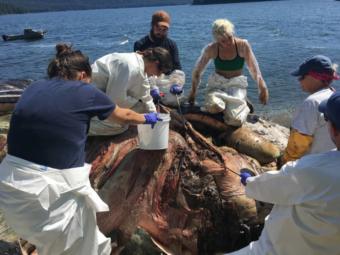
Volunteers help out NOAA by collecting samples of a gray whale carcass. Samples can help NOAA scientists figure out why so many of these whales are dying. (Photo by June Leffler/KSTK)

Biologists in Southeast Alaska are racing to examine a wave of whale carcasses to try and find what’s killing gray whales up and down the Pacific Coast. Nearly 170 have been reported triggering NOAA Fisheries to launch an investigation.

When a dead whale was reported floating near Wrangell, the troops had to rally. U.S. Forest Service workers found the carcass on this remote beach and tied it to trees so it wouldn’t float away.

The site is on Wrangell’s Eastern Passage. You have to travel by boat to site, about 10 miles southeast of town.

Translucent Tyvek poly-suits are the fashion among the dozen wildlife workers and volunteers gathered around the 35-foot-long carcass of the male juvenile.

Baleen collected from a gray whale carcass found in June of 2019 near Wrangell Island. (Photo by June Leffler/ KSTK)

This isn’t a pleasure beach. You have to tiptoe across nearly a impossible rocky incline to get to the specimen.

NOAA Fisheries veterinarian Kate Savage got the call in Juneau.

At least a dozen gray whales have been reported in Alaska. Savage has performed over 20 whale necropsies. By now she knows what she’s looking for as her crew strips the layers of tissue off the carcass.

Savage assembled a team of local citizen scientists.

Anna Allen is a Wrangell-based technician who works for the Alaska Department of Fish and Game.

“It is sad to see but it is also an amazing opportunity to be part of this team and be part of this phenomenon,” she said.

An amazing opportunity and a gross one. The carcass is baking in the mid-70-degree heat. Allen says the smell is the worse she’d ever encountered.

“It’s like a mixture of barf and poop,” she said. “I don’t think I’ll find anything remotely close. I’ll never complain about things that smell bad ever again.”

The team spends the afternoon cutting through blubber and tissue to get to the stomach and intestines. Allen is already looking forward to showering.

“We were trying to get fecal matter out of the intestines, and there was just a buildup of gas, and we cut into it and it kind of just exploded,” she said. “Somehow it only got on me.”

The intestines of a gray whale carcass found in June of 2019 near Wrangell Island. (Photo by June Leffler/KSTK)

These teams rush to carcasses that are relatively fresh and accessible in the hopes of solving the mystery: why are gray whales dying?

Deaths along Mexico to Alaska total nearly 170 now. Five whales were reported in Alaska in just over a week, with three in Southeastone in Bristol bay, and one near Kodiak.

That brings the tally to at least a dozen this year in Alaska alone.

NOAA is in its first month of an investigation into why. Declaring this mortality event brings in more funding, experts and a push for public reporting to solve the mystery. The necropsy today is a fact-finding mission to add to the national effort.

NOAA Fisheries spokeswoman Julie Speegle in Juneau says public reports are important because it allows biologists to respond quicker.

“The amount of information we can get on a fresh carcass is so much better because the samples are in much better shape,” she said.

Of the dozen dead gray whales confirmed so far NOAA has been able to collect baleen, tissue, and feces from four. Authorities are certain there are many more that remain uncounted. That’s because, Speegle said, only about a tenth of dead whales that are recovered.

“So the animals we do reach to conduct a necropsy are representative of the many more we don’t see that fall to the ocean bottom,” she said.

The investigation could take months or years. And the mystery might never be solved.

In 1999, NOAA declared an “unusual mortality event” after about 650 dead grey whales were reported up and down the West Coast over two years. But by 2001, the numbers dropped. No definitive cause was found but the high death rate subsided — until now.

Back on Wrangell’s rocky beach, the site of the dead whale, Savage said the theories posited 20 years ago, are the working hypothesis used today: Malnutrition, bio toxins.

Then there are the knock-on effects of climate change and with it, vanishing sea ice.

“That impacts just a slew of different species on every level, and I personally think gray whales are just one of the victims,” Savage said. “But that’s just one of my theories and I’d be open to changing that if we had evidence of something different.”

After packing up their samples, the team doesn’t plan to come back. The carcass will remain tied to the beach where it will take months to decompose. As the tides change, land and sea animals can feed off of it. Even though the deaths are unusual and the causes unknown nature continues.

Site notifications
Update notification options
Subscribe to notifications