KSTK - Wrangell

KSTK is our partner station in Wrangell. KTOO collaborates with partners across the state to cover important news and to share stories with our audiences.

In a rainforest, Southeast Alaska towns face extreme drought

The city of Wrangell declared a red alert water watch in March 2018.
The city of Wrangell declared a red alert water watch in March 2018. (KSTK file photo)

Believe it or not, one of the worst droughts in the nation is in Southeast Alaska. That’s according to federal meteorologists.

Ground zero for the drought is Wrangell, a city that’s struggled for years to keep up with summer water demand.

Wrangell recently issued a low-level water watch. Residents are asked to cut back water usage where they can. It’s something Wrangell’s locals are used to.

“We got some rain yesterday. As long as we get a little bit every day, I’m not too concerned about it,” said Wrangell resident Dawn Welch. “Everyone just needs to do their part.”

For years, Wrangell has struggled to meet peak demand for water in the summer. That has less to do with weather than it has to do with the city’s aging infrastructure. The city’s slow-sand filtration plant is, well, slow. It hasn’t treated water fast enough to meet the extra demand from the town’s seafood processors and other summer users.

Things were so bad in 2016 that the city declared a disaster emergency.

But a drought in a rainforest? That’s another factor that’s piling on a city that’s long had water woes.

A map showing the intensity of drought across Alaska.
(U.S. Drought Center graphic)

Right now, the National Weather Service says Southeast’s drought is among the worst in the nation. Other places may have received less rainfall, but Aaron Jacobs, a hydrologist with the National Weather Service in Juneau, points to the actual difference of precipitation. Since September 2017, nearby Ketchikan received 60 inches less precipitation than usual.

Jacobs also points to the drought’s ecological and economic impacts, most notably to the region’s hydropower supply.

“To me, living in a temperate rainforest, (the drought is) pretty exceptional,” Jacobs said. “We haven’t seen that in the 20 years since the (U.S.) Drought Monitor began.”

The three-month forecast gives little clarity for the summer months. There are equal chances that the region will get more, less or average rainfall. But June is typically a dryer month anyway.

Wrangell Mayor Steve Prysunka circulated this image on social media. It shows the lack of water running into Wrangell’s reservoirs. (Photo courtesy city of Wrangell)

Wrangell’s water supply comes from two reservoirs. Levels are healthy right now — even overflowing. But the flume that feeds water into them is already dry.

“The stream that feeds our reservoirs is really just a little bit more than a trickle,” said Lisa Von Bargen, Wrangell’s city manager.

She’s expecting warmer, dryer weather, to go along with about 50% less snowpack than last year.

Wrangell has stopped selling water to visiting cruise ships. That’s not a big loss – maybe a few hundreds of dollars per ship. But large water users that the city doesn’t want to disappoint are the two seafood processors in town.

During the 2016 water emergency, the city partially restricted water usage to the Trident Seafoods and Sea Level Seafoods plants.

Plant managers have since said they conserve more — for example, they use more salty seawater where they can. And they recycle more fresh water.

The two processors didn’t respond to requests for comment. But both are expecting a good season for Dungeness crab and chum salmon. And that’s going to require plenty of fresh water.

Von Bargen does not want to disappoint them: They’re big taxpayers, in both property tax and raw fish tax.

“That doesn’t take into consideration all the economic benefit that is going to the private sector,” she said.

For now, it’s wait-and-see at Wrangell’s city hall.

“If we need to increase the water watch because we see water levels become more concerning, we will not hesitate to do that,” Von Bargen said. “And we ask the community to hang in there with us.”

In the meantime, the city is working on its infrastructure and processing: Fixing leaks and recapturing water disposed of during the filtration process. The city had been losing up to half of its treated water due to leaks and cleaning, and it’s gradually closing the gap.

The city is also sourcing from a well, which could provide up to 30,000 gallons of non-potable water as needed for road work. The city approved the purchase of a $9 million water plant over a year ago. But work hasn’t begun, as the funding isn’t yet in place.

Wrangell’s king salmon derby is canceled again, leaving locals longing

During the derby, sport fishers weigh their king salmon for a chance to win up to $6,000. (Photo courtesy Wrangell Chamber of Commerce)

King salmon fishing in Alaska is political — but for those who can’t do it this summer, it’s also personal.

For the second year in a row there will be no king salmon derby in Wrangell. While most agree that protecting the run up the nearby Stikine River is critical, the absence of the derby nevertheless has left a king-salmon-sized hole in some hearts.
On a recent Saturday in Wrangell, plenty of folks were at Heritage Harbor, ready to get off the island for a bit.

Andy Hoyt was about to take off on his boat and head to Point Baker for his first boat ride of the season.

A young couple and their friend were right behind Hoyt in a handmade river scow. They told him they were going up the Stikine River to see some wildlife, check out the hot tubs and “catch a buzz.”

“Catch something, huh? Too funny,” Hoyt said. ” I really wish there was a king derby going on right now, especially this weekend.

This is the second year Wrangell has not had its king salmon derby. After 64 years, it was canceled when historically-low returns to Southeast’s major rivers caused the state to impose deep restrictions on all harvest — not just sport fishing. So Wrangell residents are finding other reasons to go for a boat ride or just be outside.

“But now there’s nothing to fish. So people just have to go boating to go boating,” said Shawn Curley, who helps organize the derby. He’s not bothering to put his boat in the water.

Curley grew up fishing creeks down south, wherever he could. He came to Wrangell to attend his sister’s wedding and never left. That was 23 years ago, and Curley has long since acquired the taste for king salmon.

“Right now, Saturday, it’d be the second week of the derby. As flat calm as it is, there’d be so many boats right now, coming and going,” Curley said. “Instead no one’s out fishing at all. Just that blue heron, he’s fishing.”

While Curley may sound like the Grinch, he’s not disgruntled by the folks in Whoville managing to have fun this summer. He’s had an event that he loves stolen from him. And he can’t forget it.

“It’s kind of like Christmas morning coming and going and then there’s no Christmas, there’s no presents, there’s no tree. It just came and went,” Curley said.

Catching a king salmon, which can run anywhere from 20 to 50 pounds in weight, is a thrill. There’s really no substitute — Wrangell found that out the hard way when it tried an alternative coho derby.

“Obviously we saw a large decrease in participation between the two derbies,” said Alicia Holder, director of the Wrangell Chamber of Commerce. The chamber sponsors the event, with help from Curley and other volunteers.

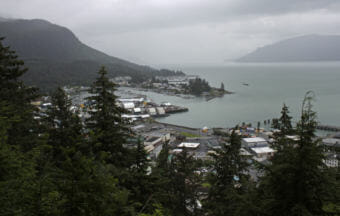
Wrangell as seen from Mount Dewey on July 24, 2014.
Wrangell as seen from Mount Dewey on July 24, 2014. (Creative Commons photo by James Brooks)

Last year’s coho derby was held over four weekends and saw none of that Christmas-morning energy Curley talks about. Ticket sales confirm this: The last king derby brought in $22,000, but the coho derby made just a quarter of that.

Holder doesn’t think the coho derby will ever be as big, but it’s important to keep the event alive. She said it’s for her clients, the local businesses.

“Because we want to see people getting out and spending money in Wrangell,” she said. “We want that revenue for our local businesses. It’s really important and makes a big difference.”

Jeff Angerman agrees. He runs Angerman’s, a local store for fishing gear and attire that he and his wife have owned for 20 years.

“We’re missing our salmon derby, that’s for sure,” Angerman said.

Like most merchants, Angerman has a pulse on the town as a business owner and lifelong resident.

“If you were to start adding up plane tickets and boats and motors and fuel and groceries — and of course in our instance fishing tackles, rods and reels and all the rest — I’m sure the derby probably generates about seven figures just in the 30 days that it’s operating,” Angerman said. “So that’s a big hit for our little town.”

A big hit for businesses, and for the vibe in town. Every day, the top contenders are announced on the radio. Couples and families make plans to get out on the water as much as possible.

Curley said he’d spend 14 hours fishing in a single day, easily.

“That was my only goal in life, was to win the derby. I didn’t want to change the world or raise any kids or cure cancer. I just wanted to win the derby one freakin’ time,” Curley said.

And he’s almost had it. But in an event that lasts a full month, there is no such thing as a secure lead. But without a win, he still hoped to make his mark on the tradition. When he dies, he wants his remains placed at Babbler Point — on opening day of the Wrangell King Salmon Derby.

“And then they’d dump my ashes and shoot guns and howl at the moon, and that’s where I would be. But I don’t know what I’m going to do now. I need to rewrite a new will,” he said.

Curley doesn’t want to give up on his favorite fishing hole as his final resting place, but he said if there’s no opening day of the free-for-all competition, it’s just an ordinary day at Babbler Point.

Dunleavy responds to Alaska legislators’ push for protection from British Columbia mines

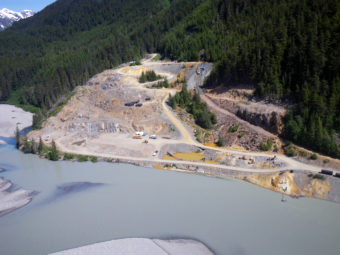
The Tulsequah Chief Mine is on the banks of its namesake river, which flows into the Taku River , which enters an ocean inlet about 25 miles northeast of Juneau. (Photo by Joe Hitselberger/ADF&G)

Gov. Mike Dunleavy has pledged to engage with British Columbia to protect Alaska’s natural resources and environment. That’s in response to lawmakers’ concern over potential threats from transboundary mining.

Lawmakers across party lines penned a letter last month urging the Dunleavy administration to keep a close eye on Canadian mines in shared watersheds.

Twenty-two legislators signed the letter urging the governor and lieutenant governor to pick up where the Walker administration left off.

This month they got an answer. A two-page letter signed by the governor catalogued high-level contacts between state and provincial officials. He called it “important work” to remain engaged over transboundary rivers.

“They said in the letter that they were going to continue with the process, so I was heartened by that,” said Ketchikan independent Rep. Dan Ortiz. “But it was not quite as energetic as I would have liked to seen.”

There was no specific mention of mining in the governor’s letter. Lawmakers had raised concerns over the roughly dozen B.C. mines that are permitted, operating or lie abandoned in shared watersheds with Southeast Alaska.

Last year Gov. Walker had urged B.C. to require mine operators post reclamation bonds before work starts. That’s in line with Alaska regulations designed to ensure mining companies can afford to pay for clean up later. It’s also insurance toward catastrophes.

Environmental and fishing groups on both sides of the border have been pushing B.C. reform its mining regulations for years.

Jill Weitz is with Salmon Beyond Borders in Juneau.

“There’s a need for financial assurances, essentially liability and accountability, to be placed on the B.C. mining industry for impacts to our shared water,” said Jill Weitz with Salmon Beyond Borders in Juneau. “As opposed to the communities of Southeast Alaska having to pay the burden of those impacts from their mining practices.”

Gov. Dunleavy’s letter didn’t get into specifics. But it said a teleconference between his cabinet and B.C. ministers is planned for June 18.

Wrangell changes prayer policy for Assembly meetings

The Borough of Wrangell is officially removing prayer from its Assembly meetings. But the Assembly has a compromise for those wanting to give invocations in city chambers.

Prayer has been a part of every Assembly meeting in Wrangell. Someone in the community, most often of a Christian faith, begins the public meeting with an invocation.

But the borough voted to remove that standing procedure, after a state Superior Court judge said the Kenai Peninsula Borough’s prayer policy was unconstitutional.

Wrangell’s attorney recommended this change, saying the Kenai ruling would create precedent for all Alaska communities.

But Borough Manager Lisa Von Bargen believes a large portion of the community wants to maintain the prayer. So she recommended anyone wanting to say a prayer before the meeting sign up to be heard for public comment.

That removes the onus from the Assembly and city staff, and puts it strictly on the will of the community.

“Anyone has the ability to give an invocation,” Von Bargen says. “And we don’t want to limit that.”

Previously the borough clerk would look for any religious folks in town to fill in for the prayer. Clerk Kim Lane said that could be misconstrued and put the borough in a compromising position.

“One could say I was being selective, and I don’t think that’s a good place for the city to be,” Lane says.

Kenai’s prayer policy went against separation of church and state. But Kenai didn’t come under fire until it tried to limit who could and could not pray.

In 2016, some Kenai residents came to say a prayer ending with the salute “Hail Satan.” In response, the Kenai Assembly approved a new policy saying only congregations could say a prayer. Then another resident started his own congregation in honor of the Flying Spaghetti Monster.

The American Civil Liberties Union of Alaska, with the help of some of those locals, sued the Kenai Borough for discriminating against these nontraditional devotees.

The Wrangell Assembly didn’t want to suffer the same litigious fate: The five present members voted unanimously to remove the invocation.

After months of negotiations, SEARHC takes over Wrangell Medical Center

Wrangell Medical Center is being transferred to the Southeast Alaska Regional Health Consortium this week. As of Thursday, the hospital is now run by SEARHC.

This follows Wrangell voters overwhelmingly approving the transfer of the city-run complex to the local health organization in the October election. The deal was recently inked by the Wrangell Assembly and SEARHC’s board of directors.

SEARHC spokeswoman Stacy Smith said hospital staff have been gearing up for this transition. She said the community shouldn’t expect change overnight: It’s still the same place with the same people.

“So they’re not going to feel like it’s foreign, and they don’t know anyone and the procedures are different,” Smith said. “Everything’s going to feel familiar as it was the day before.”

That’s largely because staff will be retained as SEARHC employees.

The health consortium said there will be eventual changes. But only as needed.

SEARHC is working to build a new critical-access hospital with long-term care. It’s scheduled to be complete by 2021. It’s unclear what will happen to the original hospital once the new complex is up and running.

In small town Alaska, conflicts of interest a tricky subject

Wrangell as seen from Mount Dewey on July 24, 2014.
Wrangell as seen from Mount Dewey on July 24, 2014. (Creative Commons photo by James Brooks)

Running a small town can be tricky: everyone knows everyone and conflicts of interest easily arise as people move from public service to public employment – and back again.

In Wrangell, the city manager’s recent decision to hire a sitting Assembly member raised eyebrows.

Rolland Howell was recently tapped to be the director of Public Works. The job pays $80,000 a year and has good benefits. But here’s the thing: when Howell applied he was an elected member of the Assembly.

What’s that mean? Well, the city manager hires senior city employees. And she serves at the pleasure of the Assembly.

Imagine being interviewed by one of your employees for a job where they’d be your boss.

City Manager Lisa Von Bargen understands the weird optics. But she checked with the city’s attorney.

“There was nothing that precluded him as a seated assembly member at that time from applying, ” she says.

Those in the know say this type of thing happens all the time.

“When it comes especially to small communities across Alaska we have community members who are wearing multiple hats,” says Nils Andreassen,the executive director of the Alaska Municipal League, which advises local governments on sticky issues like these.

“I think a good best practice is just be be upfront about what that conflict of interest is,” says Andreassen.

The move didn’t sit right with one Assembly member. David Powell voted against the deal.

“I consider Mr. Howell a friend, but this is not about him being a friend or him getting a job. It’s about our code,” says Powell.

So what does Wrangell’s code say? An elected official can take a city job if he or she receives a waiver from the Assembly – and then resigns. That’s what happened. The vote was 4-1 with only Powell against.

Other assembly members defended the move.

“The point of the waiver process as well is that it puts it in front of the community in an open forum, a public forum so we can have that discussion and make a judgement call,” says Assemblywoman Julie Decker.

Local governments like Wrangell write their own rules. They can be as strict or lax as they want. That’s because Alaska is a home rule state, where the state has little influence on how a city governs itself. In fact, until this year Wrangell’s rule was a lot stricter.

“We’ve had multiple occasions where good assembly members had to step down from serving on the assembly because their grandson wanted to work at the movie theater, or their daughter wanted to be a lifeguard at the pool, where we can’t even get enough lifeguards to apply,” Decker says.

But the city’s policy against nepotism was loosened after a mayor’s son-in-law brought up the issue. He’d had a job offer with parks and recreation retracted due to his relationship with the mayor. That’s when the Assembly changed some rules.

Wrangell’s school district made a similar move this year, though with less public scrutiny.

Georgianna Buhler served as the School Board president. She left her seat to apply for and be hired as the district’s business manager.

The district says this hire didn’t conflict with its own rules. It seems the city’s deal wasn’t unusual in a town of plus 2,000 people.

Site notifications
Update notification options
Subscribe to notifications