KSTK - Wrangell

KSTK is our partner station in Wrangell. KTOO collaborates with partners across the state to cover important news and to share stories with our audiences.

Alaska delegation urges Pompeo to take up transboundary mining concerns

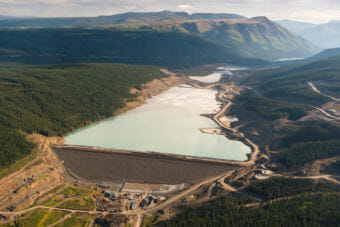
At the Red Chris Mine, a dam contains a tailings pond. that collects mine waste. Northwest B.C., 2017. (Courtesy of Garth Lenz)

Alaska’s elected leaders are pressing the Trump administration to take up the issue of transboundary mining. The renewed push comes ahead of Secretary of State Mike Pompeo’s visit to Canada.

Alaska’s congressional delegation and Gov. Bill Walker signed a joint letter urging Washington to hold Canadian mining companies responsible for any downstream impacts in Alaska.

“We’re looking to find a way to have legitimate review processes for mines that may be problematic,” says Matt Schuckerow, a spokesman for U.S. Sen. Dan Sullivan.

This message is in hopes that Pompeo will bring up the matter at a bilateral meeting he is attending in Ottawa later this month.

Alaska’s elected officials made this sort of request to the state department before. A similar letter was written to then-Secretary of State Rex Tillerson last year.

“This federal administration has been responsive and I hope they will continue to be,” says Jill Weitz, the director of Salmon Beyond Borders, an advocacy group for protecting watersheds. She applauds Alaska’s representatives for being persistent.

Lt. Gov. Byron Mallott and Sen. Sullivan met with Canadian officials last February. They asked the Canadian government to join Alaska in water quality testing in Southeast waters. And the Alaskan officials requested the immediate reclamation of the abandoned Tulsequah Chief that’s leached waste for years into a tributary of the Taku River near Juneau.

The diplomatic offensive comes as several mines – large and small – are moving through the permitting stages in B.C. prolific Golden Triangle.

The rapid development has fisheries advocates worried over potential impacts downstream in Southeast Alaska.

Environmentalists point to the 2014 Mt. Polley mine disaster. That’s when a tailings dam failed, spilling millions of gallons of mine waste into B.C.’s Fraser River watershed.

With king restrictions, Wrangell tries out new coho derby

Wrangell kicks off its coho salmon derby this weekend.

The competition is filling in for the town’s king salmon derby, which was canceled this summer due to severe sport fishing restrictions.
Wrangell has held the longest king derby — lasting a whole month — in Southeast Alaska for 65 years.

This is the first year the town canceled the event. The Alaska Department of Fish and Game closed sports fishing around the entirety of the island until mid-June.

Derby organizers are anxious, wondering whether the silver salmon derby can garner the support of the community like a king derby would.

The best measure of that interest will be in ticket sales.

“We need to sell as many tickets as we can, obviously, and have this thing work so we can justify having another one next year,” derby chairman Shawn Curley said.

He’s looking to sell 300 tickets minimum. In 2016, 858 king derby tickets were sold.

The last coho derby was held in 1996. The golf course hosted the event and sold an abysmal 50 tickets, a bad sign for this year’s derby organizers.

But the coho derby was held alongside the king derby in the past.

It’s the only fishing competition the town has this year. And the prize money is way more. In 1996, first place received $250. This year, first place will get $2,000.

“We might have went overboard,” Curley said. “We’re hoping to sell enough tickets to just break even and offer up a community event that’s fun for your family and visiting friends and just to have a local friendly competition.”

The competition may have to take over for the king derby for years to come if low chinook forecasts persist.

The derby begins this Saturday, Aug. 11, and lasts through Sept. 3. Only weekend catches count.

This year’s derby tickets will be reduced from $35 to $20.

The chamber will award weekly $250 cash prizes, with a $500 prize for Labor Day weekend.

The top awards will be based on a cumulative three-fish catch. Those prizes are $2,000 for first place, $1,500 for second and $1,000 for third.

Each ticket enters you into a raffle to win two round-trip Alaska Airlines tickets.

Town of Telegraph Creek evacuated as British Columbia wildfires rage

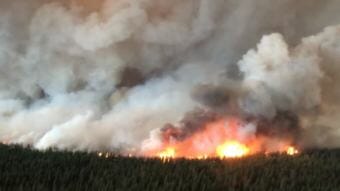
The South Stikine River fire just east of Telegraph Creek, B.C. has grown to around 60 square kilometres in size. The B.C. Wildfire Service said it was burning 'aggressively' on Monday and jumped the Stikine River. (Photo courtesy British Columbia Wildfire Service)
The South Stikine River fire just east of Telegraph Creek, B.C., has grown to about 23 square miles in size. The B.C. Wildfire Service said it was burning “aggressively” on Monday and jumped the Stikine River. (Photo courtesy British Columbia Wildfire Service)

British Columbia Wildfire Service ordered the evacuation of Telegraph Creek because of a fire about 3 miles northwest at Alkali Lake.
Telegraph Creek, a town of about 300 residents, most of whom are of the Tahltan First Nation, is one of the only towns on the Stikine River near the U.S.-Canada border.

Wildfire Service spokeswoman Jody Lucius said many Telegraph Creek residents have evacuated, mostly to Dease Lake.

Lucius said the Tahltan First Nation confirmed 27 buildings have been damaged.

The Wildfire Service expanded the order Tuesday morning for up to but not including Dease Lake to the Caribou Creek Camp.

The other fire nearby is the South Stikine River fire.

Pushed by strong winds, the two fires burn toward each other moving in a northeast direction.

Twenty-five fires currently affect the northwest Cassiar Zone of British Colombia.

Telegraph Creek is about 120 miles southeast of Juneau.

Wrangell, other small Southeast Alaska towns are ‘breath of fresh air’ for tourism

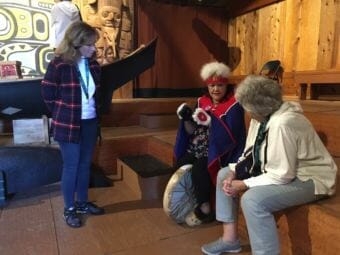
Virginia Oliver performs Tlingit dances and stories for tourists in Wrangell at Chief Shakes’ Tribal House. (Photo by June Leffler/ KSTK)
Virginia Oliver performs Tlingit dances and stories for tourists in Wrangell at Chief Shakes’ Tribal House. (Photo by June Leffler/KSTK)

Tourists travel to Alaska from all over the world to view stunning natural attractions and learn about the 49th state’s history.

Tour operators in the small Southeast Alaska town of Wrangell say they can give an intimate and authentic experience unlike other towns.

The Seaborne cruise ship docked in Wrangell on a Tuesday morning.

Roughly 400 passengers spent the day in the tiny island town.

A dozen people, mostly older couples, took a three-hour tour.

“This one intrigued us, because it was on a much smaller ship and we could get into lovely places like Wrangell, that we have not seen before,” said Judy Vineyard, who’s from Arizona and has been to Alaska five times. She loves whale watching.

The cruise passengers say they have already been to Juneau and other small southeast towns such as Haines and Sitka.

Some even started their journey in tourist hot spots like Seward and Denali.

Some tourists wander the island with a map in hand.

“I thought it was going to be not as touristy. Which is delightful,” Vineyard said. “I’m sure you want it to grow and you want it to get more touristy. But when you’ve been to other places and there’s so many people walking around, and it is just one little tourist shop after another, this is just a breath of fresh air.”

Alaska Waters tour guide Brooke Leslie grew up and lives in Wrangell.

On the Island Heritage Tour, she takes guests on the Tlingit history of the island.

At Chief Shakes’ Tribal House, Virginia Oliver and Arthur Larsen, in partnership with the Wrangell Cooperative Association, show off regalia and tell Native stories.

Oliver tells a funny but gruesome story about Raven.

Oliver and Larsen are active members in the local tribe, and continue to teach and study Tlingit culture in town and around Southeast.

The city museum gives a comprehensive take of the town’s history.

Leslie is able to point out something from her own family history in the museum: a photo of her grandpa as a teenager on Wrangell’s basketball team. And another one of him smoking salmon.

“Not everyone gets to say their grandpa is in a museum,” Leslie said.

In a super small town, maybe it’s not that surprising to see your grandpa in the museum, playing basketball and smoking salmon.

But Leslie said a similary instance won’t happen with tour guides everywhere in Alaska.

“(Tourists) are going to be on tours with people that are just college students that are in Alaska for the summer,” said Leslie, who is a part of the community.

The tourists dig that. They don’t just ask her about Tlingit history, they ask her about her life today.

“We all live a very subsistence way of life, and we actually live in Alaska,” she said. “That in itself is unique.”

The last stop of the day is Petroglyph Beach, where Native rock carvings are scattered on the ground.

Vineyard is trailing behind the group. She’s interested in something else.

“I’m collecting sea glass. We collect it all over the world wherever we go,” she said. “I thought wouldn’t it be something if there was sea glass here, and there is. It’s wherever you know they had a garbage dump.”

Even if Wrangell’s Front Street isn’t littered with gift shops, Vineyard was still able to get a souvenir.

She buys a few garnet stones from a young girl with gift shop set up by the beach, just outside her house.

Sealaska Heritage Institute to digitally preserve spruce-root basket weaving

Hans Chester, left, of Sealaska Heritage Institute, and master Haida weaver Delores Churchill examine spruce root basketry in the collections vault of the Father Andrew P. Kashevaroff State Library, Archives and Museum in August 2017. (Photo by Davina Cole, courtesy Sealaska Heritage Institute)

Sealaska Heritage Institute will digitally preserve the Alaska Native art form of spruce-root basket weaving.

With some outside help, the organization will produce how-to videos that show the entire Tlingit basket-making process.
“It was just something that really connected with me,” said Juneau-based spruce-root weaver Hans Chester. “I enjoy being outside, and I enjoy digging in the dirt,”

The art form is painstaking.

The weavers dig up thin roots which they split again and again to make delicate threads, only a few millimeters thick.

“It really does take a long time, it takes a good six to eight hours to split the roots for every hour that you’re out digging,” he said. “If you go out and dig for two hours you have another day of work ahead of you.”

That’s not even getting to the weaving, actually building the piece and incorporating the designs.

Chester acknowledges the art form takes a lot of commitment, and that’s partly why few folks do it.

“I ask myself that a lot of time, as I’m splitting roots. ‘What did I get myself into? I don’t know if I’m going to be able to get through this and get them all split?’” Chester said. “It just really challenged my own thinking.”

Chester clearly is enamored with the art form and all the challenges it presents.

“There’s just a lot of discovery that comes with weaving and not just within the art itself but within your personal life and your own goals,” he said.

He was an apprentice to master Haida weaver Delores Churchill, known in Southeast Alaska for her woven baskets, hats and robes.

Chester now serves as her assistant in some of the spruce-root workshops.

“I’m a big thinker and I have all these aspirations of making different baskets,” he said. “Using different designs that Delores says ‘I don’t see these anymore. I just see them on the old baskets in the museums.’ It inspires me to try and bring some of those things back.”

That the master weavers know now is only a fraction of what their ancestors knew, Chester said.

Once the weavers we have now pass on, how much of what they know will survive?

Sealaska Heritage Institute is documenting the spruce-root workshops for the project partially funded by National Geographic.

Linblad, an expedition company that also promotes artisan development across the globe, is producing the videos.

In the past, Linblad came to Haida Gwaii to facilitate raven’s tail weaving workshops.

These how-to videos will be posted online for weavers of all skill levels to learn the craft.

“The baskets that were made really allowed us to be who we are today,” he said. “If we didn’t have those water pales that were woven tight enough to carry water, what would we have? How would we have survived? There’s an obligation on our part to maintain and to teach it to others because of that reason.”

Spike in shipping costs has Southeast businesses up in arms

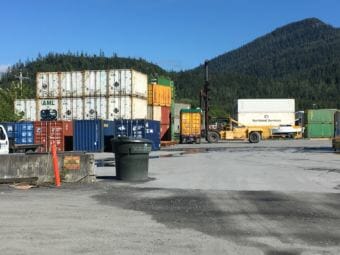
Barges carry containers full of product to ship to Southeast towns. (June Leffler/ KSTK)

Lisa Messmer works for a furniture store in the small island town of Wrangell. Earlier this year, she received an email with the heading: freight rate increases.

“When I saw the heading I didn’t read the rest of it because we don’t have a choice here,” Messmer said. “You can’t call them up and say you aren’t going to pay. We’re just stuck, and we pay what they say we pay.”

Wrangell and the rest of Southeast Alaska receive groceries, hardware, appliances, alcohol by seafaring barges coming from the Seattle. It’s really the only way things get to small island towns or remote villages.

Freight rates increase all the time. And at small increments people just suck it up. But small business owners are seeing a steeper hike than anyone expected.

“We know freight is high here, It’s just doing business in Wrangell, Alaska,” said David Powell. He runs the Bay Company. This year, his minimum load freight rate increased 58 percent. For larger loads, it’s three times what it was last year.

He sells boats, motors, buoys, anything for the water. He anticipates raising his prices to meet the extra freight costs.

“We’re talking about a boat that would sell for 5700 now would probably sell for 6400 next year.”

A bar owner saw his liquor freight increase 58 percent this year as well. He had to make a tough business decision after seeing that increase.

“Our prices went up the day after I got that invoice,” he said.

There are only two barge companies operating in Southeast, Alaska Marine Lines and Samson Tug and Barge.

Samson’s Vice President Jerry Morgan says the rates have increased to meet their own operating costs. He says when Samson got into the Southeast market five years ago, its competitors were setting low rates for the area.

“I don’t know why the rates were so, low but they were so out of market range it just doesn’t make sense to even provide service to Wrangell at the rates they were offering before. The rates in Southeast are pretty low across the board it’s just a difficult market to compete in.”

It’s difficult to peg one number for overall freight increases. Freight rates are based on different weight loads, commodities and ports. Plus, individual businesses have their own contracts with these freight companies, that all look a little different. But companies regularly submit to the federal government their tariffs, which are a baseline of their rates. Here are some of the rate changes for Samson from 2017 to 2018 in Wrangell (at minimum weight loads). Groceries went up 7 percent, building supplies went up 13 percent, liquor went up 80 percent, and mixed freight loads went up 35 percent. Gas went down 8 percent.

Alaska Marine Lines is the bigger barge company in Southeast. An AML representative said its rates are also going up, particularly for smaller loads.

The representative says handling 20 to 30 different orders in a single container requires much more handling than unloading a container for a single customer. And AML has jacked up their rates to reflect that internal cost.

But raising rates on smaller loads, means raising rates on smaller businesses. Those that are already struggling to compete with big box and online retailers. Even though it is a hard decision, there’s no way around it, businesses are going to pass that cost along to their customers.

Site notifications
Update notification options
Subscribe to notifications