KSTK is our partner station in Wrangell. KTOO collaborates with partners across the state to cover important news and to share stories with our audiences.
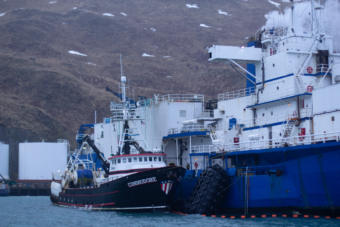
The fishing vessel Commodore sits in port in Dutch Harbor next to its floating processing ship, the Northern Victor. (Photo by Nathaniel Herz / Alaska’s Energy Desk)
Members of the citizen boards that set the rules for fishing and hunting on state lands aren’t allowed to join the discussion if they have a conflict of interest.
But Alaska’s House Fisheries Committee is considering a bill that would allow members of the Board of Fisheries and Board of Game to join in those discussions — even if they’ve declared they have a financial stake in the matter. They still wouldn’t be allowed to vote.
House Speaker Louise Stutes (R-Kodiak) co-sponsored House Bill 26. It’s her third attempt to bring the legislation forward.
“It’s a good bill,” Stutes said Tuesday. “It’s a great bill, it will allow the Board of Fish and Game — both boards, meaning the fish and game boards — to benefit from their members’ expertise, facilitating more informed decisions and stronger resource management.”
Commercial fishing groups support HB26. Frances Leach, the executive director of United Fishermen of Alaska, told the committee the change would encourage transparency by bringing discussions out in the open which might otherwise occur behind closed doors.
“The people making decisions for Alaska’s precious wildlife and fisheries resources should be qualified and bring expertise to the table, not be muted,” Leach said. “As it’s been pointed out, this bill does not allow [conflicted] board members to vote. It just allows them to share their knowledge in the area of expertise and provides for transparent deliberation. I believe we all could benefit from transparent deliberations and more experts weighing in. This will benefit all user groups, not just commercial fishermen.”
Not everyone was convinced. Ben Mohr, executive director of the Kenai Sportfishing Association argued it would allow conflicted members to improperly influence deliberations.
“The current conflict procedures are not new. The current conflict procedures are not unknown or untested. They’ve been in place for a long time. And they’ve been reasonably effective. We believe that loosening the long standing ethical guidelines for this body is not in the public interest,” Mohr told the committee.
The fisheries committee is expected to hold a second hearing on the bill. A vote could come as early as March 18. It would still need a hearing before the finance committee. And so far HB26 doesn’t have a companion bill in the state Senate.
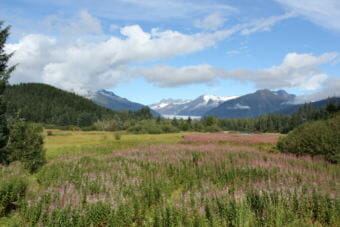
The invasive reed canary grass is encroaches on this fireweed in the Brotherhood Bridge meadow on Aug. 30, 2018. (Photo by Jake Steinberg/KTOO)
When it comes to invasive species, Southeast Alaska is relatively well off. Non-native plants haven’t overwhelmed the area like in some parts of the lower 48. But the U.S. Forest Service still has to do a lot of weeding, and they’re looking for public input about expanding their efforts.
Right now, the U.S. Forest Service is only authorized to control invasive plant species on limited federal lands. And they say that poses a problem.
“Invasive plants don’t recognize political boundaries,” said Joni Johnson, a botanist with the Forest Service in the Petersburg district. “So if we’re working on controlling invasive plants, it makes sense to cast the net wider so that it includes whole entire islands.”
The Forest Service in the Wrangell and Petersburg management areas is looking to expand their efforts against invasive plant species. That means more area, more tools — and in theory, more collaborations.
Japanese Knotweed, one of the common invasive species in Southeast Alaska. (Courtesy U.S. Forest Service)
The Forest Service’s current invasive plant species work plan is from 2013, and it’s fairly restrictive. For example, the plan doesn’t allow Forest Service workers to disturb invasive species if the roots aren’t on land.
“A great example of how [expanded permissions] would be useful to treat emergent beds would be the Anita Bay road system on Etolin Island. Control efforts for reed canary grass, they’re pretty much 92% effective now, but we have a beaver palustrine system [in the area] that is chock full of reed canary grass,” Johnson said.
A palustrine system is a marshy area.
“If we’re not controlling that [bed of reed canary grass], then there’s two issues: One, riparian condition [the water environment] is impacted. But also, then there’s a seed source for recolonizing and re-infesting,” Johnson said.
The new proposal would let the Forest Service try to stamp out water-based infestations of invasive plant species, which isn’t allowed under the current plan.
Treatment for invasive species in the Tongass varies, depending on the area.
“Wilderness areas, and the objective of maintaining a natural condition have different prioritization checkboxes, so to speak, as opposed to say, the road system on Wrangell Island,” Johnson said.
Up the Stikine River, for example, Johnson says the focus is reed canary grass, a tall, bunchy grass that can grow to nine feet tall and choke out all other plant life in moist-soiled areas around streams, lakes, and wetlands.
Orange hawkweed flowers. (Courtesy U.S. Forest Service)
In more developed areas, the focus might be the small, orange and yellow-flowered hawkweed, which Johnson says often moves from wilder areas into “human footprints”: roads, trails, and campsites.
Invasive plant species in Tongass National Forest can be traced back to fairly recent history. Some came with settlers and canneries in the early 1900s. Others came in the 1980s and -90s, when clear-cut logging started to cause major erosion in the region. Erosion control seed mixes brought with them an aggressive invader — reed canary grass.
Even so, Johnson said Southeast is “uniquely positioned to stay on top of invasive plants.”
Southeast Alaska has different fire patterns — and less human development — than our neighbors down South. Johnson says the Forest Service wants to get their more aggressive invasive species mitigation plan approved so that they have more ability to detect invasive species populations early.
However, the plan isn’t entirely without concern. The brunt of the Forest Service’s proposed invasive species mitigation relies on herbicides, which have varying effects on soils, native plant life and aquatic environments. The original 2013 work plan saw some pushback about using toxic chemicals. So did the draft version of this proposed plan.
“Herbicides are always going to be an issue, as they should be,” Johnson said. “People are critically evaluating what’s being used and how it’s being used.”
She adds that’s where the public comes in. The Forest Service encourages public comment on the scope and effects of invasive species mitigation. Wrangell’s local tribe will review the proposal at their council meeting on March 9.
Johnson also says she hopes folks will take this comment period as an opportunity to let the Forest Service know where they’re seeing potential areas for treatment and control of invasive species.
“I’m hoping that folks will be more aware especially, say up the Stikine River, noting where they’re seeing reed canary grass, or orange hawkweed, or yellow hawkweed,” she said.
The public comment period for the proposed Wrangell-Petersburg Invasive Plant Management Project opened Friday, March 5. Comments can be dropped off at either the Wrangell or Petersburg Ranger stations, or submitted online. The deadline to comment is April 4.
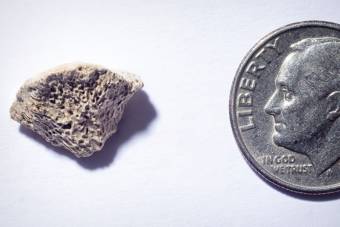
This bone was part of the femur of a dog that lived more than 10,000 years ago. (Courtesy of SUNY Buffalo/Douglas Levere)
A dime-sized fragment of dog bone — more than ten-thousand years old — has given researchers new clues about how domesticated dogs first made their way to the Americas.
Examining a pinto bean-sized bone fragment, the scientist thought she was analyzing an ancient bear bone.
“We have sort of a long standing project working on bear bones from these caves,” explained Charlotte Lindqvist. She’s an associate professor of biology at the State University of New York at Buffalo.
Caves dot the Alexander Archipelago in Southeast Alaska. The fragment of leg bone Lindqvist was examining came from a cave on the mainland just east of Wrangell Island. The cave is a marble tube, about the length of a standard swimming pool.
“This DNA, when we were looking at it and analyzing it, we realized: ‘This is not bear DNA,’” Lindqvist continued.
“That is among the oldest dog remains that we have from North America,” Lindqvist said. Ancient dog remains are a rare discovery on their own, but Lindqvist explains that the location is also part of what makes this identification so exciting.
To understand why, it helps to look back to the Ice Age — which ended about 10,000 years ago.
“During the Ice Age most of North America was completely covered in these two big ice sheets. So there was no contact north and south of the ice sheet,” said Lindqvist.
Basically, a band of ice across Canada and the northern United States prevented the people living in northern Beringia — including what is now Alaska — from moving south into what’s now the Lower 48.
Lindqvist continued: “There has been this long-standing hypothesis that as soon as these two ice sheets started melting, it opened up a sort of continental or inland corridor. If you have seen the Disney movie ‘Ice Age,’ that’s sort of what is displayed in that movie. But more and more, we’ve started to believe that the coast probably started melting earlier and became viable earlier than this inland corridor.”
And as the adage goes: “A dog is a man’s best friend.”
“Finding a dog on the coast can tell us a lot,” Lindqvist continued, “not just about dog migration and where dogs have been — but also humans, because dogs follow alongside humans.”
And human remains and tools from various points in ancient history have been found in the same cave off Wrangell Island.
The dog bone Lindqvist and her colleagues — Flavio Augusto da Silva Coelho, Stephanie Gill and Crystal Tomlin — analyzed was collected in the late 1990s by a now-retired earth science professor at the University of South Dakota named Timothy Heaton.
The 50,000-odd bones now reside in the collections of the Museum of the North in Fairbanks.
The piece of dog femur may be tiny, but Lindqvist says it could still yield a lot of information.
“For now,” she said, “we have just isolated the DNA from the mitochondria in this bone, and that is inherited from the mother. So it only tells us the maternal history of this dog. If we can, from this tiny little bone that we have left, get some nuclear DNA — DNA from the genome, we might be able to get deeper insights into the history of this particular dog and the history of new world dogs.”
Lindqvist says she hopes for other discoveries in the thousands of bones from Southeast caves that are left to analyze.
“I’m sure it’s not the last [exciting discovery],” she said, “and it will be exciting as we hopefully will find older remains as well.”
The cave off Wrangell Island has only been partially excavated. That’s because it is a heritage site, protected by federal law. Human remains from the site have been repatriated to Wrangell’s Tlingit tribe, the Wrangell Cooperative Association, under the Native American Graves Protection and Repatriation Act.
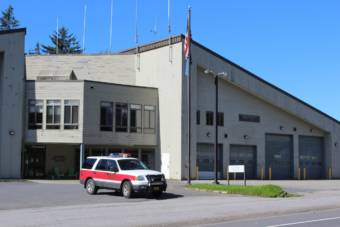
A renovation to Wrangell’s Public Safety building is at the top of the borough’s list of Capital Projects funding requests. (Sage Smiley/KSTK)
Gov. Mike Dunleavy announced earlier this month that he’d be asking Alaska voters to approve borrowing $356 million dollars as part of a bond to replace aging state infrastructure. But Southeast projects make up a very small fraction of the governor’s list, and mid-sized communities like Wrangell and Petersburg were left out entirely.
“We don’t have a choice,” says city manager Lisa Von Bargen. “It has to be done. We had to put up a shoring wall because the back side of the building was unsafe and was in danger of collapsing.”
If the community had the funding, Von Bargen says, it should be replacing the building entirely. But the estimated cost for a total rebuild overshoots the community’s budget by millions.
So Wrangell’s administration and borough assembly approved its list of capital projects priorities this year with a $10 million renovation to the public safety building at the top of the list. Von Bargen says the hope is that Gov. Mike Dunleavy’s proposed $356 million general obligation bond will cover some of the cost to make the building safe.
The governor’s initial proposal doesn’t mention Wrangell. In fact, projects for named communities in Southeast make up about 7% — or $25.8 million — of the state’s bond.
The five Southeast communities with named projects are: Ketchikan, Craig, Sitka, Hyder and Klawock.
The bond would add to statewide maintenance funds that could be disbursed to Southeast communities, though.
“Am I looking to change some things [about the bond]? Yeah, definitely,” says Ketchikan independent Rep. Dan Ortiz.
His district includes Wrangell and most of the lower panhandle. He says there are some pressing needs in his district. Along with Wrangell’s public safety building, the hydroelectric intertie between Metlakatla and Ketchikan is another priority.
But Ortiz is also cautious about the governor’s strategy of borrowing money.
“I think there’s a little bit of concern, and kind of a wait-and-see attitude,” Ortiz said. “[We’ll] see if we can come to a consensus as to whether or not it truly is in our best interest to indebt us further into the future. With the positive side being that we could begin to take care of some of these significant deferred maintenance issues that we see around the state.”
State Sen. Bert Stedman takes a similar position. The Sitka Republican says with all the federal aid and funding for capital projects likely available, he doesn’t know if this is the time to add debt.
“I’m not convinced that the time to use what bonding capacity we have is today versus a couple years from now, when we may have a less financial ability to maneuver, and there was less cash on hand,” he said.
Stedman also questions whether borrowing heavily would jumpstart Southeast’s economy, which is largely tied to natural resources and tourism.
“The construction projects aren’t going to help fish prices and fish processing — are not going to help cruise ship visitors,” he said.
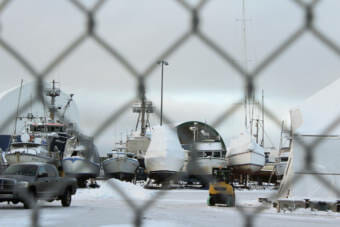
Boats in Wrangell’s shipyard, January 2021. (Sage Smiley/KSTK)
Wrangell will receive considerably less in its shared fish tax payments this year than the city expected, city manager Lisa Von Bargen explained at an assembly meeting on Tuesday.
“That speaks to the abysmal situation related to the fishing issues in our region,” Von Bargen said.
The payment she referred to is a fisheries business tax collected outside of municipal boundaries. The state disperses the tax money to communities in the region. Wrangell planned to receive $10,000 dollars this year from the shared fish tax. In reality, the city will receive just over $1,600.
Municipalities also receive another fisheries business tax for fishing business within municipal boundaries. Wrangell’s payment from that tax is lower than expected as well: about $203,000 for the last fiscal year.
Von Bargen says that what’s almost more concerning is the fact that the $1,600 payment is based on 2019’s fishing season. And as many fishermen and industry workers in the area know, 2020’s Southeast fishing season was much worse than 2019’s.
Because of their larger populations, Sitka, Petersburg and Wrangell receive the biggest chunk of the shared fisheries tax in central Southeast.
The payments through the shared fisheries business tax program have been dropping for years. In 2015, for example: Sitka, Petersburg, Wrangell and Kake all received over $10,000 dollars from the program. Sitka’s payment that year was over $40,000. This year, Sitka will receive just $4,000.
Petersburg borough manager Steve Giesbrecht says his borough didn’t overestimate this year’s payment quite as much as Wrangell. But he agrees that seeing the financial effects of a downturn in Southeast fishing is worrisome.
“It has just been bad,” Giesbrecht said, referring to the dwindling salmon fishing returns in the area. “I mean, I’ve got a couple fishermen on our assembly, and our finance director is involved in the industry. And they’ve all been warning — have been talking this up for the last couple of years. And then last year [2020] was so bad. I’m not looking forward to looking at [finances] when we start getting into our budget for next year.”
Both Wrangell and Petersburg’s managers say that the shared, out-of-municipal-boundaries fish tax doesn’t represent a massive piece of the budget. But they say it’s an indicator of plummeting fish revenue at a time when the same communities are hurting with the effects of the pandemic and a lackluster tourism season last year.
“The network issue that was causing intermittent communications issues throughout the entire area was resolved,” Kessler said Friday. “But there are still all the ongoing issues that we’ve had with a couple of sites.”
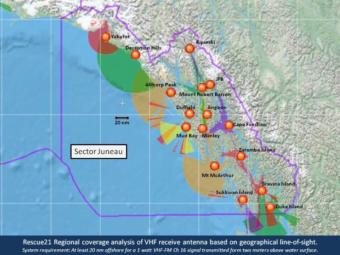
The Coast Guard’s network of VHF towers allow its search and rescue command center to hear distress calls over Channel 16. But breakdowns in the relays can prevent mayday calls from being received.
Kessler said Friday there are still problems with four towers across Southeast: Mt. McArthur, Deception Hills, Sukkwan Island, and Althorp Peak. There are also problems with two repeaters near Kodiak Island on Cape Gull and Raspberry Island.
Mariners are always encouraged to carry a secondary form of communication like an Emergency Position Radio Indicating Beacon (EPIRB), satellite phone or cell phone.
The Coast Guard Sector Juneau can be reached at 907-463-2980.
Close
Update notification options
Subscribe to notifications
Subscribe
Get notifications about news related to the topics you care about. You can unsubscribe anytime.