KSTK is our partner station in Wrangell. KTOO collaborates with partners across the state to cover important news and to share stories with our audiences.
Alaska officials have echoed that expectation. On a statewide call last month, Department of Health and Social Services officials said they believe the authorization will come by the end of this month at the latest.
Vaccine signups for those covered by SEARHC are available online.
Almost half of Alaska’s population has been completely vaccinated.
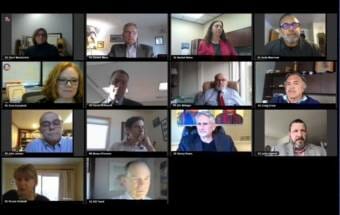
Members of the North Pacific Fishery Management Council at their April 2021 meeting. (Screenshot from Adobe Connect)
The council that manages Alaska’s federal fisheries has tightened its public comment policies. The North Pacific Fishery Management Council says recent profane comments had prompted the move. Some fishermen and community organizers say that’s a bunch of bull.
For all the controversy and emotion that can accompany fisheries debates, the federal council that manages fisheries in the North Pacific says it hadn’t ever received public comments with explicit language — until last month.
North Pacific Fishery Management Council members like Bill Twiet said at the council’s April meeting they worried that crude language and personal attacks could prevent people from speaking up.
“We lose collectively — the council loses, but also the council family loses — when people choose not to engage with us because they look at some of that testimony and they think, ‘If that’s the cost of speaking up, I don’t want to,’” Tweit said.
Council members say five of the nearly 600 comments submitted to the council last month contained vulgar language or personal attacks. The council’s executive director says his staff reached out to the commenters and asked them to resubmit, sans swearing. One did.
But those five comments were apparently enough to prompt changes to the council’s written comment policies. That includes a profanity filter, tighter deadlines for submitting comments and some discretionary power for council staff to move — or remove — off-topic comments.
And that’s prompted outcry from longtime fisheries advocates. The head of the Alaska Longline Fishermen’s Association, Linda Behnken, says she’s never seen the council move so quickly.
“I mean, never seen them bring something up, take action, boom, done without more opportunity for meaningful engagement,” she said.
Behnken says she worries that the new powers could lead to censorship of comments that council staff claim aren’t explicitly relevant to the finer technical points of a particular issue.
“There’s no guideline per issue for the staff to fall back on in saying ‘This is on-topic or off-topic,’” Behnken said. “If people are talking about how something affects them and what their concerns are, that’s on topic, as far as I’m concerned. As long as they’re doing it respectfully, then we should be welcoming that input to the process.”
The North Pacific Fishery Management Council’s executive director David Witherell defended the council’s quick decision.
“Had they put out a draft and taken a few meetings to review, kind of like the way a regulatory process might work, well, it keeps the door open for those profanity and other offensive comments that could be made for yet more meetings,” Witherell said.
He also noted that the council has expanded the types of public comments it accepts to include everything from handwritten notes to faxes and emails.
“We built a comment portal such that we made it get so easy on, all you have to do is click that button and start typing your comment, and you’re done,” he said.
But community organizer Heather Bauscher of the Sitka Conservation Society says it’s not all that simple.
“The complexities of the system in place already contribute greatly to the inequalities here,” Bauscher said. “And I think that the average fisherman or rural subsistence user does not have the means to pick apart the details of an EIS [environmental impact statement] and various alternatives in order to speak to an issue. So I have significant concerns if they’re going to make rules about what is relevant or not relevant to an agenda item.”
And, Bauscher adds, with the hundreds of comments — both written and phoned in — the council was understandably behind schedule.
“They have their own social media page. If they wanted to help support public engagement, they could have done the same thing that we were doing, and they could have provided those action alerts or given people updates on when certain things were coming up so that it is easier for the public to participate,” she said.
Bauscher adds that not everyone has hours to sit on the phone or online to wait for an agenda item to come up.
“If they’re going to change things. It should be making it easier, not harder,” she said.
Some fishermen say the comment policy change points to a deeper-rooted problem. Sommers Cole is a Juneau-based gillnetter and fisheries organizer with SalmonState. He doesn’t condone foul language, but he points to boiling frustrations over issues like troubled subsistence fisheries in the Yukon-Kuskokwim Delta region, halibut and salmon bycatch taken by the trawl fleet and a feeling of being shut out of the process.
“I don’t think it’s the smartest thing to go cuss at the decision-making bodies. It’s a terrible idea, actually,” said Cole. “But they are comments that were from legitimate stakeholders that were, you know, close to the endpoint, and they’re frustrated. So they cuss at the council, or cussed in the comments. And the council’s response is to further ban cussing, rather than — I don’t know. I think there’s a root problem where fishermen and other stakeholders are frustrated because they don’t feel the process has been responsive to their needs.”
Witherell, the council’s executive director, says his staff would only delete comments as a last resort.
“I think people are nervous about — just nervous that somehow the staff is going to be taking out comments from people that maybe somebody doesn’t agree with. Definitely not. Really, that’s never going to be the case,” Witherell said.
The new written comment guidelines mean the comment portal will open once most of the council documents have been posted online — seven to 10 days before the meeting. It will close earlier to allow the staff time to censor offending language. And public comments won’t be posted online until the comment period has closed, meaning there can’t be any back and forth debate playing out on the website.
The new rules are timed to take effect before the council’s next meeting in mid-June.
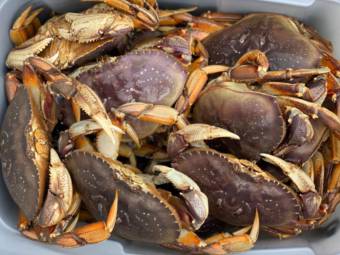
Dungeness crab in Southeast, Alaska. (Photo by Angela Denning/KFSK)
House lawmakers have passed a bill that, for the first time in Alaska, would allow shellfish like crab to be grown in hatcheries and released into the wild to bolster commercial fisheries.
Rep. Dan Ortiz (I-Ketchikan) sponsored HB-41, which would put shellfish on the same footing as salmon species that are bred in hatcheries across the state.
“The bill gives Fish and Game a solution to potentially help address declining stocks of shellfish like stocks of crab out west or abalone in the Southeast which have suffered from overfishing and predation, instead of relying only on conservative management,” Ortiz said.
The mariculture bill found bipartisan support. Rep. Sarah Vance (R-Homer) told legislators she sees benefits for coastal communities throughout the state.
“I didn’t think that I was that old to say, ‘Hey, back in the day, we had razor clams this big, and now they’re small, and they can no longer make that available to the public,’” Vance said. “This is an area that we need the enhancement, we need these nonprofits to come in and say we’re going to help rehabilitate the shellfish to make it available for common use.”
Only two lawmakers opposed the legislation, but not on environmental grounds. Rep. David Eastman (R-Wasilla) said there should be a cap on permit fees. He also took issue with the fact that the bill allows the Department of Fish and Game to penalize people, saying he thought it was backwards to allow penalties when the regulations still need to be written.
“If we are going to be in a sense creating new crimes,” Eastman said, “I think that the legislature ought to know what it is that the regulations are, that are going to attach to these stiff penalties. And have the ability as legislators — as elected representatives of the people — to make sure that those regulations are in fact, what the people want to attach to such penalties.”
Eastman and fellow Wasilla Republican Christopher Kurka were the only no votes.
The bill also allows the Alaska Seafood Marketing Institute to promote hatchery-born, wild-caught shellfish in the same way they market hatchery-bred salmon. A companion bill in the Senate has yet to be heard. It will require passage by state senators and the governor’s signature to become law.
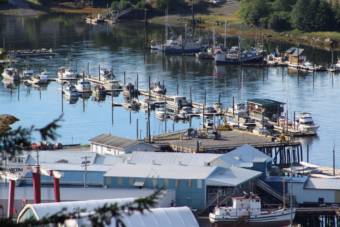
Trident’s Wrangell plant and Reliance Harbor (Photo by Sage Smiley/KSTK)
One of Wrangell’s two fish processors will remain closed for the second year in a row. Seattle-based Trident Seafoods cites a dismal salmon forecast for its decision.
Chum and pink salmon returns to Southeast Alaska over the last few years have crumpled, and the predictions for the coming season aren’t especially heartening.
“It’s been a real disaster around here,” said Wrangell commercial fisherman Gig Decker. “I mean, my main income has been the dogs — the chum salmon — and the runs just haven’t been coming back. They don’t know if it’s because of the blob or warming or what it is, but the biologists don’t seem to have a lot of optimism about it.”
Citing the poor returns, Trident’s fish processing plant stayed shuttered and silent last summer. And the royal blue plant in Reliance Harbor is going to stay closed for a second year.
Trident Seafoods has confirmed that its Wrangell plant won’t be opening again this year.
“We hope to see a return to higher abundance and opportunity to support running the facility in the future,” Trident spokesperson Stefanie Moreland wrote in a statement.
Trident has had a presence in Wrangell since 2009 when it bought out the bankrupt Wrangell Seafoods company. The seafood giant operates about a dozen other plants throughout Alaska, including in Petersburg and Ketchikan.
Decker, the Wrangell fisherman, said he understands that Trident can’t justify the cost of operating a plant if the fish aren’t there, but it complicates the fishing season to have the Wrangell plant closed: “Of course, it was really convenient for me — not just that they bought my fish, but there was a lot of other services, like machining and moving gear and equipment. And so it — it’s been a real drag to not have a cannery open.”
Wrangell’s other, smaller processing plant, Sea Level Seafoods, will operate this year although it’s getting started later than usual.
Its Oregon-based parent company Pacific Seafood said in a statement that the Wrangell plant didn’t operate during March’s halibut opening because of complications of staffing the facility due to COVID-19. It pushed its opening date back until May 1.
That’s left Wrangell fishermen like Alan Reeves feeling desperate after last year’s low halibut prices. The wholesale market was poor in 2020, with hotels and restaurants buying a lot less everything — including seafood.
“I lost $40,000 on it last year, at least,” Reeves said. “It’s not something you play with when you’ve got that kind of investment. I mean, I’ve got family that go out with me and everything else, and they rely on it [as well].”
Reeves spent about a decade on Wrangell’s port commission and he knows the importance of fisheries business taxes to the island’s local government. But he also said he couldn’t afford to wait for a Wrangell processor to come online. He had to go somewhere else to sell halibut.
“The jobs and the tax went to another town this year,” he explained. “For the first time since 1981 commercial fishing. I’ve only sold one time out of town.”
Last year’s fish tax payments haven’t been calculated yet, so it’s not clear what the financial impact of 2020’s poor returns and single operating plant will be.
Wrangell officials said it’s difficult to determine the exact effects of a shuttered plant. There won’t be large-scale utility payments from the plant. Fish taxes paid out to the borough will probably be lower. And there’s also the simple lack of processing workers eating, living, and working in the community.
Decker said he’s holding out hope that there might be a fishy hail mary this season, even though Wrangell’s Trident plant won’t be open.
“I’ve seen things like this before,” Decker said. “I’ve had years where I did tremendously well after everyone thought it was going to be a disaster. So that’s fishing.”
Sea Level Seafoods said they’re working on icing and baiting boats. They’re typically up and running through the end of October.
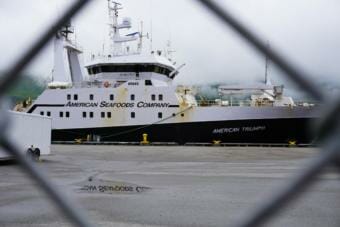
The American Triumph — a 285-foot factory trawler with an onboard processing plant — sits in the Port of Dutch Harbor. (Hope McKenney/KUCB)
Alaska’s commercial fishermen have been speaking out against big trawlers for years, complaining that the large vessels in federal waters are scooping up mature and juvenile fish. The regional council that manages federal fisheries recently heard from hundreds concerned about the number of salmon and other species that end up as bycatch in trawl nets.
For Alaska’s troll fleet, king salmon is their money fish. In state waters, small crews on these 40-to-50-foot boats — or on even small skiffs — will catch a fish at a time, and it’s worth it: chinook salmon can fetch $6 a pound from a processor.
But there’s another big-money fish in Alaska: Pollock. It’s the white fish found in a McDonald’s Filet-O-Fish or an imitation crab stick. And the factory trawlers that ply the Bering Sea and Gulf of Alaska in search of pollock and other groundfish scoop up chinook salmon and other species in their wide nets.
Federal fisheries data shows trawlers in the North Pacific took about a tenth of the chinook — or king salmon — caught by Alaska’s commercial salmon fleet last year. And those numbers are tracking the same this year. But none of that catch happens on purpose.
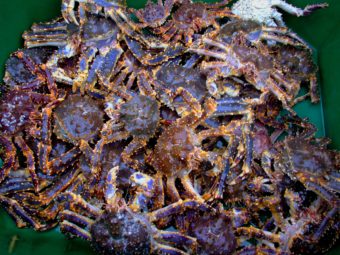
Preliminary ADF&G data shows about 263,000 kings were commercially harvested last year statewide. As of April 15, bycatch in the Bering Sea and Gulf of Alaska areas for 2021 was around 16,000 fish, over six percent of last year’s statewide commercial harvest. Last year’s trawler bycatch was 26,000 kings, or about a tenth of the 2020 commercial chinook harvest in-state.
The trawlers can’t keep or sell the kings. Those salmon are bycatch and have to be donated or thrown overboard.
Lexi Hackett is a Sitka-based troller. She says the waste of the industrial trawl fleet is a black eye on Alaska’s other well-managed and sustainable fisheries.
“I’m sitting here and trying to explain sustainability of fisheries — Alaska seafood, and Alaska sustainability, and how we have this great managed system up here,” Hackett said. “And of course, there’s always going to be room for improvement. But for me, the big elephant in the room is this kind of mismanaged, wasteful bycatch issue with trawlers that happens. And honestly, it’s just unacceptable.”
This isn’t a new issue. But recently the North Pacific Fishery Management Council, which manages federal fisheries, invited testimony on the issue of bycatch. Hundreds of fishermen, industry workers, and Native people and organizations from around the Pacific Northwest and Alaska wrote and called in over three days of this month’s meeting.
Crew members shovel pollock on the deck of a Bering Sea trawler last year. (Nathaniel Herz/Alaska’s Energy Desk)
By nature, trawl fisheries incidentally catch all kinds of species — salmon, herring and halibut, to name a few. It’s a tiny proportion of what they catch — roughly 1% according to NOAA Fisheries — but trawlers harvest such massive volumes that it’s an issue. Especially for species like chinook salmon, which are by far the most threatened.
Becca Robbins Gisclair, the director of Arctic Programs at the Ocean Conservancy, an environmental nonprofit, says commercial and subsistence harvests of kings in Alaska have been dropping for years.
“Fifteen years ago, when I was first working on the Yukon River and we were first having these conversations about salmon bycatch, you could buy Yukon chinook salmon in a grocery store — there were marketing campaigns to try to expand those markets,” Robbins Gisclair testified to the council. “Now the idea of buying a Yukon chinook salmon in a grocery store in Washington seems as bizarre as hugging someone outside of your household.”
There are a variety of federal measures already in place to try and reduce wasted bycatch. One is what’s called the “Mothership Salmon Savings Incentive Plan Agreement” (MSSIP). It basically allows some flexibility in bycatch limits for processors and fleets by letting them earn credits for minimizing bycatch. Those credits can then be used in later years to take even more when industry analysts say bycatch is less avoidable.
Some in the industry say that’s a good system.
“The incentives are clearly forcing the fleet to fish in the same general areas of lowest chinook bycatch,” said Austin Estabrooks. He’s with the At-Sea Processors Association, which represents some of the largest factory trawlers.
But others associated with groundfish and pollock trawl fisheries in Alaska point out that rolling closures and strict bycatch limits can be, well, limiting. In the vast expanses of the Gulf of Alaska and Bering Sea, the places trawlers need to avoid can vary wildly year to year. Last year, the winter savings area of the Bering Sea and Aleutian Islands fishing area closed — a stretch of water the size of Maryland.
“It’s a huge problem to manage bycatch when you have mandatory closure areas for other species or other reasons,” explained John Gruver, the intercoop manager for United Catcher Boats, a fishing trade association.
Many of those who testified to the council noted the destructive impacts on subsistence fisheries. Rural Alaskans, many of them in Native communities, rely on this to feed their people.
“The continued waste of salmon and halibut in the federal fisheries at the current levels are unacceptable, and action must be taken to reduce bycatch,” said Mellisa Johnson. She’s the executive director of the Bering Sea Elders Group, a tribal association from 39 tribes in the Yukon-Kuskokwim Delta and Bering Strait regions.
“Our elders have always taught us not to waste our different food sources, whether they be birds, different greens from the land, berries, and, most importantly, a lot of us throughout the state of Alaska and into the Lower 48 and other areas around the world can we all can relate about a type of fish,” Johnson said.
Raychelle Daniel is Yup’ik, and an officer with the Pew Charitable Trusts. She said she appreciates what has already been done by the industry and council to reduce bycatch, but she still sees a glaring hole in the discussion — formal invitations to Native people and organizations to share their ways of knowing.
“To gain a deeper understanding about the issue, you should also invite Indigenous organizations and regional management bodies to share more information, not only to gain a better understanding about what food security and cultural perspectives mean, but about observations and measures that people are taking to conserve salmon,” she told the council.
Members of the powerful North Pacific Fishery Management Council say they’re listening.
Council member Andy Mezirow says he hopes to get a formal report that can shed light on this issue that puts it in plain terms that anyone can understand.
“Not for the average person with a Master’s degree in marine biology, because I think we’re seeing a lot of engagement on this issue,” he said. “And I think the more public can understand the good work that’s being done to figure out how many — where these salmon are coming from, and the impact on the exact streams that they’re worried about, the more informed the public is, the better they’ll become aware of the extraordinary efforts that we’re making to try to figure out the impacts on these communities.”
After hearing public testimony and invited presentations, the North Pacific Fishery Management Council formally requested more information on where salmon would have been returning if they hadn’t been bycatch, as well as updated information to update matrices that correlate salmon length to age — another vital part of determining the total impact of bycatch to Alaska’s chinook salmon populations.
Pribilof Island blue king crab, last harvested commercially in 1999. (Photo by Celeste Leroux/Alaska Sea Grant)
Alaska lawmakers are considering legalizing hatcheries to boost wild shellfish stocks like king crab and mussels. It’s an idea that’s been around since at least the 1990s, and the goal would be to replicate the economic success of Alaska’s enhanced salmon fisheries.
But some scientists say they’re worried about what hatchery crab and other species could do to natural populations.
Throughout Alaska’s waters, shellfish populations have been in decline for decades — decimated by overfishing in the 1980s and by changing ocean environments in the years since.
Bristol Bay’s world-renown sockeye salmon fishery was a bright spot in a dismal statewide salmon harvest last year. But its red king crab fishery is in steep decline.
“There’s quite a lot of concern that this [Bristol Bay red king crab] fishery could close as early as this year,” says Ginny Eckert. She’s a professor of fisheries at the University of Alaska Fairbanks. Eckert spoke at a legislative hearing earlier this month in favor of a bill that supporters say could help re-animate shellfish populations statewide, including in Bristol Bay.
The Dunleavy administration supports the initiative. Sam Rabung, the commercial fisheries director for the Alaska Department of Fish & Game, has a background in mariculture. He says allowing hatcheries for crab and other commercially harvested wild species could help state fisheries managers in Alaska.
“The only tool the ADF&G has at this time to help those stocks recover is to keep the fisheries closed, which we have done for over 35 years,” Rabung said. “With the passage of SB64, there’ll be another tool to try.”
Sponsored by Kodiak Sen. Gary Stevens, Senate Bill 64 would specifically allow shellfish hatcheries in the state. Proponents say investors could then grow and release shellfish like clams and crab to boost statewide shellfish populations.
There’s already mariculture in Alaska on state leases. Aquatic farms produce Pacific oysters, blue mussels and several species of kelp. But Rabung says mariculture hatcheries would be a form of fishery enhancement for species released and caught in the wild.
“This entails the restoration, rehabilitation or enhancement of natural production, and benefits common property fisheries, subsistence or personal use, sport and commercial rather than private ownership,” Rabung explained.
Ketchikan Rep. Dan Ortiz sponsored the House version of the legislation.
“It’s all in the name of taking advantage of what has so far been an untapped resource in terms of the oceans and the shorelines of Southeast Alaska and of coastal Alaska,” Ortiz said. “[Those areas] have always been ripe for this kind of thing.”
Ortiz says new mariculture development could be a significant economic driver: “The recognition that we need to diversify our fisheries industry even more as other fisheries start to maybe encounter problems — I guess there hasn’t been the need, necessarily, up to this point in history. And now that there’s the need, we’re providing the pathway for that need.”
But there are some who worry how releasing juvenile shellfish species would affect the larger ecosystem.
University of Alaska Fairbanks fisheries professor Milo Adkison wrote a letter warning lawmakers that juvenile crabs aren’t like young salmon that mainly return to the same rivers and streams each year. Crab go wherever.
“The big problem with the crab hatcheries and makes them a lot more risky is that they are not going to segregate from the wild stocks,” Adkison said. “They’re not going to congregate in the spot where you can harvest them without also harvesting the wild-born animals, and they’re not going to be reproductively isolated from the wild crabs as well. Basically, you’re going to have a mixture of wild and hatchery-born crabs.”
Adkison told KSTK in an interview that he knows mariculture has the potential to benefit fishing communities. But he wants to make sure the state doesn’t harm its marine resources.
“Based on the evidence and the research we have right now, in my opinion, it’s much too risky to proceed with a crab hatchery program,” he said. “But further research could possibly change my mind.”
Fish and Game’s Sam Rabung says even if the bill becomes law, don’t expect a gold rush-type stampede for shellfish hatchery permits. He says his agency would be deliberate and conservative with an emphasis on natural productivity.
“Alaska already has the most stringent aquaculture guidance in the world,” Rabung reassured legislators. “And it’s held up as the example of how to do it right, in a manner that minimizes negative effects on natural production and maintains the sustainability of natural production and the fisheries and people who depend on that. That will not change.”
The legislation would also allow the Alaska Seafood Marketing Institute to throw its weight behind hatchery-raised shellfish products, and would allow Alaska’s nonprofit salmon hatcheries to get into the mariculture business.
Both versions of the bill — House Bill 41 and Senate Bill 64 — are still being heard and debated by legislative committees. A date on a floor vote hasn’t been set.
Close
Update notification options
Subscribe to notifications
Subscribe
Get notifications about news related to the topics you care about. You can unsubscribe anytime.