KSTK - Wrangell

KSTK is our partner station in Wrangell. KTOO collaborates with partners across the state to cover important news and to share stories with our audiences.
A state government shutdown could also shutter Alaska fisheries

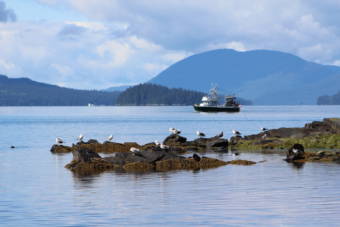
A fishing boat passes Wrangell’s City Park. (Sage Smiley/KSTK)

If Alaska state leaders can’t resolve an impasse over the budget, large swaths of state government will shut down in July. That could include Alaska’s lucrative summer salmon fisheries, which is causing concern across coastal communities.

Southeast Alaska’s summer salmon troll fishery opens July 1. That’s the same day nearly 15,000 state workers could be out of work. Among those is Grant Hagerman, a state fisheries biologist managing the fishery from Sitka.

“We’re planning not to be here on July 1 unless we hear differently,” Hagerman said. “And with that, that summer fishery does not commence.”

Many of Alaska’s fisheries are operated by emergency order. That means fisheries open and close based on real-time data and the professional judgment of biologists like Hagerman. But he’s not part of the special class of state employees that would keep their jobs even in the shutdown — public safety and public health workers.

“You would think that we would have had a message, maybe from administration, just saying ‘Here are the exempt or partially exempt or whatever job classes that could remain open,’ but we didn’t get anything like that. I think it’s just pink slips across the board if they don’t pass so just — it’s really scary, you know, not just for us losing our jobs, but I mean, we manage a fishery with 1,000 permit holders and Southeast, so it affects a lot of people.” Hagerman said. “But I have faith that they’ll get something agreed to.”

Even at the top of the ladder, agency leaders say they don’t have many answers. Rick Green, a special assistant to the commissioner of the Alaska Department of Fish and Game, says this is the closest his agency has come to actually shutting down.

“We as a state are on uncharted ground, because I think last time — the closest it ever got resolved was nine days before, or eight days before,” Green said “So we’re closer than we’ve ever been before.”

Green says the department is operating with the hope that the budget discussion will be resolved before that deadline.

“It’s a big question, but it’s one that we’re not addressing, and we’re hoping with best intent that this comes to a resolve and we don’t have to change anything,” he said.

This lack of clarity is stressful for everyone in the industry, says Amy Daugherty, executive director of the Alaska Trollers Association.

“Here’s the bottom line — many of our guys [commercial trollers] head out of town in preparation for the July 1 opening a few days in advance, obviously. And we’re coming right up on that within the next few days,” Daugherty said. “So, you know, this is incredible that we’re going to be so directly impacted by these huge decisions, which, you know, are way over our head.”

Ketchikan Rep. Dan Ortiz — an independent — says he and most of his legislative peers understand the gravity of the situation.

“Any kind of commercial fishing where it requires management — on-site management of the department — is in jeopardy,” Ortiz said Wednesday morning.

The main sticking point he says was a procedural vote in which four Republican House members refused to set the effective date of the budget to July 1. It’s part of a larger battle over the size of Permanent Fund dividend checks for Alaskans.

“And so therefore, we are where we are,” Ortiz said. “We all are aware that if we can get that thing done, or if we can convince the governor that he doesn’t have to have it done in order for him to enact the budget, either those two things would prevent a government shutdown.”

The economic impact of shutting down Alaska’s lucrative commercial salmon season would be huge, especially in places like Bristol Bay which peaks in July.

Dan Lesh, a Juneau-based fisheries consultant with McKinley Research, looked at the value of salmon landed over the past five years. He says that on average about $316 million worth of salmon is typically taken in the month of July alone.

“Over 50-52% — over the last five years of the value of our overall salmon harvest for the year was in the month of July, and that’s value to the fishermen,” Lesh said.

And even if state workers go back to work just a week or so late, the damage could be done. That’s because most salmon species are heading towards rivers and streams. It’s not possible for the fishing fleet to get a second chance for intercepting a lot of them.

“The only species that harvest could maybe be made up for would be king salmon,” Lesh said. “You could have some of those — good portion of those harvests are not necessarily heading to their home river, but the other fisheries are all timed to runs that are as a fish are entering spawning habitat. So they’re not available for harvest later on in the summer.”

The potential $316 million loss in payments to fishermen doesn’t include the possible impacts to seafood processors and other shoreside support for Alaska’s commercial fleet.

This story includes reporting from Izzy Ross at KDLG in Dillingham, and Jacob Resneck with CoastAlaska in Juneau.

Wrangell’s new wildlife trooper knows what it’s like to make a mistake

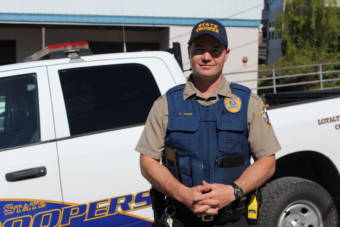
Wrangell’s state wildlife trooper, Chadd Yoder. (Sage Smiley/KSTK)

Alaska’s hunting and fishing rules are strict. They’re primarily enforced by the state’s Wildlife Troopers whose sworn duty, according to their motto, is to be “Protectors of People and Resources.”

But wildlife troopers can make mistakes and find themselves on the other side of the law.

Wrangell’s state wildlife trooper has been here on the job for about two months. Trooper Chadd Yoder came from Wasilla, where he spent six years — two as a trooper. The 33-year-old is originally from Pennsylvania but says he’s long been drawn to the rainforest.

“This is a post that I put in twice for. So I really wanted to be here in Southeast Alaska,” Yoder explains.

He arrived here on the ferry with his wife and three young kids — the oldest is eight and the youngest is two.

“Initially, when we pulled into port, my son — you know, it was a little bit overcast, the clouds were burning off — he’s like, ‘Dad, I don’t like it.’” Yoder says. “[I told him] ‘Buddy, you have to give it some time.’ Well, you know, an hour later, they’re all smiles, running around, introducing themselves to the kids that are walking down to school, kind of making arrangements for playdates and all that.”

As a trooper, it’s his job to live and breathe hunting and fishing regulations. But he says even a professional can make mistakes.

Last November, he was convicted of taking a moose that was too small during a September hunt in Unit 13, between Wasilla and Glennallen. Yoder says he has a passion for moose hunting — his personal schedule revolves around the season.

“I go with my wife, and we normally go for five or six days,” Yoder says, “And it’s a whole event. We go out there, we set up a grand camp that normally overlooks an expanse of land. And we have a great time, just hiking around inventorying the moose and photographing and hunting.”

They’d been at camp for a couple of days with his wife and her father.

“I was awakened by my father-in-law, who was exclaiming about two moose who are fighting right outside our tent. Two bull moose, that was very exciting. And, you know, he said the one definitely has potential. You know, it may be legal,” Yoder relates.

The three watched the fighting moose and talked it over. Should they take a shot?

“I’ve been through this before and passed up lots and lots of moose. And so we discussed: ‘Man, that one’s clearly bigger than the other and by golly, looks legal.’ We took our time actually, assessing the situation and we had probably 10 minutes to look and to gauge. And so it was a consensus that it was legal, and it was my turn to shoot a moose that was of, you know, trophy value or larger.”

It was a clean shot. The animal fell lifeless and Yoder says he walked over to measure the antlers. But they didn’t meet the width requirement or the brow tine requirement. He’d just broken the law he’s sworn to uphold.

“Of course, you have that sinking, sinking feeling only accentuated by my position, right?” Yoder said. “It went from a grand day and an awesome trip to ‘This is probably like, one of the worst things that has happened in my adult life.’”

Yoder says it never occurred to him to do anything else but cop to it. He took a video of his unlawful kill.

“Then we validated our harvest ticket, we complied with salvage requirements by taking all the edible portions of the meat even though I knew we weren’t going to be able to keep it — for the next person,” he said.

Then they made the 20-mile ATV journey out of camp toward Wasilla.

“As soon as I got within cell reception, I made that call to the Alaska Wildlife Troopers,” he said. “And of course, it went exactly like you’d think: ‘Hi, this is Chadd Yoder.’ ‘Trooper Chadd Yoder?’ ‘Yes, it is.’”

Yoder paid a $320 fine and received a ticket for the unlawful hunt. Troopers confiscated the antlers and meat — sub-legal kills are often donated to charities. He says he feels like the whole experience has made him more empathetic in his job as a wildlife trooper.

“When I tell people — it’s a common thing I say is like, ‘Hey, I know how you feel.’ And I will share my story with people, you know, and I’ve done that even last week. I truly do know how they feel,” Yoder said.

While the experience of killing a too-small moose was embarrassing, he says it didn’t have anything to do with his transfer to Wrangell. The Department of Public Safety, which oversees the troopers, told KSTK in a statement that it doesn’t punish troopers by transferring them.

“Trooper Yoder volunteered to accept the challenge of being the lone Wildlife Trooper for the Wrangell area. DPS does not transfer Troopers as a punitive measure for any reason. DPS does not comment on any personnel matters,” the department wrote.

Wrangell has had a fair bit of turnover at its one-person AWT post. The last wildlife trooper arrived in 2019 and left a little more than a year later. Yoder says he hopes to stick around longer.

“We intend to be here for a while — want to build trust with the community,” Yoder said, explaining that he and his wife bought a house here.

Compared to living in the Interior, Yoder says he most enjoys the proximity to the ocean and the fact that there aren’t long distances to travel.

“My son gets to walk to school,” Yoder said. “We don’t even have to walk with him, he walks to school, he comes home, he walks with the neighbor kids. Little League is just down to just down the hill. So everything’s close, we spend more time living life versus just running around in a vehicle.”

Yoder grew up in Lancaster, a town of about 60,000 in Pennsylvania’s Amish country. He says he initially came to Alaska on the invitation of a homesteading acquaintance and moved here with his family in 2015. He graduated from the Alaska State Trooper academy two years ago, which was a career change.

“I worked 14 years as a contractor, a handyman. Which I enjoyed, I really did like working with my hands. I liked doing those things. But I wanted a career that was challenging — something different, something that would stretch me as a person and professionally. And so I saw the troopers as an opportunity for that,” he said.

Yoder says his job requires him to be strict. If rules are broken: “You’re going to get a fine. I got a fine, and I wouldn’t have it any other way.”

“If you make a mistake, own it,” Yoder says. “That’s what we ask of hunters. Like, if you shot a sub-legal animal, there’s a violation that occurred, it’s going to be addressed. But it’d be far better to go that route versus the other route of hiding it, and it’s discovered later.”

Yoder encourages people to stop by and bring their questions — the office is in the Kadin Building on Wrangell’s Front Street.

“If my truck’s there, I’m there,” he says.

Wrangell summer camp teaches kids about science and culture

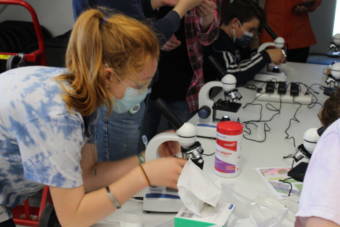
Culture Camp attendees hold up devices to catch plankton in Wrangell’s Reliance Harbor.
(Sage Smiley / KSTK)

School’s out for the summer, but that doesn’t mean kids aren’t learning. KSTK attended an afternoon of a science and arts camp put on by Wrangell’s local tribe and Sealaska Heritage Institute.
The mood is buzzy as we make the walk from the local Tlingit tribe’s cultural center to Wrangell’s Reliance Harbor. Sixth-grader Devin Aleksiev is already wearing his life jacket, which he demonstrates he can put on even if it’s already buckled.

“It’ll hurt like heck on your wrist if you have a watch on,” Aleksiev says, pausing to take off his watch. He says he likes everything about culture camp and is happy to be here.

“Just wasn’t happy when I woke up,” he adds, wryly.

About 15 middle schoolers are participants in Wrangell’s 2021 Culture Camp. The camp has a STEAM focus — that’s science, technology, engineering, art, and math, helping Wrangell kids build cultural knowledge and learn about careers in the community.

“Last year was the first year and we did a virtual summer camp last year, because of COVID” says Paul Leininger. He’s a Juneau-based STEAM project coordinator with Sealaska Heritage Institute. “This year, we wanted to get out and reach out to all six communities, instead of bringing kids to Juneau during COVID. We thought it would be a great opportunity to send everyone out — to send adults out to the communities and serve the kids where they are.”

Sealaska Heritage Institute is running similar camps in Juneau, Sitka, Hoonah, Angoon and Klawock, with help from a federal Alaska Native Education Program grant.

“They all have their own local twist,” Leininger says, “All doing something unique. [We’re] really excited to see how everyone is able to get to experience their own community and STEAM careers in their community.”

It’s mostly sunny out, with a stiff breeze. Strange contraptions that look like jellyfish made of plastic bottles and nylon stockings float from the hands of a few of the kids. Aleksiev points to one, and explains the exercise: “We made plankton nets, and we’re gonna catch plankton and then we’re gonna look at them through microscopes.”

Hopefully, the jellyfish-like contraptions will concentrate microscopic water critters into a little sample bottle. Camp participants will take that water back to the cultural center, where half a dozen microscopes sit ready.

Aleksiev is excited for the opportunity to look at something alive through a microscope.

“I’ve gotten a microscope before,” he says, “But it sucked. And all it gave me to look at was dandruff. Literally, it just gave me dandruff to look at.”

Down on the float plane dock, Kim Wickman rounds up the campers to explain the experiment. The kids drop the makeshift nets off the dock, and shuffle along single file, scraping the water surface with their stockings.

Wickman is the Indian General Assistance program coordinator for the Wrangell Cooperative Association. It’s a wide-ranging job. Today, she’s a plankton-collecting and analyzing expert.

After putting in her dues trawling back and forth, eighth-grader Phebe Garcia steps away from the side of the dock. She says she appreciates the opportunity to learn about different careers in the sciences and other outdoor fields, even if she doesn’t see herself ending up in a fieldwork sort of job.

“I don’t really like going outside,” Garcia says. “If I get bit by a bug I swell up, so I like staying inside. I think it’s fun, though, to learn about this stuff. And I think other people [here] want to work outside.”

Trying to catch microorganisms in homemade contraptions is just one of the wide variety of activities on the schedule of culture camp. Kids heard presentations from the Forest Service and a local tour operator. They paddled canoes, made their own canoe paddles, listened to traditional stories and songs, and had Tlingit language lessons throughout the week. This culminates in an overnight trip to Kaats’litaan, Old Willow Town, the historic Wrangell site.

Back at the cultural center, Tlingit bead artist Florence Marks Sheakley sits bent over a partially complete blue flower pattern, about the size of a palm.

“They want me to do beadings,” Sheakley says, pausing her needle. “So that’s what I am doing with the kids. I’m teaching them how to bead.”

Sheakley says she’s been coming to Wrangell’s culture camps for a few years now. Under her watchful eye, the kids get to make their own tiny bead designs.

In another corner of the building, with — hopefully — plankton-filled water bottles in tow, six kids at a time stoop over microscopes, overseen by IGAP coordinator Wickman.

Looking for plankton (Sage Smiley / KSTK)

“So you see the little guy that’s moving up here in this kind of corner,” Wickman says, peering into a microscope. “That is a Tintinnid. And he’s actually zytoplankton, and actually as he’s moving, he’s hunting. So he is trying to find other little creatures that he can absorb into himself for lunch.”

“Oh my gosh!” exclaims someone at the table.

Eighth-grader Ben Houser squints through one eye into his microscope.

“Basically just a bunch of debris,” Houser narrates as he adjusts the slide over the microscope light. “Small plants… I think there’s a bunch of little squiggly lines that — everything’s moving because there’s too much water in my slide.”

It’s sort of what he was hoping to identify on his microscope slide.

Houser describes his dream slide: “Seaweed, maybe a shark. We could always wish.”

It remains to be seen what Houser will call his favorite moment from culture camp, although realistically, it won’t be finding a shark in a sample of Wrangell harbor water.

Wrangell gathers for fleet blessing at nearly finished Mariners’ Memorial

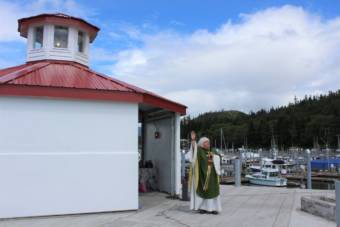
Pastor Sue Bahleda blesses Wrangell’s fleet on behalf of the Wrangell Ministerial Association. (Sage Smiley, KSTK)

As summer fishing seasons gear up and get started, Wrangell community groups gathered at the Wrangell Mariners’ Memorial to wish safety to anyone on the water and remember those who have lost their lives at sea.
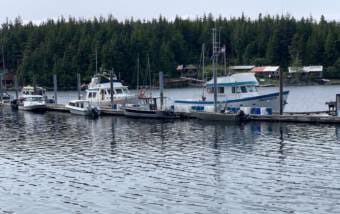
A handful of boats bobbed outside the breakwater of Wrangell’s Heritage Harbor on Sunday afternoon, listening by VHF broadcast to the town’s 2021 “Blessing of the Fleet.” To the delight of attendees on foot, the morning’s cloud cover broke just before the start of the ceremony.

“The blessing of the fleet is a tradition that began centuries ago in Mediterranean fishing communities,” began Island of Faith Pastor Sue Bahleda, who delivered remarks representing the Wrangell Ministerial Association. Her blessing concluded: “We bless these crafts and their crews, in their work, in their play, in their days, and their nights. Be safe, be strong, be fruitful, this day and every day.”

While fleet blessings have been a storied tradition of coastal communities for generations, Wrangell hasn’t had a solid, annual tradition. But the Wrangell Ministerial Association and Wrangell Mariners’ Memorial Committee aim to revitalize the event, at a more permanent space for reflection on lives lost at sea — the Wrangell Mariners’ Memorial.

Committee chair Jenn Miller-Yancey says the memorial is in the final stages of construction.

“As you can see, we have fresh concrete poured,” Miller-Yancey announced at the start of the service. “Thank you everyone for being really careful around that. The concrete truck was only available this weekend.”

Wrangell’s Mariners’ Memorial is an idea that’s been in the works for decades but was formally brought to the city’s port commission in 2012. Five years later and after many discussions, a group of Wrangellites formed the Wrangell Mariners’ Memorial Committee and got the group nonprofit status.

After deciding on a design, the group broke ground on the Mariners’ Memorial in late 2018. Over the last year, the site has really taken shape, with the construction of a hexagonal lighthouse pavilion with an 800-pound compass rose in its center and sweeping, boat-shaped iron walls which will hold the names of Wrangell mariners who have passed on.

Some of the first names to grace the memorial will be those of Helen and Sig Decker. The 19- and 21-year old Wrangell sister and brother died along with two of their fishing crewmates in a car crash on Mitkof Island last year. Some of the funds raised in the siblings’ memory were donated to help complete construction of the Mariners’ Memorial.

To wrap up this year’s fleet blessing, Wrangell middle-schooler Madelyn Davies read the poem “If you’ve Ever Lived On an Island” by J. Earnhart. 

Here are the last two stanzas:

Attendees at the 2021 ‘Blessing of the Fleet’ (Sage Smiley / KSTK)

“If ever you’ve heard the seagulls
the waves, a foghorn, the winds;
Then you’ve heard the song of the island
and the peaceful message it sends.

Indeed, if you live on an island
if you’re lucky to live by the sea
You’ll never return to the mainland,
as your spirit has been set free.”

One of the assembled boats responded with a honk of thanks as land-based well-wishers milled about, chatting and enjoying local cookies and donuts.

The Mariners’ Memorial Committee hopes to raise up to $25,000 to complete the current phase of construction: finishing the memorial walls and starting to add memorial plaques. After that, it’ll be on to landscaping the site.

Wrangell to compensate Meyers Chuck residents for repairs on sinking docks

Blue and white barrels lined up on a Meyers Chuck dock. The barrels have been used as a temporary repair to keep the community’s docks above water. (Courtesy City and Borough of Wrangell)

A critical lifeline for the Southeast hamlet of Meyers Chuck is sinking.

The tiny community is about 50 miles south of Wrangell proper but still within the borough boundaries. It’s only accessible by boat or float plane, and the planes are especially important for mail deliveries and medical emergencies. But Meyers Chuck’s docks, including where float planes land, are slowly going under.

Wrangell Borough Manager Lisa Von Bargen explained that sinking docks have been a problem in Meyers Chuck for around a decade. And she says Wrangell’s government has failed to meet its obligation to do maintenance on the docks and floats. So to save the hundreds of feet of sinking dock, Meyers Chuck residents made multiple repairs themselves.

“Because we had not done anything about it,” Von Bargen told the assembly last week, “the citizens went and bought their own barrels and installed them, with their expertise and their labor, installed them under the dock — more than 100 of them the first time, and I think about 30 of them this round, and put them in to make sure that that dock remained floating.”

At a meeting last month, Wrangell’s borough assembly approved almost $8,000 to reimburse Meyers Chuck residents for dock repairs. But Von Bargen says help with their docks is  really all that residents of Meyers Chuck want. In their estimation, Wrangell’s water system is worse than their own.

“With all of the infrastructure we have to deal with, the folks in Meyers Chuck were like ‘Yeah, we have a water system, and you don’t want anything to do with that. And we don’t want you to have anything to do with it,’” Von Bargen said, laughing.

Von Bargen says the harbor department is working as quickly as possible to replace the failing airplane float. It will also begin the process of fully replacing the float system under all of Meyers Chuck’s docks.

Remembering Kurt Brodersen, the ‘MacGyver of Union Bay’

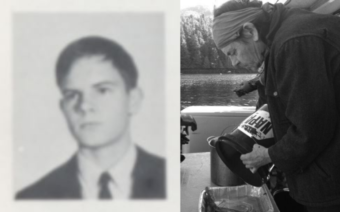
Kurt Brodersen in his 1966 yearbook photo (left), and the photo published with his obituary (right).
(Juneau-Douglas City Museum and Ketchikan Daily News)

The Union Bay mariner who made the news last year after cheating death when his boat capsized during a storm succumbed to cancer less than five months later.

On a dangerously stormy night last November, four Coast Guard members risked their lives to save Kurt Brodersen, a 70-year-old man whose boat sank about 50 miles south of Wrangell.

The four crew members of the MH-60 Jayhawk helicopter — pilot and copilot Lt. Justin Neal and Lt. Jonathan Orthman, flight mechanic Petty Officer 2nd Class James Schwader, and rescue swimmer Petty Officer 2nd Class Grant Roberts — received Air Medals for heroic service at a ceremony in early May.

Brodersen lost nearly everything he owned that night. But he remained upbeat about the whole thing. Here he is speaking to KSTK on Nov. 13, a week and a half after his boat — the Irony — sank in the storm.

“In a way, it’s sort of liberating because I’m starting fresh,” Brodersen said at the time. “Just the clothes I’m wearing. The problem that I’m having is — I don’t know. I don’t exactly have a goal for the rest of my life. But you know, maybe something will occur to me.”

Brodersen spoke with hope of life after the Irony sank. But after recovering initially in Ketchikan, Brodersen came to Wrangell, where doctors discovered a fast-moving spinal cancer. Brodersen died on March 26 — his 71st birthday. His neighbor Debbie Johnson in Union Bay recalls a humble person who didn’t want to take up too much space.

“He wasn’t intimidating at all,” Johnson said. “He wasn’t aggressive at all. He was just this very gentle person. And it just made you just want to know him. And he never made you feel in any way awkward or anything, you know. Just a very loving person.”

She said it was difficult to see her good friend go through so much tumult in such a short period of time.

“He just had a hard time of it — at the end there. Just, he definitely didn’t deserve all the things that life threw at him there at the end,” Johnson said.

She and her late husband first met Brodersen in 1979.

“We were shrimping and caretaking Bell Island back in the day, and he was shrimping up around Behm Canal at the same time,” she said.

It was an instant and lifelong friendship. Brodersen was a whiz with problem-solving and could fix just about anything.

“It’s like he was like, he was like our MacGyver. That’s what we called him here in Union Bay; he was the MacGyver of Union Bay.”

But even as close as they were, she said Brodersen valued his privacy.

“He liked being alone,” she said. “His property out here — you have to cross a bar at high tide to even get back to where his property was. And he absolutely loved that. Because nobody, you know, he would know when someone could come through there to see him if they wanted to see him. You have to wait for a high tide.”

Brodersen had a floathouse on his property, but lived on his boat. Johnson said she’d check up on Brodersen how she could.

“He had a lot of stuff on the back deck [of his boat], his hot tub and all kinds of all kinds of stuff,” Johnson said. “He liked taking a hot tub every day, so I’d always know that he was down there and doing okay down at his place because I couldn’t see him from my house, but I could hear his chainsaw every afternoon cutting firewood for his daily hot tub. So I knew everything was okay.”

Johnson said she misses Brodersen’s unfailing helper attitude.

“He was mister reliable,” she said. “Someone to go to if you had a problem because it just never failed, he would drop whatever he was doing to give you a hand and he wouldn’t even ask what it’s about. He would just stop and come and lend a hand.”

He was a treasured friend to his small, chosen-family circle.

“I just genuinely loved him, and my husband did, too,” Johnson added.

At Brodersen’s request, there was no funeral. Johnson says he bequeathed his Union Bay property and small floathouse to some of his closest friends. His boat and former home, the Irony, remains unrecovered on the seafloor.

Site notifications
Update notification options
Subscribe to notifications