KSTK - Wrangell

KSTK is our partner station in Wrangell. KTOO collaborates with partners across the state to cover important news and to share stories with our audiences.
Wrangell seeks ‘COVID greeter’ to tell visitors about local mandates

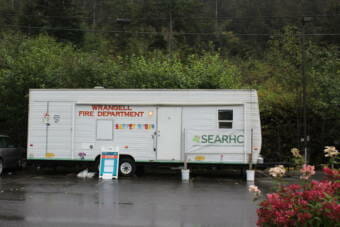
A white camper trailer used for COVID testing
While community COVID-19 testing used to take place at the airport, it’s now run from SEARHC’s testing trailer from 12-4 p.m. Monday through Saturday. (Sage Smiley/KSTK)

In late September, Wrangell’s community COVID-19 test site moved from the airport to the hospital, a little over a mile away. But Wrangell’s local government mandates testing for unvaccinated people arriving in the community.

So the emergency operations center is looking to hire a greeter to help air passengers find their way to the testing site.

Borough Manager Lisa Von Bargen says the EOC developed the position “to be able to try to provide folks at the airport to assist with providing information, since the testing is no longer being held there, it’s up at the at the clinic, or to provide information, whether it be answering phones or wherever we may find we need an information greeter.”

That information could include telling arriving people about local mandates, where to test and access to COVID-19 vaccines.

The greeter would report to the local emergency operations manager and could provide information at the ferry terminal, harbors or other locations where people might be arriving.

And there could be more than one greeter working at a time.

“Likely this will be more than one person because you can’t have coverage [of] both flights seven days a week with just one person,” Von Bargen said. “So it may be two or three different people that are serving this need at different times.”

Wrangell’s assembly approved the position, with Jim DeBord as the only ‘no’ vote. DeBord did not explain his opposition.

The position will earn the same hourly wage as a city clerical position, just over $15 per hour. The position does not include benefits.

Von Bargen says the city will pay for the positions through an unspent $125,000 grant from the state meant to help boost local COVID-19 testing and vaccinations.

The position is expected to last through at least the end of the year, when Wrangell’s testing mandates are slated to expire. Unless renewed, the state’s contract for cost-free COVID testing for incoming travelers will expire then as well.

Tribal and commercial fishing groups call for drastic reductions to trawl salmon bycatch

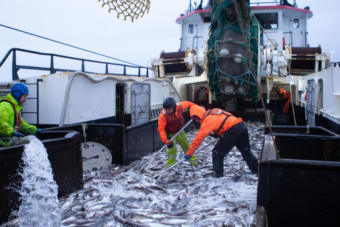
Crew members shovel pollock off the deck of a Bering Sea fishing boat earlier this year.
Crew members Joe Johnson, left, and Derrick Justice shovel pollock on the deck of the Commodore as another crew member, Brian Hagen, holds the hose. (Nat Herz/Alaska’s Energy Desk)

Fisheries managers allow whitefish trawlers to inadvertently scoop up halibut, crab and salmon in their nets. The bycatch rate is relatively low. But because the trawlers catch so much of their target species, the unintended harvest adds up.
That’s raising alarms in Western Alaska, where chum and king salmon runs have been performing poorly.

While the bycaught salmon is often donated to food banks, that’s of little assurance to those living along the Yukon and Kuskokwim rivers, where subsistence is a way of life.

“We eat dry fish like people from the Midwest eat bread, with every meal,” Mary Peltola told the North Pacific Fishery Management Council this month. She’s the executive director of the Kuskokwim River Inter-Tribal Fish Commission and lives in the largely Yup’ik community of Bethel. “Our babies teethe on dry fish. It’s the first food most Yup’iks eat, and it’s something that we crave year-round.”

Peltola said fishing on the Kuskokwim has been severely restricted to preserve wild salmon stocks. Meanwhile, trawlers haven’t faced new restrictions of their own as they scoop up lucrative whitefish like pollock, cod and halibut. She asked the council to put an end to bycatch in the industrial commercial trawl fleet.

“We’re not policy experts,” Peltola said, “We’re not scientists. We’re not career people. This isn’t part of our career ladder. We’re very desperate to pass on the knowledge that we’ve received over 12,000 years on how to live in harmony with salmon and utilize salmon as our foundational diet.”

The At-Sea Processors Association — a large industrial trawl organization — said in an emailed statement that no fishery is without bycatch, and there’s always other species in the nets or caught on a line. The group argued that a moratorium on salmon bycatch in the Bering Sea would mean a total shutdown of the pollock fishery.

North Pacific Fishery Management Council member Andy Mezirow said he’s heard the call for “zero bycatch” before. He asked: Why not request less bycatch?

“I can see how it would be galling to have no chinook salmon returning to your river and have thousands of them being caught in the ocean out in front of the river, so I understand your frustration,” Mezirow told Peltola during public testimony. “But what I don’t understand is what the strategy of asking for zero bycatch is. That’s a huge change from where we’re at now.”

Peltola responded that the goal should be zero.

“For people who rely on salmon for food security, if they cannot harvest one (salmon), then the commercial industry should not be able to harvest any accidentally when it is not even what you’re targeting,” Peltola said. “There are strong feelings also that even the term bycatch is an affront to foundational principles of not wasting and making sure that all life is sustainable and able to regenerate itself.”

In 2020, Bering Sea trawlers reported bycatch of tens of thousands of chinook salmon and hundreds of thousands of chum.

This year’s abysmal salmon runs to the Kuskokwim, Unalakleet and Upper Yukon rivers have already triggered one of the council’s bycatch reduction measures. But even under these rules, the trawl fleet is allowed to catch up to 45,000 kings.

And the Bering Sea isn’t the only place where bycatch is a problem.

In the Gulf of Alaska, some salmon fishermen complain about rules that allow bycatch allocations to be moved around. If pollock trawlers in one area catch 1,300 fewer king salmon, for example, that 1,300 salmon allowance can be transferred to another fishery.

Kodiak-based commercial salmon fisherman Alexus Kwachka is a former member of the NPFMC’s advisory panel and was among the dozens who recently called on Gov. Mike Dunleavy and the NPFMC to tighten the rules.

“The trawl fleet has done a mighty job of trying to mitigate their interaction with king salmon,” Kwachka said in a phone interview. “But the bottom line is, they still use a bunch of them. And, you know, as these programs have developed, we’ve allowed for one fishery to roll fish into the next fishery. And I think that it’s time to revisit that, and see if that’s really, you know, if we’re talking about saving king salmon, then the net result should be savings.”

Kwachka said he believes that weighing commercial interests like the billion-dollar pollock industry against rural subsistence traditions is a false equivalence.

“The tax that the state receives is minor compared to the cost that’s being incurred by the residents of the state, as far as way of life, whether you’re talking about halibut or crab or salmon,” he said.

Kwachka said he knows that climate change issues play a factor in the ongoing declines of wild salmon stocks in much of the state.

“It’s not all put on the pollock fishery,” he said. “Obviously, there’s something going on in the ecosystem. But until we have a better understanding of what’s going on, I think that savings should be savings.”

The Alaska Whitefish Trawlers Association, an industry group representing independent catcher vessels in the Gulf of Alaska, said its business model depends on its ability to shift bycatch limits around.

“If trawling shuts down, then life as I know it is over,” says Kodiak-based trawler Paddy O’Donnell. “I can’t pay my mortgage, I can’t keep my boat running. And so that’s the impact it’s gonna have on me and a lot of other families that are in the same situation. I don’t have other fisheries to go to. I trawl, I don’t salmon fish, I don’t do any other fisheries.”

O’Donnell said the fleet has spent years working to improve technology and methods to reduce salmon bycatch.

“The trawl sector has gone a long way in gear development … gear modifications, electronics, and what have you over the years to try and decrease the amount of incidental take we have when it comes to salmon,” he said. “We’re continuing to work on that. We’ll continue to work on that.”

Bycatch isn’t limited to salmon. Crab fishermen are also calling for serious reductions in bycatch of juvenile crab in trawl nets.

The North Pacific Fishery Management Council’s ongoing meeting runs through Friday.

While the advisory panel rejected a zero salmon bycatch proposal, the council will still consider a broader plan that supports consulting with tribes and encourages further research about chinook and chum salmon bycatch.

Navy training and testing in Southeast Alaska will stay at similar levels for the next 7 years

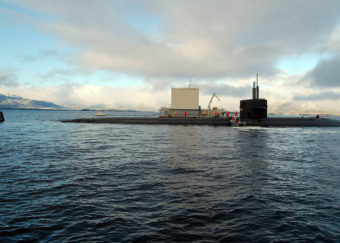
Fast attack submarine USS Los Angeles (SSN 688) is moored at the Southeast Alaska Acoustic Measurement Facility Static Site in Ketchikan, Alaska, as part of Escape Exercise 2006. “First and Finest,” Los Angeles was the first nuclear-powered U.S. submarine to conduct an open ocean escape. U.S. Navy photo by Mass Communication Specialist 1st Class Cynthia Clark
Fast attack submarine USS Los Angeles (SSN 688) moored at the Southeast Alaska Acoustic Measurement Facility Static Site in Ketchikan. (U.S. Navy photo by Mass Communication Specialist 1st Class Cynthia Clark)

The U.S. Navy says its operations in Southeast Alaska won’t increase over the next seven years. It announced on Oct. 1 that it will continue training and equipment testing in the Northwest Testing and Training Area — which includes Southeast Alaska — under what it calls its “preferred alternative.”

In Southeast Alaska, that mostly consists of measuring the sound signature of submarines at the Southeast Alaska Acoustic Measurement Facility (SEAFAC) in the Behm Canal near Ketchikan.

The Navy says it won’t be testing any weapons in Southeast Alaska waters and only proposes one or two sonar tests per year at SEAFAC.

NOAA Fisheries granted a final permit for the Navy to conduct its training activities last November. The permit authorizes the possible impact the Navy might have on marine life over the next seven years of training and testing.

In Alaska, the permit includes permission to behaviorally harass marine mammals more than 16,000 times throughout the next seven years.

Under the Marine Mammal Protection Act, the Navy must submit an environmental impact statement for its Northwest Training and Testing Area. The statement includes projected impacts to marine life and some mitigation efforts. The Navy released the final supplement to its EIS last September.

The federal agencies tasked with protecting marine mammals then evaluate the EIS and approve a permit for harm. The Navy is not allowed to physically harm or kill any marine mammals in Southeast Alaska over the next seven years, but it is permitted thousands of what it calls behavioral disturbances. That can include disruption to feeding, interactions or travel from place to place.

The Navy’s calculation of its disturbance to marine mammals and other ocean-dwellers is theoretical. It does not keep track of actual harm done to animals during training exercises, instead using the number of training and testing activities as a tool to estimate marine impacts.

Environmental groups have expressed concern that the Navy does not do enough to mitigate its impact on marine life — from larger marine mammals like whales and porpoises down to fish populations and zooplankton.

Wrangell questions population loss reported by US Census

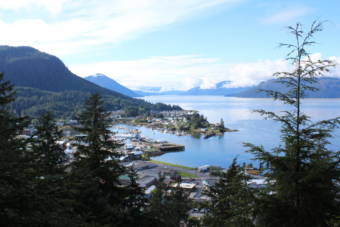
Wrangell seen from Mt. Dewey. (Sage Smiley/KSTK)

Official U.S. Census data reports Wrangell lost a tenth of its population — 242 people — over the last decade.
Wrangell’s economic development director Carol Rushmore says she was shocked when the borough received the 2020 figures.

“It doesn’t make sense when you look at our housing situation and other factors within the town,” Rushmore says. “We just don’t believe that there was that much of a drop.”

The Census Bureau’s own 2019 Wrangell population estimate showed about a 10% increase in the number of people living in the borough. The state department of labor’s population projections, published in April of last year, also show Wrangell’s population staying about the same as the community’s 2010 count.

Rushmore says she thinks the count could be artificially low for two main reasons. One is the COVID-19 pandemic, which delayed the census and forced reductions to in-person survey work. The other reason is the census’ reliance on its own online mapping of residences around the country.

“Everything is so dependent on their digital mapping these days through the census, with addressing and where the housing is,” Rushmore says. “Of course, our addressing within town is terrible. There’s duplicate numbers, there are houses without addressing. There are people who use their own addresses at times.”

But she also admits that some blame could lie on Wrangell’s low self-response rate, which was less than other Alaska communities, including Anchorage, Juneau, Ketchikan and Petersburg. Just under 42% of Wrangell residents responded by phone, mail, or online to the census questionnaires. Census workers who tried to reach out to the non-responsive people might not have been able to verify the number of individuals living in a household, she says.

Even so, a low census count is concerning to the community because state and federal funding opportunities often take population into account. As does redistricting, which helps apportion a community’s political weight in state elections.

Rushmore says Wrangell’s administration is still looking into its options. The federal Census Bureau has a program called Count Question Resolution, where governments can appeal their census counts, but the data requirements are strict.

Rushmore says she doesn’t know if the Wrangell will have the right numbers to appeal.

“What we will be looking at to make sure we want to go through with the count [appeal] is from the PFD registrations, the voter registrations, the utility bills, the number of housings that we have, I mean all the data that we might have available to make sure it does show there should be an increase, not a drop, or at least [stayed] flat,” Rushmore says.

Rushmore also adds she’s in contact with the Haines Borough government, which the census shows lost more than 15% of its population in the last decade. Its response rate was around 34% — also well below the state average.

How could British Columbia commercial fishery closures affect Southeast Alaska?

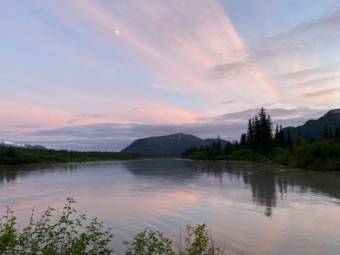
Sunset on the Stikine River. Canada’s government closed transboundary fisheries on the Canadian side of the Stikine in late June.
(Sage Smiley/KSTK)

This summer, Canada closed most of British Columbia’s commercial salmon fisheries. Declining stocks were to blame for the drastic conservation measures. Southeast Alaska shares coastline and transboundary rivers with B.C. — so what could this mean for the region?

The Department of Fisheries and Oceans Canada — the federal agency that manages Canada’s fisheries — effectively ended the 2021 commercial salmon season on the West Coast in late June.

Seafood Alliance Executive Director Christina Burridge says Canada’s fishing industry was stunned.

“First Nations have harvested salmon forever. And post-contact, salmon canneries are what in the sense built this province. To be now in this situation seems really tragic to me,” she said.

The closure came just weeks after Canada announced a $535 million plan to revitalize its flagging Pacific salmon stocks in B.C. and Yukon Territory.

But Burridge says the closure erased most of the Canadian fleet’s entire year.

“The minister’s announcement and most subsequent media coverage has said that it’s 60% [of B.C.’s commercial fisheries closed],” she explains. “In terms of the number of actual fisheries, that is correct. In terms of landed volume, it is 80%. And for gillnet fisheries, it’s about 95%.”

Canadian government officials say this has been a long time coming.

“I know it was a bit of a surprise to some — to many — but those that have been close to the industry and close to Pacific salmon fisheries here, at least and [along] the B.C. coast recognize that the overall level of catch has been dropping significantly for some time,” Sarah Murdoch said. She’s the senior director of Canada’s Pacific Salmon Strategy Initiative, which aims to shape Canadian fisheries policy moving forward.

So what does Canada’s salmon shutdown mean for its Alaska neighbors?

From a market standpoint, not much, says McKinley Research analyst Dan Lesh in Juneau.

“Alaska dwarfs B.C.,” Lesh explains, “And so anything that happens in those markets is not going to be a big impact on our fisheries. For instance, Canada produces only about .017%, so less than .1%, of sockeye globally — that’s as of 2019.”

B.C.’s largest wild salmon market is chinook: about 14% of the global market in recent years. But its shares of the other four salmon species represent less than 2% of worldwide production.

So, while the closures are devastating for B.C., they shouldn’t move world markets.

Still, Lesh says the shutdown isn’t good for the perception of wild salmon as a sustainable product. Concerns about declining food sources for killer whales have prompted some in the Pacific Northwest to avoid chinook salmon.

“Of course, that doesn’t make sense for protecting the orcas,” Lesh said. “The salmon are coming from a different area and a different stock. But so that’s my broader concern with some of these declining stocks on Alaska’s market.”

State fisheries managers say B.C.’s experience isn’t likely to be repeated in Alaska. Southeast management biologist Troy Thynes says Alaska has safeguards in place to keep salmon runs from dropping too far, allowing spawning fish to keep moving up rivers and streams. Drastic measures like widespread closures aren’t in the nature of Alaska’s dynamic management, where biologists can time openings at will.

“When Fish & Game is concerned about stocks — if a stock is not making escapement after a number of years, those types can be listed or recommended to the Board of Fisheries as a stock of concern. And we do have several stocks of concern that are in Southeast Alaska right now,” Thynes said.

The chinook on the transboundary rivers Unuk and Chilkat are among the current Southeast stocks of concern. Stikine and Taku kings — both also transboundary rivers — are proposed to be added to the list.

Burridge, with the B.C. Seafood Alliance, says she admires Alaska’s proactive strategies, which involve long-range management plans and a lot of public input.

“Basic things like stock assessments in Canada have been starved for at least two decades,” Burridge said. “And I think that’s one of the reasons why we’re looking at these closures is that the work simply hasn’t been done. I suspect most Alaskans would agree with me that the foundation of good fisheries management is good stock assessment.”

Burridge says the sacrifice being made by B.C. fishermen will only be worthwhile if there’s more investment in research and restoration of fish habitat.

“Salmon, as you know, are doubly vulnerable because they depend both on the marine environment and the freshwater environment,” she said. “And we have certainly compromised the freshwater environment here and particularly in southern B.C.”

But about a third of Canada’s $500 million salmon rescue plan will likely be spent buying out permit holders.

“I’m not for a moment saying that we should go fishing because people need to go fishing,” Burridge said. “We have to be extremely careful and cautious, but this is very, very devastating. And I think while some of the closures were probably necessary, many it seems to me are just putting the burden on the commercial sector rather than putting it on other sectors.”

U.S. states and Canadian provinces work cooperatively to co-manage transboundary salmon runs through the Pacific Salmon Treaty. But the Canadian government says the shutdown on their end likely won’t affect current allocations, as the treaty won’t be renegotiated until 2028.

Wrangell brings back testing requirement for unvaccinated travelers returning from out of state

Alaska Airlines’ milk run flight stops twice a day in Wrangell. (Sage Smiley/KSTK)

Unvaccinated visitors and residents returning to Wrangell need to be tested for COVID-19, Wrangell’s assembly decided Tuesday evening.

Borough manager Lisa Von Bargen said the community’s emergency operations center recommended bringing back mandatory testing for people arriving on the island who haven’t been inoculated against the coronavirus.

“We’re seeing [case] explosions as close as Cordova and Sitka,” Von Bargen told the assembly, “And it’s disturbing in other places around the country. I’m not hitting the panic alarm by any stretch of the imagination, but it’s one tool that allows us to be able to catch positive cases if they’re there.”

Wrangell’s previous testing requirement lapsed in June.

The testing mandate is the same as the previous rule the assembly first approved in March and updated in May. It applies to all unvaccinated travelers arriving from outside Alaska, including those arriving on the ferry or cruise ships. In-state residents may choose to quarantine for 14 days upon arrival in lieu of testing. There’s no enforcement or fines for those that flout the rules.

Southeast Alaska Regional Health Consortium, the regional tribal health provider, is under contract by the state to conduct the tests at the airport, which are open to everyone during the community’s twice-daily jet arrivals in the morning and afternoon.

The new travel testing mandate is set to expire when Wrangell’s current COVID emergency declaration is scheduled to lapse, but the assembly could renew the mandate before it expires.

Site notifications
Update notification options
Subscribe to notifications