KSTK - Wrangell

KSTK is our partner station in Wrangell. KTOO collaborates with partners across the state to cover important news and to share stories with our audiences.

‘Tidal Network’, Tlingit & Haida’s new broadband internet service, coming to Wrangell

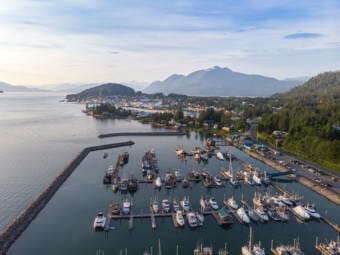
Wrangell in June 2018 (Photo by David Purdy/KTOO)

Southeast Alaska’s regional Tribal government will pilot its new broadband internet program in Wrangell, which it says will, eventually, be available to everyone on the island.

Last year, the Federal Communications Commission opened up a special program to allow rural Tribes to secure broadband licenses to improve connectivity. Hundreds of Tribes applied, more than a third in Alaska.

The Central Council of Tlingit and Haida Indian Tribes of Alaska announced on December 17 that it got its license. The FCC has granted the regional Tribe exclusive use of a mid-band broadband spectrum in a number of Southeast Alaska communities.

Chris Cropley, one of the Tribal council’s network architects, says the license is for the 2.5 gigahertz spectrum: the same tech used by cell phone LTE networks.

“We’re starting in Wrangell,” Cropley said. “It’s perfect – it’s the Goldilocks, as they say. It’s got everything going for it. We’ve got a lot of people there, relatively, we own the 2.5 [GHz spectrum] there, and we have funding for it.”

The Tribe is calling its broadband service Tidal Network. It will just be home internet, not mobile data service. But it will still need to build its own towers, so that wireless internet can be broadcast directly to homes and businesses that don’t already have reliable internet access.

“Anywhere that’s already served, we’re not interested in serving,” Cropley said. “So if you have a cable modem to your house, fiber optic to your house, if you’ve got good service to your home or are downtown, we’re not really super interested in replacing that with something else. We’re not looking to displace GCI or ACS or AT&T or anybody.”

Wrangell is ideal because there are people with spotty service, but it’s not such a remote community that the Tribe would struggle to get people and equipment to town. Cropley said residents living towards the southern end of the 14-mile stretch of Zimovia Highway would be good candidates for Tidal Network.

Once the service is in place, Tlingit & Haida will be required to “defend” it – meaning they have to offer internet service to 80% of the area’s population within the first two years of holding the license, and full-coverage after five years. But that doesn’t mean people have to take the new provider up on the offer.

Central Council of Tlingit and Haida Indian Tribes of Alaska began working on getting its license back in 2019. And federal pandemic relief it has received since will help pay for the project.

“We are buying two what we call COWs – cell on wheels,” he said. “They are towers on a trailer with a generator and a little cabinet underneath, and they extend out. We’re able to stand them up, and they have radio microwave on them and they accept fiber optic and we’re able to wire them up or wireless them and begin to provide service on those towers.”

Permanent towers can cost $500,000 to $600,000 each and come with miles of red tape.

The pieces are already in place to get started now, though. Cropley said he has a multi-million dollar budget headed to Wrangell for the pilot broadband project, but declined to say precisely how much.

Once the details are worked out, Tidal Network will operate in Wrangell as a subscription service with different plans, like any other internet provider. The goal is to provide the best possible internet at the lowest possible price.

“We’re just looking at finding the most people with the least internet or no internet, ideally, and providing them with internet where they didn’t have before, where they had to use a satellite,” he said.

The pilot project in Wrangell is just that: a test. It’ll help flesh out the program – from the tech itself to collaboration with other vendors, policies and provide training to Tidal Network employees.

The process will take time, and investment.

“There’s a reason that somebody isn’t already doing this, right?” Cropley said. “There’s no gold mine at the end of the road here. It is a service.”

Cropley says they hope to have the Tidal Network up and running by spring 2022. And after piloting the program in Wrangell, the service could expand to more than 20 other Southeast Alaska communities in the coming years.

Wrangell skin care company’s kelp-infused bath soak wins big at regional seafood product competition

Angie Flickinger, owner and founder of Waterbody, holds up a package of her award-winning bath soak. (Sage Smiley / KSTK)

Waterbody, a Wrangell-based skin care company that sells products like facial and body oils, soaps, salves and bath soaks won first prize in the Beyond the Plate category of the Symphony of Seafood product competition last month.
The category is meant to highlight seafood products that can’t be eaten. In this case, Waterbody’s winning product is a kelp-infused bath soak, called Deep Blue Sea.

Waterbody founder Angie Flickinger says the epsom and sea salt soak has Alaska bull kelp, peppermint, lavender and jojoba oils, and — like all of her products — is inspired by the nature of Southeast Alaska.

“One of the main areas of focus for the Symphony is mariculture, and kelp is a very up-and-coming ingredient and resource in the region,” Flickinger said. “So I wanted to highlight one of the products that use kelp. There are whole flakes of kelp in the sea soak, so you’re actually soaking in it too, which I think is cool.”

While Waterbody has multiple products that use Alaska kelp, Flickinger says she wanted to highlight the bath soak on the big stage.

“That’s my best selling product overall,” she said. “And so it has a large following and a lot of folks love it. I also really love the packaging of the bath soak, because I think it communicates — it sort of draws people into what it feels like to be on the water here. It just has that feeling, so the whole package just felt like a good fit for that contest. It really looks like the ocean, and it has parts of the ocean in it.”

Flickinger makes, packages and ships Waterbody products from a 500-foot studio next door to the Churchill Laundromat and across the street from Wrangell’s marine service center. And she says winning one of the five category prizes at this year’s Symphony of Seafood won’t radically change that operations model.

“I’m just working to grow the business. As I’ve, you know, learned how to better operate a business and challenge myself in all these ways and grown as an entrepreneur, I see this business as a way to invest more in my community, locally and regionally,” Flickinger says.

The Symphony of Seafood is a product competition sponsored by the Alaska Fisheries Development Foundation. There are five main competition categories — retail, food service, Beyond the Plate, salmon and whitefish — as well as a grand prize and prizes for Seattle’s Choice, Juneau’s Choice, and Bristol Bay Choice.

The Symphony of Seafood Grand Prize will be announced at an event in Juneau in February 2022. As a category winner, Waterbody will get booth space at the Seafood Expo North America in March and an entry into the expo’s product competition, the Seafood Excellence Awards.

Waterbody is one of two small Southeast Alaska companies to win category prizes at this year’s Symphony of Seafood.

The other, Seagrove Kelp, sources kelp off Prince of Wales Island in Doyle Bay. It won the food service category for its Alaska Grown Ribbon Kelp, which it sells to retailers and wholesale to restaurants and other food producers.

Sudden windstorm takes out power for thousands in Wrangell and Petersburg

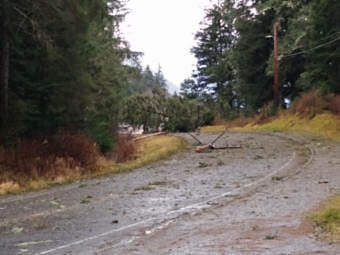
Downed trees and the broken top of a utility pole sit in Zimovia Highway near City Park on Tuesday afternoon.
(Courtesy Don Sherman)

Wrangell and other Southeast Alaska communities experienced power outages Tuesday after a sudden windstorm snapped utility poles and downed trees, plunging thousands into darkness and causing an Alaska Airlines flight to skip its Wrangell stop.

The first outages happened on Wrangell Island around 12:30 Tuesday.

Wrangell capital facilities director Amber Al-Haddad told KSTK in a phone call Tuesday afternoon that the storm caused a problem with the Southeast Alaska Power Agency hydroelectric transmission line entering Wrangell from the strait. The line also moves electricity to Petersburg, about 50 miles north of Wrangell.

The storm also snapped the tops off of three utility poles near Wrangell’s City Park, causing power outages in Petersburg as well.

As of Tuesday evening, Wrangell was still running on a standby diesel generator. Around 100 Wrangell residents who live out the highway were expected to be without power for much of the night and possibly into Wednesday.

Power was restored to some of Wrangell town beginning around 2:00 p.m. and continuing through the afternoon.

Downed trees also damaged power lines near Wrangell’s ferry terminal, shutting off electricity to the airport for nearly four hours. That caused an Alaska Airlines jet on the milk run from Petersburg to skip its scheduled landing in Wrangell.

The main access to Wrangell’s hospital was also cut off by fallen trees, necessitating hospital access by a gravel road. The Wood Street fallen trees also took out power for the eastern side of Zimovia Highway from Case Avenue to the old Armory Building on Bennett Street.

The National Weather Service in Juneau said that rapidly warming temperatures, melting snow and heavy rains saturated the ground, making trees and power lines less stable.

The forecasters reported wind speeds greater than 35 mph at the Wrangell Airport. Wrangell harbor residents reported top wind speeds of 47 mph to KSTK Tuesday afternoon.

Wrangell’s Dove Tree ceremony gives a chance grieve and remember at the start of the holidays

Alice Rooney adds a dove to Wrangell’s Dove Tree on Nov. 28, 2021. (Sage Smiley/KSTK)

For many, the winter holidays are a time of togetherness. But they can also be a stark reminder of the recent loss of loved ones. For nearly two decades, Wrangell has begun the holiday season with a ceremony of remembrance for those who have passed on.

In the high-ceilinged lobby of Wrangell’s Nolan Center, a small Christmas tree with gold and white decorations stands dwarfed between two 20-foot high totems. But its purpose isn’t small at all.

Known as the Dove Tree, it’s a nearly two-decade-old tradition meant to give community members a time at the outset of the holiday season to remember and grieve loved ones lost in the years previous.

Central is the symbolism of a white dove. Hospice of Wrangell’s Alice Rooney penned a story about the bird and its importance. Cindy Martin read the story at this year’s ceremony, which took place on Nov. 28. It concludes: “No matter what your religious beliefs are, and whether the dove means to you, we hope the dove brings you comfort.”

A list shows some of the names of those who have passed on this year. (Sage Smiley/KSTK)

The annual Dove Tree ceremony is an interfaith celebration. Pastor Sue Bahleda of Wrangell’s Island of Faith Lutheran Church delivered the homily.

“We — each of us — are unique and particular and special,” Bahleda said. “There is no one else who has lived our story, yet in all that diversity we hold one thing in common. We die. And that is what has gathered us here today — to hold for one moment longer, the memory of those who have died. They are our mothers and our fathers, our children, our spouses, our family, our neighbors, our friends. They were ordinary and amazing. Sometimes ornery and awful, and what will we do without them? I appreciate that the symbol that we use to mark this day is a dove. It is the symbol of peace. And as we speak of those who have died, we often express this hope, ‘May they rest in peace.’ They do. I have entire faith and confidence in this.”

Wrangell also celebrated and remembered loved ones with music. Wrangell assistant librarian Sarah Scambler sang the Rogers and Hammerstein tune “You’ll Never Walk Alone,” accompanied by Rooney.

The Dove Tree and ceremony were started by Wrangell nurse Trudy Johnson in 2003 after a triple murder-suicide rocked the community. The nature of the crime meant closure was difficult. The ceremony has carried on every year since, organized by Hospice of Wrangell.

Little has changed, except for precautions taken earlier during the pandemic when the tree was moved to an outdoor pavilion downtown. The paper doves were secured with wires so they wouldn’t blow away, and the 2020 program was broadcast on KSTK.

Doves hang on this year’s Dove Tree. (Sage Smiley/KSTK)

Wrangell tribal citizen Thomas Rooney, Jr. drummed as volunteers read the names of Wrangell’s loved ones who have passed on in the last year. Slowly, community members placed white paper doves on the branches of the tree.

After the reading of names and placing of doves, Bonnie Demerjian on cello and Alice Rooney on piano played “Heroes of Longhope,” a Scottish fiddle tune written to commemorate the crew of a rescue vessel who were lost in a storm.

The Dove Tree will stay in the lobby of the Nolan Center through the new year. Paper doves are available for anyone who lost a loved one to add their name to the tree.

Wrangell administration, tribe to survey site of former boarding school for Native children

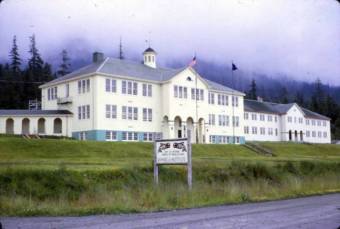
The Wrangell Institute. (National Archives/BIA Photo)

A government boarding school for Native children in Wrangell was one of the first of its kind in Alaska. Now, there are plans to redevelop the site of the former Bureau of Indian Affairs facility that was open for 43 years. But sensitivity toward the legacy of abuse and trauma and recent discoveries of graves at Canadian boarding schools have caused local officials to tread carefully before breaking ground.
After the Wrangell Institute closed in 1975, the former boarding school was sporadically used. It was transferred to Wrangell’s local government about 20 years later. There was some outside interest in using at least part of the site for another boarding school, but nothing panned out.

Now, the Wrangell assembly is eying it as land for new housing, with a plan to subdivide the 134-acre property into residential lots. One of Wrangell’s borough assembly members ran for re-election this year on a platform of getting the former Institute Property developed and sold off.

But first, the city needs federal permits to fill wetlands. It applied earlier this year to the U.S. Army Corps of Engineers after teeing up about $1.3 million towards redevelopment.

When the City and Borough of Wrangell applied in May for a wetlands fill permit to start developing the former Wrangell Institute property, the Army Corps of Engineers stated that it was unaware of any cultural resources at the site.

But days later, news broke of a grisly discovery in Canada: the remains of more than 200 Native children were found on the grounds of a former residential school in British Columbia. In the following weeks, thousands more bodies would be discovered at the sites of former residential schools across Canada, shedding light on the country’s dark history of mistreatment of Indigenous peoples. Canada’s Truth and Reconciliation Commission has documented more than 6,000 Indigenous children’s deaths at Canadian residential schools, but estimates that 15-25,000 Indigenous children may have died at the schools.

Wrangell economic development director Carol Rushmore says the discovery in Canada brought the redevelopment process of the Institute property to a halt. That’s partly because the U.S. Army Corps of Engineers is taking a fresh look at former residential school sites in the United States: the former Wrangell Institute property among them.

“The permit was not issued because of the concerns of cultural resources, perhaps burials on the site,” Rushmore told KSTK in an interview.

U.S. Secretary of the Interior Deb Haaland, an enrolled citizen of the Laguna Pueblo and the first Native American cabinet secretary, ordered a federal investigation of suffering and burials at former BIA schools, with a report due next April.

“They’re looking through the old archives, and many of the records are in boxes, they’re not digitized, they’re having to go through them by hand,” Rushmore said. “There are issues with privacy act requirements in looking at some of these records, and they’re trying to do consultations with the different tribes, including the WCA, to identify their concerns and information concerning this record search.”

Present day, the former Institute property sits overgrown. (Photo by Sage Smiley/KSTK)

While the federal investigation is more records-based, the Army Corps of Engineers and State Office of Historic Preservation are looking to do an on-the-ground search in Wrangell.

“They both will have their own sort of requirements as to what the borough needs to do to make sure that there are no cultural resources on-site,” Rushmore said.

Cooperation with Wrangell’s tribal government is an integral part of the task.

“We’re just happy to be able to work with the city on something of such critical importance and a sad part of the history of our people,” said the tribal administrator for the Wrangell Cooperative Association Esther Reese, whose Lingít name is Ax̱seen. “So it’s very appropriate that the city is working with the tribe on it.”

Reese says the City and Borough of Wrangell has kept the tribe apprised of developments at the property. Earlier this year, the city was looking at possibly using ground-penetrating radar to survey the site.

“Because the ground is somewhat uneven, they were looking at bringing in dogs that would help with a search, because it sounded like the radar technology would be more difficult because of the topography,” Reese said.

In September, Rushmore reported to the borough assembly that the city was drafting a letter to tribal entities and Native corporations around the state, informing them of Wrangell’s development plans and asking for their input.

With that feedback, Reese says Wrangell’s tribe is starting work on the design for a memorial for Native children from all over the state who attended the Wrangell Institute.

“What the tribe is looking at is consultation with affected tribes and then the construction of a memorial gazebo honoring all the tribes that attended the Institute, then doing a healing ceremony,” Reese said.

Rushmore says at this point, the borough is still trying to contact tribes and figure out how to proceed with a ground search of the property, but nothing is set in stone yet.

Located at a Lingít site known as Keishangita.’aan, or Alder Top Village, the boarding school opened in 1932. It was not affiliated with a particular religious denomination, although federal records show Wrangell’s Catholic priest in the late 1930s took an interest in the school and incorporated it into his parish.

Reese says the site’s name, Keishangita.’aan, was rediscovered by a tribal citizen in University of Alaska Southeast professor Thomas Thornton’s book “Our Grandparents’ Names on the Land.”

“We let the city know that because we can’t rename something that already had been named by our ancestors,” Reese says, “So that was the name that the tribe brought forward to the city.”

The Wrangell Institute was one of about 20 residential schools for Alaska Natives that operated through the 20th century. Its enrollment peaked in the mid-1960s with just over 260 students from five to 15 years old.

The institute housed more than Native children. During World War II in the summer of 1942, Unangax̂ people who were forcibly relocated from their homes stayed in tents on the Institute grounds.

State-collected and individual records recall intense physical, sexual and emotional abuse of Wrangell Institute students. Students were beaten for speaking their first languages, survivors told KSTK in 2016.

So there’s a lot of work — and healing — to do before the property could be redeveloped. In part, that means federal and state surveys. Reese, the tribal administrator, says the borough should be putting out a proposal request for ground surveys soon, possibly with the help of federal funding.

The borough and tribe say they will also continue to collect feedback from tribes and Native organizations around the state whose children were sent to the Wrangell Institute, with the hopes of collecting comments and stories for a memorial that will speak to its history before the ground is repurposed for the future.

Dunleavy administration announces formation of bycatch task force

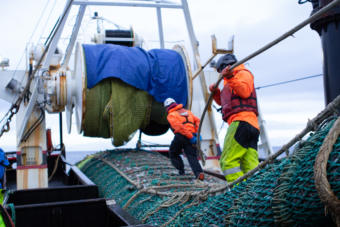
Crew members work to unload a trawl net full of pollock on Jan. 24, 2019. (Nathaniel Herz/Alaska’s Energy Desk)

Gov. Mike Dunleavy’s office recently announced that it’s setting up a task force to tackle the thorny issue of trawler bycatch.

Bycatch is what fishermen catch unintentionally — fish they aren’t targeting that get caught up in their nets, anyway. Federal bycatch data shows trawl fisheries in the Bering Sea and Gulf of Alaska this year have caught tens of thousands of chinook salmon, millions of pounds of halibut and hundreds of thousands of crabs.

Meanwhile staple species like chinook salmon, red king crab and halibut have been on the decline, forcing subsistence, sport and commercial fishermen to pack up nets or reduce harvest.

“We’ve had a reduction in or closure of the crab fisheries in the Bering Sea. The [North Pacific Fishery Management] Council is discussing how to deal with halibut bycatch, and I think there’s a lot of perception that there are bycatch issues associated with what’s happened with salmon in Western Alaska systems,” said Alaska Fish & Game Commissioner Doug Vincent-Lang.

And, he says, his boss has taken notice.

“I think the governor was hearing loud and clear that there was just a lot of noise around the issue of bycatch,” Vincent-Lang said Friday, “And I think he wanted to get Alaskans together, discuss what the issue is, what we know about it, what we don’t know about and identify different strategies that we all could take to try to reduce bycatch or manage bycatch better.”

The executive order establishing the task force says its goal is to study the impacts of bycatch on what it calls “high-value” state fisheries, recommend policies based on that impact, advise state agencies on how to address bycatch and use science to inform policy-makers and the public about how bycatch is felt in Alaska fisheries.

Vincent-Lang says that “high-value” designation is meant to be more expansive than just cash value.

“It could have value to coastal communities in terms of jobs and collateral benefits of the value back from collecting fish taxes to those communities,” he said. “You can have high value for food security, it could have a high value for cultural purposes.”

The task force will be made up of 13 voting members, nominated by the governor, meant to capture a swath of Alaska fishing interests. That means seats for state administration officials, various fisheries, Alaska Native organizations and the general public.

The task force will also include two non-voting members from the state legislature, nominated by the leadership of the House and Senate. The chair and vice-chair of the task force aren’t set yet — they’ll be selected by the governor once the voting seats are filled.

Bycatch critics warn that the task force’s effectiveness will depend on its composition.

“That task force initiative is definitely welcome,” said David Bayes, a longtime sport charter business owner in Homer. “It shows a level of commitment from the governor’s office which we’ve rarely seen.”

In addition to his charter business, Bayes is also an online activist of sorts, moderating a Facebook group called STOP Alaskan Trawler Bycatch that has more than 15,000 member.

“We’ve seen, a lot of times, especially at the NPFMC, that undercurrents of the trawl industry run pretty deep in Alaska commerce and politics,” he said.

Bayes is talking about the North Pacific Fishery Management Council, which has been criticized for giving too much clout to big-money industry trawlers who are responsible for much of Alaska’s bycatch.

“One of the named seats or positions [on the task force] is a representative from the NPFMC,” Bayes said, “There’s also a trawl rep on [the task force]. Again, it’s kind of this question of: Are they speaking towards conventions and practicability in the industry? Or are they going to try and derail the conversation by saying it’s all a facade, or something that we shouldn’t worry about in the first place?”

Bayes says he’s planning to apply for a seat on the governor’s task force. He says he’s optimistic that this could be a new opportunity for fisheries users to have a voice.

Most bycatch happens in federal waters, beyond the 3-mile line. Vincent-Lang says the Dunleavy administration hopes the bycatch task force will have an impact on federal fisheries management.

“I have a seat on the North Pacific Fishery Management Council,” Vincent-Lang said, “[So] hopefully the information we collect will be used to inform federal decision making — Council decision-making regarding bycatch moving forward.”

But he also says that bycatch in state waters deserves scrutiny, and ideas that come out of the task force could inform decisions at the state Board of Fisheries or within the administration.

The bycatch task force won’t have funding to allocate towards research. Vincent-Lang says that’s a piece of the puzzle that will come once it issues recommendations to policymakers next year.

“Funding will probably be some joint effort between industries associated with bycatch, users, as well as state and federal efforts,” he says. “But before we identify the money for it, we need to identify what it is we want to do.”

Vincent-Lang says he hopes the administration can convene the group early next year to meet on a monthly basis, as outlined in the governor’s order. The task will be dissolved on Nov. 30, 2022.

The deadline to apply to serve on the task force is Dec. 3.

Site notifications
Update notification options
Subscribe to notifications