KSTK - Wrangell

KSTK is our partner station in Wrangell. KTOO collaborates with partners across the state to cover important news and to share stories with our audiences.
Wrangell tribe blesses Together Tree and sends it to Juneau

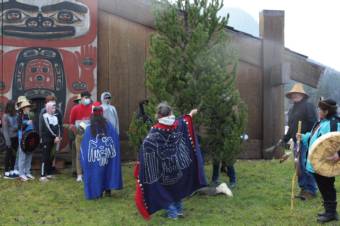
Tribal elders from the Wrangell Cooperative Association bless the 2021 Together Tree, headed for the governor’s mansion in Juneau. (Sage Smiley / KSTK)

Every year during the holiday season, the U.S. Forest Service in Alaska sends a tree to decorate the governor’s mansion in Juneau. This year, it was Wrangell’s turn to provide the tree. At a Thursday ceremony, Wrangell’s tribe blessed the chosen pine tree before it was sent up north.

Tiny flakes of snow fell Thursday morning on the small crowd assembled at Shakes Island in Wrangell’s Inner Harbor to bless a towering conifer bound for Alaska’s capital city. Wrangell Cooperative Association citizen Virginia Oliver, whose Lingít name is Xwaanlein, wore a woven cedar hat and beaded gloves and carried a painted drum.

“Gunalchéesh, Ldakát yeewháan yak’éi ix̱wsateení, so good to see all of you,” Oliver greeted the crowd, “Yak’éiyi ts’ootat, good morning. Welcome onto the ancestral home of the Naanyaa.aayí.”

Blessing the tree. (Sage Smiley/KSTK)

Volunteers held the 14-foot lodgepole pine to be blessed upright in front of the red and black bear carving which frames the Chief Shakes House doorway.

The tree was picked by the U.S. Forest Service’s Wrangell Ranger District. Acting district ranger Tory Houser says it’s important for the U.S. Forest Service that the pine tree be blessed by the people whose land it came from.

“We were able to sustainably harvest this tree from Etolin Island,” Houser said. “ It’s known as the Togetherness Tree, and like the trees that stand in the forest together, we are all stronger when we all stand together.”

The tree’s placement at the governor’s mansion coincides with the Christmas season, but it’s meant to represent more than just one winter holiday.

Tribal president Richard Oliver, whose Tlingit name is Xúns, expressed gratitude to the Forest Service, Coast Guard, and Wrangell High School’s Lingít language class for being there, as well as the tree itself.

“I’d like to thank the tree for giving itself up for the governor,” Oliver said. “It’s a very nice gift.”

To bless the 2021 Together Tree, tribal elders and the high school language learners sang while walking slowly around the tree, waving fronds of cedar. Some wore cedar hats or button blankets.

Wrangell tribal citizen Virginia Oliver explains that the cedar fronds used in the blessing are not just backyard trimmings.

“The [tribal] president asked a tree and took the bottom fronds and then he gave pieces to everybody,” she says.

Oliver says it’s not the first time the tribe has blessed a tree bound for Juneau.

“We’ve done this before, the last time a tree left,” she said.

That last time was in 2018, when the community procured the governor’s mansion tree shortly after Gov. Dunleavy was elected. The Forest Service says this is the fifth year in a row that the Together Tree for the governor’s mansion has come from the Tongass.

The Together Tree is carried to the USCGC Elderberry to be transported to Juneau. (Sage Smiley/KSTK)

The 2019 Together Tree came from near Ketchikan, and last year’s came from the Petersburg Ranger District. It was delayed on its journey to Juneau when the Coast Guard Cutter Anacapa was rerouted to provide disaster assistance in the wake of the Haines landslides. But it got there in the end.

This year’s tree will be on display at the governor’s mansion in Juneau for the holiday season. The mansion will hold an open house on Dec. 7.

“It’s such a prestigious thing, I think, that it’s going to the governor’s mansion and it’s from Wrangell,” Virginia Oliver said. “So we just wanted to turn out and show a good showing for it and let the tree go.”

As tribal members sang Wrangell’s paddle song, volunteers carried the tree across the bridge between Shakes Island and the harbor parking lot, through the lot and down a ramp to the Coast Guard buoy tender Elderberry, the tree’s ride up to Juneau.

Years in the making, Wrangell Mariners’ Memorial reaches home stretch

Wrangell Mariners’ Memorial just needs a few finishing touches. One is the memorial plaques themselves.
(Sage Smiley/KSTK)

A grassroots effort in Wrangell to erect a mariners’ memorial is reaching its final stage. Volunteers are ready to start etching the names of those lost at sea or otherwise passed on.

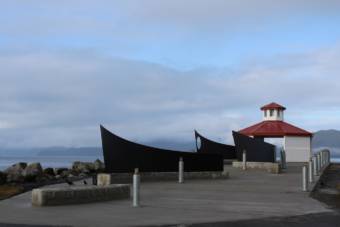
Over the last two years, Wrangell Mariners’ Memorial has leapt from the pages of theoretical design onto a quiet plot of land at the mouth of Heritage Harbor. Curved, trapezoidal walls evoke the hulls of ships and lead up a slight hill to a red and white octagonal gazebo. It’s a lighthouse, with a compass rose in the center.
Mariners’ Memorial board member John Martin said this is a pivotal time for the memorial, located about a mile south of downtown.

“It’s been fascinating to watch,” said Mariners’ Memorial board member John Martin. “We found a site, we selected this site, we upgraded the site, pretty exciting stuff. They placed the big steel structures there, and the whole thing is getting more interesting all the time. But now we’re at the powerful point, this is where the individuals are going to make the connection to the whole thing. They’re going to have their family member’s name up on this memorial.”

An 800-pound compass rose in the center of the Wrangell Mariners’ Memorial pavilion. (Sage Smiley/KSTK)

Wrangell fisherman Gig Decker is a volunteer board member. He said Wrangell’s history and development are tied to the water.

“As far as seafaring people, it goes back 10,000 years,” Decker said. “When you live in a small community, and it’s a very supportive community — we are the type of community where we want to be a part of other people’s lives and the things that they care about.”

While the idea of a Wrangell Mariners’ Memorial has been around for decades, the project was really kicked into gear about 16 years ago, when Wrangell high school seniors who lost their captain at sea revived the idea of a local memorial site.

The Wrangell Mariners’ Memorial incorporated as a nonprofit organization in 2017.

Jeff Jabusch is the group’s treasurer. The community has fundraised tens of thousands of dollars for the memorial’s development.

“I think we’re really not that far from the end,” Jabusch said. “The big things were the concrete and the getting the walls up, we’ve got one more wall, it’s pretty much done. It’s just got to be set in there. Then it’s getting the plaques up.”

To fundraise for ongoing maintenance, final construction, and getting plaques installed, the Mariners’ Memorial Board hosted an all-day, catch-all sort of event Thursday.  There was a silent auction and membership sign-ups. The event was also where applications opened for memorial plaques, and sample plaques were available.

“We ordered a couple, so we could have them in hand. We wanted to feel them, we wanted to see what the lettering looked like on them, we wanted to look at a couple different colors,” said the board’s president Jenn Miller-Yancey. “And so people will be able to take a look and see what three lines and four lines look like on a plaque and hold them. They’re pretty heavy, heavier than I expected them to be. And then also being able to just talk about the application, answer any questions and guide people through it.”

The process of getting plaques won’t just be one of the plaque design itself.

“Part of it is ‘what do you want the plaque to look like?’ The other part is to tell your mariner’s story,” Miller-Yancey said.

It won’t just be a name memorialized, but a story as well, Decker said.

“I think that’s going to turn out to be a very attractive part of this, because we do want to share each other’s grief and joys,” he said. “It’s part of what really makes Wrangell a very unique place.”

Decker said the stories of mariners recognized in Wrangell will be stored on the board’s website, but he also hopes to eventually put together a physical book of mariners’ stories that could be sold in Wrangell’s museum.

It’s taken an immense amount of time and effort to get the project to the point it’s at, Miller-Yancey said.

“I couldn’t even begin to count the hundreds of hours that every individual has put into the research and the pieces and the parts,” she said. “There’s no better team. These old guys here, they’re pretty amazing. Everybody brings something unique and special to the table. And I think it’s been a great representation of our community.”

But it hasn’t just been the efforts of the volunteer board that brought the project to this point of near-completion.

“Since I’ve been serving, I couldn’t begin to also count the amount of support that people have emailed, text, called, ‘what can I do?’ Or just wanting to know how the project is going,” Miller-Yancey said.

She said that she’s been blown away by the commitment of the community, from Wrangellites of all ages.

“When we put the compass rose into the pavilion, I don’t know how many kids we had help with that,” Miller-Yancey said. “It was truly amazing, that they all wanted to be there and that they chose to be there because they also are very proud of the project, even as young people. And of course, we hope that those young people grow up to be people sitting around this table in the future that help keep that project alive and going.”

The City and Borough of Wrangell funded the memorial’s design and provided the land. The spot is near the water, between Heritage Harbor and the cemetery. Decker said that connection between the boats leaving and returning, and the final resting places of generations of Wrangellites, was intentional.

“Part of the design of it, too, is to border it with beach grass,” Decker said. “And that will give it — if we’re successful with it, which it looks like it grows everywhere — if we’re successful with it, I think it’s going to give it that transition feel to it between what’s going on now and what’s happened in our memories and out on the water. I think it’s gonna be killer.”

This cutout will hold a transparent panel with a drawing of the Star of Bengal. It’ll look like it’s sailing in front of Woronofski Island. (Sage Smiley/KSTK)

One of the most deadly marine disasters in Alaska history happened near Wrangell — the wreck of the Star of Bengal, an iron-hulled sailing vessel that went down in a storm in 1908, killing one crewmember and 110 of the 111 cannery workers onboard — migrant workers from China, the Philippines and Japan.

Decker — a licensed commercial diver — helped locate the century-old shipwreck, and said he wants to make sure those lives are remembered.

In a small, close-knit community like Wrangell, many have personal connections to marine tragedies, too.

Decker and his wife Julie lost their college-aged children a year and a half ago in an automobile accident during the fishing season on Mitkof Island south of Petersburg.

“They grew up on a fishing boat, fished all their lives, never had a summer off since they were babies,” Decker said. “So it’s a very special thing for me — for us. It was very special to me even before we lost our kids. I think it’s a really necessary thing in a town like this to be able to share people’s grief. It’s very positive for people to do that with each other, and it’s a great place to go to and to meet. It’s going to be very significant for us down the road.”

The commercial fishing captain who died in 2005 whose high school-aged crew revived the idea for the memorial was Ryan Miller, Miller-Yancey’s husband.

And John Martin, who lost his father in a commercial fishing accident when he was a toddler, said having a place like the Mariners’ Memorial to come and reflect will fill a need.

“To put it in the simplest terms, I lost my father a fishing boat when I was two years old. And now there’s a place for all that to fit,” Martin said.

Wrangell’s public library celebrates its hundredth year

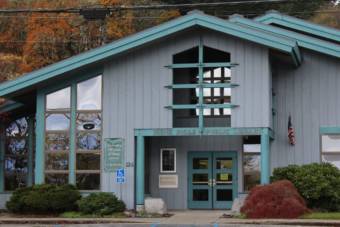
Wrangell’s Irene Ingle Public Library in October, 2021. (Sage Smiley/KSTK)

The Wrangell Public Library’s 100th birthday fell on Halloween. Generations of Wrangellites have enjoyed the services of the century-old institution.

Compared to its usual calm, quiet atmosphere, Wrangell’s Irene Ingle Public Library was buzzing with activity on the afternoon of Oct.28. A black and gold spiraling balloon arch framed tables with punch, coffee, and two cakes, both covered in black and orange frosting rosettes, and sporting “100”s.

“I feel honored to be a part of this library story here in Wrangell,” said assistant librarian Sarah Scambler, holding a piece of cake on a small, black and gold plate. Scambler says her mom used to work at the library, which brought her in often.

“I participated in the summer reading program growing up,” Scambler says, “And then I moved back, I had a young family, and we started coming to story time. Then when Lana retired, I applied for the job and was fortunate enough to get it.”

Scambler says she did a bit of research in the run-up to the 100th-anniversary party. She says it’s given her a unique perspective about what it took to get — and keep — a library in Wrangell.

Wrangell’s public library began as an idea put forward by the ladies’ Civic Improvement Club in 1913.

It took eight years for the idea to be realized, but there was wholehearted public support for the establishment of a library.

T.C. Havens, a local businessman, was among the Wrangellites who committed to buy a subscription to a magazine to fill out the library’s shelves. He also said he’d volunteer to paint, stain and varnish anything necessary in the library. Also, Havens wrote in a 1921 letter to the Wrangell Sentinel that “if it becomes absolutely and unavoidably necessary, I agree to go over to the library one day each week and make ardent love to the librarian in order to keep her on the job.”

The offer went unclaimed. With donations from Wrangell residents and the failing Perseverance Mine near Juneau, the library opened on Halloween of 1921. It started out as a room in the City Hall building, which is now the Senior Center. Local government donated the room, as well as heat and lights.

Havens, the businessman who offered to pleasure the librarian, also donated a model airplane to hang in the library when it opened, to be studied by “older boys who wish to try airplane construction.”

Its first librarian was Helen Hofstad, who presided over the 802-book collection — about one for each town resident at the time. It also had a subscription to nearly 40 periodicals. In its first month, the library issued 58 library cards, checked out 153 books, and seven magazines.

In 1929, Wrangell’s library was one of the first five libraries in Alaska to receive funding from the territorial government. While it started as a subscription model, the library quickly became one of the few free public libraries in Alaska. To raise money, the Friends of the Library held benefit dances and sold prepared dinners.
In the ensuing decades, the library also hit a number of rocky patches. It was moved to the old school building, which sat where the library gazebo now stands. Wrangell’s town council offered to help fund the librarian’s salary, then rescinded the funding three years later.

A picture of Irene Ingle hangs on the wall of the library.(Sage Smiley/KSTK)

When the namesake of the library — Irene Ingle — was hired as head librarian in 1951, the library didn’t have heat, running water or a bathroom.

In 1974, Wrangell sold more than $150,000 in bonds to fund a new public library facility, and in 1975, the library became a fully-funded city department.

When Irene Ingle retired in 1981, the library was renamed the Irene Ingle Public Library. There have only been two head librarians since: Kay Jabusch, who retired in 2015, and Margret Villarma, who is the city’s current head librarian.

Scambler — the assistant librarian — isn’t the only Wrangellite who’s got a multigenerational history at the library. Kristy Woodbury came to the library’s birthday party with her son, Stuart.

“It’s neat to have something so consistent,” Woodbury said. “I went here when I was little, and now I can bring my kids here.”

Along with Woodbury’s kids, Lilly Ellis is another kid who frequents the library.

“I don’t really like reading,” she says with a grin, “But for some reason, I really like the library and getting books.”

Ellis says her favorites are books that have “the old school mythical creatures.”

For Alice Rooney, who came to Wrangell in 1975, the library is a place she feels comfortable. It’s one of the first places she came to in town, she says, and the fact that it’s a century old speaks to its community value.

“I think it means that we really value what the library has to offer, and that is more than books,” Rooney said. “It’s been a gathering place. It’s been a community center. It’s opened our eyes to new technology, been a meeting place for different meetings, and all kinds of interests, more than just books.”

Irene Ingle has been quoted as saying that “a town can be no better than its school and library.”

In the 100 years since it began as a small reading room in City Hall, the library that bears her name has weathered its struggles, due in large part to the commitment of community members to keep it open.

Thanks to Bonnie Demerjian for her book, “A history of the Irene Ingle Public Library (Wrangell, Alaska) 1921-1986, which was an invaluable resource in writing this story. The book is a part of the Irene Ingle Public Library’s reference collection.

Southeast Alaska commercial salmon harvest 4 times higher than last year

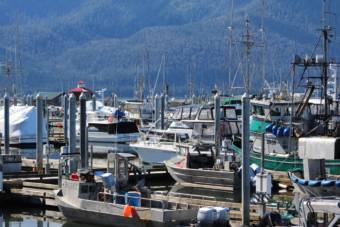
Heritage Harbor in Wrangell. (Sage Smiley/KSTK)

Southeast Alaska’s salmon harvest was over four times more than last year’s, according to a preliminary report from the Alaska Department of Fish and Game released on Monday.

Commercial fishermen in Southeast harvested 58 million salmon across the five species this year: almost 7 million chum salmon; 48 million pinks; 1.5 million coho; 1.1 million sockeye and 216,000 king salmon.

That’s a marked improvement in harvest for every species. Even the embattled Southeast king salmon had a commercial harvest increase of more than 16,000 fish. In total, commercial salmon fishermen in the region caught and sold 44 million more salmon than last year.

Even taking into account the odd-year pink salmon peaks, this year’s pink salmon harvest was more than double 2019’s Southeast Alaska pink salmon catch.

The preliminary ex-vessel value of the 2021 salmon fishery in Southeast was over $132 million this year — more than double last year’s preliminary ex-vessel value for the salmon fishery. That breaks a three-year streak of dropping ex-vessel values for Southeast’s salmon fishery.

Price per pound was also up across all five species this year in Southeast, according to the preliminary report. That was true for many other salmon fisheries in the state. In Bristol Bay, the price per pound for sockeye jumped 250% from 2020’s preliminary price.

Fish & Game reports that the statewide salmon harvest — both by numbers of fish and by weight — was the third-highest on record, and this year’s statewide salmon harvest was almost double last year’s.

The statewide ex-vessel value of almost $644 million is the third-highest reported since the mid-1970s.

What’s that reddish color on Wrangell’s petroglyphs?

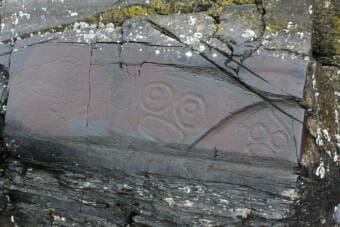
Wrangellites, scientists, and local police aren’t quite sure what’s coloring this set of petroglyphs on Wrangell’s Petroglyph Beach. (Sage Smiley/KSTK)

A beach on the northern tip of Wrangell Island is home to rock carvings estimated to be at least 8,000 years old — petroglyphs made by the ancestors of Wrangell’s Lingít people. Recently, one of the larger petroglyphs seemed to change color — and ignited some debate in town. Is it vandalism or naturally occurring?

Listen to this story:

While most of the carvings on Wrangell’s Petroglyph Beach are the weathered grey of boulders in a tidal zone, one of the largest intact rocks appears a deeply pigmented red-brown, especially when wet. A dinner-plate-sized animal figure with a fin adorns the left side of the rock face. Two similarly sized faces with round, wide eyes and open oval mouths are carved to its right — all stained.

“We always come down here for our dog walks, morning and evening. So I’ve gotten pretty familiar with all the petroglyphs. It’s fun looking at them in different light and whatnot,” said Wrangell resident Dan Trail.

“We,” is Trail and Dougie, his curly-haired black poodle-Portuguese water dog-mix.

“The other day when I was looking at it it was just like wow, somebody poured paint on this thing,” Trail said, explaining why he recently posted a photo on social media, alleging the burnt-sienna color was vandalism.

A fiery discussion ensued on Wrangell’s community Facebook group.

“I mean, I don’t care if it’s a different color,” Trail said. “Just the fact that it looks like paint.”

Dan Trail throws a tennis ball for his dog, Dougie at Petroglyph Beach. Trail posted about the coloring on the petroglyphs on Wrangell’s community board, sparking discussion about the source of the color.
(Sage Smiley/KSTK)

Trail said despite all the time he and Dougie spend down at Petroglyph Beach, he’d never noticed color like that on the carvings before. Plus, it was isolated to just the one large slab.

“I haven’t seen it on any of the other petroglyphs,” he said.

Wrangell police investigated. Police Chief Tom Radke said it was puzzling.

“We went out and looked at it and felt it and touched it and it doesn’t … It seems weird, don’t get me wrong, but it doesn’t seem like it’s paint like we know it as paint,” Radke said.

For one thing, the petroglyph is at least a hundred feet from the stairs down to the beach.

“Where the couple of them are — where the one is — I can’t imagine anybody bringing paint all the way out there,” Radke explained. “And number two, it’s been really rainy. I mean, not exactly painting weather.”

Ultimately, Radke said the police don’t think it was recent vandalism. More likely it’s tannins, a natural pigment that also gives the water around muskegs that coffee color.

Trail isn’t totally convinced: the discoloration is uneven.

“This is splotchy, you know,” he said, gesturing to the slab of rock. “It’s really obvious at the bottom end of the mouth there, there’s nothing and just now when we were looking at it, you can see this part was rubbed off there. And that would make sense because that’s the part that’s protruding, so if any logs or whatever rubbed up against it, it could rub that off.”

In the comments of Trail’s Facebook post, some Wrangellites said they believe the coloration has been around for years and posted pictures of a similar, red-brown color from 2014 and 2015.

Others say it could be vandals — but from decades past. Petroglyph Beach was made a state historic site in 2000 to protect the carvings of faces, animals, and spiral shapes. Janell Privett was on the Friends of the Wrangell Museum board at the time and recalls people messing with the 8,000-year-old petroglyphs. She said that prompted elders from Wrangell’s tribe and the Friends of the Museum to push for protections for the site.

“One of the biggest situations that happened was a tour group,” Privett recalled. “Photography, of course, has changed and changed and changed and there’s absolutely no reason for a good photographer to spray paint a petroglyph. And that has happened more than once. And the last one was a brown and another time a black.”

She thinks the color could be leftover paint from that tour group vandalism.

In a survey in the early 2000s, state archaeologists identified more than 40 ancient rock carvings on the Wrangell beach near the northern point of the island.

Tis Peterman said there used to be more. She’s a tribal citizen who said the Wrangell Cooperative Association had asked for assistance from the state to do a dig in the beach sand to catalog petroglyphs that could be buried by time, but “they turned us down flat.”

Years later, she said state Department of Natural Resources officials approached Wrangell’s tribe, soliciting help funding park improvements, which she said was frustrating, considering the lack of previous engagement.

The reddish color could also come from other wear and tear. Chalk, rice paper, and ferns were used to make rubbings of the petroglyphs for years. In fact, Wrangell’s tourism industry encouraged it as recently as the early 1990s.

KSTK sent photos of the petroglyph to chemists, geologists, and archaeologists at the University of Alaska Southeast. They’ve proposed a variety of possible natural causes for the coloring, including iron oxide or microscopic organisms. But they all agree — nothing can be determined by looking at photographs of the petroglyphs.

Biochemist Konrad Meister is an assistant professor of chemistry at UAS, based in Juneau. He said he thinks it could be some sort of bacteria.

“You might know from these very fascinating pictures from some of the national parks in the hot springs, there’s quite a lot of color variations,” Meister explained. “And so if you have microbes growing onto something, it can give it a set of those shades that you see in these images. But again, based on just this picture, it’s a bit tricky to be very conclusive about it.”

The only conclusive way to find out what’s coloring the petroglyph would be to take samples. If it’s biological, Meister said that could be as simple as bumping a culture plate up against the surface and seeing what grows.

“And that is probably the answer that the general public might be interested in,” Meister said. “But then you can go much further and say like, ‘Okay, what is actually causing the color change?’ and then we have to look into some of the chemical biochemical reactions and ‘Okay, where did it come from? Why is it only there seasonally?’”

Meister said this is a good time to be asking questions about changing color in the carvings.

“There’s a lot of research going into this because a lot of times, these color changes can just be color changes,” Meister said. “But you can also see that [change] in the deterioration of those petroglyphs. And that’s, that’s obviously something that we don’t want to happen, because they’re such amazing historical artifacts.”

Meister said he’d be interested in enlisting the help of a Wrangell UAS student, or even a science-minded high school student to look into what’s coloring Wrangell’s petroglyphs.

Whatever the color is, Peterman said Wrangell’s Petroglyph Beach is a rocky strip of refuge for her.

“I get a sense of peace out there,” Peterman said. “I feel a calmness, that no matter what, we’ve been a part of this land forever. And even though looking back over the years and how the natives have been treated, good and bad. We’ve always come from here.”

Being out among the petroglyphs makes her think about the thousands of years her ancestors have lived in the area.

“You go up there and you just are like, ‘Wow, this is really, proof that we live in harmony with the land and water,’” she said.

While the red tint on one of Wrangell’s petroglyphs remains a mystery, for now, the tide continues to pull and push against the ancient carvings.

Wrangell joins other Southeast communities, tribes in calling for transboundary mine reforms

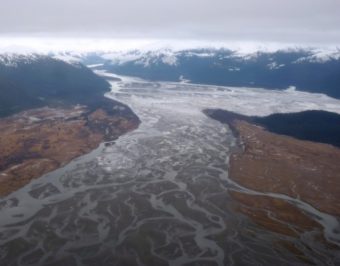
The Stikine River empties into the ocean near Wrangell. Mines and energy projects proposed for upstream sites in Canada are worrying some fishermen and tribal leaders. (Ed Schoenfeld/CoastAlaska News)
The Stikine River empties into the ocean near Wrangell. Mines and energy projects proposed for upstream sites in Canada are worrying some municipal and tribal governments. (File/CoastAlaska News)

Wrangell has joined with a dozen other Southeast municipal and tribal governments in calling for stronger protections from mines in Canada that straddle transboundary watersheds.

Wrangell’s assembly and residents say the issue is especially pressing to the community, which sits in the mouth of the British Columbia-originating Stikine River.

Wrangell’s assembly has unanimously called on Canadian regulators to immediately pause permitting, development and expansion of mines upstream from Southeast Alaska’s waterways. It’s also asking the provincial government of British Columbia to permanently ban the practice of storing liquid mine waste behind earthen dams.

That’s because there aren’t financial or legal protections in place for Southeast Alaska tribes and communities that depend on transboundary salmon watersheds. If a mine dam failed in Canada, it argues the downstream waste could devastate the environment and economy of communities like Wrangell.

Wrangell Mayor Steve Prysunka says he’s seen firsthand how mines have been abandoned in Canada, “And I’m here to tell you it was insane,” Prysunka told the assembly at a meeting on October 26.

In a previous job, he ran canoe trips on the Iskut River — the largest tributary of the Stikine — near the old Johnny Mountain mine site. “This was shortly after the shutdown and they literally walked away. We’d go into a building and there would still be the beakers inside the lab with Bunsen burners and rain gear still suspended. It was like they just disappeared. And over the course of three years or four years, I watched that tailings pond drain down the side of the mountain … It was this unreal turquoise color that was just unnatural. It reminded me of Lake Louise in Alberta. And it was just filled with all these minerals and was all draining down into the Iskut and into the Stikine.”

Mining industry publications report that the former Johnny Mountain mine was further cleaned in 2017.

But Prysunka’s larger point was that it’s important to protect Wrangell from legacy pollution. The borough’s resolution points out how the Stikine River is integral to Wrangell’s fishing economy, the work of the community’s Marine Service Center, and the traditional lifestyle of the indigenous population.

Wrangell resident and artist Brenda Schwartz-Yeager spoke in favor of the action at the assembly’s Tuesday meeting.

“I believe that for all of us here, whether you’re a fisherman, a health care worker, a teacher or a boat repair person, a little bit of Stikine River water runs through just about everything we do here in Wrangell,” Schwartz-Yeager told the assembly. “I don’t think this community would exist at all if it wasn’t for the remarkable richness and bounty of the Stikine. It’s a fragile ecosystem.”

Schwartz-Yeager told the assembly she finds it “incredible and scary” the size of the tailings upriver from Wrangell.

The largest mine operating in the Stikine River watershed is the Red Chris Mine, operated by Imperial Metals since 2015. That’s the same company that operated the Mt. Polley Mine that had a tailings dam failure in 2014. The tailings dam which holds mine waste from the Red Chris Mine is more than twice as tall.

“These mining companies have a pretty deplorable track record for taking responsibility for previous messes that they’ve made,” Schwartz-Yeager said. “We have a lot to lose, and they kind of have a lot to gain and really not a lot to lose. I feel like we need a place at the table, and I feel like this resolution will help bring us closer to using the treaty to put some teeth in the agreements that might help us downstream stakeholders. We just need a voice.”

The Petersburg assembly recently passed a similar resolution calling on its Canadian neighbors to tighten restrictions on mines in transboundary Alaska watersheds, including along the Stikine, Taku and Unuk rivers.

The Mining Association of British Columbia responded with a letter defending its safety record. Reached for comment, the industry group pointed to the October letter that says B.C.’s mine sector has made improvements to tailings dam oversight and safety in the years since the Mt. Polley disaster.

The Southeast Alaska Indigenous Transboundary Commission is a coalition of 15 tribes that banded together in the wake of the 2014 dam failure. Wrangell tribal citizen Tis Peterman is a former executive director of the commission, and said in an interview that they’re still working to gain representation as stakeholders in transboundary watersheds.

“We feel as tribal members in Southeast Alaska, that we should have a voice,” Peterman said, “Because anything that’s being done on the B.C. side on transboundary mining is going to affect downstream communities.”

Peterman says the Canadian government needs to recognize the rights of all indigenous peoples affected by its actions, not just those within a relatively recent border: “Tribes have pretty well taken care of the land for thousands of years. And to have a say in how the waters are being affected in Southeast Alaska is one of our rights.”

“It’s literally out our back door. Look across the backchannel. There’s Canada,” Peterman added.

Wrangell’s local tribe, the Wrangell Cooperative Association, is a member of SEITC, and had already passed a resolution asking for more engagement and protections from the effects of transboundary mines.

The years following the Mt. Polley mine disaster renewed calls for transboundary mining permit requests to be considered under what’s called the International Joint Commission. The IJC was formed under the Boundary Waters Treaty of 1909 and is meant to resolve water disputes between the U.S. and Canada.

But Alaska critics say that call for IJC oversight of transboundary mines hasn’t borne fruit.

“Until we have binding protections in place, we are just sitting ducks below what everybody calls these ticking time bombs,” says Jill Weitz, the Juneau-based campaign director for Salmon Beyond Borders, one of the organizations that requested a resolution on transboundary mining protections from Wrangell’s government.

Like Peterman, Weitz notes that the community of Wrangell is mere miles from the mouth of the Stikine River.

“Nearly the entire riparian corridor of the Stikine watershed is staked with mineral claims –54% of the river’s lower watershed is covered by mineral claims that overlap with salmon spawning habitat,” Weitz explains. “We’re not under the illusion that mining is going to stop or that any of us are going to stop mining in British Columbia. We need some of these resources towards the energy transition that is underway in face of a changing climate. But mining can be done better, it has to be done better.”

Alaska and B.C. regulators have been meeting regularly to discuss transboundary mining issues since 2016 under a bilateral agreement signed during Gov. Walker’s administration. And state officials say their B.C. counterparts do consult with them when permits are being reviewed for mines in transboundary watersheds.

Earlier this year, the government of B.C. did invite the tribal consortium SEITC to meet about transboundary mining and other tribal environmental concerns. It was the first such meeting for Southeast tribes. That’s in addition to discussions underway with the Tahltan Central Government on Canada’s side of the border about mining safety and indigenous input to the permitting process.

This isn’t the first time Wrangell has called on the Canadian government to create a table for discussion with indigenous and municipal governments from Alaska — the assembly passed resolutions in 2017, 2019 and 2020. But it’s a stronger request than before, with a call for an immediate pause on permitting new mines and a full ban for earthen tailings dams.

Site notifications
Update notification options
Subscribe to notifications