
KSTK - Wrangell

KSTK is our partner station in Wrangell. KTOO collaborates with partners across the state to cover important news and to share stories with our audiences.
Competition aims to strengthen and grow small Southeast Alaska businesses

Haines’ Port Chilkoot Distillery Icy Strait Vodka, 50 Fathoms Gin and 12 Volts Moonshine. (Photo by Emily Files/KHNS)

Walk into a gift shop in Southeast Alaska, and you’re likely to see cans of smoked seafood, jars of kelp salsa and hot sauce lining a section of the store. Enter a liquor store, and there might be glass bottles, decorated with marine life, of liquor distilled in Haines. Wildfish Cannery, Barnacle Foods, and Port Chilkoot Distillery are all success stories of a small business competition called Path to Prosperity.

“Really recommend their hot sauce, their Bullwhip Hot Sauce,” said business coach Marc Wheeler, speaking of Barnacle Foods’ award-winning hot sauce. Wheeler works with Spruce Root, which runs the competition. Spruce Root is an Alaska Native nonprofit focused on building up small businesses — and what they call a regenerative economy in Southeast Alaska.

“This word regenerative kind of sticks in your mouth, and it’s like, ‘What does that really mean?’ It feels pretty jargony,” Wheeler said, “But it’s really thinking about sustainability for the next level. How do we operate in this world and make things a little bit better? Not just how do we keep this thing going, but how do we improve the situation, so our grandchildren and our grandchildren’s grandchildren can have a future here?”

Wheeler used to own a coffee and ice cream shop in Juneau – Coppa – which was an early participant in the business plan competition. He sold the shop last November but said participating in the program shaped his business philosophy.

“I hadn’t thought about the community sustainability, of how to build the social capital,” Wheeler said. “Thinking about that really kind of shaped our business practices and was a big influence on us.”

Wheeler developed a local workforce, employing people in the kitchen who might struggle to find work elsewhere because of disabilities.

“It just really made us, I think, more human, but also just added so much to our business in a way that you can’t really describe,” Wheeler said. “And I attribute that to going through the competition.”

Wheeler said Spruce Root has re-tooled its business development competition this year – it’s now called Business and Balance. It involves a nine-week virtual business course, every Friday over Zoom, which will help participants create a business plan and financial projections.

“That plan can be really important for figuring out if an idea is feasible or not,” Wheeler explains. “They can also really kind of crystallize your thinking about your business.”

The course and competition are open to people who want to start a new business or bring an existing business to the next level. Wheeler said this year there are three $20,000 prizes. The nine-week training costs $175, but Wheeler said it’s refundable if business owners come to most of the classes.

Wheeler said it’s also a way to get to know other entrepreneurs around the region.

“It’s kind of lonely to be an entrepreneur,” he said. “You can’t really talk to employees, and maybe your spouse doesn’t want to hear about it anymore. So it’s fun to have a network of folks.”

Brooke Leslie works with Spruce Root and the Sustainable Southeast Partnership as what’s called a “catalyst,”  focusing on helping spark community development opportunities.

She explains: “[It’s] kind of reframing how we do business in Western culture versus creating a new working model based on Indigenous values and community first. So it’s really a full-grass approach. You often hear, ‘top-down’ or ‘grassroots’ but we’re really trying to take a blend of approaching the entire blade of grass.”

Participating in the Business and Balance program and competition can take out some of the trial and error of starting a small business, she said.

“You can really save a lot of like time and sometimes money [lost] through the trial and error process by taking courses like the Business and Balance course,” Leslie said.

Spruce Root is taking applications for the Business and Balance course through the end of the month. Find more information here or by emailing Marc Wheeler at marc@spruceroot.org.

Alaska delegation re-introduces “landless” legislation to include Southeast communities in federal claims law

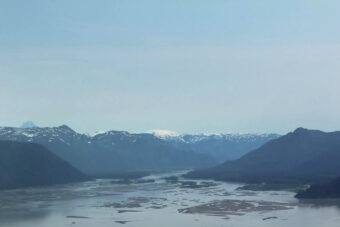
The mouth of the Stikine River, near Wrangell, one of the five ‘landless’ communities. (Sage Smiley/KSTK)

Alaska’s Congressional delegation has re-introduced legislation that would make the five so-called “landless” communities of Southeast landless no more. The communities have long argued being left out of the Alaska Native Claims Settlement Act is an injustice, but inclusion has remained elusive.

It’s been more than half a century since Congress passed ANCSA. It put millions of acres of land in the control of more than 200 newly formed local and regional Alaska Native corporations, while extinguishing aboriginal land title in the rest of the state. But five Southeast Alaska Native communities were left out of the deal.

“We were literally involved from the very, very beginning, going back to the very first part of land claims,” says Tashee Richard Rinehart. He is Lingít – Kiks.ádi from Wrangell, which is one of the five communities excluded from ANCSA.

“To be left out was a surprise to us,” Rinehart says.

Alaska’s Congressional delegation has been trying to change that by submitting and re-submitting bills over the past two decades. The bills are aimed at amending the 1971 legislation to include Wrangell, Petersburg, Ketchikan, Haines and Tenakee Springs.

“We see this as correcting an oversight from Congress that resulted in unfulfilled promises to the landless communities of Southeast,” says Sam Erickson, press secretary for Rep. Mary Peltola (D-AK), Alaska’s sole representative in Congress. “It’s been a priority of the Congressional delegation for decades, and we’re carrying on the legacy of Don Young and others who’re struggling to fix this injustice.”

Peltola filed a bill in the U.S. House of Representatives in late July. It’s a bipartisan bill, co-sponsored by Rep. Pete Stauber (R-MN). It is functionally the same as many others proposed in the past by Alaska legislators.

“ANCSA was intended to address Alaska Native land claims by conveying land that can be used for economic, social and cultural well-being,” Erickson says. “Because they’re left out, these communities (Wrangell, Petersburg, Ketchikan, Haines and Tenakee) never got the opportunities for economic development and cultural preservation that the other communities did.”

Erickson continues: “We think that this is a matter of fairness and of the federal government keeping the promises that it makes to Alaskans. Providing these lands is an important step to empowering these communities.”

It’s a matter of longstanding discussion why the five communities were excluded from the initial 1971 law. A report by University of Alaska’s Institute of Social and Economic Research in the mid-1990s found no clear reason why the communities were excluded, other than Congressional intent.

At a Congressional hearing in 2015, the late Rep. Don Young speculated it was because of the thriving logging in and around the five communities at the time of the law’s passage in the early 1970s. At the time, Young said timber groups lobbied hard against the communities’ inclusion, fearing it would impact future logging claims.

“It is so impactful for the five communities that were left out,” says Aaltséen Esther Reese, the tribal administrator for the Wrangell Cooperative Association, Wrangell’s federally-recognized tribal government. “This was our land since time immemorial. And it is recognizing that and giving our tribal citizens, some of our land back that we had stewarded for tens of thousands of years. On a philosophical level, I think that’s very important.”

Not only does Wrangell’s exclusion from ANCSA keep it from receiving a township of land – just over 23,000 acres, spread out over the vicinity of the community – it also means community members have been barred from forming a local corporation, although many members of the local community are shareholders in the regional Native corporation, Sealaska.

Alaska Native corporations are a huge chunk of the state’s economy, and the largest type of private employer in the state.

“What could it do [for Wrangell]?” asks Rinehart. “I think the sky’s the limit.”

Rinehart explains it’s unlikely a Wrangell Native corporation would go down the logging route of many original ANCSA corporations. He says village corporations are now looking at carbon credits, contracting jobs, and other economic endeavors.

“It’s been a long, long time, it’s way overdue,” Rinehart says. “It’s over 50 years past due. And it’s just a matter of justice at this point, really. It’s the right thing to do to fix a past wrong.”

He adds: “I believe that each and every community will benefit. And when I say that, I don’t mean just the Native community. Of course, the Native community would benefit but the entire community of Wrangell would benefit and Ketchikan, Petersburg, Haines and Tenakee. They would all benefit – non-Natives as well as the Native shareholders.”

The people who would be shareholders in a Wrangell Native corporation wouldn’t be exactly the same as the WCA tribal citizenship in town. Reese explains it would be an entirely separate entity with its own board of directors and management: “So it isn’t necessarily related to the tribe as far as our membership rolls,” she says, “But WCA is very supportive of all the efforts to get Wrangell, and the other four communities their land.”

Reese agrees with Rinehart: a local corporation could be a significant boon for the community.

“You’re talking about economic development, more opportunities for jobs in the community, being able to bring some of our people home, so that they can help in significant positions with the corporation, whatever the board decides,” she says.

If an ANCSA amendment to add the communities passed Congress, shareholder enrollment for the five communities would be the same as the original enrollment under ANCSA. It would allow shareholders and their descendants of the regional Native corporation Sealaska to receive a mirrored number of shares in a newly formed community-based corporation.

Members of the five communities have banded together to advocate as “Alaska Natives Without Land,” a campaign backed by Sealaska, and the “Southeast Alaska Landless Corporation,” a nonprofit also focused on organizing the five communities.

The years-long effort to include the five communities under ANCSA has faced pushback. Last year, Petersburg’s borough government narrowly approved a letter to Congress opposing a previous version of the bill after years of divided town discussions.

Some have concerns about specific sites included in proposed maps of the parcels that would be transferred to the landless communities. A few proposed tracts of land have come under criticism for falling outside areas where the landless tribes have direct historic ties.

Landless legislation has also, in the past, faced opposition from some environmental groups, because of potential development at the sites. Still others are concerned about the potential for restricted public access.

Senator Lisa Murkowski (R-AK) acknowledged the difficulty of establishing land plots and negotiating potential use and access conflicts during an interview with KSTK last fall (September 11, 2022).

“It’s hard,” Murkowski said, “Because every acre in the Tongass is already committed or loved in some way.”

But, she said that she still believes Congress should honor the obligation of ANCSA. She re-introduced a bill in the Senate in June that would include the five landless communities.

“What we’re trying to do is to resolve a long-standing inequity,” Murkowski said, “And do so in a manner that brings about consensus rather than conflict.”

Reese, Wrangell’s tribal administrator, says the years-long campaign to include Wrangell and the other landless communities speaks to how important it is.

“I think it is indicative of how passionate our people are, to be able to receive that recognition and to be able to receive that land and to be able to receive those rights,” Reese says. “My hat is off to those who just continue to work tirelessly, because this has been going on, […] for quite some time. So a recognition of Richard Rinehart, of all of those who are passionately working on this, because it’s not easy to keep going.”

Alaska’s delegation has introduced a handful of other bills aimed at amending ANCSA this term as well – in all, the law has been amended over 100 times.

Amateur historian wins national award for podcast on one of Alaska’s deadliest shipwrecks

The Star of Bengal is remembered with an image at the Wrangell Mariners Memorial. (Sage Smiley/KSTK)

A podcast on Wrangell history has won a national award for its series on one of Alaska’s deadliest shipwrecks.

In late September of 1908, the iron-hulled Star of Bengal, battered by a storm, smashed against the rocks of Coronation Island in Southeast Alaska. The ship broke apart, killing 111 of the 138 people on board – most of them Chinese, Filipino and Japanese cannery workers.

“It’s so viscerally real to me,” said podcaster and amateur historian Ronan Rooney. “Those of us who live in Southeast Alaska, we know that coastline. We’ve all seen miles and miles of it just going around, and to imagine a ship of that size wrecking against the coastline is just extraordinary.”

The Star of Bengal’s captain survived the wreck and publicly blamed the captains of two tugboats that had been towing the ship. After months of federal investigation, nobody was ever held responsible.

Rooney started his podcast, Wrangell History Unlocked, early in the pandemic, as he found himself with a lot more time at home. He’s looked into all sorts of local history, including a five-part series on the wreck of the Star of Bengal.
“I intended for it to be kind of about an hour, when I set out,” Rooney said. “I wanted for people to hear a story about the Star of Bengal that was maybe something they hadn’t heard before. So I really went into: let’s get into different narratives and let’s pick apart who I think is embellishing or outright lying. Because that’s what I really like.”

Rooney says previous researchers and historians had thoroughly analyzed the federal investigation and how the Star of Bengal was battered by the storm. He wanted to do something different.

“I kind of feel like I brought for the very first time: Here is a reason why we should all take sides in this debate, we should say the captain and the survivors are totally wrong, and that the steamship captains were in the right the entire time,” Rooney said. “Making a case for why I think the captain of the Bengal and the survivors lied under oath about the chance of rescue, which was absolutely impossible. The morning that they sat at anchor, there was no way they could be rescued. They tried to destroy the steamship captains, who themselves were victims of the same storm.”

Star of Bengal (Courtesy of the Wrangell Museum)

Looking at what the survivors of the wreck told newspapers down the West Coast, Rooney found an evolving story.

“What drew me was the near-universal sort of conclusion for over 100 years from people who wrote about it was that there was really no way of knowing if the accusations about cowardice were true or not, it was always more like, ‘Well, we’ll never know,’” Rooney said, “And that really rubs me the wrong way. I just couldn’t accept that.”

Although Rooney’s podcast on the wreck contributes new perspectives to the event’s history, it’s not a complete record. The history is skewed to the captain and ship’s crew, who were mostly white — Rooney says there’s very little out there about the cannery workers, most of whom died in the wreck.

“What the story is severely lacking is the voices of the Chinese, Japanese and Filipino cannery workers,” Rooney said. “We don’t have their words to go by. So there’s always going to be a cloud of mystery that may never go away.”

Rooney isn’t a professional historian. Born and raised in Wrangell, he graduated Wrangell High in 2003. As a senior, he wrote a pamphlet on Wrangell.

“I wrote a booklet for the museum, which you can still buy down at the gift shop, it’s that little red book,” Rooney explains. “The fact that they still sell it is really a huge honor. That was me dipping my toe in this sort of, ‘Well, maybe this is something I like researching, and I do like to share with people.’”

Rooney now works in tech and lives down south with his family – wife Mary, daughter Rosemary and son Conan – on the Willamette River in Wilsonville, Oregon. He was born in Wrangell at the old hospital building.

“My father was a fisherman and mother was a social worker,” he said. “I went to St. Philip’s Episcopal Church, I had great exposure to Lingít culture, Haida culture, and all that you have access to and Wrangell even today, and I sort of took it for granted.”

But the early pandemic brought him back to looking at Wrangell’s history. The podcast is a sort of audio theater, with narration from Rooney, sound effects, and friends and family playing parts.

“I had my friends who did voices for the piece,” Rooney said. “I’d get people on the phone and have them record little lines here and there, and my mother is in this piece playing piano as well as talking to Bill Taylor. My wife plays piano and does the voice is Joan.”

Joan is Joan Lowell, the daughter of the Star of Bengal’s captain. She was a silent film actress and published a book about the wreck of the Star of Bengal in the late 1920s. Rooney’s wife voiced Joan in the final episode of Rooney’s series on the wreck.

“It’s campy, it’s weird,” Rooney said. “And it’s just a treasure to me. I listen to it from time to time, just because hearing it makes me laugh.”

But “The Rise and Fall of the Star of Bengal” is much more than its entertainment value.

Star of Bengal (Courtesy of the Wrangell Museum)

Katie Ringsmuth is the Alaska State Historian and deputy State Historic Preservation Officer for the state of Alaska. Ringsmuth’s office in Anchorage has been gathering information to potentially place the Star of Bengal shipwreck on the historic place register. It’s part of a broader push in recent years to investigate and recognize the importance of the wreck. She stumbled on the podcast while searching online.

“I was very interested in looking at that shipwreck as a potential national register nomination,” Ringsmuth explains, “And actually, just happenstance came across Ronan’s podcast while doing a quick search on Google to see what more was out there about the shipwreck, and was just really, really impressed with the amount of work Ronan had put into it.”

Ringsmuth says Rooney’s podcast series on the shipwreck is compelling for a number of reasons. It’s an important story about an underrepresented community, as well as an important story in Alaska maritime and cannery history.

“I thought that it was probably the best account of that event that I’ve ever read, or experienced,” Ringsmuth said.

So she decided to nominate the series for an American Association for State and Local History award.

“It’s not just something that is cool and connects people, but also offers an important contribution to the scholarship and our greater understanding of the historic record,” she said.

And the awards committee thought so too – Wrangell History Unlocked: The Rise and Fall of the Star of Bengal won an award of excellence from the American Association for State and Local History.

For Rooney, the recognition has him on Cloud 9.

“I felt like I wanted to ride that fire truck through town,” Rooney said, referencing the long tradition of winning sports teams in Wrangell parading through town on the fire engine. “It felt like a validation of this thing that I do as a hobby. As a passion project, it paid off.”

But he’s not resting on his laurels – Rooney is bursting with ideas for future series and episodes.

“Did you know that the very first woman to become mayor in Alaska was from Wrangell?” Rooney said. “It was 1946. And her name was Doris Barnes.”

He’s got other ideas, from telling the story of the corrupt officials overseeing Wrangell during the Cassiar Gold Rush in the 1870s to the founding of the former Bureau of Indian Affairs boarding school on the island, the Wrangell Institute.

“That’s the great thing about history,” he said. “Is that it’s always just there, you can always go tap into it, you can always go find the power in it. That it’s a long time ago doesn’t hurt. In fact, that can make it more meaningful.”

Rooney’s podcast will be formally presented with the award at the American Association for State and Local History awards conference in Boise, Idaho in September. Another Alaska history project focused on the former Diamond NN Cannery in Bristol Bay, will also be honored with an award.

Wrangell holds Blessing of the Fleet at newly finished Mariners’ Memorial

Wrangell’s 2023 Blessing of the Fleet. (Sage Smiley/KSTK)

The Blessing of the Fleet is a tradition for many coastal communities as fishermen get ready for their summer season. On May 28, the Southeast Alaska community of Wrangell revitalized the tradition by holding the ceremony in its newly completed Mariners’ Memorial.

Wrangell residents and visitors gathered in clumps under a drizzly rain, some in suits, others in rain gear and Xtratuf boots. They stood between the curved, ship-like memorial walls and under the red-and-white lighthouse gazebo of Wrangell’s Mariners’ Memorial.

Some removed hats as Girl Scout Troop #26 presents the colors.

Wrangell’s Mariners’ Memorial sits on the edge of Heritage Harbor, about a mile south of town. Outside the breakwater of the harbor, three boats bobbed, tuning in to the Blessing of the Fleet over VHF radio.

Wrangell’s Mariners’ Memorial in 2021, before it was finished.
(Sage Smiley/KSTK)

Pastor Sue Bahleda introduced the service.

“The blessing of the fleet is our collective hope, our collective prayers for those who ply our waters,” she said. “And so if you’ll follow along in your bulletin, it’s not just us who are calling out for these blessings. It’s all of our voices together.”

Together with Salvation Army Lts. Jon and Rosie Tollerud, Bahleda read a blessing for boats of all types — fishing boats, barges, ferries and cruise ships.

Last year was the first year that friends and family could apply for plaques at the Mariners’ Memorial – 43 names were added to its walls. Some have an anchor next to the name, indicating a life lost at sea. Members of the board read the names and rang a ship’s bell for each.

This year, there are 14 new names. Some are longtime fishermen who’ve passed on from natural causes. Others have more tragic stories, like 27-year-old Arne Dahl, who died after his boat sank in late November. His partner, Kelsey Leak, survived the sinking and attended the Blessing of the Fleet with a few of Dahl’s friends from down south.

“My friends,” Bahleda said as the last of the 57 names were read, “We conclude this day with a prayer that is a song from the familiar hymn: Eternal Father of love and power. All travelers guard from dangers our; from rock and tempest, fire and foe, protect them wheresoever they go. Thus evermore shall rise from the glad hymns and praise from land and sea and together we say: ‘Amen.’”

It’s the first time Wrangell’s Blessing of the Fleet has been held since the memorial’s ribbon-cutting last September.

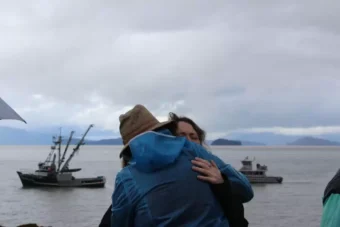
Hugs after the ceremony. (Sage Smiley/KSTK)

Memorial board member Jeff Jabusch notes that there’s still work to do.

“We have landscaping to install, we’re going to do some display cases inside that will display our membership or volunteers and donors,” Jabusch said. “We also are going to have an online accessible database that all the members on the wall can tell their story and people can access those eventually.”

Wrangell’s Mariners’ Memorial has come a long way since the project began in earnest in 2018.

It’s been the work of dozens of local people – some who’ve lost family members to the ocean. They’ve given hundreds of thousands of dollars and countless hours of volunteer time.

And now it’s home to the annual Blessing of the Fleet — and to the memories of generations of Wrangell mariners.

An 800-pound compass rose in the center of the Wrangell Mariners’ Memorial pavilion. (Sage Smiley/KSTK)

To get an electric bus, Wrangell schools must first buy an old diesel bus — and destroy it

A school bus outside Stikine Middle School. (Sage Smiley/KSTK)

Last fall, Wrangell Public Schools was selected as the only school district in Alaska to receive federal grant funding for an electric school bus. But the district is having some trouble fulfilling the requirements of the grant.

The grant is meant to get old diesel buses off the road by helping districts to buy electric ones. But to get reimbursed for the new vehicles, districts have to prove they’ve junked previously used buses.

The problem is that Wrangell’s three public schools contract with a local company, Taylor Transportation, for bus service. To get a rebate for an electric bus, that private company would have had to destroy one of their buses — something Superintendent Bill Burr says the company decided was not in their best interest.

That put the district’s bus grant in jeopardy.

“Since we don’t run a bus company, we’re looking at the possibility of purchasing a school bus somewhere else, having it disabled and getting the [electric] school bus ourselves, as well as the electric bus charging station,” Burr explains. “I had requested from the EPA: ‘Can I do this? Is this possible?’ They got back to me and said, ‘Well, we don’t see why you can’t.’”

The Environmental Protection Agency gave Wrangell an extension on the grant window until the end of this month. It’s a tight turnaround, but the school board has given Burr the go-ahead to keep trying to work out a solution.

The cost of an old bus can vary wildly. Burr says the district has looked in Southern California, where old school buses can sell on public surplus sites for around $1,000. Up in Alaska, he says his search has turned up old buses closer to $8-$10,000.

But cost isn’t the only issue.

“They have to fit certain requirements of age, that they were diesel, they were running students for the last two years, that they have to be taken out of service,” Burr said. “And there are specific agreements with EPA on what makes a disabled bus. So you don’t have to show them a crushed bus. There are certain ways that would make that bus inoperable according to the EPA.”

Now the district has about two weeks to find an old bus in a workable price range, buy it, have someone disable it, get the disabled bus approved by the EPA, and then order an electric.

Burr says it’s a lot that needs to fall in place, but he wants to do his best to make the grant work.

“We also have to be good stewards of both ours and federal money,” Burr adds, “So if we can’t do it, I don’t want to do it partway.”

Rep. Peltola calls for more collaborative management of Southeast’s transboundary watersheds

Mary Peltola chats with voters at the Blueberry Arts Festival in Ketchikan, Alaska on August 6, 2022. (Eric Stone/KRBD)

Alaska’s sole congressional representative is urging the federal government to do more in the transboundary watersheds of Southeast Alaska.

The United States and Canada share dozens of watersheds throughout Alaska and the Lower 48. In 1909, the two countries signed an agreement to collaborate and co-manage the watersheds through the Boundary Waters Treaty, which is administered by the International Joint Commission. But while the commission has more than a dozen standing boards to oversee specific watershed issues across the northern United States, it doesn’t have one in Southeast Alaska.

On Monday, Rep. Mary Peltola announced her support for the formation of an international watershed board to bring together stakeholders from Southeast Alaska, British Columbia and the U.S. and Canadian federal governments. It would be a major step towards fulfilling the long-standing requests of tribal and municipal governments throughout Southeast Alaska for a more open and collaborative watershed management process as mineral exploration in B.C. grows along major transboundary rivers.

KSTK’s Sage Smiley spoke to Peltola about what prompted her support for a more formal international process. She says it comes down to widespread support from Southeast tribal governments and communities.

Listen:

Read a transcript of the interview below (the transcript has been lightly edited for clarity):

Sage Smiley: To start with the obvious, you’ve expressed your support for an international watershed board. As far as I’m aware, that’s a first for Alaska’s congressional delegation, so what made you want to support an international watershed board for Southeast Alaska specifically?

Mary Peltola: Well, my understanding is that people in Southeast Alaska have been asking for this for some time — both the Native community and the non-Native community have been asking for accountability and oversight on the transboundary water issues for over a decade and maybe even longer. So I just really felt like it was important to voice my unequivocal support for this effort, because there is such widespread support of this throughout Southeast Alaska. I haven’t run into any Alaskans who are not in support of having a commission to oversee it. And this is something that Congressman [Don] Young supported. I don’t know how out front he was about that, but Congressman Young did support this.

Sage Smiley: Why is this important, in your understanding? What would this do that is not already being done by the mere existence of the IJC (International Joint Commission), for example?

Mary Peltola: I know that there are watershed councils in other states in the country that share borders with Canada — I think there are ones in Idaho and Montana, I think there are others. And there isn’t really a formal process to have a transboundary watershed council like this. So we need to make sure that — I feel confident that there is the political will among residents of Southeast, but we just need to make sure that people within policy positions and elected positions understand that the political will exists, and then seeing that translate to elected and appointed officials, that same kind of political will.

Sage Smiley: This isn’t the only area with transboundary watersheds in Alaska, why Southeast specifically for this support of an international watershed board?

Mary Peltola: Because there is so much political will in the communities and among fishermen and among stakeholders themselves. This really is a stakeholder-driven process; this has been a grassroots effort for many years. So I just am responding to folks from Southeast Alaska who have been clamoring for this for quite a while.

Sage Smiley: There’s only so much, of course, that members of Congress or anyone — borough governments in Southeast Alaska — can do about this. But what’s next? So you support this formation — What happens? What else can you do, can residents of Southeast Alaska do to continue pushing for this process?

Mary Peltola: I think that it’s incumbent upon us as Alaskans, to communicate that our communities and livelihoods are at risk. And we need to make sure that our neighbors are including us in their decisions in Canada. Currently, they are not including us, and they are not engaging in a real discussion. There have been some responses that would indicate that they are receptive, but then those taper off and go away. And so I just think it’s important that we communicate to the State Department, the United States State Department to help us. They have not been proactive, regardless of which administration we’re in. And I’ll be communicating my support for this Watershed Board strongly to our State Department and Canadian federal and provincial counterparts. The Boundary Waters Treaty was signed in 1909, and this process has been accepted as international law for well over a century, but we’re not really seeing that translated in Southeast Alaska at the ground level.

Sage Smiley: Is there anything else you’d want to add about your support for this additional process to include Alaskans and people across the border in Canada in this watershed management process?

Mary Peltola: I just want to reiterate that I think the support is very, very strong among every stakeholder group in Southeast Alaska. And we’re united as Alaskans on this effort, and where we do have broad-based consensus, we should be working together and moving the dial for protections in our waters and our watersheds. As Alaskans, there is nothing more important to us than our watersheds and our ecosystems, and we stand ready to protect them and make sure that they’re protected across the border where there are things that can have implications on our side. We have a very united front and we want to see forward progress on this collectively.

Sage Smiley: Thank you very much for sharing your thoughts today, I really appreciate it.

Mary Peltola: Thank you, Sage.

Site notifications
Update notification options
Subscribe to notifications