KSTK - Wrangell

KSTK is our partner station in Wrangell. KTOO collaborates with partners across the state to cover important news and to share stories with our audiences.
Facing busier tourist seasons, Wrangell is buying high-end port-a-potties off eBay

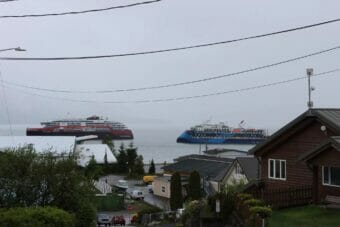
Cruise ships anchored outside Wrangell’s downtown, May 2022.
(Sage Smiley / KSTK)

After hours-long tours up the Stikine River or down to the Anan Wildlife Observatory, visitors to Wrangell often step off the jet boat and ask, “Where’s the nearest toilet?” But Wrangell’s only downtown public restroom facility is a small brown building with just two toilets.

This year, Wrangell Island is expecting around a 50% increase in the number of cruise ship stops compared to last summer — and last summer was pretty packed. Although Wrangell’s city dock can only fit one mid-size or large ship at a time, one day last May saw three ships: one at the dock, and two anchored out in the Zimovia Strait.

“That’s going to put over 1000 passengers hitting the streets of Wrangell with no place to go potty,” Stikine River Jet Boat Association Executive Director Caitlin Cardinell told borough assembly members at a meeting last April. “The majority of the downtown businesses here do not have public access restrooms or the capacity to provide for the public.”

Out of the nearly 40 businesses in the downtown Wrangell area, only three have public access restrooms, Cardinell said. Two of those establishments are bars.

Wrangell’s only downtown restroom facility doesn’t have a large capacity. (Sage Smiley / KSTK)

Wrangell’s local government thinks it has found a solution that will help fill the gap and save the borough money. They’ve purchased two high-end port-a-potty stalls from online auctioneer eBay.

Unlike the recognizable blue or green of regular portable toilets, these stalls are white and have their own sinks. They’ll be connected into the borough’s wastewater system on a corner lot near the city dock, eliminating the need for a truck to pump out sewage.

At a meeting in January, Borough Manager Jeff Good told the assembly that Wrangell won the potty stalls for $3,099, plus just over $800 for shipping. The borough will still need to purchase an accessible bathroom stall as well, he said.

“Hooking [the stalls] into the sanitary sewer system, doing some of the bench work we want to do, and if we put a fence on the backside of it as well, we’re probably into it for around $50,000 total,” Good said, continuing: “So saves us a significant amount of money.”

The original cost estimate for procuring new potties was double that, if not more. And speaking of doubles, the new toilets will more than double the number of standalone stalls in Wrangell’s downtown area.

Auction photos show the portable toilets purchased by Wrangell’s borough government. (Courtesy City and Borough of Wrangell)

Wrangell isn’t the only Southeast community struggling with seasonal restroom solutions. Sitka, which sees far more tourists than Wrangell, implemented its own temporary solutions last summer and is still on the hunt for a permanent fix to the need for more stalls when tourists are in town.

At the meeting last April, Cardinell told Wrangell Assembly members that dealing with restroom capacity sooner will pay dividends for the community down the line.

“I think this is a really important issue because tourism is one of the top three driving economic industries in this town,” Cardinell stated, “And I believe that if we do it sustainably, we can continue to help that grow.”

Wrangell’s first cruise ship of 2023 is scheduled to arrive on May 11 — the Ocean Victory, which can carry 200 passengers. Borough manager Good says he expects the first two new toilet stalls to arrive in Wrangell in the next few weeks.

Board of Game authorizes first Zarembo Island elk hunt in 17 years

A game camera photo of several small elk on a gravelly beach
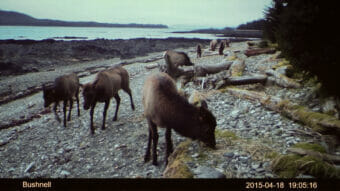
Elk on a Zarembo Island beach. (Courtesy Mike Kampnich)

Alaska’s game management board has authorized an elk hunt on Zarembo Island in Southeast Alaska for the first time in nearly two decades. The state Department of Fish and Game opposed the hunt, but strong support from Wrangell and other local communities helped convince the board to take the leap.
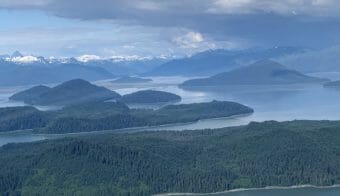
Elk are not native to the Alexander Archipelago in Southeast Alaska. They were introduced to Etolin Island in the mid-1980s and spread to other islands nearby. That includes Zarembo, which is about 10 miles across the Zimovia Strait and visible from downtown Wrangell.

But the Alaska Department of Fish & Game has shut down elk hunting on Zarembo for the past 17 years, concerned about low population.

Chris Guggenbickler is the chair of Wrangell’s Fish & Game Advisory Committee. He says locals have kept the flame for a Zarembo elk hunt.

“Elk is always something that we’re talking about,” he says. “There are so many people that have talked to us about the abundance of elk on Zarembo and the fact that they want to have a hunt again.”

Biologist Frank Robbins, who oversees Game Unit 3, the area around Petersburg and Wrangell, told Board of Game members at their January meeting in Ketchikan that he’s seen at most 23 elk on Zarembo Island. He says the current population is around 50, although that’s just an estimation because elk are hard to spot on the island.

“There is no available data that suggests that the Zarembo Island elk population has increased since hunting ended in 2006,” Robbins told the Board of Game.

For Board of Game members, that raised the question of whether it’s possible to sustainably harvest elk when the population is so small. Biologist Robbins was doubtful but conceded it’s feasible.

“I’ve been a biologist for pushing 30 years,” Robbins related, “I did at one time manage the Chitina bison herd, and year in and year out we would fly over the Chitina bison herd and count 50 animals. We issued two permits annually.”

Committee member Guggenbickler doesn’t think Fish & Game’s population estimate is correct .

“The last hunt was in 2006 — there were six bulls taken. They closed the hunt, thinking that there really weren’t a lot of bulls left on the island,” Guggenbickler says, “And then the proposal came off of the books. It’s been 17 years since we’ve had a hunt, so they’ve had that long to rebuild.”

There’s already a federal subsistence elk hunt in the area, but it excludes Zarembo and Etolin Islands and some of the smaller neighboring islets.

The Board of Game rejected three other elk hunt proposals, including a different proposed hunt on Zarembo and nearby islands, as well as two proposals to modify the current elk hunt on Etolin Island, south of Zarembo. But they unanimously supported Guggenbickler’s and Buness’s proposal at their January meeting.

Hunters from around the region wrote letters and spoke to the board about how they’ve seen increasing numbers of elk on Zarembo Island. And Guggenbickler says he believes the strong show of public support for the proposal helped swing the board’s favor.

Burnett said his opinion on the hunt was also somewhat swayed by the fact that elk aren’t a native species.

“Maybe elk just don’t belong there, and maybe it’s just not an appropriate place for elk,” Burnett said.

Robbins, the biologist, referenced a research project in the 90s which found significant overlap — about 64% — in the diets of elk and deer, especially when resources are strained after a heavy snow.

Guggenbickler says he explained to the board that deer are a major meat source in Wrangell, and hunting elk could reduce the deer’s competition for food.

“We were worried that if there was a hard winter, the deer were gonna end up on the beach, the elk would have ate all the food, the deer would have been compromised,” he said.

The newly approved elk hunt will take place in October. Hunters can apply for one of up to 25 tags to take one bull, but the actual number available will be up to Robbins, the area biologist.

Guggenbickler expects the department to be cautious in how they issue tags.

“The department is going to be conservative because they feel there’s going to be a higher success rate,” he said. “Etolin has a very low success rate; there are actually quite a few tags that go out but the success rates are only two or three percent.”

Guggenbiclker says he and colleagues on the Wrangell Advisory Committee may try to add a residency priority to the hunt.

“We were concerned that the entire proposal might fail based on that,” he said. “So the idea was just to kind of get the whole thing in the books – let’s baby-step this thing, and then hopefully we can get a resident priority later on.”

For now, they’re just glad it passed.

“Elk are kind of one of those species we don’t get a shot at much around here, and there’s some huge animals,” Guggenbickler says, “And I think everybody’s just hoping they might draw that tag and kill that great big bull.”

If the new Zarembo elk hunt makes it on the official regulation books in time, hunters may be able to submit their names for an elk tag on Zarembo this fall, with the first season in October of 2024.

Biden administration restores Roadless Rule protections to Tongass National Forest

""
The Stikine River Flats area in the Tongass National Forest, viewed from a helicopter on July 19, 2021. (Photo by Alicia Stearns/U.S. Forest Service)

The largest national forest in the United States is once again protected from development under the Roadless Rule. The United States Department of Agriculture announced Wednesday it had restored roadless protections to 9.37 million acres of the Tongass National Forest, which spans most of Southeast Alaska. 

In a press release, Agriculture Secretary Tom Vilsack said the Tongass is key to conserving biodiversity and addressing the climate crisis, adding that the decision listened to the requests of Alaska Native tribes and people of Southeast while also recognizing the importance of fishing and tourism to the region’s economy. 

The agency said in a press release it got around 112,000 public comments in the two-month period after it began the process to get the Roadless Rule back in place. The majority were in favor. 

The Roadless Rule was put in place at the end of the Clinton administration in 2001. It prevented road construction, reconstruction and timber harvest in most areas of the Tongass and many other national forests. 

But under the Trump administration, more than half of the national forest had been removed from Roadless Rule protections. Tribes and environmental groups in Southeast Alaska quickly sued, saying the decision disregarded overwhelming opposition.

Throughout the last two decades, multiple Alaska governors and members of the state’s congressional delegation have pushed back against the rule, saying it hampers resource development and economic growth in the state

Correction: An earlier version of this story understated the number of acres that regained Roadless Rule protections.

Flagship ferry Columbia will serve Southeast for the first time since 2019

The Alaska mainliner Columbia tied up in Ketchikan. (Eric Stone / KRBD)

Alaska’s flagship ferry Columbia will sail in Southeast communities this spring. It’s the largest of the Alaska Marine Highway’s ferries, but it’s been docked in Ketchikan since 2019, when it was taken out of service as a cost-saving measure.

The Alaska Department of Transportation announced the move Wednesday. Spokesperson Sam Dapcevich says crews made an unfortunate discovery while working on maintenance for the ferry that typically covers Southeast routes. He says the 60-year-old Matanuska has a fair amount of what’s called “wasted steel.”

“That’s like corroded steel on the vessel that needs to be repaired,” Dapcevich said in an interview with KSTK Wednesday afternoon. “They didn’t expect to have to do it, and it increases the cost and pushes out the timeline for it to return to service.”

Last fall, the Department of Transportation announced the 418-foot Columbia would remain docked despite years of work to make the ship ready to sail. The department had originally planned to task the Matanuska with the mainline Southeast route.
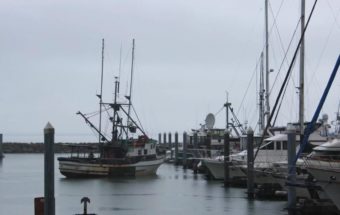
During its more than three-year layup, the Columbia served as housing for Alaska Marine Highway crew. Dapcevich says the Matanuska will likely take over that role with the Columbia back in service.

“While [Columbia] was operating as a housing vessel, or ‘hotel ship’ we call it, it was also getting work done,” Dapcevich says, “And that will likely be the same case with the Matanuska – while it’s being worked on, it will be a hotel ship.”

Dapcevich says the Columbia is scheduled to begin sailing Southeast routes on Feb. 13.

That will mean some changes to routes and schedules. For one, the Columbia isn’t certified to serve international ports. That means it won’t be able to stop in Prince Rupert, British Columbia. Dapcevich says the smaller Kennicott will take over the Canadian route in May once crews finish scheduled maintenance on the vessel.

The Columbia also isn’t able to dock in the Kupreanof Island community of Kake, so Dapcevich says the Marine Highway is working to add sailings to Kake using the day ferry LeConte.

Dapcevich added on Thursday that the Columbia’s fine-dining room — one of only two in the state ferry fleet — will be open for breakfast and dinner, according to the ship’s captain. The ship’s cafeteria will also be open for lunch and dinner, and he added the department hopes to have the Columbia’s bar open for service in the summer.

The department says it hopes to publish the Columbia’s full sailing schedule in the coming days.

This story has been updated to reflect that the Columbia’s dining room will be open when the Columbia sails. 

Southeast’s salmon harvest was half as large this year, but worth millions more

""
A boat leaves Wrangell’s Heritage Harbor, October 2022. (Photo by Sage Smiley/KSTK)

Southeast’s commercial salmon harvest was half as big as last year’s, but it netted fishermen more money. That’s according to a preliminary 2022 harvest report released by the Alaska Department of Fish & Game on Thursday.

Commercial fisherman in Southeast hauled in just over 29 million fish across the five salmon species during the 2022 season — 17.5 million pink salmon, 9.3 million chum, 1.2 million coho, 1.1 million sockeye and 257,000 king salmon.

Even though the total harvest was half the size of last year’s 58 million catch, the total value at the docks for Southeast increased by $12 million this year, to $144 million. That rise in value came primarily because the price per pound of chum salmon increased by half this year compared to last year, at a region-wide average of $1.18 per pound.

Sockeye also had an 18 cent increase per pound this year. The other three species had lower prices than in 2021.

The drop in overall harvest numbers can mostly be attributed to a drop in pink salmon harvest. It’s an even-numbered year, when fewer pinks return to the passages of Southeast. Even still, Southeast fishermen caught 10 million more pinks than the last even-numbered year, 2020.

Every other species saw harvest increases, including the embattled Southeast king salmon population — fishermen landed 40,000 more kings than in 2021. Southeast fishermen harvested more than 80% of the king salmon statewide this year.
Chum salmon had the largest harvest increase in the region, jumping over 2 million fish and more than $40 million dollars in value.

Statewide, ADF&G reports this is the largest even-year salmon harvest since 2010, and close to the longterm average harvest of 167 million fish.

There’s another bear contest in Alaska, and the awards range from cutest bear to most chill

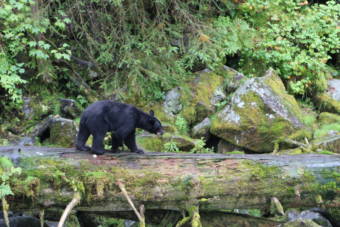
A black bear crosses a log at Anan Creek. (Sage Smiley/KSTK)

Katmai National Park’s Fat Bear Week contest, where the public votes on Southwestern Alaska’s fattest bears, is an international sensation. A smaller bear-viewing site in Southeast Alaska has kicked off its own bear awards this year, but the focus isn’t just on the rotundity of the area’s resident bruins.

Each year in early July, salmon return from the ocean, through the waterways of Southeast Alaska, and up Anan Creek. Bears follow close behind. And close behind the bears are visitors, hoping to catch a glimpse of fishing bears and other wildlife at Anan Wildlife Observatory.

The remote site, located on the mainland about 30 miles southeast of Wrangell, is staffed by seasonal workers with the U.S. Forest Service who rotate shifts living at a nearby floathouse anchored in Anan Bay.

That’s where the idea for the Anan Bear Awards was born, said Recreation Planner Dee Galla, with the U.S. Forest Service in Wrangell. This year, the Forest Service had six employees working at Anan.

“One of their duties is to try and identify the bears, because that helps us get an idea of the trends of the population, how many bears that we’re seeing at a time, are they the same bears, that kind of thing,” Galla explains.

As a part of that identifying, Anan employees take photos and videos of the bears walking, resting and eating.

“We have anywhere from 40 to 60 black bears that we see every year, that’s hard to determine because, you know, sometimes people are counting on the same one. Sometimes, we’re guessing if it’s the same bear or not,” Galla said. “And then we probably have about half a dozen to a dozen brown bears in a given year that people see.”

All that watching leads to a familiarity between Anan staffers and the bears at the creek.

“You watch them for a while and you start to be able to pick out different characteristics that each of them have, I mean, that’s generally how they acquire their names,” Galla said. “This year, how it started is that we just had a whiteboard in our breezeway at the float house, and I think one of the gals just started writing out categories for bear awards, and everybody would throw – you know – write down what they thought and why. And it got to be something kind of funny: every week, you’d go out there and see who was winning the new awards.”All that watching leads to a familiarity between Anan staffers and the bears at the creek.

At the end of the season, Galla said staffers made the informal whiteboard awards into a full presentation, which they sent to Paul Robbins, the public affairs officer for the Tongass National Forest.

“They sent me a bunch of videos and pictures of the bears that they took throughout the season, and their unique attributes, and entertaining anecdotes, and their names on this in this email, and said, ‘This would be an interesting way to recognize all these unique animals that we have this imagery of,’” Robbins explains, “And I thought, ‘Absolutely!’”

Robbins said that was about two weeks ago. The Tongass National Forest social media kicked off the first annual Anan Bear Awards with an award for “Fattest Bear” on Oct. 3. That went to “Unnamed Thick One.” (Not all the bears have names.)

“We’ve had ‘Cutest Bear,’ We’ve had the ‘Best fisherman,’ or fisher-bear, I should say, Scuba Sue was the ‘Best Fisher-bear,’” Robbins said. “And then we had the ‘Most Chill Bear,’ who was doing an impersonation of Baloo from ‘The Jungle Book’ just leaned up against a tree, scratching along to the music. Entertaining stuff.”

Scuba Sue is a well-known bear at Anan Creek – one of the only bears that regularly dips her full head and ears under the water to fish for salmon.

Robbins said the Forest Service is bestowing a grand total of nine awards to Anan bears this year, with the potential for expansion in years to come.

He said as a social media campaign for the Tongass National Forest, the Anan Bear Awards are a hit so far.

“We’re getting more engagements, more likes, more loves, more laughs than we usually do on our posts, which are primarily informative and not have adorable bear antics,” Robbins said. “And definitely more shares than we usually get.”

Robbins said it also helps to elevate Anan, which is a relatively remote and under-the-radar bear-viewing site.

“Not many people actually get to go to Anan and see that amazing place,” Robbins said. “So there’s a great way to share with folks who can’t make it.”

Although the timing of the first annual Anan Bear Awards coincides with Katmai National Park’s Fat Bear Week, it’s not meant to compete with that well-established ursine election cycle. For one, the Anan Bear Awards aren’t public choice. Plus, Anan is a different site, with a different vibe.

“I don’t think we have the amount of fat bears to really have a fair competition,” Robbins muses, “And we’re running this at the same time, so we’re not really looking to compete with Katmai. We just know that people are really interested in Fat Bear Week and they love it. People love bears in general. And this just looked like a great opportunity to highlight our bears here on the Tongass at Anan.”

“And,” he continues, “we prefer to highlight their unique personalities and traits over their girth. Katmai has that well done, so we’ll leave that to them and focus on the antics of Anan bears.”

Whether Unnamed Thick One and Scuba Sue can hold onto their titles next year remains to be seen.

Find the awards presented in the First Annual Anan Bear Awards on the Tongass National Forest’s Facebook and Twitter pages.

Get in touch with KSTK at news@kstk.org or (907) 874-2345.

Site notifications
Update notification options
Subscribe to notifications