KUAC - Fairbanks

KUAC is our partner station in Fairbanks. KTOO collaborates with partners across the state to cover important news and to share stories with our audiences.
Stephen Downs sentenced to 75 years in 1993 death of Sophie Sergie

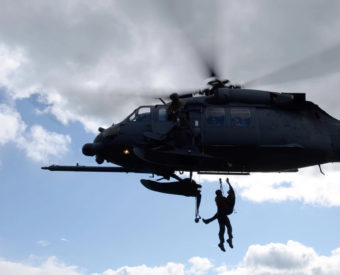
The defense table, at left, and the prosecutors, right, listen to Superior Court Judge Thomas Temple (not pictured) describe sentencing for Steven Downs.(Screenshot)

Steven Harris Downs was sentenced yesterday to 75 years in jail for the 1993 rape and murder of Sophie Sergie in a dormitory bathroom at University of Alaska Fairbanks.

The case baffled investigators for decades and became notorious because of the circumstances: a young woman stabbed and shot while she was visiting friends at college in Fairbanks right before finals week that spring. Among the potential hundreds of witnesses in the dormitory complex, no one had enough evidence to give Alaska State Troopers a solid suspect.

In 2018, DNA science provided a breakthrough. A sample on the victim was matched to Downs, who was living in Bartlett Hall that semester, one floor up from where the victim was found.

“The murder and rape took place in a woman’s restroom on the UAF campus in the woman’s floor of a dormitory, and the women’s restroom is an area where women are likely at their most vulnerable, but this is the location Mr. Downs chose to invade and commit his crimes,” said Superior Court Judge Thomas Temple.

Temple presided over the trial last January and listened Monday to pre-sentence reports from prosecutor Jenna Gruenstien and Defense attorney James Howaniec.

Gruenstein asked the judge to consider factors to influence a longer sentence: the use of multiple weapons in the crime, both a knife and a gun, as well as using a murder to prevent the reporting of a sexual assault.

“Whether they’re aggravators by analogy, or just factors that the court considers and places weight on (for) implementing the appropriate sentence — so in this case, the court has very wide discretion in the murder in the first degree sentence, 20 to 99 years to impose,” she said.

The judge said he would use the 1993 sentencing guidelines.

“To the charge of sexual assault in the first degree, the court is required by law to impose exactly an eight-year term of incarceration, and the court has no discretion to deviate from that number according to the laws in effect in 1993,” Temple said.

Defense attorney Howaniec asked the judge to consider Downs’ health and approach sentencing from a more “practical” approach.

“I’ll be honest, Judge. The way we’ve approached this is really more on a practical plane. Steve is 48 years old now. He’s over 400 pounds. He’s got very high blood pressure. I think that his life expectancy is not gonna be, you know, 103 years old here. Anything in excess of a 20-year sentence, that’s gonna be bringing him to near the end of his life under the best of circumstances,” Howaniec said.

Downs attended University of Alaska Fairbanks from 1992 to 1996. He lived in Arizona for a while and returned to his home state of Maine. Both the state and the defense noted Downs had no criminal record before, and had no known criminal activity since.

“We asked the court to consider the intervening nearly 30 years. He’s been nothing but a model citizen. He became a nurse, one who cared for hundreds if not thousands of patients. He’s really been a model prisoner at the Fairbanks Correctional Center. He’s helped his fellow prisoners there with everything from their GEDs to help helping to counsel them if they’re dealing with depression or substance abuse issues. He was on the Dean’s List multiple semesters for the remainder of his four years at UAF and then went on to be successful, without a criminal history for the next 30 years,” Howaniec said.

The victim’s brother, Alexi Sergie, was on the phone from Western Alaska before Monday’s hearing began, but the call was dropped before he could testify about the effects his sister’s death had on his family. He did not rejoin the hearing, even after a recess. Friends of the victim were ready to testify, but Judge Temple said it was not appropriate for this hearing.

“I will note that there’s no sentence this court could impose that there be adequate restoration to Ms. Sergie’s surviving family or her extended support network. There’s nothing the court could do to restore those folks,” Temple said.

Steven Downs, himself, did not say anything at the hearing. Howaniec says Downs maintains that he is innocent of the crimes.

“With regard to murder in the first degree, the court imposes a sentence of 67 years. Time to serve court is imposing the eight years of time for the sexual assault consecutive to the 67 years for murder in the first degree. The composite sentence is going to be 75 years,” Temple said.

Under Alaska law, Downs could be released after he serves one-third of his sentence, or 25 years.

Alaska-based pilots intercepted Russian aircraft 3 times in a week

A four-propellor Russian military plane climbing and trailing black exhaust
JBER-based F-22s intercepted a Russian Ilyushin Il-20 like this one on Monday, Tuesday and Wednesday of last week. (Creative Commons photo by Kirill Naumenko)

Fighter jets from Joint Base Elmendorf Richardson intercepted Russian reconnaissance planes three times last week in airspace around Alaska. That’s happened often in recent years, but a Fairbanks-based military analyst says it’s noteworthy because this time, it happened while the United States is helping Ukraine defend itself from Russian invaders.

JBER-based F-22 fighters scrambled on Monday, Tuesday and Wednesday last week to intercept a Russian IL-20 that had entered the Alaskan Air Defense Identification Zone, or ADIZ. That’s international airspace, but it’s not unusual for a nation to send fighters out to meet foreign aircraft that enter their ADIZ and often to accompany them until they leave it.

“On average, we conduct about six to seven intercepts a year,” says Capt. Lauren Ott, a spokesperson for the North American Aerospace Defense Command’s Alaskan Region based at JBER. Ott says the number of intercepts has varied annually since Russia resumed its so-called out-of-area long-range aviation activity 15 years ago.

“Some years, as high as 14, and some years, as low as zero,” she said in an interview Monday.

This year, however, the usual game of cat-and-mouse is playing out in an entirely different context — one where the United States and Russia aren’t at war but are certainly at odds because of the U.S’s leading role in supporting Ukraine.

But Ott says that didn’t affect last week’s otherwise routine interceptions of the Russian planes near Alaska.

“The recent activity by the Russian aircraft in the Alaskan ADIZ is not perceived as a threat, nor is the activity seen as provocative,” she said.

But a military analyst based at the University of Alaska Fairbanks says the intercepts are notable at the very least.

Troy Bouffard is a 22-year Army veteran who now directs UAF’s Center for Arctic Security and Resilience. He says the timing of the Russian sorties is notable because they likely were intended to send a message to the United States and its allies.

“Russia is trying to demonstrate that it can still project power in different areas, even being decisively engaged in Ukraine,” he said in an interview Monday.

Bouffard says it’s also no coincidence that the Russians decided now is a good time to resume the flights around Alaska because the Il-20 is equipped for intelligence, signals and reconnaissance missions. He suspects they were interested in radio communications between the U.S. and allied forces engaged in the latest round of Red Flag military training exercises that were going on around the state last week.

“It was definitely right in the middle of Red Flag,” he noted.

Bouffard said he thinks the Russians also were sending a message by conducting the sorties with only one Il-20 and not a Tu-95 Bear bomber, which often carries out the missions accompanied by a Russian jet fighter. He says the flights enable the Russians to gain useful intelligence, sometimes just by noting how the Americans respond.

“All the aircraft that they send into an ADIZ is meant to invoke a response and a reaction for the purposes of being able to monitor that and see if they can learn from it,” he said.

Ott said that there haven’t been any Russian aircraft sorties since last week. She declined to say whether there had been any others earlier this year, or to say exactly where the Il-20 entered the Alaska ADIZ.

Arctic Road Rally aims to show electric vehicles’ potential in Alaska

A truck makes its way south on the Dalton Highway near Coldfoot, Alaska. (Photo by Rashah McChesney/Alaska's Energy Desk)
A truck makes its way south on the Dalton Highway near Coldfoot, Alaska. (Photo by Rashah McChesney/Alaska’s Energy Desk)

Ten electric vehicles set out Friday from Fairbanks on a thousand-mile journey up the Dalton Highway and back. The Arctic Road Rally is intended to demonstrate the ability of electric vehicles to operate in the far north.

Organizers say the rally also will showcase EV technology and promote efforts to enable the vehicles to drive anywhere on the state’s road system.

“With this event, we’re showing that it’s possible to electrify even the most remote parts of Alaska very quickly and cost-effectively,” says Dimitri Shein, the executive director of the Alaska Electric Vehicle Association. AKEVA is one of the main supporters of the rally, along with Launch Alaska, an Anchorage-based startup-business accelerator.

Shein, one of the organizers of the rally, says he’ll be one of those traversing the remote stretch of the Dalton between Fairbanks and Oliktok Point — the farthest-north point in North America accessible by road.

“I’ll be driving my wife’s Tesla, and I hope she forgives me for driving her car down this stretch of road,” he said.

A map showing the locations of charging stations installed on the Dalton Highway for the rally
The 2022 Arctic Road Rally course and charging station locations. (Alaska Electric Vehicle Association)

The federal Department of Energy also is supporting the event, along with the Alaska Energy Authority, Sandia National Laboratories and the Center for Technology and the Environment, a Georgia-based nonprofit that promotes electrifying the nation’s transportation system.

The state Department of Transportation is providing power for an electric-vehicle fast charger at the Yukon River crossing, the first of four charging stations on the route. The others are at Coldfoot Camp, Trans-Alaska Pipeline Pump Station 4 and Deadhorse.

“This will the most advanced charging network and highway in Alaska,” he said in a recent interview.

Shein says the arrangement is only temporary, but he says the infrastructure that’ll be built-out at the four sites will remain after the rally ends. He says that would enable charging stations to be permanently set up those locations, once the state gets around to the Dalton as part of its plan to enable EVs to travel throughout the road system.

“We’re pro-charging anywhere in Alaska,” he said. “So, I mean, that would be a great outcome.”

That’s one of the objectives of the rally, says Tim Leach, who heads up Launch Alaska’s transportation program.

“We’re interested in increasing the awareness and adoption of electric vehicles here in the state of Alaska,” he said. “We want to make sure that electric vehicle savings and emissions benefits are accessible to all folks who are interested in electric vehicles.”

Leach says the rally will bring together manufacturers of EVs and charging-station suppliers, and startups that will use the lessons learned from the rally to understand how to make more EVs and the facilities needed to power them available to Alaskans, wherever they live in the state.

“Some of this technology demonstration that we’re undertaking here at the Arctic Road Rally will help us identify what technology solutions are suitable both on the vehicle and the charging side for some of these communities that have different sets of infrastructure,” he said.

Electric vehicle owner and advocate Phil Wight says he hopes the rally also will help Alaskan’s understand the benefits of converting to an electric vehicle.

“The electrification of transportation can save Alaskans ultimately billions of dollars,” he said.

Wight is an assistant professor of history and Arctic and Northern Studies at the University of Alaska Fairbanks, and he’s a policy analyst with the Alaska Public Interest Research Group. He says wasn’t able to sign up in time to enter his Chevy Bolt in this year’s rally, but hopes to next year.

Wight hopes Alaskans will pay attention to the event because it will demonstrate the billions in savings for would come in the form of keeping money Alaskans keeping the money they pay local utilities for transportation here, instead of the corporate offices of oil companies Outside.

“We spend, I think, one billion dollars every year paying for oil. We do not get a hometown discount for our oil.”

Wight says the other savings come in the form of health benefits that come from breathing cleaner air — an especially important consideration for people who live in the Fairbanks area.

“Local air pollution — right? There is a significant chunk of air pollution which emanates from light- and heavy-duty vehicles,” he said.

The 2022 Arctic Road Rally got under way at 11 a.m. Friday, Aug. 12. The starting line was at the Golden Valley Electric Association’s headquarters on Illinois Street in Fairbanks. The 1,096-mile rally isexpected to wrap up on Tuesday.

‘She wasn’t afraid of adventure’: Alaska author Lael Morgan dies at 86

Lael Morgan photographed in a radio studio
Lael Morgan appears on Talk of Alaska on June 14, 2016. Morgan passed away on July 26, 2022. (Photo by Wesley Early/Alaska Public Media)

Longtime Alaska journalist, author and historian Lael Morgan died last week at age 86. Morgan led an unconventional life, telling the stories of others and creating her own.

She came to Alaska from New England with her husband in 1959, said her adopted daughter, Diana Campbell of Fairbanks. Campbell said Morgan wanted to earn money to sail around the world — an adventure she half completed before returning to Alaska and embarking on a journalism career that took her around the state and beyond.

“The Juneau Empire, the News-Miner, Jessen’s Weekly, the Los Angeles Times and then the Tundra Times, which was probably one of her most important things,” said Campbell.

Morgan’s work at the Tundra Times gave her insight into some of Alaska Native people’s pivotal fights to protect their way of life.

“She really had a front row seat to land claims,” said Campbell. “The Tundra Times covered land claims. They also covered the Rampart Dam project, plus Project Chariot.”

Morgan wrote a book about Inupiaq carver and Tundra Times founder Howard Rock, “Art and Eskimo Power,” as well as many others, including an acclaimed history of Gold Rush-era prostitution, “Good Time Girls of the Alaska-Yukon Goldrush,” published by Epicenter Press, a company she co-founded in 1988.
Morgan’s many other pursuits included freelance photography and writing for publications like the New York Times and National Geographic, a stint as a private detective in Los Angeles and retracing Jack London’s travels in the South Pacific.

A black and white photo of a woman posing with long, willow snowsheos
A young Lael Morgan. (Lael Morgan collection)

“She was nomadic in that way, and she wasn’t afraid of adventure,” said Campbell. “She wouldn’t say she was a women’s libber, but she didn’t think that being a woman held her back from anything. She was always working. She never retired.”

Another Morgan project brought attention to the buried history of Black soldiers who built the Alaska Highway.

“We had two reunions of Alaska Alcan veterans and they had personal photos,” Morgan told KUAC in a 2017 interview. “We made a museum show and took it all around. And then Colin Powell took it to the Pentagon.”

Morgan pushed for the history to be taught in Alaska schools.

Campbell said she first met Morgan when she had her as a journalism instructor at the University of Alaska Fairbanks, and was initially intimidated by Morgan’s no-nonsense style.

“I was terrified of her,” said Campbell. “She scared the dickens out of me.”

But they eventually formed a bond.

“Native people were important to her. Of course, I’m Alaska Native myself, and she wanted to see an Alaska Native do well in journalism,” said Campbell.

Campbell said the connection deepened and Morgan, who had no children of her own, informally adopted her.

“She said, ‘I’m going to be your mother.’ And I said, ‘OK,’” said Campbell.

Campbell underscored that Morgan was not all about work.

“She also collected people, oddball people, and would sometimes see things in other people that other people did not see,” said Campbell.

A memorial service for Morgan is being planned for Anchorage around Labor Day but Campbell said Morgan’s ashes will be buried at Fairbanks Birch Hill Cemetery.

“She’s actually going to be buried next to Georgia Lee, a woman she found out about through her book, ‘Good Time Girls,’” said Campbell. “Georgia Lee was maybe Fairbanks’ most famous good time girl.”

Lael Morgan’s burial will be followed by a celebration of life event.

‘We’ve seen this before’: After cow mutilation, Delta Junction ranchers put up $2,500 reward

Two people on a 4-wheeler in a field, surrounded by cattle
Tangy and Matt Bates have lost at least three cows over the past couple of weeks that were among about 100 they kept in a field like this that was owned by another farmer in the agricultural area south of Delta Junction. (Photo courtesy of Mugrage Hay And Cattle)

Alaska State Troopers are investigating the killing and mutilation of a cow near Delta Junction. The ranchers who owned the animal are offering a $2,500 reward for information about its death and the disappearance of two other cows over the past week. 

Tangy Bates and her husband, Matt, own 300 head of cattle. And because there’s not enough pasture at their ranch, they keep most of their beef cows in other farmers’ fields. But all that changed this week, when kids next door to one of those farmers found a dead cow.

“It was a couple of 8-year-old girls that found it,” Tangy Bates said. “They were out playing.”

She says the girls found the cow Wednesday in the woods that surround the field, where she and her husband kept about a hundred of their cows. She says last week they’d found the carcasses of two other cows that had gone missing, and they weren’t sure of their cause of death, either. 

But Bates says the third cow, a lactating female, had clearly been killed and mutilated.

“They had cut her ears off, cut her udder off, her reproduction organs, cut her eyes out, backstraps out,” she said.

Bates says it appears the cow was killed within the past five days or so. She says some people have suggested it was killed by a predator, like a bear. But she disagrees because the incisions clearly were made with a sharp edge.

“We have a butcher shop,” she said. “We know the difference.”

Bates and her husband have been operating their farm and ranch in Delta Junction for about six years, and she’s never heard about any cattle mutilations in the area during that time. 

Nor has Scott Mugrage, another Delta Junction rancher who’s also president of the Alaska Farm Bureau.

“I haven’t run into such a thing,” he said.

Mugrage says perplexed by the cow killing, too. But he says the fact that they cut out the backstraps — the two long strips of meat that run along the spine — leads him to suspect the cows were killed for food by someone who can’t afford to buy it at the grocery store.

“Meat, groceries are getting pretty doggone high,” he said. “And you’re probably going to see more instances of something like this.”

But the high cost of beef also means that Bates and her husband will have to pay some $2,500 to replace each cow. And that doesn’t include the loss of revenue they would’ve gotten from the sale of calves the cows would’ve produced.

“The short-term value is $2,500. But the long-term value of that animal is, I’m losing out on thousands of dollars,” she said.

Troopers are investigating the cow killing, and that’s about all a spokesperson could say about it Wednesday afternoon. 

Bates says she and her husband have sent tissue samples from the three cows to a lab in Washington state for necropsy in hopes that might shed some light on the case. But she, too, has her suspicions, based on what she’s encountered during a lifetime of ranching.

“I originally come from Idaho, and we’ve seen this before, where you have cults that have come through and do cattle mutilations and take reproductive organs, eyeballs,” she said.

Bates says she’s just speculating about that. 

Meanwhile, she and her husband have been spreading the word around the local agricultural community about the suspected cattle killings. And fellow farmers and ranchers have been donating money towards the $2,500  reward the Bateses are offering for information leading to the conviction of the suspected rustlers.

Bird flu concerns mean there will be no poultry at this year’s Tanana Valley State Fair

A black-and-white photo of an older woman looking at a large, white rooster in a cage
Fairgoers in the poultry tent at the Tanana Valley State Fair in Fairbanks in August, 2016. (Photo courtesy of Ian Dickson)

There will be no poultry at the upcoming Tanana Valley State Fair in Interior Alaska for the first time in decades. Fair board president Coleen Turner says the decision was made because of the threat of avian influenza.

“We really felt like it was in the best interest of people who bring their poultry to the fair, that we make sure that they’re safe and that we don’t cause any undue harm to those animals,” said Turner. “And that’s why we made that decision. And it was thoroughly vetted with our livestock committee, the state vet and our board of directors.”

More than 40 million poultry have been impacted by the bird flu nationwide, plus over 1,800 wild birds, according to the Centers for Disease Control and Prevention.

The birds on display at the Tanana Valley State Fair typically include geese, turkeys, chickens and ducks.

Turner said when deciding to ban them organizers also took into account the fairgrounds’ location next to Creamer’s Field Migratory Waterfowl Refuge.

“They’ve actually had birds there infected,” she said. “That made it a higher risk and so we really felt like we could not have the poultry here because of that.”

The Tanana Valley State Fair starts Friday and Turner said preparations are going well despite Monday’s windstorm which damaged some vendor tents.

“Quite a few people’s tents were blown away and destroyed, but I have to tell you, people are very resilient, helping to find poles to put things together,” she said.

Turner said the fair’s big-top tent barely survived the high winds.

“It was kinda touch and go with that tent,” she said. “We literally had to take all the tent sides off because the poles were coming off and we definitely were quite concerned that we were gonna lose that tent.”

The Tanana Valley State Fair runs from Friday, July 29, through Aug. 7.

Site notifications
Update notification options
Subscribe to notifications