KUAC - Fairbanks

KUAC is our partner station in Fairbanks. KTOO collaborates with partners across the state to cover important news and to share stories with our audiences.

For Denali area tour operators, canceled season means economic uncertainty, fewer dog cuddles

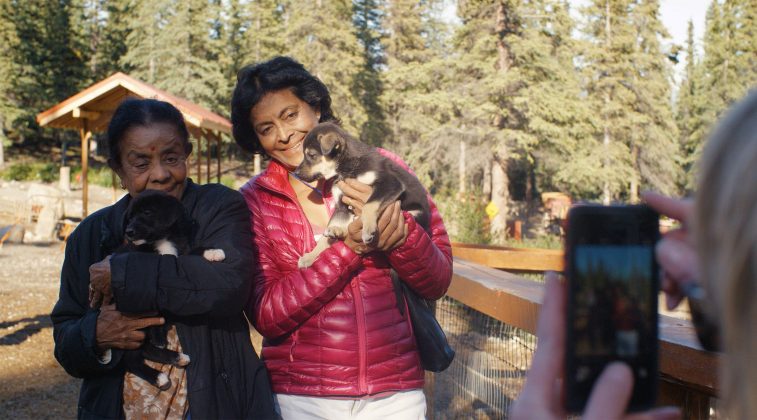
A couple of tourists cuddle husky pups during their visit to Husky Homestead, which informs visitors of Alaska’s sled-dog tradition. (Courtesy of Husky Homestead)

As this summer’s tourism season winds down, Denali Borough officials and business persons are assessing the economic impact of the sharp, pandemic-driven decline in visitors to Denali National Park. The downturn has been especially painful for communities that are heavily dependent on the tourism industry, like those in the Denali Borough.

Among the dozens of businesses outside of Denali National Park and Preserve is the Husky Homestead. General Manager Carrie Skinner says it’s a popular tourist attraction that gives visitors a chance to learn about sled dogs up close and personal, starting with little fuzzy husky pups.

“Guests come and get to hold a puppy, when they arrive,” she said, “and then the first portion of our presentation is about the Alaskan husky sled dog. We share people how we name them, train them, raise them …”

Skinner says the Husky Homestead had its best season ever last year, with more than 21,000 customers. But this season, that number fell to just over a thousand — a drop-off of some 95%.

“We never could’ve seen COVID coming, and what kinds of impacts it would have on the travel industry worldwide,” she said. “I mean, it’s pretty much decimated it.”

Skinner also serves as the Denali Chamber of Commerce’s board president, and she says the downturn has been hard on both tourism businesses and those that depend on the economic activity the industry generates locally. She says most of this summer’s missing tourists were those who would’ve come to the national park in buses or trains as part of package tours offered by cruise companies.

“We are heavily dependent on visitors who are coming up on the cruise ships,” she said.

Borough Mayor Clay Walker says the drop-off in tourism has in turn reduced revenues that the industry usually generates for the borough government. He says to help ease the pain, the borough has established relief programs, one of which, Denali CARES, distributed $730,000 in federal grants to local businesses that have been feeling the pinch.

“It was a really rough year,” Walker said. “A lot of businesses didn’t open. Some of those that did, wish they hadn’t. Others that did open actually said it was worthwhile.”

Walker outlined the sharp decline in visitors in the mayor’s report he delivered in last week’s borough assembly meeting.

“As expected, due to pandemic mandates and travel restrictions, the final quarter of Fiscal Year 2020, which ended June 30, saw a dramatic decline in overnight accommodations tax revenue,” according to the text of the report in last week’s agenda. “Preliminary numbers show a 96 percent decline. Overall, the preliminary numbers for FY 2020, which will be finalized and audited in the months ahead, show a more modest net contraction in our financial position, thanks to a robust first quarter of receipts.”

The mayor said he’s encouraged that bookings for cruises to Alaska next summer are brisk.

“The level of bounce back next visitor season depends upon many factors,” according to the text of his report. “”I have spoken to visitor industry leaders and have heard different levels of 2021 projections. Without cross-gulf sailings in 2021, projections are maybe twice the level of visitation we saw this July and August. With cross gulf sailings, we could see a much more significant rebound.”

Walker says businesspeople who opened their doors this season muddled through partly by adjusting their expectations early in the season. He says the fact that they faced much less competition this year has also helped.

“I spoke with several (businesspersons), some (owners of) restaurants and even a rafting company, that said their season was actually decent, based on lower expectations and the fact that there weren’t many others open.”

Walker says that ability to adapt to changing circumstances is essential to conducting business this year and next, when he hopes a vaccine will be available and the concern over covid hopefully begins to recede. For example, he says businesses should be flexible to accommodating changes that might include booking fewer tourists at a time.

“I do think people will be traveling in smaller groups, potentially, especially next summer, and looking for smaller-group activities,” he said. “And I think businesses that can respond to that and provide those opportunities may be poised for success.”

Both Walker and Skinner say the state’s efforts to promote more in-state tourism by Alaskans have helped boost the otherwise slow season.

Skinner agrees the tourism business and many other industries all will have to adapt and adjust.

“I’ve heard from a few people who are like, ‘It may take a while, but we’re going to return to normal,’” she said. “And there’s a few who say, ‘Well, we need to realize that may take a while and that this may now be our new normal, at least for a time period.’”

Skinner says regardless of whether the new normal persists into the coming year, she’s pretty sure there will always be a strong demand among visitors to hold a little fuzzy husky pup.
Increasing COVID-19 cases push Fairbanks school district into red zone

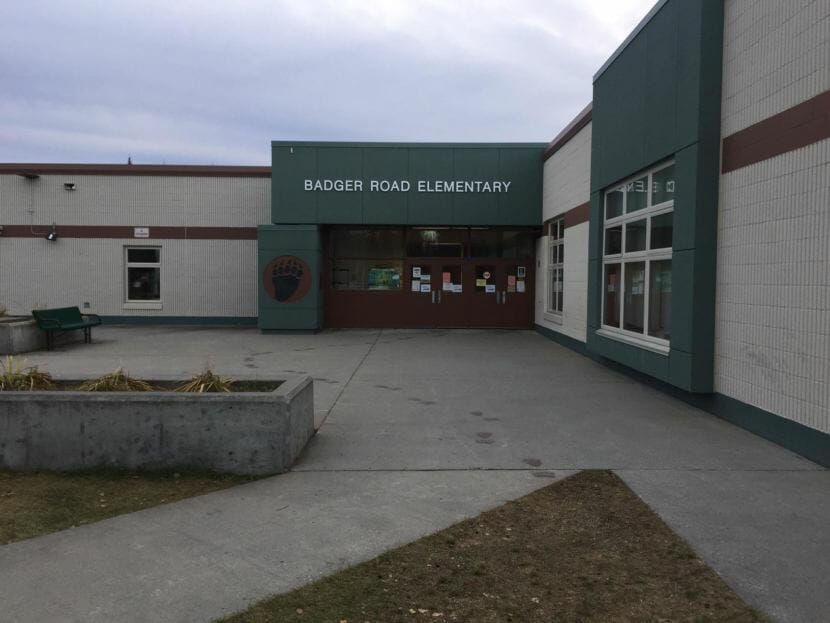
Badger Road Elementary School (Photo by Robyne, KUAC – Fairbanks)

An increasing number of Fairbanks North Star Borough COVID-19 cases has pushed the school district into an operational red zone.

According to a district release and a notice sent to parents Monday afternoon, the decision was made based on consultation with a school medical advisory committee.

The state defines the red zone as an average of 10 or more daily cases per 100,000 people in a community over the last two weeks. State red zone guidelines include distance learning and cancellation of all in-person school activities, with sports practices limited to those where 10-foot social distancing can be maintained.

District Medical Advisory Committee chair Dr. Mishelle Nace and district Superintendent Karen Gaborik will provide an update on the situation during a school board meeting Tuesday at 6 p.m.

During a local League of Women Voters municipal candidate forum on Monday evening, all candidates underscored the value of classroom over online learning. Seat F candidate Gregory Gregory Cahoe said the COVID-19 pandemic situation in Alaska needs to be put in perspective.

“Let’s put this risk in context and let’s get the kids back in school please,” he said.

Seat G candidate Brandon Boylan agreed about the importance of returning students to classrooms, but cautioned against doing so now.

“COVID numbers are going up in our community and we need to be conscious of that and think through how COVID is going to impact our kids across the district,” he said.

Denali National Park plans to expand fall and spring park access

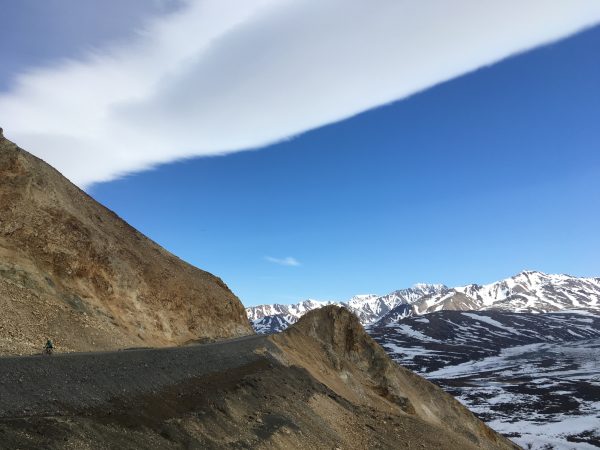
A cyclist pedals through the Pretty Rocks area of the Denali Park Road on the approach to the Polychrome Overlook on Saturday, May 9, 2020. (Nat Herz/Alaska Public Media)

The National Park Service is moving ahead with changes aimed at enhancing shoulder and winter season access to Denali National Park.

Formal planning for the changes began two years ago, although some of the changes — like plowing and opening the Park Road to the Mountain Vista rest stop at Mile 12 each February — have already been happening for several years.

Denali National Park recreational planner Jennifer Johnston says the plan also includes allowing traffic to Mile 30 in the fall when conditions permit.

“Traditionally, if we got a really severe weather event, say in late September, that would close the Park Road at headquarters at Mile 3 and it wouldn’t reopen again until the Spring. Under this new vision, if we had a really severe weather event in September, but then the weather cleared up and it was just beautiful and the road dried out all of its own accord, the road could then open again to the Teklanika Rest Area,” she said.

The plan also includes ski trail grooming near the park entrance, snowshoe and mushing access upgrades at Mountain Vista and expanded winter commercial guiding operations.

“Guided skiing and snowshoeing will be allowed in the wilderness area that surrounds the Park Road,” Johnston said. “Mushing is already allowed in that area and will continue to be allowed.”

Other changes will allow concession or transit and tour bus service to begin earlier in the spring, and for private vehicles to park along the road in May to facilitate access to hiking and backcountry trips.

Johnston said the park service also plans to open the Savage River and Teklanika campgrounds earlier in the spring and keep them open later in the fall. A recently issued decision on an environmental review said the changes will result in no significant impact of the park. Johnston emphasized that all the changes reflect the growing demand to visit Denali outside of the traditional summer season.

“We wanted to make sure that we could provide for those visitors and better manage that visitation,” said Johnston.

But some in the area are skeptical.

“We don’t think that the park needs to make easy or more accessible beyond a certain minimal approach.” said longtime Denali Citizens Council board member Nancy Bale. She says the park watchdog group is especially concerned about the increased private vehicle traffic. She points to its expansion this summer due to a pandemic-caused reduction in traditional bus transport options.

“[It’s] shown that people don’t really know how to behave around wildlife. They get out of their cars inappropriately. They’d leave their cars parked in the road,” she said.

Bale says the apparent management shift diverges from the 1970s approach when the Park Service first opted for buses to transport visitors along the Park Road to both provide safe access and protect wildlife and other park resources.

Trailing by 14 votes, Coghill asks for recount

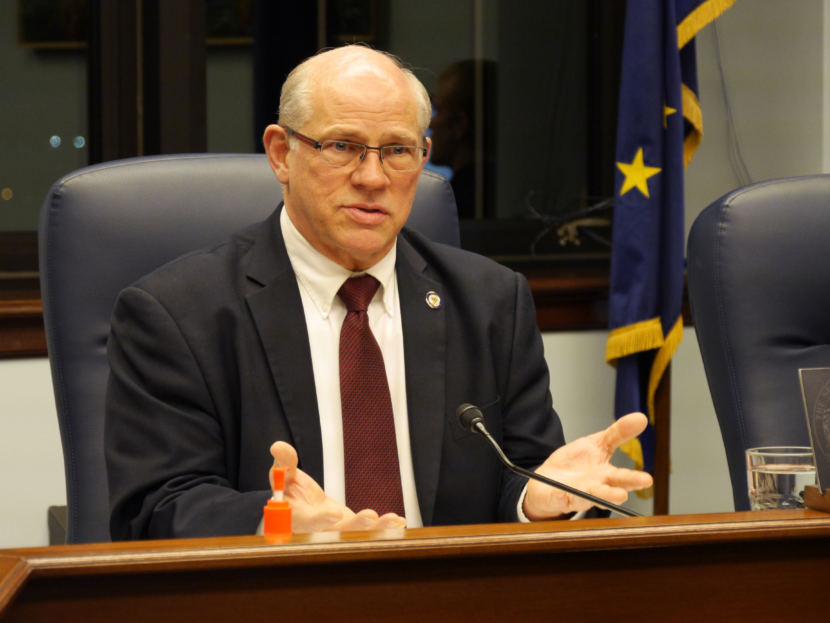
Sen. John Coghill, R-North Pole, responds to Gov. Bill Walker’s annual State of the State Address during a Senate Majority press conference, Jan. 21, 2016. (Photo by Skip Gray/360 North)

North Pole state Sen. John Coghill says he will ask the Division of Elections for a recount in his Republican primary race. Coghill lost the race for Senate District B to Robert Myers by 14 votes, according to unofficial results from the Division of Elections.

According to Alaska law, the state will pay for a recount if the difference between candidates is 20 votes or fewer or less than 0.5% of the total number of votes cast for the contested office.

On Friday, the Division of Elections finished counting absentee and questioned ballots.

“I’m gonna definitely call for a recount,” Coghill said. “When it’s this close, you just need to double-check everything.”

Monday, reviewers will be working through the last of the August 18 primary election results.

Tiffany Montemayor of the Alaska Division of Elections says the ballots will get one more review today before the election is certified.

As soon as that is done, Coghill’s request for a recount should be formally received. “I’ve already sent in an email saying, ‘once the certification comes out, if it remains the number that you gave me on Saturday, I would like this notice that I would like a recount.”

State law says the recount must be held within five days of the elections director receiving the request.

In House District 1, Christopher Quist won the Democratic primary over Bennie Colbert by a mere eight votes, according to the unofficial results. That, too, is within the statutory limit for a state-funded recount if requested by one of the candidates or 10 interested voters.

Colbert says he is being encouraged by supporters to request a recount, but as of Sunday night, he had not made up his mind.

Air Force major struck and killed on bike trip to Circle

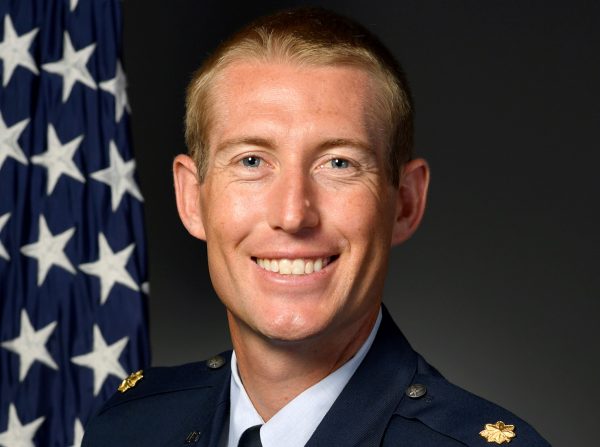
Maj. Michael Gentry, 354th Contracting Squadron commander, is shown in his official military photo. He died in a crash while cycling on the Steese Highway on Aug. 1, 2020. (Photo from Eielson Air Force Base)

A 37-year-old squadron commander stationed at Eielson Air Force Base died Saturday after he was struck by a pickup truck while cycling in Interior Alaska, according to officials.

Maj. Michael “Cal” Gentry was hit around 6 a.m. near milepost 125 of the Steese Highway, just west of Central, said Alaska State Troopers. He was pronounced dead at the scene.

Gentry was commander of Eielson’s 354th Contracting Squadron. He graduated from the U.S. Air Force Academy in 2007 and served in both overseas and deployed locations before assuming command of the 354th CONS in June 2018.

“Our entire team is heartbroken at the loss of Cal Gentry to this tragic accident,” said a statement from Col. Shawn Anger, 354th Fighter Wing commander. “He loved anything and everything outdoors and there is at least a little solace knowing Cal died doing something he loved.”

According to Alaska State Troopers, the person driving the pickup Saturday was traveling with Gentry and another airman, 39-year-old Jay Butler. The group was cycling from the Fairbanks area to Circle, said Eielson officials.

“They were taking turns riding bicycles and driving the support vehicle, a 2015 Dodge Ram truck,” troopers said in an online report. “The driver inadvertently struck Butler and Gentry as he was following them on the Steese Hwy.”

Butler was flown to the Fairbanks Memorial Hospital, where he was treated and released.

Troopers say they’re withholding the name of the driver while their investigation continues. The agency is working with Eielson officials on the case.

University of Alaska regents rescind idea of merging campuses

The University of Alaska Board of Regents met in Anchorage for an executive session. At the end of the meeting, they went into public session and voted 9-1 to rescind President Pat Gamble’s retention bonus. (Photo by Josh Edge, APRN – Anchorage)
A sign on the door outside a University of Alaska Board of Regents meeting in Anchorage. (Photo by Josh Edge/Alaska Public Media)

University of Alaska Regents will no longer consider a controversial proposed merging of the University of Alaska Southeast and the University of Alaska Fairbanks. In a meeting Wednesday,  regents unanimously voted to rescind a June 4th resolution that directed administration to explore the merger introduced in May by former UA President Jim Johnsen.

Regent Darroll Hargraves of Wasilla led the charge to rescind, noting abundant and diverse opposition to the merger.

“I want to express appreciation to everyone and every organization that has passed resolutions and written letters supporting their opposition to consolidation,” he said.

The board approved a new measure which calls on UA’s interim president Pat Pitney to work with chancellors and shared governance to analyze unspecified structural changes, and on four specific directives related to enrollment, the fisheries and ocean sciences programs in Juneau, and more collaboration with industry, communities and Tribal organizations.

“And lastly, assure the Alaska College of Education has clear roles and responsibilities for program delivery that address the priorities of teacher education that are transparent and well integrated,” she said.

The UA system faces up to a $40 million deficit in 2022, and Pitney stressed that there will be other downsizing proposals.

“We have to be smaller,” she said. “When you take a 30% reduction, plus a [more than] $30 million reduction due to COVID. We are going to smaller, but we’re going to be more efficient and have more cross-campus programs.”

In a UA release following the meeting Pitney said “Success of the University of Alaska system is dependent on our communities and businesses embracing their campuses and programs. Future actions will keep the trust of communities and businesses at the top of the list.”

Site notifications
Update notification options
Subscribe to notifications