KUAC is our partner station in Fairbanks. KTOO collaborates with partners across the state to cover important news and to share stories with our audiences.
The University of Alaska Board of Regent has postponed voting on a declaration of financial exigency, a contractual tool that allows more expedited cost cutting, including laying off of tenured faculty.
UA is facing over $135 million in reductions for state funding from the current year, including $130 million vetoed by Gov. Mike Dunleavy. Exigency would be a serious hit to the university’s reputation, and Regent Darroll Hargraves, a Dunleavy appointee, suggested there may be a way to ease into reduced state support.
”What we need is a glide path of, I would say, three years to make the cut,” Hargraves said.
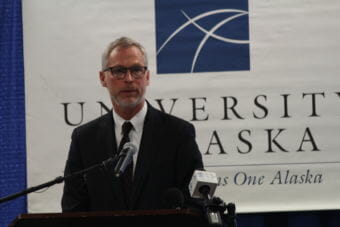
UA president Jim Johnsen delivers his State of the University address in 2018. (Photo by Wesley Early/Alaska Public Media)
Regents voted to delay consideration of exigency until a July 30 meeting, when UA President Jim Johnsen will lay out specific cost reduction measures. The new fiscal year began July 1, and Johnsen emphasized that each day the university operates at status quo compounds the impact of any state funding cut.
”It just means that it will be a steeper reduction that will need to be achieved in-year,” Johnsen said.
Johnsen said he’s in regular communication with the governor’s office and state legislators, who last week failed to garner enough votes to overturn Gov. Dunleavy’s vetoes, which targeted the university as well as numerous other state programs. Override supporter Republican state Sen. Click Bishop of Fairbanks attended the regents meeting and offered a tearful apology, calling the university cut a travesty that sends the wrong message to young people.
”But I want you to know, I’m not done and we’re going to turn this around,” Bishop said.
Another override backer, Democratic Rep. Andy Josephson of Anchorage also spoke at the meeting. Josephson described the situation which has yielded the massive budget cuts as a political crisis, and said an alternate means of funding the university is in the works.
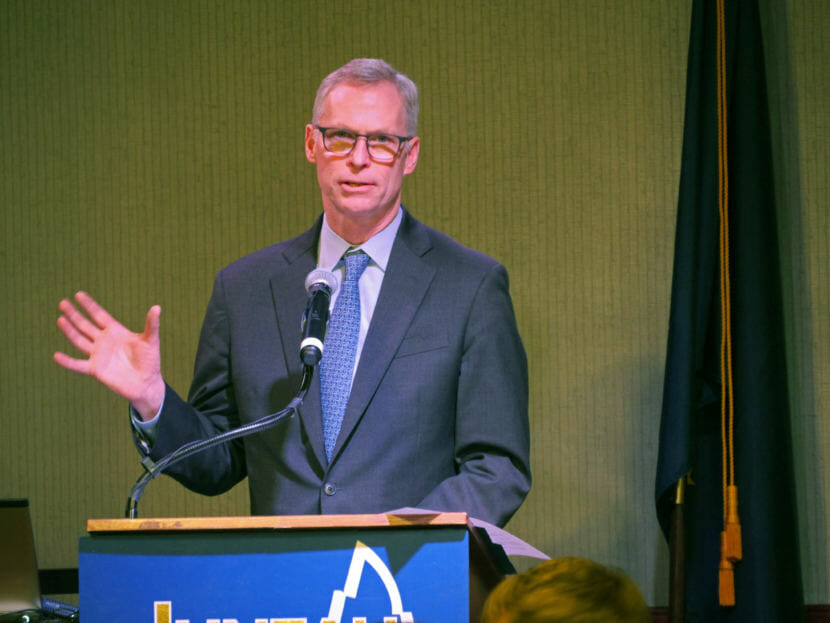
University of Alaska President Jim Johnsen delivers the State of the University address at a Juneau Chamber of Commerce luncheon in Juneau on Feb. 16, 2017. (Photo by Skip Gray/360 North)
Gov. Mike Dunleavy’s line-item budget vetoes, announced on Friday, include a roughly $130 million reduction in state support for the University of Alaska system. That’s in addition to a $5 million cut to UA already approved by state legislators. Combined, they reduce state support for the university by about $135 million, or about 40% from the previous year’s budget.
Dunleavy said on Friday he has faith that university leaders will be able to work through the loss.
“I believe they can turn the University of Alaska into, if not the finest university of the Arctic — in a few select areas, I don’t think they can be all things to all people. And I think that’s, generally speaking, the state of Alaska. We can’t continue to be all things for all people. We don’t have the money to do that,” Dunleavy said.
Speaking to the University of Alaska Board of Regents during a special budget meeting Friday, UA President Jim Johnsen underscored the severity of the cut.
”This budget will impact everything we do in every location where we operate,” Johnsen said. “Every student, every faculty member that we employ, every staff person that we employ.”
Dunleavy included a similar UA cut in his original proposed budget. Johnsen described the reduction as “devastating” and outside what university administrators had planned to accommodate.
”We were estimating a $30 million cut, a $40 million cut, a $50 million cut and a $60 million cut,” Johnsen said. “While severe, these were manageable. The cut is more than twice the most extreme cut that we anticipated.”
Johnsen said the cut means plans for an orderly downsizing plan cannot be followed, and he listed immediate actions being taken.
”A hiring freeze immediately effective, a travel freeze immediately effective, unnecessary contracts with vendors and contractors immediately effective,” Johnsen said. “We will be distributing a furlough notice to all our staff immediately.”
Johnsen said the university is also stepping up advocacy to encourage legislators to override the governor’s veto.
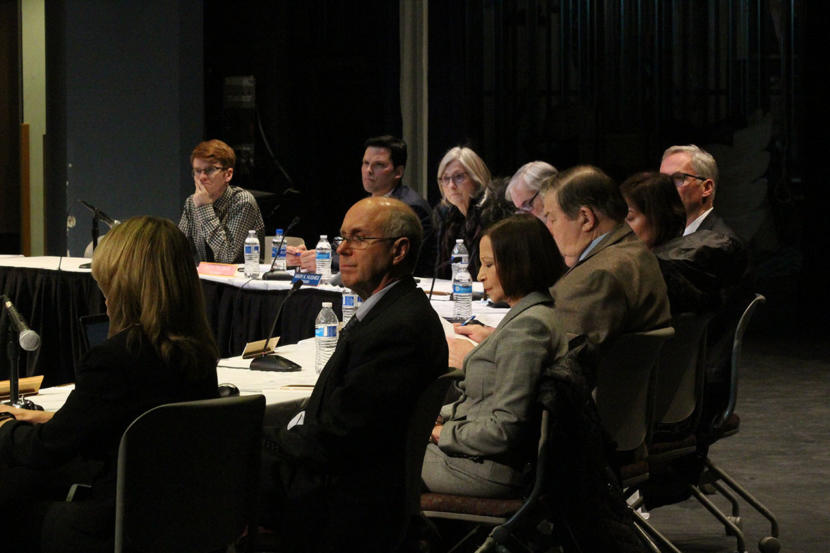
The University of Alaska Board of Regents, as well as representatives from the University of Alaska Anchorage, assemble for a meeting on the UAA education program, Feb. 12, 2019. (Photo by Wesley Early/Alaska Public Media)
A University of Alaska task force will look at options for restructuring the UA system. The Board of Regents voted last month to form the task force.
Regents chair John Davies has appointed 11 Alaskans to the group charged with considering at least four restructure options.
Davies said the “status quo” option would keep the three universities under one system.
“And then there’s a lead university model, where each university would specialize more than they do now,” Davies said. “And then there’s a single accreditation option where we could go to having all three universities combined under one administration. And then the fourth option would be three independent universities with separate administrations.”
Davies said the task force analysis will reflect anticipated state funding reductions and instruction from the Alaska Legislature to consider a single accreditation model.
”We want to take a look at that,” Davies said. “And of course, there’s always a trade-off issue: Are the savings worth the cost of the programs?”
Davies noted that the task force will able to draw on past and current downsizing and restructure analysis and initiatives, including UA 2040, a plan for improved online access.
”A single portal website that any student, anywhere in the state, can log in to and get information about all the programs that are available across the entire state, to break down some of the silos that exist now,” Davies said.
Davies underscores the importance of the task force’s work given the real effects of ongoing uncertainty about the university’s future.
”People are making choices to go elsewhere,” Davies said. “Students are deciding to go outside. And faculty are looking around to see if they have better options.”
The 11-member task force includes the following members:
Former UA Regent Jo Heckman
UA Regent Sheri Buretta
Alyeska Pipeline Service Company President Tom Barrett
Doyon Ltd. President and CEO Aaron Schutt
Former Northrim Bank board of directors chair Joe Beedle
Former Alaska state legislator Reggie Joule
Retired UA faculty members Terrence Cole of UAF, Cathy Connor of UAS and Gunnar Knapp of UAA
Former UA executive Wendy Redman
Former Student Regent Joey Sweet
The task force, which will hold public meetings around the state, has to get a final report to regents by November.
Alaskan farmers say the state gets a big bang for the small buck it provides to agriculture. That’s why they say big cuts like those proposed by Gov. Mike Dunleavy would inflict serious, long-term harm to the industry.
Bryce Wrigley owns and operates a barley farm and mill near Delta Junction. (Photo courtesy of Alaska Flour Co.)
Bryce Wrigley earns his daily bread as manager of the Salcha-Delta Soil and Water Conservation District. And in what he jokingly calls his “spare time,” he operates the family farm near Delta Junction, where he grows and mills barley. He’s also past president of the Alaska Farm Bureau board, so he knows a bit about the importance of government support for the industry here.
“Inspections, land sales, financing – those kind of things are really important to having agriculture continue to grow and continue to provide that needed resource in Alaska,” Wrigley said.
That needed resource, of course, is food. And although Alaska imports the vast majority of it from outside the state, Wrigley and a lot of others believe it’s essential to develop the industry here. Those include people who want healthier locally produced food and others who feel better about eating stuff that doesn’t create a huge carbon footprint from bringing it in by truck or barge.
Most important, he says, the industry could help provide for Alaskans if natural disaster makes it impossible to import food. Like the big earthquake that hit Anchorage last November.
“Alaska’s remote location kind of necessitates a certain level of production, just to manage and to provide food for when those emergencies occur,” Wrigley said.
Wrigley says in addition to food security, agriculture also boosts local and state economies. So he says he and others who work in and support the industry are all seriously concerned about the impact of Dunleavy’s proposed funding cuts to the state Agriculture Division and other agencies that support farming.
“If you take so much capacity away from the Division of Ag that it can’t even rebuild, then you do long-term damage to the state’s ability to feed itself,” Wrigley said.
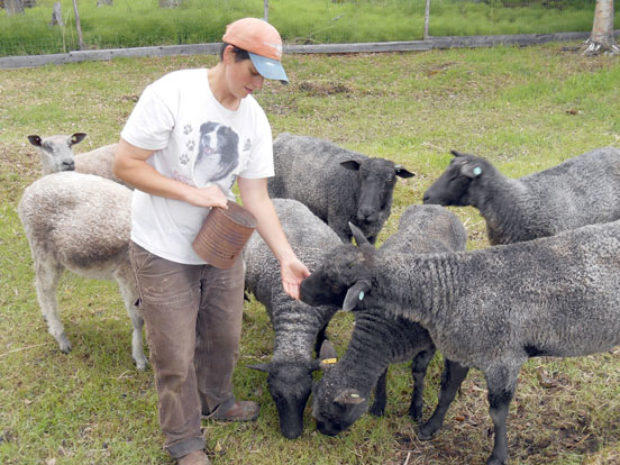
Alaska Farm Bureau Executive Director Amy Seitz operates a Lancashire sheep farm on the Kenai Peninsula. (Photo courtesy of Alaska Farm Bureau)
Farm Bureau executive Director Amy Seitz says that’s what farmers around the state have been telling her about Dunleavy’s proposed cuts.
“It’s basically the entire agriculture-development section of the Division of Ag, and then a large portion of the Plant Materials Center, and then the Revolving Loan Fund,” she said.
The governor proposes zeroing out the $1.8 million the state gives to the division’s marketing program – the folks who came up with the Alaskan Grown promotion, among other things. Dunleavy says that and other so-called “lower-priority programs” should instead be funded by farmers.
But Seitz says farmers operate on a slim margin, and the agency helps keep them solvent.
“It’s the division helping farmers get into retail stores,” she said. “It’s helping them get into institutional markets. It’s running the federal grants through to help develop the industry.”
Seitz says the governor’s proposal to zero out funding for the state’s lone dairy inspector may force the Havemeister family in Palmer to shut down the state’s last dairy.
“FDA requires this inspection,” she said, “So, getting rid of this eliminates any chance of commercial dairies.”
Wayne Gentz is a former dairyman who lives in Fairbanks. He says he got out of the business and started selling real estate because it’s almost impossible to make a living running a dairy. And he says Dunleavy’s cuts will make it even more so, especially for startups.
“That’s a tough business to start out, if you know what I mean,” Gentz said.
Wrigley, the Delta barley farmer, says the governor is wrong to propose cutting a half million dollars from the state Agricultural Revolving Loan Fund, because he says it competes with private industry. Wrigley says the private sector doesn’t seem interested in lending to farmers.
“Banks will not loan money on agriculture,” he said, “and that’s been the case for the last 30, 40 years.”
Wrigley says the money the state invests in agriculture may seem small but yields big dividends, as shown in the industry’s growth in recent years. He says farmers are hard-working and willing to endure their fair share of funding cuts, but he says the governor’s proposals will inflict disproportionate harm on the industry. And he says that’s setting back efforts to help Alaskans feed themselves.
Sophie Sergie (Photo courtesy of Alaska State Troopers)
The governor of Maine has signed a warrant allowing the extradition of a man accused of a rape and murder 26 years ago in Fairbanks. Forty-four-year-old Steven Harris Downs is charged with the April 1993 sexual assault and killing of Sophie Sergie of Pitka’s Point, at the University of Alaska Fairbanks. Downs’ attorney James Howaniec says it’s never been in question that his client will have go to Alaska to face the charges.
”The only question was if it was going to happen on a more expedited basis, like it usually is, or if it was going to happen a little further down the road,” Howaniec said.
At the time of Sergie’s murder, Downs was an 18-year-old UAF student who lived at the Bartlett Hall dormitory, where the 20-year-old Sergie was found stabbed and shot to death in a bathroom. The case had been cold until investigators last year cross referenced genetic evidence from the crime with a genealogical database and identified Downs as a suspect. Howaniec says Downs, who’s been jailed in Maine since being indicted in February, challenged extradition to buy time to settle his affairs and consider the charges.
”He’s flabbergasted at this charge, and we’re stepping back a little bit to try to assess at least what some of the evidence involved is,” Howaniec said.
Howaniec says Downs can challenge the Maine governor’s warrant, but that even if he does, extradition proceedings will likely conclude next month, with his client being sent to Alaska. The genetic genealogy science used to identify Downs has been employed to ID other murder suspects across the country, including the Golden State Killer in California.
Nancy Reeder has been selected by Fairbanks Mayor Jim Matherly to be the next police chief of Fairbanks. (Photo courtesy city of Fairbanks)
Anchorage police Lt. Nancy Reeder has accepted Fairbanks Mayor Jim Matherly’s offer to serve as the city’s new police chief.
Matherly chose her over two other finalists vying for the job that’s about to be vacated by retiring Chief Eric Jewkes.
“She’s a terrific candidate with a lot of experience,” Matherly said.
Reeder has served in several positions during her 35 years with the Anchorage Police Department, where she currently heads the department’s internal affairs office. Reeder’s also an Air Force and Alaska Air National Guard veteran.
Matherly said Reeder has also worked with the Fairbanks Police Department on cases and other issues.
“So it’s going to be an excellent fit, and I’m very happy she’s accepted,” Matherly said.
Matherly said the job offer is contingent on her passing routine background checks, and approval by the Fairbanks City Council. He expects the council will consider the issue in next week’s meeting.
“The city council will be hearing more about it on Monday, at the Monday meeting,” Matherly said. “Hopefully we’ll get their nod, and then she could be in place in mid-May.”
If approved, Reeder would be the first woman to serve as Fairbanks police chief.
Close
Update notification options
Subscribe to notifications
Subscribe
Get notifications about news related to the topics you care about. You can unsubscribe anytime.