KUAC - Fairbanks

KUAC is our partner station in Fairbanks. KTOO collaborates with partners across the state to cover important news and to share stories with our audiences.

For Halloween, ‘Molly of Denali’ creators explain how to dress up like Molly

A still from the upcoming PBS KIDS program Molly of Denali (Image courtesy of WGBH Educational Foundation).
The PBS KIDS program “Molly of Denali” features an Alaska Native character in the title role. (Image courtesy of WGBH Educational Foundation)

Kids across the country are embracing the new animated show “Molly of Denali” that launched this summer on PBS.

It is the first children’s TV show with an Alaska Native lead character. Now some young fans want to dress like their hero Molly for Halloween.

The show’s producers want kids to have fun — but not co-opt Molly’s Athabascan culture.

Princess Daazhraii Johnson, the program’s creative director, said the show wants to head off the cultural appropriation that often comes when non-Natives use Native dress as a costume.

“And so we really wanted to get ahead of the curve, with Halloween coming up, and make a suggestion of what kids could wear to dress up as Molly without it being our culture on display, because our culture is not a costume,” said Johnson, a resident of Fairbanks.

https://www.facebook.com/MollyOfDenali/posts/547810922637431

The show posted that people should refrain from wearing Molly’s traditional Native regalia as a costume. They posted a meme; a drawing of Molly in her everyday wear, suggesting that kids could dress up in Molly’s blue jeans, or the blue winter hat she often wears.

”Her kind of iconic hat that she has with the pom-pom on the top, and her jacket and boots and mittens. That was one of the suggestions. She only has so many changes of clothes,” Johnson said. “But definitely not her traditional dress. You’ve seen her in a couple of episodes; she has her moosehide dress. And that’s what we don’t want to see.”

The show already has millions of viewers, and the creative team wants to support kids honoring their cartoon hero without the harm that comes from trivializing her culture.

“We love that children across the nation are trying to emulate Molly, because she is emulating all of who we are as Alaska Native people and emulating our values,” said Johnson.

The show is, like most PBS programming, an educational tool. Johnson said several episodes have opened up conversations about race, historical violence and generational trauma. The Halloween costume issue is another teachable moment.

“It’s a wonderful way for us to have an honest and open dialogue about race, about culture, about healing,” she said.

University of Alaska debt rating downgraded after years of cuts

Standard & Poor's
(Creative Commons photo by eflon)

Standard & Poor’s Global Ratings has lowered its debt rating for the University of Alaska system. They cited big cuts in state funding as an indicator of credit risk.

S&P Global Ratings report is the second time this year a rating agency has down-graded this measure, after Moody’s downgraded the UA system’s credit rating in July.

However, this week’s downgrade is only one notch in S&P’s rating system, from AA- to A+.

On their scale is AAA, AA, A, BBB, BB, B, CCC, CC, C and below that are junk bonds.

“In our rated universe, for higher education public institutions in the United States, A is the average rating, so it is above average,” said Mary Ellen Wriedt, S&P Global’s primary credit analyst in San Francisco. She wrote report on UA’s ability to pay back bonds. She said it is based on both strengths and weaknesses.

“The S&P Global Ratings criteria we have that dictate how we come to a rating looks at enrollment, matriculation, selectivity, graduation rates, tuition discounting, how much financial aid the university pays out,” she said.

In addition to the enterprise profile, S&P Global looked at the university system’s financial profile, including cuts every year from the state since the 2014 drop in oil prices. Especially this year’s $25 million cut. It’s what S&P Global calls “Negative net operating income.”

But Wreidt said there were a lot of indicators to keep UA’s rating in the A category.

“There are still tremendous strengths to the system despite enrollment declines and cuts to the state appropriation. Management also has been working very proactively to operate the system in a prudent fashion,” she said.

UA Chief Finance Officer Myron Dosch said the rating is a measure of creditworthiness, or of risk that UA will pay back what it borrows.

“The university would sell bonds to finance or pay for a new building, like the engineering building here in Fairbanks or the new power plant,” Dosch said.

Dosch said the downgrading from S&P global doesn’t affect any debt service payments the university is already making. About two-thirds of the new power plant and about a third of the new engineering building was financed by bonds.

And he said the university isn’t about to bond for any new construction in the near future.

“The university presently doesn’t have any new construction on the horizon. We have reduced state funding, that’s why it may not be the best time to borrow,” he said.

That means this downgrading will probably have no effect on university finances.

More than 2,000 Fort Wainwright soldiers to deploy to Iraq

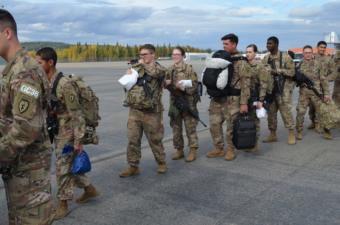
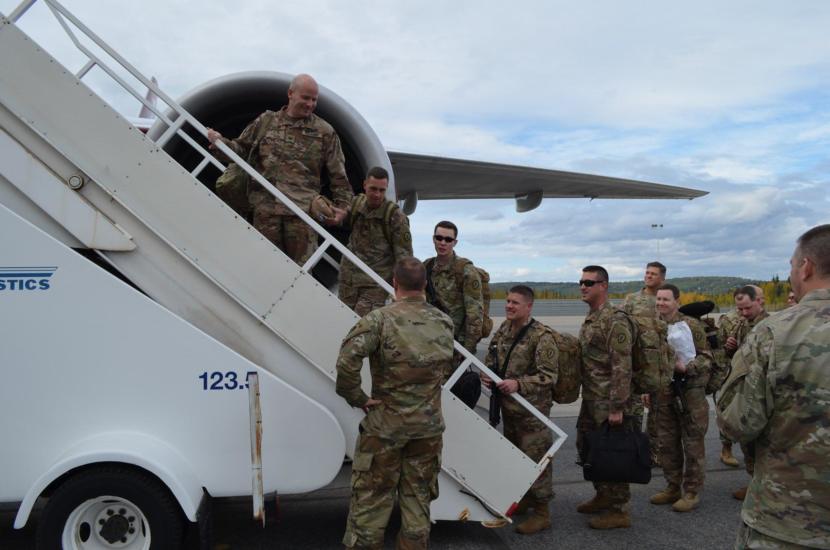
Soldiers with Fort Wainwright-based 1st Stryker Brigade Combat Team board an aircraft at Fairbanks International Airport last week en route to a nine-month deployment to Iraq. (Photo courtesy Fort Wainwright)

More than 2,000 Stryker Brigade Combat Team soldiers from Fort Wainwright are en route to Iraq — or soon will be — for a nine-month deployment.

The deployment officially began a little over two weeks ago, with a sendoff ceremony on Fort Wainwright. By the end of this month, more than half of the brigade assigned to Wainwright will be in Iraq.

U.S. Army soldiers wait to depart from Fort Wainwright.
U.S. Army personnel wait to depart from Fairbanks, Sept. 2, 2019. (Photo courtesy Fort Wainwright)

“The deployments are ongoing right now, so … we’re well over halfway pushing soldiers out,” said Lt. Col. Drew Lynch.

Lynch is helping coordinate the movement of the seven Stryker battalions, which include cavalry, infantry, field artillery and engineer units. He said the soldiers fly out of Fairbanks on Army-contracted commercial airliners, but most of their gear is transported separately — initially via the Alaska Railroad to the Port of Alaska in Anchorage.

Lynch said the Stryker soldiers are part of a joint task force that will mainly be helping train Iraqi troops, law enforcement officers and others who maintain security in the Middle Eastern nation. But he said that doesn’t mean this deployment won’t be dangerous.

“Any deployment, especially to a Centcom region, has inherent dangers and inherent risk,” Lynch said. “But we’ve found through time that unless we do this by, with and through our partner nations, then there’s always the risk that they don’t grow the capacity, and that we end up going back in the future.”

The Stryker Brigade’s deployment to Iraq is in support of the Pentagon’s Operation Inherent Resolve.

Army and contractor begin planning to dismantle deactivated Fort Greely nuclear power plant

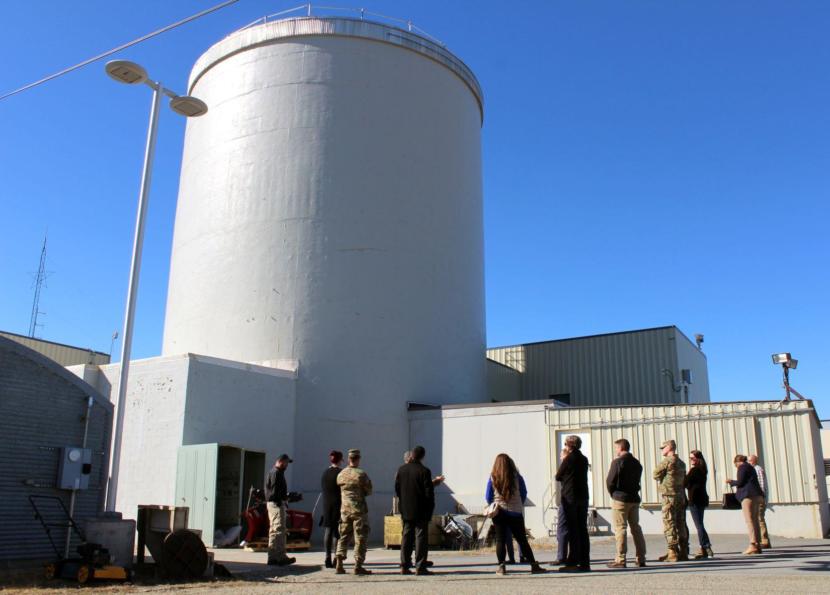
Officials with the Army Corps of Engineers talk with prospective contractors and others before going in for a tour of the Fort Greely nuclear power plant, known as the SM-1A. The facility, which went online in 1962, is Alaska’s first and only nuclear power plant.
(Photo courtesy Rebecca Nappi/U.S. Army Corps of Engineers)

The Army Corps of Engineers is moving ahead on a project to decommission the mothballed nuclear-power plant at Fort Greely. A team from the agency has just wrapped up a three-week visit to the fort and awarded a contract to develop plans on how it’ll dismantle the Cold War-era relic over the next 10 years.

When Army officials shut down the old power plant’s nuclear reactor back in the early 1970s, they replaced it with a diesel-fired boiler and connected it to the system that provides steam heat and electricity to Fort Greely. Now, in order to dismantle and remove the remaining nuclear components, the project contractor will have to first disconnect the two utility systems – carefully, so as to not interrupt the flow of heat and power to the post.

“So we are engineering the separation of those two ends of the facilities, so that we can implement our work without interfering with the utilities to Fort Greely,” said Project Manager Brenda Barber. She says that’s why the Corps of Engineers awarded a $1.5 million contract last month to a Texas-based company that will develop a plan on how to remove the nuclear components, located in the northern half of the building, from the diesel-fired system that’s in the southern end of the building.

“So there are a lot of complexities,” Barber said, “because there are a lot of intermingled and co-mingled utilities between the two ends of the facility that we’re going to have to slowly take apart piece by piece and make sure that we don’t interfere with the utilities being provided to the installation.”

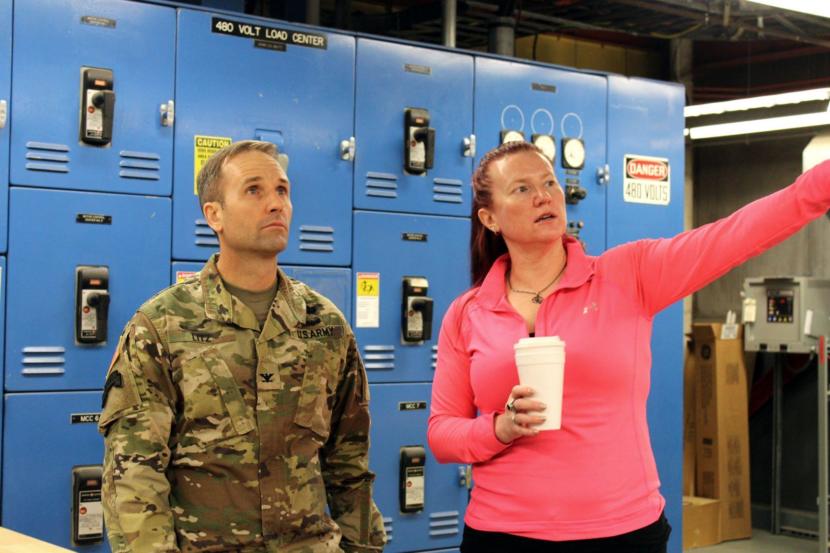
Army Corps of Engineers Baltimore District Commander Col. John Litz, left, and Baltimore District Project Manager Brenda Barber exchange ideas on dismantling and decommissioning Greely’s nuclear power plant. Corps officials spent the past three weeks at Greely preparing to ramp up work on the project.
(Public domain photo by Rebecca A Nappi/U.S. Army Corps of Engineers)

Barber says those components include the electrical switch gear, which controls the facility’s functions.

She says she and members of her team from the Corps’ Baltimore office and the Alaska District office spent most of last week giving tours of the facility to representatives of firms that may bid on a contract to remove the nuclear side of the building.

“We are hosting these initial contractor visits in order to allow potential interested contractors to come to the site … so that they can start to understand how they would approach the work, what kind of team they would put together,” Barber said.

Barber says the engineering work called for in the initial contract awarded last month should be done by September 2020. She says the Corps hopes to award the next contract for removal of the facility’s nuclear components within the next federal fiscal year. And she says the work should be completed about 10 years from now.

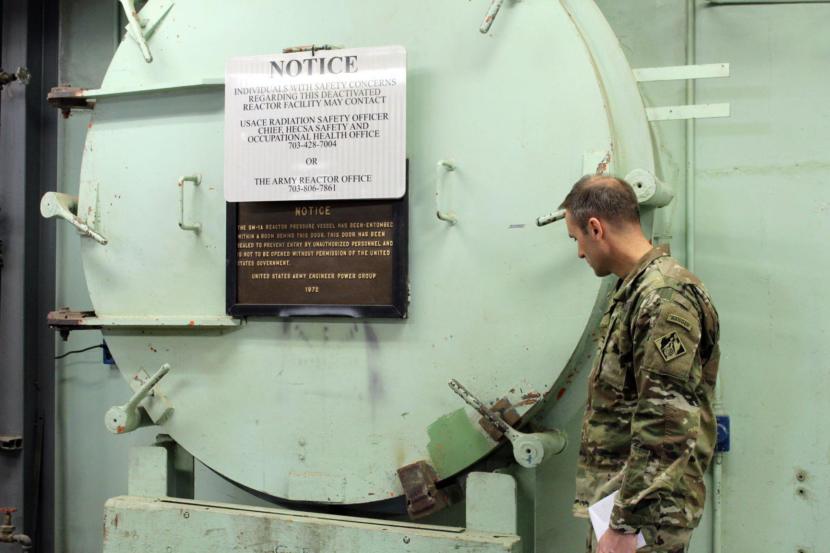
Litz takes a look at a massive hatch over the containment vessel leading to the SM-1A during a visit to the site in April. The entrance has been sealed shut since the nuclear reactor was shut down in 1972.
(Public domain photo by Rebecca A Nappi/U.S. Army Corps of Engineers)

“Our team is really focusing on getting the project geared-up and pushing ahead to the decommissioning phase,” she said in an interview Monday. “There’s a lot of work here to be done in order to get to that phase of the work, because of the complexities of the site. So we are putting a lot of extra effort into this location.”

Although several highly radioactive components remain entombed in concrete at the site, Barber emphasized that they presents no health hazard to the employees of Doyon Utilities — the contractor that operates the power plant — nor to the contractor workers that will be brought in for the dismantling project. She says the Corps and its contractors will focus on safety throughout the project.

Corps officials don’t want to disclose their estimated cost of the cleanup project before the agency begins to solicit offers. A Corps official last year pointed out that the cost of decommissioning a similar facility came to about $67 million.

Barber says that project, along with one at Fort Belvoir, Va., and the one at Fort Greely, will eliminate the last of the Army’s old decommissioned nuclear power plants.

Circuit Court justices hears Fairbanks Four appeal

The Fairbanks Four shortly after their release from prison in December 2015. From left to right: Marvin Roberts, Eugene Vent, Kevin Pease and George Frese.
The Fairbanks Four shortly after their release from prison in December 2015. From left to right: Marvin Roberts, Eugene Vent, Kevin Pease and George Frese. (Photo by Rachel Saylor/Tanana Chiefs Conference)

A panel of three 9th Circuit Court justices heard arguments Friday morning in Fairbanks in the appeal of a federal civil rights suit filed against the city of Fairbanks. Four Native men, known as the Fairbanks Four, appealed an October 2018 lower court judge’s dismissal of their case, which alleges police misconduct in the investigation of a 1997 murder.

George Frese, Kevin Pease, Marvin Roberts and Eugene Vent allege racial bias-driven police misconduct, including coercion of false confessions and fabrication of evidence, lead to them being wrongfully convicted of the beating death of John Hartman.

Evidence aired during a 2015 evidentiary hearing pointed to another group of local men being responsible for the killing, and under a settlement agreement, the state vacated the Fairbanks Four convictions.

The deal allowed three of the four men, who were still in prison, to walk free, but stipulated that the original convictions were lawfully obtained, and that the four would not sue the state or city for damages.

The men sued the city regardless, contending they signed the agreement under duress to avoid further prison time while the case played out in court.

Last fall’s ruling dismissing their suit maintained that the 2015 agreement did not meet a civil rights suit precedent that the prior case be “favorably resolved.” City of Fairbanks attorney Matt Singer argued for the justices to maintain that legal bar.

“The requirement to bring a malicious prosecution claim is to first show that the criminal case resulted in a favorable termination, that shows innocence,” Singer said.

Singer says the settlement falls short of that, but Fairbanks Four attorney Anna Benvenutti Hoffman counters that it effectively wipes the legal slate clean.

”There’s no question. If you go to the state of Alaska website and you look up their convictions, they’re vacated,” she said. “They’re not in effect anymore. They don’t have any collateral consequences.”

The three 9th Circuit Court justices could take up to a year to rule on the appeal, a decision that can be appealed up to the 9th Circuit’s full panel of judges.

Recent missile launch alerts direct Fort Greely residents, workers to take shelter

A ground-based interceptor missile is placed into position at the Missile Defense Complex in Fort Greely near Fairbanks.
A ground-based interceptor missile is placed into position at the missile defense complex in Fort Greely near Fairbanks. (Still from public domain video by Petty Officer 2nd Class Aiyana Paschal/Defense Media Activity Forward Center – Pacific)

Fort Greely has declared five so-called “shelter in place” alerts over the past two weeks.

The alerts announced over loudspeakers advise people on the fort to stay indoors and take precautions to protect themselves from the toxic exhaust of interceptor missiles that would be launched from Greely in an attempt to knock down U.S.-bound enemy missiles.

Steve McCombs was out hiking last week in an area about 3 miles west of Fort Greely’s missile defense base, headed toward a couple of ponds he likes to fish in, when he heard a siren followed by an announcement blared out over the post’s loudspeaker system.

“I was walking in there and then started to hear these announcements, and then started to kind of get a little bit startled,” McCombs said in an interview Wednesday.

McCombs is a retired schoolteacher and state Division of Forestry dispatcher who lives in nearby Delta Junction. And he, like most people who live around Greely, has for years heard announcements over the post’s loud PA system that’s called “the Giant Voice.” But he said the announcement he heard on July 30 calling for people on post to take shelter was pretty unsettling.

“I figured there may have been something that happened with the North Koreans again,” McCombs said.

McCombs was referring to common knowledge among the locals that Greely’s security level is elevated whenever North Korea launches missiles. Post spokesperson Chris Maestas declined to confirm that and deferred to the Missile Defense Agency, which didn’t respond to queries.

Maestas said announcements went out five times over the past two weeks, twice each on July 24 and July 30 and again on Aug. 6. The alerts coincided with North Korean missile launches that weren’t part of an attack.

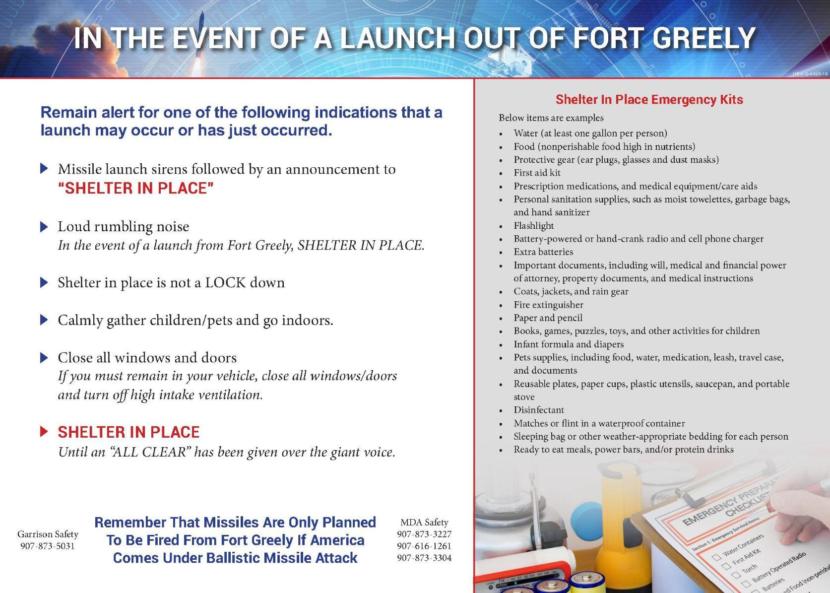
“The announcement is a shelter-in-place notification,” Maestas said, explaining that the alerts direct workers and resident to “go indoors, close windows or doors. If you’re in a vehicle, go ahead and roll up your windows. Turn off any intake fans or high-ventilation intake systems.”

Maestas said the precautions are intended to minimize the chances of human exposure to the toxic exhaust that’s blasted out of an interceptor’s solid-fuel booster upon launch. That’s not a problem when the interceptors take off from remote launch facilities, like the one at Vandenberg Air Force Base in California, where two interceptors were launched during a March 25 test.

Fort Greely officials distribute this pamphlet and others that advise people who live or work on post what to do when an interceptor missile is about to be launched. (Graphic courtesy of Fort Greely)

But Greely’s missile base is located about a half-mile from its residential area. And post officials say it may also be necessary to tape plastic over vents, windows, doors and electrical outlets and switches. And then hole up in a shelter-in-place room, like a bathroom, and close the door.

McCombs said as he was listening to the announcements, he wondered whether he too should try to find shelter — then realized he was way out on the trail, an hour away from his vehicle.

“Going out for a quiet day in the woods, and then you hear all this chatter that’s coming over the air … I started thinking, ‘Was this a drill?’” McCombs said. “And as it went on, I thought maybe something happened.”

As for everyday Greely residents, Maestas said those who live and work on post know what they’ve signed up for.

“I think when you take a job here, being assigned to Fort Greely, whether you’re a soldier, civilian, family or tenant, you really understand the importance of the mission being conducted here,” Maestas said. “It’s all about ballistic missile defense of the United States.”

According to Maestas, the length of the five recent shelter-in-place alerts lasted from 5 to 25 minutes each.

Site notifications
Update notification options
Subscribe to notifications