KUCB - Unalaska

KUCB is our partner station in Unalaska. KTOO collaborates with partners across the state to cover important news and to share stories with our audiences.
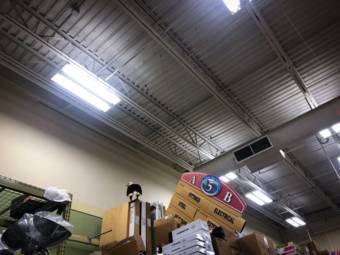
Unalaska volunteers rescue eagle that ‘decided to go shopping’ at ship supply store

A bald eagle perched on top of merchandise in a store, next to a sign that it knocked askew
A large female eagle entered Alaska Ship Supply on Thursday evening, knocking down aisle signs and occasionally swooping down toward the people and merchandise below. (courtesy of Megan Dean)

As staff at a local shop opened the back door for a delivery last week, they got an unexpected visitor. An adult female eagle dashed in and headed for the rafters, occasionally swooping down at people and merchandise below.
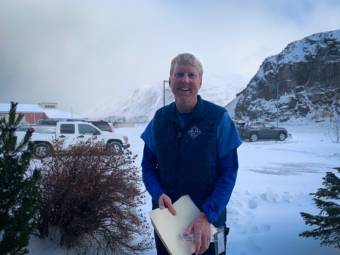
Or as Megan Dean, one of the rescuers put it: “An eagle decided to go shopping at Alaska Ship Supply.”

Dean regularly helps rescue injured or sick eagles on the island, which are then flown to the Bird Treatment and Learning Center in Anchorage. She said the eagle at the store on Thursday flew around for more than an hour as staff tried to evict her.

When Dean arrived, the eagle was high up in the store’s rafters. She and another volunteer, Brianna McGrath — a local fisheries biologist who heads the group of four local eagle wranglers — had to tire the large bird out by making noise and waving blankets and long objects in the air until she landed on the ground.

Then they were able to catch her and release her back outside.

“The eagle did not appear to sustain any injuries, and was met by her impatiently waiting mate in the parking lot,” Dean said.

Eagle-human interactions like this one are a common affair in Unalaska. There are about 300 to 600 eagles on the island, according to the Christmas Bird Count — a census of birds performed annually by volunteer birdwatchers for the National Audubon Society. The eagles often get injured or killed by cars or in fights and need to be flown off island for rehabilitation or to be euthanized.

“I was talking to someone in Connecticut, and they said, ‘If we see an eagle, we talk about it for two weeks,’” Dean said. “I just drove past the landfill the other day, and there were at least 100. And so they behave and interact with humans a little differently, I think, here than they do in other places because of that.”

Dean — a self-proclaimed “bird nerd” — decided to help in the local rescue effort earlier this year to bridge the summer gap in volunteers.

She’s responded to two dozen calls about potentially injured eagles in the past six months. And about half of those, she said, have been flown out to Bird TLC.

“There were a lot that had extensive injuries and most of them had to be euthanized, unfortunately,” Dean said.

The process of securing the giant injured raptors would be daunting to most.

Dean said volunteers have to throw a thick blanket over them and secure their talons and beak to avoid getting hurt. Even when eagles are severely injured, she said, they still have extensive strength.

“Their talons have a psi of about 400 pounds per square inch. I read somewhere it’s about the same strength as a lion’s mouth,” she said. “So they’re pretty strong. There was one this summer where before the talons were secured, it reached up and it went through two layers of a fleece blanket like butter.”

Dean said the majority of birds that get sent off island to Bird TLC don’t return because they have to be euthanized or aren’t strong enough to be released back into the wild. But earlier this year, she said, a large female eagle that was injured on a fishing vessel was successfully rehabilitated and released this summer near Cook Inlet.

Unalaska doctor nationally recognized for bringing emergency training to providers in rural Alaska

Dr. Murray Buttner was named a community star by the National Organization of State Offices of Rural Health. He was the first to arrive on the scene of a fatal plane crash off of Unalaska’s runway in 2019. After that crash, he coordinated with organizations across the state to bring Comprehensive Advanced Life Support classes to providers in rural communities in Alaska. (Hope McKenney/KUCB)

Unalaska’s Dr. Murray Buttner has been nationally recognized for his work bringing emergency training to rural Alaska communities.

Buttner, a family medicine doctor and co-medical director of the island’s Iliuliuk Family and Health Services clinic, was named a 2021 community star by the National Organization of State Offices of Rural Health. The award went to one health care provider in each state.

“It was a nice little award because I have been working in rural Alaska since ‘97. And that’s what I consider myself: a rural family doctor,” Buttner said. “I loved the job in Anchorage, but it didn’t feel like me. And then when I got back here, it’s like, this is what I love.”

Buttner received the honor for his work organizing trauma training workshops around the state. Trauma is the leading cause of death in Alaskans age 45 and younger, and overall, Alaskans die from trauma at rates 50% higher than the rest of the U.S.
Buttner said the first 30 minutes after a traumatic event — like an ATV accident or heart attack — are crucial to treating that patient. But most health care providers don’t receive the proper training to respond to initial emergencies.

That’s where the Comprehensive Advanced Life Support classes — or CALS — come in. The classes help train physicians and responders in critical lifesaving care in the most remote and austere environments.

“This course is sort of like a boot camp in paramedic training for physicians and nurses who haven’t done a lot of that first 30 minutes,” Buttner said. “Paramedics get trained in how to take care of someone in the car, in the house, on the side of the river — all that early, quick stabilization stuff. And when you’re in rural Alaska, you actually end up being that person a lot more than you would if you were an internist in New York City or an obstetrician in St. Paul, Minnesota.”

Buttner has found himself in the position numerous times in Unalaska.

The island’s IFHS clinic, located 800 air miles from Anchorage along the Aleutian Chain, sees a larger number of trauma cases than most clinics due to its remote location, extreme weather and busy commercial fishing seasons.

Buttner who has been working on and off in rural Alaska since the late ‘90s completed CALS training in the Lower 48 in the fall of 2019. Two weeks later, he was the first to arrive on scene of a plane crash off Unalaska’s runway that killed one person and injured a dozen more.

“I was literally the first person to get on the plane,” he said. “As everyone was jumping off, I was jumping on. Myself and three or four passengers tried to help the young man who was hit by the propeller, and from running to the plane to getting on the plane, and then trying to help him for the next 30, 40 minutes, it was like everything was sort of on automatic from the stuff I had learned in the course. And there is absolutely no way I could have done any of that stuff if I hadn’t taken the course. I might have tried to help, but it would have been more comfort care and shouting for help.”

The CALS course helps responders stay systematic and calm by teaching a step-by-step process for what to do in an emergency, according to Buttner.

“You’re taking the exact same approach to a newborn that’s having trouble breathing or a pregnant lady who’s hemorrhaging or a person who has been in a car accident or someone who’s having a stroke so that you stay calm, remember the basic steps and then keep working through the algorithm,” he said.

Unfortunately, he said, the reality is that while some people survive, in many traumatic situations, the person doesn’t live. But working through a step-by-step process helps to eliminate the guessing.

“If you’ve been taught what you’re supposed to do, and you do what you’re supposed to do, and you do the best you can, it takes away a lot of the ‘what ifs.’ ‘What if I had known how to do this? What if there had been someone else there instead of me?’” Buttner said. “I think that’s important because this kind of work can really burn people out. And a lot of people do end up leaving the field or leaving the community they’re in because of bad experiences, where they’re traumatized or feel guilty.”

After the plane crash, Buttner started coordinating with other organizations throughout the state, including the Alaska Association of Family Physicians, State Office of Rural Health and Alaska Trauma Review Committee, to bring the Midwest-based training to Alaska.

In May, dozens of health care providers from 16 rural locations throughout the state completed CALS training in Anchorage, and six Alaska providers were mentored as instructors for future courses.

Now, Buttner said, he thinks they’re in good shape to teach a number of the courses throughout the year. 

“I think over time we’ll help modify the course so it’s even more relevant to Alaska,” he said. “We’ll have moose stompings and Paralytic Shellfish Poisoning and ATV accidents and snowmachine accidents — things that we all see up here that maybe you wouldn’t see in the Midwest.”

Buttner said all of Unalaska’s providers have taken the advanced lifesaving course, along with two of the island’s nurses. He said he hopes to bring the training to subregional hubs to continue to train providers, health aides and responders throughout the state.

Eruptions are still going at 3 Aleutian volcanoes

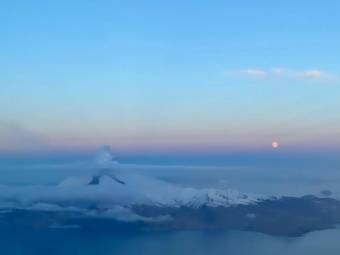
A volcano with a small plume above it, seen from an airplane at twilight
Great Sitkin seen from an airplane on Nov. 17, 2021 at 5:30 p.m. (Courtesy of Angela McConnell)

Three volcanoes continue to erupt across the Aleutian Chain. But that’s not out of the ordinary, says an Alaska geologist.

There are at least 54 historically-active volcanoes in Alaska in what we call the ‘Aleutian Arc.’ That’s the volcanic belt that stretches from just north of Anchorage all the way out to Attu,” said Chris Waythomas, a geologist with the Alaska Volcano Observatory. “‘Historically active’ basically means that there’s been documented activity within the last 200, 250 years.”

Three of those historically-active volcanoes are all at elevated alert levels — geologists’ way to say the trio is erupting, but there’s no immediate cause for concern.
Semisopochnoi Volcano in the western Aleutians has actually been erupting on and off for nearly a year, but it’s just producing low-level ash clouds.

Pavlof Volcano, Aug. 20, 2021. (Ben David Jacob/Alaska Volcano Observatory)

Great Sitkin, located about 35 miles from Adak, has been producing lava at the summit since mid-summer.

And Pavlof — one of the most active volcanoes in Alaska — has been producing low-level activity with ash bursts since late August. Pavlof is between Sand Point and Cold Bay.

None of the volcanic activity has been hazardous, said Waythomas.

“The big issue with all three of these places is that they’ve been hard to see because the weather’s been pretty cloudy,” he said. “So we don’t get observations as often as we would like.”

Scientists have a network of seismic sensors that detect ground motion around the remote volcanoes to help monitor when they may be erupting, according to Waythomas. But visual observations — currently obstructed due to cloud cover — confirm it.

“Satellite data and observations are often pretty key in confirming or refuting what we think might be happening,” he said.

Despite the bad weather, Waythomas said there’s no concern for nearby communities and no indication hazardous conditions will arise anytime soon. However, he said, each of the three volcanoes has a geologic record that indicates they can be much more explosive.

Semisopochnoi Volcano has been erupting on and off for nearly a year, but it’s just producing low-level ash clouds. (Alaska Volcano Observatory photo)

If something bigger was happening, he said, there’d likely be an uptick in geophysical data, like more magma or bigger earthquakes in these areas.

“We don’t see anything like that,” Waythomas said. “And we really don’t think that that’s a likely possibility. We think these will just play out. The volcanoes will slowly go back to sleep, and then sometime again, they’ll pick up. That’s kind of what we’ve observed, historically, at these places.”

Waythomas said the Alaska Volcano Observatory will continue to keep a close watch on the volcanoes and work with the aviation sector and the weather service to alert communities of any hazardous activity.

Indigenous metal band riffs on issues affecting Native people

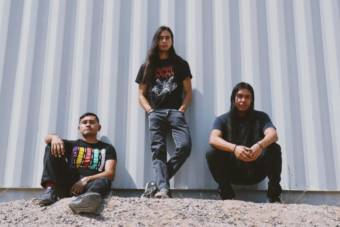
With the music scene rising again after it was nearly extinguished by the COVID-19 pandemic, M.I.S. looks forward to performing together more and playing their debut album, “Kill the Man/Save the Indian.” (courtesy of Jacob Stepetin)

Jacob Tix̂lax̂ Stepetin remembers growing up in his aunties’ and uncles’ homes, listening to Metallica.

“Aang, Tix̂lax̂ asax̂takuq. Unangax̂ akuq. Akutanam ilan angix̂takuq,” Stepetin introduces himself in Unangam Tunuu. “My name is Jacob, or Tix̂lax̂, my Unangax̂ name. I’m from Akutan, which is a village in the Aleutians on Akutan Island. That’s where I grew up most of my childhood. So that’s home for me.”

Stepetin says heavy metal was popular when he was growing up in the Unangam village of around 100 people

“As a kid, that was just one of the types of music that I was surrounded by, and I latched on to that,” he said. “I would spend a lot of time at my cousin’s house and my older cousins were all into metal, they all played Metallica, they all played instruments.”

Stepetin started his music journey at the age of 12 and has been dialing in his metal riffs ever since. In 2014, he began playing music with his college roommate, another Indigenous metalhead.

Together, the two founded the Indigenous heavy metal group Merciless Indian Savages. Stepetin plays lead guitar. The band’s music addresses a lot of heavy topics, some that come from their own experiences. They have song titles like “Pseudo Savior,” “Manifest Death” and “Kill the Man/Save the Indian.”

The song titles grab your attention, but Stepetin says the point is to create an opportunity to talk about Indigenous issues.

“I think our lyrical content focuses a lot on things that make us angry about the Indigenous experience,” Stepetin said. “I feel like you could also write a lot of really positive music. But that’s the nature of the genre. You know, we’re metalheads, we’re passionate about metal. And so the nature of the genre isn’t really positive.”

Each song that the band writes highlights an aspect of the Indigenous experience. But more specifically, Stepetin says they want to call attention to “the histories and systems that perpetuate colonization.”

“In the Declaration of Independence, it calls the Indigenous people of the land, ‘Merciless Indian Savages,’” said Stepetin.

He said that racist language in the Declaration was included in a list of wrongdoings the king of England had committed against the United States.

“And one of those bad things [it says] is, ‘He has brought on the merciless Indian savages,’ and then says something about how they only know about war and death, or killing or something like that,” Stepetin said. “So it’s pretty brutal. And it’s obviously extremely racist, which is not a surprise for something that was written in the 1700s.”

The statement in the Declaration of Independence that Stepetin is referring to is this:

“He has excited domestic Insurrections amongst us, and has endeavoured to bring on the inhabitants of our frontiers, the merciless Indian Savages, whose known rule of warfare, is an undistinguished destruction of all ages, sexes and conditions.”

According to Stepetin, their band name is an educational opportunity to bring awareness to issues impacting Indigenous people of North America.

“I don’t think we’re trying to embrace this name as if it’s a valid description for who we are. It’s like an intentional misnomer,” he said.

After graduating college in 2019, Stepetin and his fellow band members relocated to Tempe, Arizona, the ancestral homelands of the Akimel O’odam people. With the music scene rising again after it was nearly extinguished by the COVID-19 pandemic, M.I.S. looks forward to performing together more and playing their debut album, “Kill the Man/Save the Indian.”

M.I.S. band members include Corey Ashley (Diné) on vocals/rhythm guitar, Jacob Stepetin (Unangax̂) on lead guitar, Ruben Dawahoya III (Hopi/O’odham/Yaqui) on bass, and Joseph Manuel Jr. (Hopi/Akimel O’odham) on drums.

M.I.S. played their second show earlier this month at the Navajo Nation Metal Fest in Gallup, New Mexico. You can listen to M.I.S. on all major streaming platforms or find more information on their website at mercilessndns.bandcamp.com.

Cleanup of contaminated WWII military sites on Unalaska could start next year

An abandoned concrete pillbox with a mountain in the background
Military sites, ranging from abandoned pill boxes to quonset huts, are scattered all over the island. Many pose no threat, and are popular tourist attractions. (Theo Greenly/KUCB)

Unalaska may be one step closer to cleaning up some of the contaminated military sites left over from World War II.

Formerly Used Defense Sites — or FUDS — are properties the military used for things like defense or weapons testing. And as anyone who has spent any time in Unalaska knows, there are World War II sites all over the island.

Rena Flint is the project coordinator for the Amaknak FUDS, which covers 190 thousand acres across Unalaska and Amaknak Islands. While the U.S. Army Corps of Engineers has taken strides to clean up some of those places, she says it’s been a long road with lots of red tape.

“The restoration history in this area is very, very, very long. So we’re reframing all the history, we’re trying to put it into bite-sized pieces,” Flint said. “We’re at a jumping off point right now.”

Last year, Flint helped organize a group of community members to determine the best plan for moving forward.

Police Chief Jay King is one of those community members. He says the group discussed which sites to focus on first, including places like Little South America and Summer Bay. He says the group ultimately prioritized “residential and recreational areas for our families.”

“Trying to make sure that ‘I serve and protect; doesn’t necessarily mean always fighting crime,” King said. “It also means making sure the environment and the surroundings are safe for families.”

Flint said cleanup of contaminated sites in the Unalaska Valley could begin as early as next summer if the corps approves funding, which she anticipates they will. When that happens, the corps will move in with machinery to start removing contaminated soil from several locations in the valley, including a fuel tank storage unit up Ski Bowl.

“It’s an area where we would like to do additional removal action. And so that would be [with] an excavator, and it would also be a dewatering plan. So we would have some equipment on site to deal with the shallow water and remove soil,” Flint said.

In the meantime, the corps may be adding another site to its list. The Unalaska Airport Master Plan, which aims to improve Tom Madsen Airport, creates a new challenge.

Thomas Roufos works for the city’s planning department. He says the airport master plan proposes an object-free buffer zone off the runway to protect aircraft coming in and out of town. And that zone is currently where the World War II Visitor Center is located.

“The proposal is to basically pick up the museum and move it down the road across Terminal Drive,” Roufos said.

The corps will visit Unalaska again in January. They say they expect to know by then if funding is approved for the cleanup to begin in the Unalaska Valley next summer.

Aleutian Airways delays launch of its service to Unalaska to ‘tighten up’ safety

A view of the single-runway Unalaska airport with Dutch Harbor behind it.
Aleutian Airways co-owner Kent Craford said the new carrier won’t be flying to and from Unalaska until next March. (Hope McKenney/KUCB)

A new airline that’s announced regular flights between Unalaska and Anchorage has delayed its start of service to the island until next spring, saying it’s studying safety recommendations made in the wake of 2019’s fatal crash at Dutch Harbor involving the same type of aircraft.

This summer, Aleutian Airways had said it would fly nonstop between Alaska’s largest city and Unalaska as early as the fall.

The airline is a partnership between Juneau-based Alaska Seaplanes, Florida-based Sterling Airways and two venture capital firms.

Aleutian Airways co-owner Kent Craford said the new carrier won’t be flying to and from Unalaska until next March. That’s to give the carrier time to study the National Transportation Safety Board’s recommendations stemming from the PenAir crash involving a Saab 2000 at Tom Madsen Airport that killed one person in October 2019.

“We’ve decided that, proactively, we’re going to be putting in place some additional safety mitigations just to further improve our operating margins in Unalaska,” Craford said.

The NTSB blamed the fatal crash on a mix of faulty wiring, lax oversight by aviation regulators and inexperienced crew.

Even though Aleutian Airways plans to fly the same model of turboprop aircraft, Craford said he’s confident it can be done safely.

“There’s processes that take place in the pilots’ decision making that we just want to take a look at and further tighten up,” he said. “There’s decisions about where on the runway to land — the ‘go, no go decision points,’ as they say.”

Currently nonstop air service is offered between Unalaska and Anchorage by Ravn Alaska. There are also charter flights.

But the delay in adding a second scheduled carrier to connect the community has worried city leaders. At a City Council meeting on Nov. 9, Unalaska Vice Mayor Dennis Robinson expressed concern that limited options could impact the community, as the island’s commercial fishing industry prepares for Pacific cod and pollock season.

“It’s going to create a bottleneck in this community,” Robinson said.

Aleutian Airways will begin offering services on other routes. Craford says the new airline plans to roll out charters in Southwest Alaska that would connect Cold Bay and Sand Point with Anchorage in the coming weeks.

Site notifications
Update notification options
Subscribe to notifications