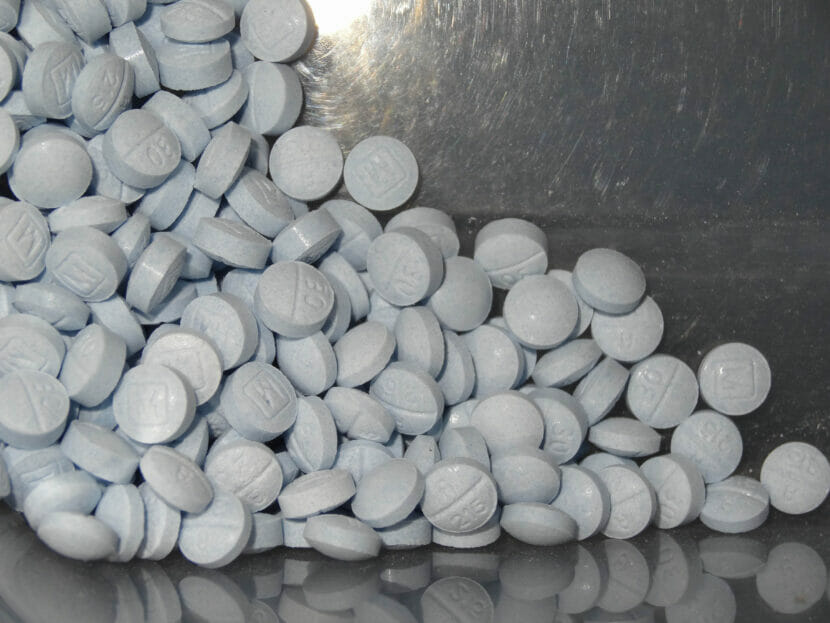
This photo provided by the U.S. Attorneys Office for Utah and introduced as evidence in a 2019 trial shows fentanyl-laced fake oxycodone pills collected during an investigation. (AP photo)
U.S. public health officials are continuing to warn of a growing threat fueling the country’s historic opioid crisis: fake prescription pills.
The share of overdose deaths involving counterfeit pills more than doubled between mid-2019 and late 2021, and the percentage more than tripled in western states, according to a new report from the Centers for Disease Control and Prevention.
According to the CDC, overdose deaths that had evidence of fake pill use accounted for just 2% of fatalities between July and September of 2019. That figure jumped to 4.7% between October and December of 2021.
Those who died from overdoses with evidence of fake pill use — compared to overdoses without it — were more often younger, Hispanic or Latino and had misused prescription drugs in the past.
When looking at states in the west — including Arizona, Washington and Alaska — researchers found that the rate surged from 4.7% to 14.7% over that time period. The CDC says that’s a change for this region, which has historically seen less illegal white-powder fentanyl — a powerful opioid commonly found in counterfeit pills — because it’s difficult to mix with black tar heroin, which is more prevalent in the western U.S.
The report comes as drug deaths across the country remain at record highs, with the CDC estimating that more than 105,000 people fatally overdosed in 2022.
“The proliferation of counterfeit pills, which are not manufactured by pharmaceutical companies, but are typically made to look like legitimate pharmaceutical pills (frequently oxycodone or alprazolam), is complicating the illicit drug market and potentially contributing to these deaths,” the report’s authors said.
Illicit fentanyl was the sole drug involved in 41.4% of drug overdose fatalities with indications of counterfeit pill use, the CDC added.
The Drug Enforcement Administration issued a public safety alert in 2021 warning of an uptick in fake prescription pills being sold illegally, many of which contained potentially deadly amounts of fentanyl.
Some commonly faked prescription drugs included OxyContin, Percocet, Vicodin, Xanax and Adderall, and authorities said the counterfeit pills were being sold online and over social media.
“Drug traffickers are using fake pills to exploit the opioid crisis and prescription drug misuse in the United States, bringing overdose deaths and violence to American communities,” the DEA said at the time.
Meanwhile, U.S. officials continue to try to combat the country’s raging opioid epidemic.
The Biden administration announced last week that it was setting aside more than $450 million to combat the ongoing opioid crisis, including $18.9 million to expand a law enforcement program targeting drug trafficking and production at a regional level.
Portions of the funding will also go to a national ad campaign about the dangers of fentanyl aimed at young people as well as to services in rural areas across the U.S. for those at risk of overdosing on illicit fentanyl or other opioids.
The Food and Drug Administration also announced in March that it approved the overdose-reversing nasal spray Narcan for over-the-counter sales without a prescription.
Copyright 2023 NPR. To see more, visit https://www.npr.org.
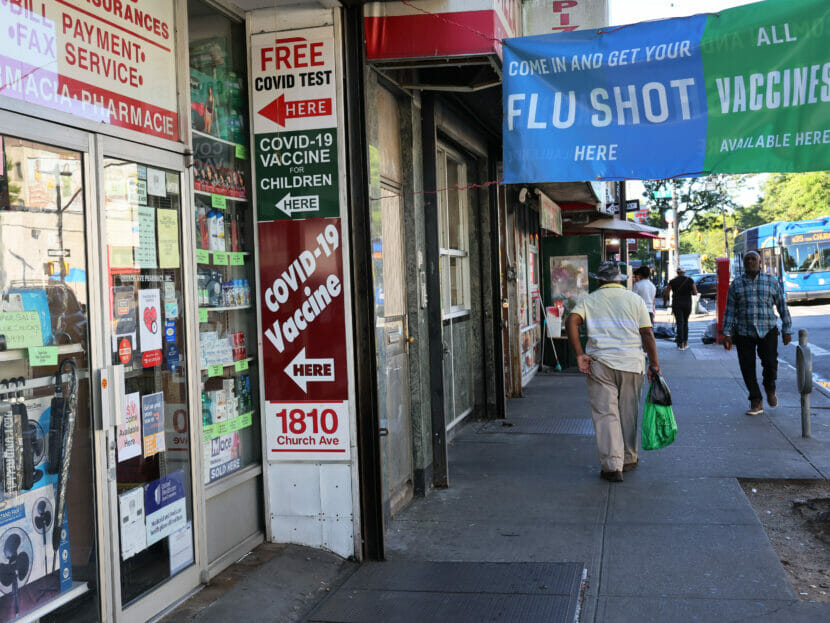
Lab data suggests the new COVID-19 booster shots should protect against a variant that concerns scientists. The boosters should be widely available this fall at pharmacies, like the one seen in the Flatbush neighborhood of Brooklyn borough in New York City. (Michael M. Santiago/Getty Images)
Scientists have produced the first data indicating that a variant that has raised alarm is unlikely to pose a big new COVID-19 threat.
Four preliminary laboratory studies released over the weekend found that antibodies from previous infections and vaccinations appear capable of neutralizing the variant, known as BA.2.86.
“It is reassuring,” says Dr. Dan Barouch, who conducted one of the studies at the Beth Israel Deaconess Medical Center in Boston.
When it was first spotted, BA.2.86 set off alarm bells. It contains more than 30 mutations on the spike protein the virus uses to infect cells. That’s a level of mutation on par with the original Omicron variant, which caused a massive surge.
The concern was BA.2.86, while still rare, could sneak around the immunity people had built up and cause another huge, deadly wave.
“When something heavily mutated comes out of nowhere … there’s this risk that it’s dramatically different and that it changes the nature of the pandemic,” says Benjamin Murrell, who conducted one of the other studies at the Karolinska Institute in Sweden.
But Murrell and Barouch’s experiments, along with similar studies conducted by Yunlong Richard Cao at Peking University in China and by Dr. David Ho at Columbia University in New York, indicate BA.2.86, is unlikely to be another game-changer.
“It’s reassuring that this is not a variant that’s going to pose a huge problem for our soon-to-be-released vaccines,” Ho says. “At least from this perspective, it’s not as threatening as feared.”
Murrell agrees.
“For BA.2.86 the initial antibody neutralization results suggest that history is not repeating itself here,” Murrell says. “Its degree of antibody evasion is quite similar to recently circulating variants. It seems unlikely that this will be a seismic shift for the pandemic.”
The studies indicate that BA.2.86 doesn’t look like it’s any better than any of the other variants at evading the immune system. In fact, it appears to be even be less adept at escaping from antibodies than other variants. And may also be less efficient at infecting cells.
“BA.2.86 actually poses either similar or less of an immune escape risk compared with currently circulating variants, not more,” Barouch says. “So that is good news. It does bode well for the vaccine.”
Moderna released a statement Wednesday saying the company has data indicating its new shot produces a strong immune response to BA.2.86.
The Food and Drug Administration is expected to approve new vaccines soon that target a more recent omicron subvariant than the original shots. And the Centers for Disease Control and Prevention would then recommend who should get them.
While that subvariant, XBB.1.5, has already been replaced by others, it’s a close enough match for the new shots to protect people, scientists say.
“I wish the booster was already out,” says Dr. Peter Hotez of the Baylor College of Medicine and Texas Children’s Hospital, noting that yet another wave of infections has already begun increasing the number of people catching the virus and getting so sick that they’re ending up in the hospital and dying. “We need it now.”
Copyright 2023 NPR. To see more, visit https://www.npr.org.
Transcript :
ARI SHAPIRO, HOST:
Today, we have some good news about the pandemic. New data indicate that a variant that has raised alarm is unlikely to pose a big, new threat. NPR health correspondent Rob Stein has the details.
ROB STEIN, BYLINE: When scientists first spotted the new variant, known as BA.2.86, it set off alarm bells, even though it’s rare. That’s because BA.2.86 had mutated like crazy – on par with the original omicron, which caused a massive surge – raising fears BA.2.86 could sneak around the immunity people had from all their infections and vaccinations and cause yet another huge, deadly wave. Ben Murrell has been studying the variant at the Karolinska Institute in Sweden.
BEN MURRELL: When something heavily mutated comes out of nowhere, and there’s a lot of uncertainty, and there’s this risk that it’s dramatically different, then it changes the nature of the pandemic.
STEIN: But the first studies to analyze how well our immunity can neutralize the variant came out over the weekend and indicate BA.2.86 is unlikely to be another game-changer. At least four preliminary laboratory experiments all found that antibodies people have in their blood from getting vaccinated or infected with one of the more common variants that are already circulating widely can effectively block BA.2.86.
MURRELL: For BA.2.86, the initial antibody neutralization results suggest that history is not repeating itself here. Its degree of antibody evasion is quite similar to recently circulating variants, and it seems unlikely that this will be a seismic shift for the pandemic.
STEIN: Because, it turns out, BA.2.86 doesn’t look like it’s any better than any of the other variants at evading the immune system. In fact, it appears to be even less adept at escaping from antibodies than other variants and may also be less efficient at infecting cells. Dr. Dan Barouch has been studying the variant at the Beth Israel Deaconess Medical Center in Boston.
DAN BAROUCH: BA.2.86 actually poses either similar or less of an immune escape risk compared with current circulating variants, not more. So that is good news. That is reassuring. It does bode well for the vaccine.
STEIN: The Food and Drug Administration is expected to approve new vaccines soon that target a more recent omicron subvariant than the original shots, and the Centers for Disease Control and Prevention will then recommend who should get them. While that subvariant, called XBB.1.5, has already been replaced by others, it looks like a close enough match to protect people. Dr. Peter Hotez at the Baylor College of Medicine hopes as many people as possible will get the new vaccines as quickly as possible.
PETER HOTEZ: I wish the booster was already out. That’s – my only concern is we need it now.
STEIN: Because yet another wave of infections has already begun, increasing the number of people catching the virus and getting so sick that they’re ending up in the hospital and dying.
Rob Stein, NPR News.
(SOUNDBITE OF STATIK SELEKTAH SONG, “TIME”) Transcript provided by NPR, Copyright NPR.
A shortage of pilots is partially to blame for major airlines’ departure from smaller airports. But changing airline economics means the challenge facing regional airports could become insurmountable.
“The 50-seat jet today is just not economic as it was 10 years ago. Labor costs going up. Fuel costs going up. Maintenance costs going up. And it’s hard for that airplane at that seat size to be profitable,” longtime industry analyst William Swelbar told Morning Edition.
Those are the planes that typically service regional airports like Williamsport, which is why we’re likely to see more small cities lose their airline service, according to Swelbar.
“In the West, the distances are greater, the terrain is more difficult, people need to fly. Whereas you look in the East, there’s lots of airports that are located in a certain geography. And the highway system is terrific. That’s why there will be more Williamsport,” he said.
As regional airports increasingly run out of options for passengers, it will change how many Americans begin their journeys, Swelbar believes.
“The highway has become and will become the first access point to the air transportation grid going forward,” he added. “Not every community can support the trend toward larger airframes.”
Hard feelings
Despite the economics, the way legacy airlines are leaving smaller cities is frustrating to Richard Howell, the executive director at Williamsport Regional Airport.
“During COVID the airlines took $55 billion worth of money from the government for a variety of loans and PPP and all the rest of it. And as soon as COVID’s gone, they start pulling out of markets like mine. I mean, they’re literally abandoning rural America,” he said.
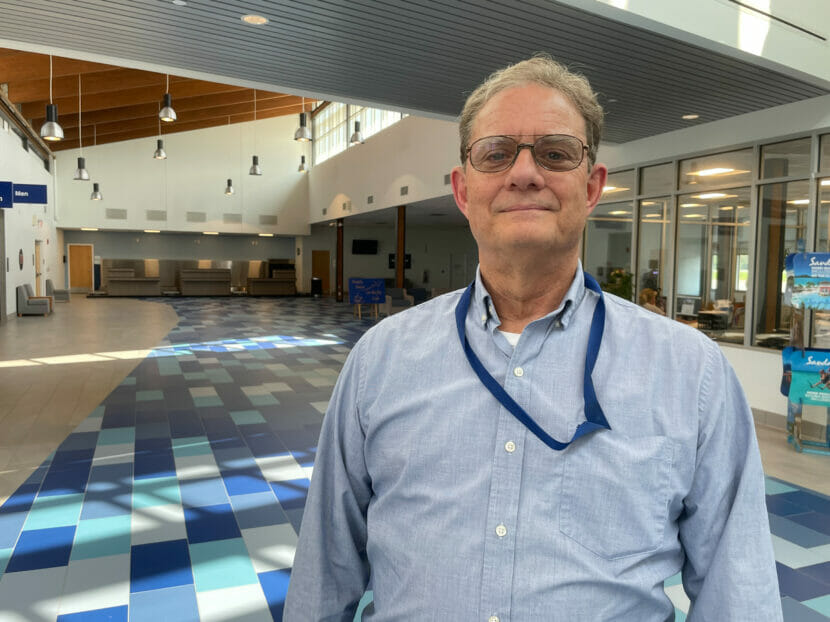
Richard Howell, the executive director at Williamsport Regional Airport, stands in the terminal building. (Adam Bearne/NPR)
In a statement to NPR, American Airlines said: “It’s always difficult to decide to end service to a market and there are always several factors to consider, including customer demand, alternative airport access for local residents and industry constraints like the regional captain shortage.”
The economic effect of their decision to leave is already being felt.
World Travel International is a travel agency based inside the airport terminal. But in a cruel irony, the company’s clients can’t begin their journeys there.
“It’s very sad. To know that we can’t help people that need immediate service to leave right from here. Or like our older clients, having to pay a driver to get them to other airports because they’re no longer able to make those drives,” said owner Julie Johnston McManus.
“We’ve lost all our walk-by traffic,” she added.
Beyond the terminal
It’s not just inside the airport where businesses are struggling because of the lack of air service.
That’s been identified as a big issue by site consultants looking to potentially bring businesses to Williamsport.
The Williamsport Lycoming Chamber of Commerce invites businesses to visit the city during the Little League World Series, which is held every year.
“We all work to try to get them to land their projects here. Last year was the first year that we did it post-COVID. And it was also the first time that we did it without an air service,” said the Chamber’s president and CEO Jason Fink. “And the number one deficiency that was cited was the inability to easily get here.”
In another ironic twist for a city without airline service, one of the biggest employers is Lycoming Engines, which makes piston engines for aircraft.
“When you’re trying to conduct different business meetings and have the opportunity to bring in prospective customers, you want to have that flight service available in your city,” said Shannon Massey, senior vice president at Lycoming Engines.
It’s also affecting Lycoming’s recruitment process.
“If you’re trying to have candidates come in and they want to be interviewed, they have family members. And they want to know if they can or can’t get to their families in a certain distance,” Massey added.
Hope for the future
Howell believes his airport can still make a comeback, if he can get some help from Congress.
He wants Williamsport to get back into a program called Essential Air Service (EAS).
It gives grants to airlines to fly to locations where it’s tough to make money.
Williamsport dropped out when Congress changed the rules in 2012, saying that airports who didn’t use EAS funds the previous year were no longer eligible.
Back then, the airport didn’t need the money. But it does now.
“There’s carriers out there that all they do is EAS because it’s fully subsidized. They’ve got no risk. Even if I could just get back in the program for five or six years or something like that, so we get past this pilot thing,” said Howell.
“Just get me in the door. Ultimately we get back to where we were, where there’s no subsidy at all. The market sustains itself,” he added.
But Howell understands the reality that cities like Williamsport are facing in an era where smaller planes are grounded.
“The planes keep getting bigger and bigger. So you out there with your 75 seat airplanes and things like that, you’re next,” he said.
“If we don’t have some pieces in place that we get our elected officials to put there for us, then you’re just going to be next on the list,” Howell warned.
An old Challenger jet used to train students of the Pennsylvania College of Technology is seen behind a fence at Williamsport Regional Airport. (Adam Bearne/NPR)
A quiet runway
On the airfield at Williamsport Regional, a lone green tractor mows the grass.
But finally, a plane is spotted heading for the runway, a small blue and white private aircraft.
It’s the type of plane that might be used to learn how to fly. And this pilot practiced a touch-and-go landing before immediately taking off again.
Circling the airport and repeating the process, there was no rush.
There’s plenty of time for training when you have the runway all to yourself.
The audio version of this story was edited by Halimah Abdullah. The digital version was edited by Treye Green.
Copyright 2023 NPR. To see more, visit https://www.npr.org.
Transcript :
LEILA FADEL, HOST:
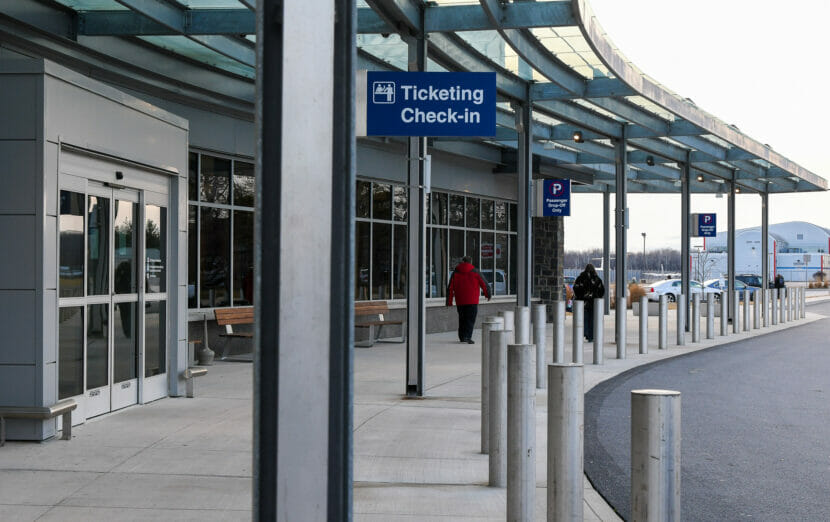
If you’re flying this Labor Day weekend, you might need to drive further than you’re used to to catch your flight. Airline service to smaller cities around the country is dwindling due to a shortage of pilots and changing airline economics. So what does this mean for the surrounding communities? NPR’s Adam Bearne traveled to Williamsport, Pa., to find out.
(SOUNDBITE OF HELICOPTER FLYING)
ADAM BEARNE, BYLINE: A black helicopter takes off into the clear, blue skies above Williamsport Regional Airport.
(SOUNDBITE OF SLIDING DOORS)
BEARNE: Inside, the airport’s executive director, Richard Howell, points out the beautiful, blue tiled floor.
RICHARD HOWELL: The colored floor is representative of the Susquehanna River going through the community. So it goes through the terminal. So it takes people from the airline ticket counter to TSA.
BEARNE: There’s, like, a flow to it.
HOWELL: Yes. Yes, yes.
BEARNE: But there are no passengers flowing through here. Those airline ticket counters stand empty. And at TSA, there are no blue-shirted officers anywhere to be seen.
HOWELL: You get the behind the scenes here.
BEARNE: Yeah. It’s not often that you get to just walk past TSA like that.
HOWELL: Yeah. It’s kind of fun.
BEARNE: No need for security when there’s no flight to catch. There hasn’t been any commercial service at Williamsport since American Airlines left in 2021. While that’s an extreme example, regional airports around the country are seeing legacy airlines pull out. Since the pandemic, American, Delta and United combined have left 74 of them, according to a study by aviation consulting firm Ailevon Pacific. That’s due to a shortage of pilots to fly smaller jets and because it’s harder to make money with those planes.
WILLIAM SWELBAR: The 50-seat jet today is just not economic as it was 10 years ago.
BEARNE: That’s longtime industry analyst William Swelbar.
SWELBAR: Labor costs going up, fuel costs going up, maintenance costs going up. And it’s hard for that airplane at that seat size to be profitable.
BEARNE: In a statement to NPR, American doesn’t mention that as a factor for leaving regional markets, instead, saying it’s due to the pilot shortage and that they have to factor in customer demand and what other airport’s residents have access to. But the way airlines are taking off from small cities still frustrates Howell.
HOWELL: During COVID, the airlines took $55 billion worth of money from the government for a variety of loans and PPP and all the rest of it. As soon as COVID’s gone, they start pulling out of markets like mine. I mean, they’re literally abandoning rural America.
BEARNE: In one corner of the airport, the economic effect of that decision is already being felt.
JULIE JOHNSTON MCMANUS: We’ve lost all our walk-by traffic.
BEARNE: Julie Johnston McManus owns World Travel International, a travel agency based in the terminal.
MCMANUS: It’s very sad to know that we can’t help people that need immediate service to leave right from here or, like our older clients, having to pay a driver to get them to other airports because they’re no longer able to make those drives.
BEARNE: One of her customers is Christina Ertel, who drops by to pay for a tour of the British Isles, but she can’t get there from here.
CHRISTINA ERTEL: Normally when we traveled, we would probably fly out of Williamsport. At this point, we’re flying out of Newark. So we’ll have to make plans to stow a car or get transportation to Newark.
BEARNE: That’s a three-hour drive. Starting a journey this way is becoming increasingly likely, says industry analyst Swelbar.
SWELBAR: The highway has become – and will become – the first access point to the air transportation grid, going forward. Not every community can support the trend toward larger airplanes.
BEARNE: And he believes other American cities are likely to suffer the same fate, especially east of the Mississippi.
SWELBAR: In the west, the distances are greater, the terrain is more difficult. People kind of need to fly. Whereas you look in the East, there’s lots of airports that are located in that certain geography, and the highway system is terrific. That’s why there will be more Williamsports.
(SOUNDBITE OF HORN HONKING)
BEARNE: Back in Williamsport, the downtown has the feel of a place making a comeback from hard times. But the head of the local chamber of commerce, Jason Fink, says the lack of airline service is holding the city back, despite it being home to the world’s most famous youth baseball tournament.
JASON FINK: During the Little League World Series, we bring in site consultants, and they usually introduce companies to various communities, and we all work to try to get them to land their projects here. Last year was the first year that we did it post-COVID, and it was also the first time that we did it without an air service. And the No. 1 deficiency that was cited was inability to easily get here.
BEARNE: Out at the airport, Richard Howell is still confident that can change if he can get some help from Congress. He wants Williamsport to get back into a program called Essential Air Service, or EAS. It gives grants to airlines that fly to locations where it’s tough to make money. Williamsport dropped out when Congress changed the rules in 2012, saying that airports who didn’t use EAS funds the previous year were no longer eligible. Back then, Williamsport didn’t need the money. It does now.
HOWELL: There’s carriers out there that all they do is EAS because it’s fully subsidized. They’ve got no risk. Even if I could just get back in the program for five or six years or something like that until we get past this pilot thing, just, you know, get me in the door, ultimately, we get back to where we were where there’s no subsidy at all. The market sustains itself.
BEARNE: And Howell’s warning other small cities to make sure they get funded, too.
HOWELL: Today it’s Williamsport. We lost our air service. There’s other communities in the area that have lost their air service. The planes keep getting bigger and bigger. So you out there with your 75-seat airplanes and things like that, you’re next. And if we don’t have some pieces in place that we get our elected officials to put there for us, then you’re just going to be next on the list.
BEARNE: Out on the airfield, a lonely green tractor mows the grass, but then a plane can be spotted heading for the runway. It’s a small, blue-and-white private aircraft, the kind you might use to learn how to fly. That’s what this pilot seems to be doing – practicing landing…
(SOUNDBITE OF LANDING GEAR HITTING RUNWAY)
BEARNE: …And taking off again.
(SOUNDBITE OF AIRPLANE ENGINE)
BEARNE: Plenty of time for training when you have the runway all to yourself.
Adam Bearne, NPR News in Williamsport, Pa.
(SOUNDBITE OF ADIE DERRICK SONG, “COME FLY WITH ME”) Transcript provided by NPR, Copyright NPR.
For three and a half years, tens of millions of federal student loan borrowers have enjoyed an unprecedented respite, not only from their loan payments but from the accumulation of interest on top of those loans. Countless books and doctoral theses will be written about what that money paid for instead; what matters today, though, is that interest resumes its inexorable march come September and, in October, so do loan payments.
Here’s the problem for borrowers: A lot has happened over the past few years. Their lives have likely changed – perhaps dramatically – and, like them, so has the student loan system itself. Some of the biggest loan servicers pre-pandemic are gone, their borrowers shuffled to other servicers, and a new, more generous repayment plan awaits low-income borrowers.
It’s a lot to navigate – but don’t worry, we’re here to help. NPR’s Education Desk has been covering student loans for years. We’ve published investigations into mismanagedloanprograms, and then written about the fixes that cameout of those stories. And most importantly, we’ve been following every development in the pandemic payment freeze. It’s a lot. So…
Here’s a list of 12 things borrowers should know as they return to repayment.
1. It’s time to log into your student loan portal (no really, stop putting it off!)
First thing’s first. Many borrowers haven’t checked in on their loans in months – in some cases, years. Or ever (I see you, younger borrowers)! That’s fine. This is a guilt-free zone. But it’s time to get online and get reacquainted – or acquainted for the first time.
Once you’re logged in, make sure your contact information is up to date. If your email or brick-and-mortar address has changed, the U.S. Education Department and your servicer need to know.
Speaking of servicers, while you’re there, you can find out who your servicer is now. It may be a name you’ve never heard before, like MOHELA (in case you’re curious, it’s moh-HEE-lah). Millions of borrowers got shuffled around during the pandemic. Don’t be alarmed if you’re one of them.
From there, you’ll need to go to your servicer’s website and add or update your contact information there too. Redundant? Perhaps, but you need to do it. If they can’t find you, they can’t bill you – but that won’t keep your loans from ballooning with interest.
If all of this requires you to go down a rabbit hole remembering old passwords or your FSA ID, take a moment now to save them somewhere. Because moving forward, if you didn’t before, you should make a habit of checking in on your loans every month or two.
If you can’t figure out how to log into the government’s portal, you can always call for help: 1-800-4-FED-AID (1-800-433-3243).
2. Figure out the repayment plan that makes sense for you
The kind folks at the Department of Education’s office of Federal Student Aid have built a handy tool to help you do just that. It’s a loan simulator, and it will ask you all sorts of life questions, like whether you’re currently employed, or paying for health insurance, or married (with children). It’ll ask you where you went to school, how much debt you have and how much income you’re earning. And then it will let you choose your plan based on how you answer the most important question of all …
3. What is your repayment goal?
Do you want to pay as little money as possible in the short-run… or the long-run? For the long-run, the traditional, “standard” 10-year plan is almost certainly your best bet. You’ll have larger, fixed payments right out of the gate – but that also means you’ll end up paying the least amount of interest over time compared to other, more stretched-out plans.
The “graduated” plan works similarly, though you’ll start with smaller payments that then get big enough over time that you’ll still repay the loan in 10 years.
If shorter-term affordability is more your priority…
4. You might qualify for a $0 monthly payment!
If you’re a young earner and want/need a low monthly payment, great. The Biden administration’s new income-driven repayment plan, known as the SAVE plan, might be a good fit. If you’re single and earn less than about $33,000, you should qualify for a $0 payment.
Among the many new perks with this plan: As long as you’re paying each month what the government thinks you can afford, then it will waive any leftover interest not covered by your payment. For example, let’s say your loans accrue $60 in interest every month, but your monthly payment is just $40. The government will waive the remaining $20 in interest. But don’t be fooled. There’s still interest, and you may end up paying a ton of it over the life of the loan.
Another example: Let’s say you earn $40,000 and need to pay back $32,000 in federal student loans. According to the department’s loan simulator, the cheapest way to do that, long-term, is to repay on the standard 10-year plan, with a $322 monthly payment. That plan would have you paying back a total of roughly $39,000 with interest.
On the other hand, under the SAVE plan, your initial payment would be just $60 a month. But, with interest, you’d be paying $49,400 over the life of the loan. This is really important. If you’re making a small payment, say $60, it’s possible much or even all of it would go toward interest.
Your loan won’t grow, but it won’t shrink quickly either. That’s where loan forgiveness comes in.
5. Yes, loan forgiveness is still a thing
OKAY, deep breath… yes, the loan forgiveness landscape has been confusing. President Biden’s big loan relief plan, to erase between $10,000 and $20,000 of student loan debt for most borrowers, was struck down by the U.S. Supreme Court. But there are other loan forgiveness options that are very real and plentiful.
Like Public Service Loan Forgiveness. Sure, you’ve seen stories about how poorly managed the program was (many of which came from NPR), but the Biden administration has since overhauled PSLF, making it easier to navigate. The rules are still roughly the same: work for 10 years in public service (in government or for a qualified nonprofit) while making 120 qualifying payments and your remaining balance will be forgiven. If this rings your bell, you should consider the new SAVE plan. There’s no point paying hefty monthly sums upfront, through the standard 10-year plan, if you think you will qualify for forgiveness in 10 years anyway. Also, don’t worry if you logged three years as a teacher, dabbled as a stock broker, then went back to teaching. The years of service don’t have to be consecutive.
Income-driven repayment plans also come with different levels of forgiveness. Typically, it’s 25 years for graduate school debt and 20 years for undergraduate debt. The new SAVE plan will also include a new tier of forgiveness for low-debt borrowers: folks who take out $12,000 or less can qualify for forgiveness after 10 years, though that part of the plan won’t go into effect until July of 2024.
One last thing to consider as you weigh your odds of loan forgiveness…
6. You may get retroactive credit toward forgiveness
If I could write this section in neon, I would.
Right this minute, the Education Department is reviewing the records of millions of borrowers and giving them retroactive credit toward forgiveness for time already spent in repayment – time that didn’t previously qualify: months in forbearance, deferment or other repayment plans.
This means, for older borrowers, enrolling in an income-driven repayment plan now, for the very first time, could come with 10, 15 or even 20 years of back credit toward loan forgiveness. Here’s a quick explainer re: why that’s happening and what it means for borrowers.
Skeptical? Earlier this summer, the first wave of borrowers – more than 800,000 of them – had their debts erased after receiving this retroactive account adjustment.
And next summer could bring a mini-explosion of loan forgiveness. Again, that’s when the SAVE plan’s new, 10-year forgiveness promise kicks in for borrowers with original loan balances below $12,000. Well, lots of these borrowers are in a position to get at least 10 years of back credit. Meaning, the moment the policy begins they’ll qualify to have their debts erased.
7. Borrowers with old federal loans may want to consolidate
Millions of borrowers still have old loans known as FFEL Program loans. These date back to the days when federal loans were backed by the U.S. government but held by private banks, and these borrowers have gotten used to being excluded from previous loan relief efforts.
But it’s not too late for FFELP borrowers to qualify for Public Service Loan Forgiveness or forgiveness under that big, retroactive account adjustment the Education Department is doing right now. They simply need to consolidate their old loans into a new federal, Direct Consolidation Loan by the end of 2023, according to the Education Department.
8. Consider enrolling (or re-enrolling) in auto pay
If you tend to pay your bills at the last minute and have been known to miss a deadline or two, consider enrolling in auto pay. You’ll even get a 0.25% cut on your interest rate.
If you were enrolled in auto pay before the pandemic, the Education Department says you’ll likely need to re-enroll. So don’t sit back and assume that train will roll without a fresh nudge.
9. There’s an on-ramp for all of this
For the next year, the Biden administration is trying to ease borrowers into repayment by not reporting them to the credit agencies if payments are late or missed altogether. But don’t take that as a license to wait. Interest will keep growing, whether or not you’re making payments.
10. Avoid default
If a borrower goes 270 days without making a payment, they’ll go into what’s called default, which is a place so awful only Dante could do it justice. Default destroys a borrower’s credit and allows the government to dip into your wages, tax refund and Social Security. In short, the government’s likely going to get its money the easy way, or the hard way. Try the easy way first.
If you can’t afford a monthly payment right now, that’s fine – check out the SAVE plan. You may qualify for a $0 payment. You can also call your loan servicer and request a temporary forbearance or deferment – not as good as being on a repayment plan but preferable to default.
11. Borrowers already in default are being offered a “Fresh Start”
This is a big deal, but this fresh start requires that you opt in – it’s not entirely automatic. If you’re in default, you need to reach out to whoever holds your loan. That may be a guaranty agency. You can find a list of agency contacts here.
If your loans are still held by the U.S. Department of Education, you can initiate the fresh start process by going to this website or calling 1-800-621-3115. As part of that process, you’ll be able to enroll in the new SAVE income-driven repayment plan, which should help keep your monthly payments reasonable while also keeping you out of default. According to the Education Department, half of Fresh Start borrowers currently have a $0 monthly payment.
12. Don’t wait. Your servicer may be understaffed
NPR reported back in January that the federal office that oversees student loans has been flat-funded for the year, and it’s now passing on its budget crunch to the servicers it pays to deal with borrowers. Several months ago, it gave those servicers permission to cut student loan call center hours. Now do the math:
More than 40 million borrowers returning to repayment + loan servicers cutting service = a whole lotta hold music, depending on your servicer and when you call.
So, if you can, try to get back on track online. You might be surprised by how useful the Education Department’s loan tools can be.
And if you still have a question, don’t wait till Oct. 1 to call your servicer.
Edited by: Nicole Cohen
Visual design and development by: LA Johnson
Copyright 2023 NPR. To see more, visit https://www.npr.org.
A snowy egret stands within the salt marsh at Station Creek Landing in St Helena, S.C., on July 10, 2023. (Jim Watson/AFP via Getty Images)
The Environmental Protection Agency removed federal protections for a majority of the country’s wetlands on Tuesday to comply with a recent U.S. Supreme Court ruling.
The EPA and Department of the Army announced a final rule amending the definition of protected “waters of the United States” in light of the decision in Sackett v. EPA in May, which narrowed the scope of the Clean Water Act and the agency’s power to regulate waterways and wetlands.
Developers and environmental groups have for decades argued about the scope of the 1972 Clean Water Act in protecting waterways and wetlands.
“While I am disappointed by the Supreme Court’s decision in the Sackett case, EPA and Army have an obligation to apply this decision alongside our state co-regulators, Tribes, and partners,” EPA Administrator Michael Regan said in a statement.
A 2006 Supreme Court decision determined that wetlands would be protected if they had a “significant nexus” to major waterways. This year’s court decision undid that standard. The EPA’s new rule “removes the significant nexus test from consideration when identifying tributaries and other waters as federally protected,” the agency said.
In May, Justice Samuel Alito said the navigable U.S. waters regulated by the EPA under the Clean Water Act do not include many previously regulated wetlands. Writing the court’s decision, he said the law includes only streams, oceans, rivers and lakes, and wetlands with a “continuous surface connection to those bodies.”
The EPA said the rule will take effect immediately. “The agencies are issuing this amendment to the 2023 rule expeditiously — three months after the Supreme Court decision — to provide clarity and a path forward consistent with the ruling,” the agency said.
As a result of the rule change, protections for many waterways and wetlands will now fall to states.
Environmental groups said the new rule underscores the problems of the Supreme Court decision.
“While the Administration’s rule attempts to protect clean water and wetlands, it is severely limited in its ability to do so as a result of the Supreme Court ruling which slashed federal protections for thousands of miles of small streams and wetlands,” said the group American Rivers. “This means communities across the U.S. are now more vulnerable to pollution and flooding. Streams and wetlands are not only important sources of drinking water, they are buffers against extreme storms and floodwaters.”
“This rule spells out how the Sackett decision has undermined our ability to prevent the destruction of our nation’s wetlands, which protect drinking water, absorb floods and provide habitat for wildlife,” said Jim Murphy, the National Wildlife Federation’s director of legal advocacy. “Congress needs to step up to protect the water we drink, our wildlife, and our way of life.”
Meanwhile, some business groups said the EPA’s rollback did not go far enough.
Courtney Briggs, chair of the Waters Advocacy Coalition, said federal agencies “have chosen to ignore” the limits of their jurisdictional reach. “This revised rule does not adequately comply with Supreme Court precedent and with the limits on regulatory jurisdiction set forth in the Clean Water Act,” she said in a statement.
Copyright 2023 NPR. To see more, visit https://www.npr.org.
In this Friday, Sept. 29, 2017, photo, Lexi Montgomery poses with supplies she has purchased in the event of another storm, in Miami Beach, Fla. Hurricane Irma was the first hurricane that Montgomery ever experienced. (Alan Diaz/AP)
Sherri McKinney, the national spokesperson for the Red Cross, knows just how unpredictable natural disasters can be. She lived through the deadly Nashville tornadoes in 2020 – the 6th costliest tornado in U.S. history. 25 people died, over 300 were injured, and the city suffered 1.6 billion dollars in damage.
The tornado hit overnight quickly and unexpectedly, leaving McKinney and others without any time to evacuate ahead of it touching down.
“Emergencies are more common than people may think, and disasters happen anywhere and any time. It can even begin in someone’s own home,” said McKinney.
McKinney says that proper preparation can make navigating a disaster event less difficult.
“Being prepared for any type of emergency or disaster can make the difference between life and death,” McKinney added. “We can’t stress that enough. Have a plan, have a kit, and know how to evacuate your area.”
After a disaster happens, it could take days before first responders are able to reach people. And it’s usually friends or neighbors in your community who can get to each other first.
Lea Crager, FEMA’s Ready Campaign Director, says there are still steps you can take to prepare yourself for situations where your access to medical assistance is limited.
“That’s why we tell people [to] take a CPR class, have a first aid kit, know that if something happened in your neighborhood or community, you may be having to help some of your neighbors or they may be having to help you,” said Crager.
Crager added that the more prepared you are as a community, the easier it is on first responders. Because there are only so many resources to go around.
A go bag is an important part of your emergency prep
The Red Cross is helping recovery efforts in Maui, and McKinney is stationed there. Following a disaster like the Maui fires, McKinney says people are most in need of food, water, and clothing.
“I think people may think they’re ready when something’s going to happen. But they usually haven’t taken the time to know where a few key items are in their house or things they might need in case of an emergency,” said Crager. “You kind of take for granted that everyone will know what to do. But when real events happen, a lot of times, people are stressed and don’t think as clearly.”
When it comes to a properly stocked go bag, McKinney suggests packing several essential items. Your go bag should be ready with a three-day water supply per person. Make sure that you have foods that are shelf-stable and don’t have an expiration date. You should also include first aid supplies.
“We heard of people leaving here with burns on their legs and arms. To have that emergency kit with product in it that you can treat a quick burn or a quick cut is critically important sometimes,” McKinney said.
It’s important to start slowly building an emergency kit that you can keep nearby, such as in your garage or closet. You can start by buying one item at a time. Or you may opt to create a full list of items you need in your go bag and purchase them in bulk. No matter how you choose to build your go bag, the Red Cross says a go bag should have enough items in it for your entire family for three days.
But the amount of food and water you should have is dependent on where you live. Some local or state officials ask for you to have more than three days of items.
“If you live on an island like Puerto Rico, they request you have 7 to 10 days worth of supplies,” said Crager. “If logistical chains are broken, it’s going to take longer to get aid and relief to some areas. So if you’re in a more rural area, you’re probably going to need more than someone who’s in an area where you’re going to have resources readily available.”
You can visit the Red Cross website for a full list of basics to have in your own go bag.
These items include:
1. Water: one gallon per person, per day (3-day supply for evacuation.)
2. Food: non-perishable, easy-to-prepare (3-day supply for evacuation)
3. First aid kit
4. Medications (7-day supply) and medical items.
5. Copies of personal documents (medication list and pertinent medical information, proof of address, deed/lease to home, passports, birth certificates, insurance policies)
6. Family and emergency contact information.
FEMA emphasizes that everybody will have a different list because everybody’s needs are different.
“What my mom needs in her bag or what your coworker needs are all going to be different things. Do you have a pet? Do you have children? Do you have prescription medication? Look at what your needs are and what you’re going to need to be able to leave your house,” said Crager.
While stocking their go bags, people often forget about their medications. When there’s a disaster, The Red Cross will replace any and all medications, as well as medical equipment, eyeglasses, and other health needs. “We do see people many times evacuating and they leave that all behind,” McKinney said.
Another common item to forget is personal documents like a renter’s agreement or the deed to your house. Crager says that FEMA always tells people to save backup copies of these documents in the cloud.
If you don’t want to start an emergency kit from scratch, McKinney says the American Red Cross has go kits or emergency kits on their website redcross.org. She says they make great gifts for weddings, Christmas, and for people who are going to be new homeowners.
“It’s really important that we think of that kind of gift as a gift of life,” she said. “To make sure that we’re protecting our loved ones.”
But FEMA stresses that a ready-made go bag needs to be customized to your needs. Crager suggests you sit down and go through the bag with your family to make sure it has all your essential items.
Don’t forget to craft a detailed emergency plan
And while building an emergency go bag is crucial, McKinney emphasizes the importance of also talking to your family and making an emergency plan to stay in touch if you’re separated during a natural disaster.
It’s important to include your children in these conversations too. Tell them someone they can reach if they can’t reach you, where they should go, and where they can meet up with you again.
“If a disaster happens, people think they’re going to be with their children. And we’re seeing more and more that disasters can happen while kids are at school or at an after-school program. And parents can’t reach their kids,” said Crager. “So have those conversations where everyone would know the roles we would play and what we’d have to do if we were separated.”
Copyright 2023 NPR. To see more, visit https://www.npr.org.
Close
Update notification options
Subscribe to notifications
Subscribe
Get notifications about news related to the topics you care about. You can unsubscribe anytime.

9(MDEwMjQ0ODM1MDEzNDk4MTEzNjU3NTRhYg004))
9(MDEwMjQ0ODM1MDEzNDk4MTEzNjU3NTRhYg004))

9(MDEwMjQ0ODM1MDEzNDk4MTEzNjU3NTRhYg004))

9(MDEwMjQ0ODM1MDEzNDk4MTEzNjU3NTRhYg004))

9(MDEwMjQ0ODM1MDEzNDk4MTEzNjU3NTRhYg004))

9(MDEwMjQ0ODM1MDEzNDk4MTEzNjU3NTRhYg004))