Members of the House and Senate raced to pass a spending bill ahead of the shutdown deadline. (Nathan Howard/Getty Images)
The Senate voted 88 to 9 to approve a stopgap spending bill to fund the federal government through Nov. 17, narrowly averting a shutdown by a midnight deadline. The bill now heads to President Biden’s desk for his signature.
The legislation also includes $16 billion in emergency disaster assistance requested by the White House and extends authorization for the Federal Aviation Administration through the end of the year. It does not include any additional aid to Ukraine, despite widespread bipartisan support for that funding in the Senate.
Biden praised the legislation and called for Congress to move quickly to address the lack of funding for Ukraine.
“We cannot under any circumstances allow American support for Ukraine to be interrupted,” Biden said in a statement. “I fully expect the Speaker will keep his commitment to the people of Ukraine and secure passage of the support needed to help Ukraine at this critical moment.”
The sudden agreement in Congress on spending was a major reversal after House Republicans remained at an impasse for weeks. House Speaker Kevin McCarthy, R-Calif., unveiled the bill Saturday morning after a closed-door meeting with House Republicans.
The vote came after an hours-long delay led in part by Sen. Michael Bennet, D-Colo., who demanded a firm commitment from leaders in both parties on the Ukraine aid.
“I think it’s really important for us to send a message that the dysfunction that we have, in terms of this immediate question about opening or closing the government, doesn’t reflect on our bipartisan commitment to make sure that the United States stays in this battle and that we continue to support the Ukrainian people in their fight,” Bennet told reporters outside the Capitol.
The Senate vote capped a day of dramatic swings in Congress ahead of the shutdown deadline.
Earlier in the day the House voted 335 to 91 to approve the extension. McCarthy has refused for weeks to consider any spending bill that would require the support of Democrats. But facing the potential for a politically and economically harmful shutdown, McCarthy reversed course, specifically calling on Democrats for help passing the bill.
“What I am asking, Republicans and Democrats alike, put your partisanship away, focus on the American public,” McCarthy told reporters before the vote.
In the final vote, more Democrats than Republicans supported the measure, 209 to 126.
No funding for for Ukraine
The White House, congressional Democrats and many Senate Republicans have insisted on including financial support for Ukraine, because current funding is set to run out at the beginning of October. However, a bloc of House Republicans strongly oppose more funding for Ukraine, and lawmakers abandoned those plans in order to pass a deal on spending.
Senate Democrats lamented the lack of Ukraine funding but said there is a bipartisan commitment to find a path for funding. House Republicans have suggested the only way to do that is to pair the funding with money to address illegal immigration at the U.S. border with Mexico. Sen. Chris Murphy, D-Conn., rejected that idea.
“I just think it’s much better for all of us, much better for the world if we separate the question of Ukraine from any other political question,” Murphy told reporters in the Capitol.
He said lawmakers are “going back to the drawing board” to figure out what would go in a Ukraine assistance package but “that can’t happen overnight.”
Many Republicans in the House and some in the Senate oppose new funding for Ukraine without further accounting of how the previous funds have been spent.
“We’re going to have a really, really tough conversation about whether and how we’re going to fund Ukraine,” said Sen. J.D. Vance, R-Ohio. “I think this is a victory for those of us who are skeptical of indefinite funding for Ukraine. But there’s going to be another fight, whether it’s next week or three weeks from now.”
McCarthy’s reversal
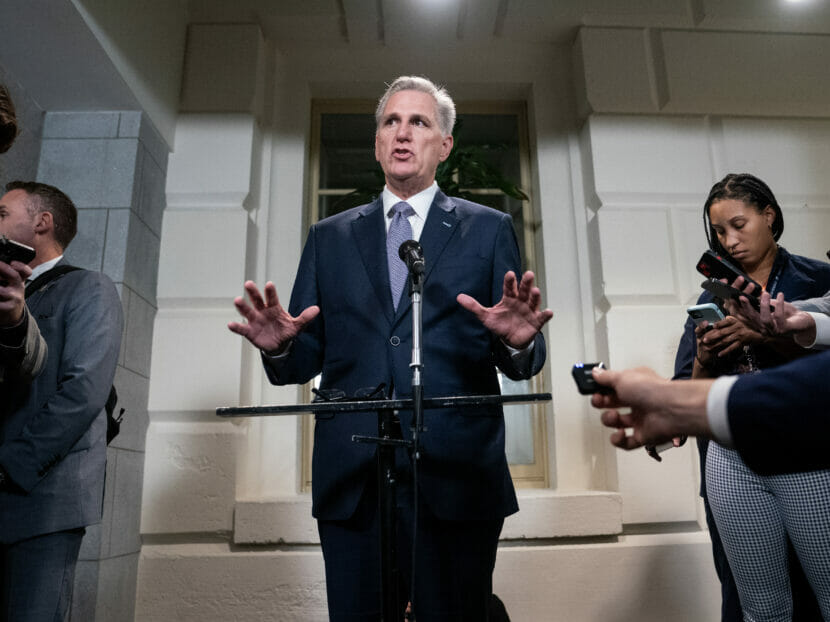
House Speaker Kevin McCarthy, R-Calif., speaks with members of the media following a meeting of the Republican House caucus on Saturday in Washington, D.C. (Nathan Howard/Getty Images)
The sudden rush of action came after House Republicans huddled in the basement of the Capitol to discuss strategy.
Some McCarthy allies, like Rep. Dusty Johnson, R-S.D., argued a temporary fix to funding the government was needed so House Republicans can continue to push for conservative spending policy without the threat of a shutdown. Leaders stressed that with continued resistance from a group of conservative GOP members, there was no way to move a bill with just Republicans. McCarthy holds a narrow majority and can’t lose any more than four votes.
Johnson pointed to the 21 far-right Republican members who blocked a GOP bill on Friday as the reason why the speaker moved to this new plan. Those members “put us in a position to unfortunately pass something a little less conservative. Now the good news is this is still a pathway to get the kind of conservative wins we need through the appropriations process.”
House Republican leaders canceled the planned district recess for the beginning of October and said the House will continue to move their own spending bills — they passed four of the 12 that fund federal agencies.
Conservatives pushed back against the stopgap bill. Rep. Bob Good, R-Va., told reporters he would vote no against a continuing resolution. “There’s no such thing as a clean CR.” He argued if one passed he didn’t believe the House would continue taking up the rest of the annual spending bills.
The threat to McCarthy’s leadership
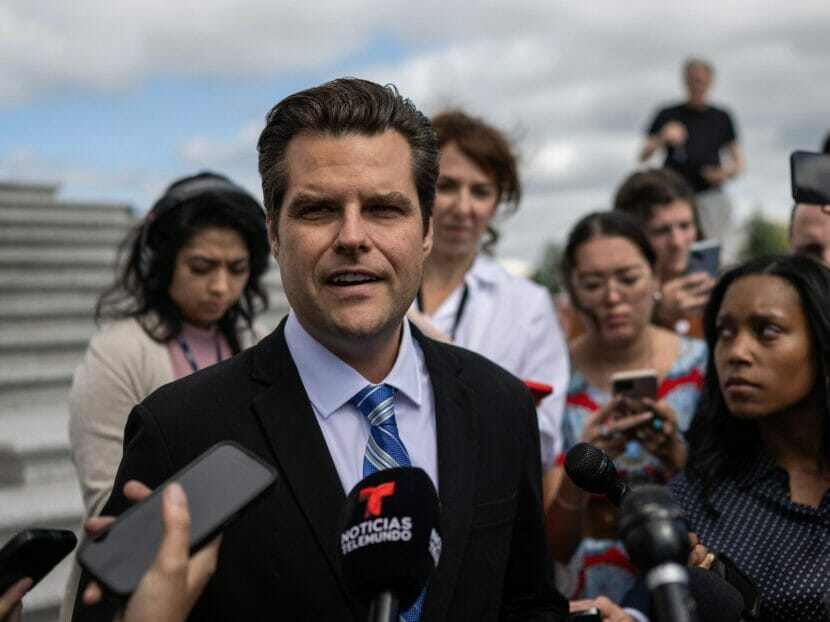
Republican Rep. Matt Gaetz of Florida speaks to the press outside the U.S. Capitol on Saturday. (Andrew Caballero-Reynolds/AFP via Getty Images)
McCarthy’s move opens him up to a challenge for his gavel. Florida GOP Rep. Matt Gaetz has been hinting for days he was planning to file a resolution to oust the speaker. Under rules McCarthy agreed to in January when he was elected, only one lawmaker is needed to file a “motion to vacate” — a resolution that calls for a vote of confidence in the speaker.
Asked by reporters if he was worried about his job, the speaker said, “you know what, if somebody wants to remove because I want to be the adult in the room, go ahead and try.”
Democrats join with McCarthy’s plan
There was drama early in the day as House Democrats attempted to stall progress on the House bill in order to give the Senate time to vote first on their own version of the legislation that would have provided roughly $6 billion for Ukraine.
As senators crept toward their own vote, across the Capitol, the House Appropriations Committee’s Democratic staff members released an analysis criticizing the bill for not including money for Ukraine.
But it quickly became clear that Senate Republicans were on board with McCarthy’s plan and House Democrats relented.
Rep. Jim McGovern, D-Mass., the top Democrat on the Rules Committee, said he was disappointed with the decision to remove Ukraine aid, but Congress needed to move ahead with the deal they could reach.
“There’s bipartisan consensus on [Ukraine], we’ve had overwhelming votes on this, so I think we will work that out,” McGovern told reporters. “But right now this is a bill — I mean I would have written the bill a little bit better, but this is a bill that Democrats can support and I think we won some important victories.”
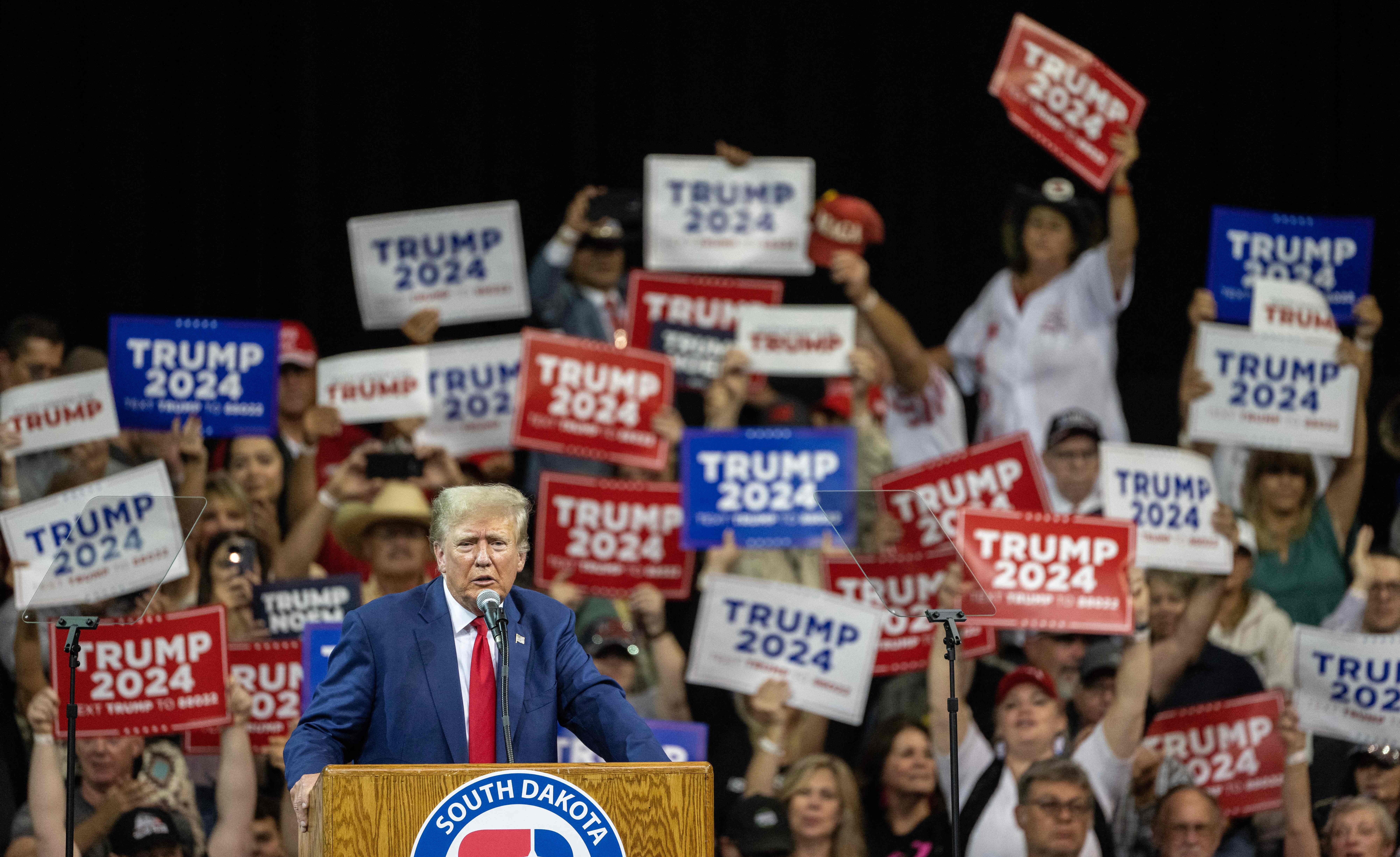
Former President Donald Trump speaks at a campaign rally in Rapid City, S.D., on Sept. 8. (Andrew Caballero-Reynolds/AFP via Getty Images)
A little-known provision of the U.S. Constitution is at the center of a growing debate about former President Donald Trump’s eligibility for the 2024 election, with a number of Trump opponents claiming it should prevent him from appearing on ballots next year.
The 14th Amendment was ratified in 1868, following the Civil War, and its Section 3 essentially disqualifies from office anyone who engaged in “insurrection or rebellion” against the U.S.
It was designed to prevent former Confederate leaders from serving in Congress, and got the most use in the decade or so after the war, says James Gardner, a professor at the University at Buffalo School of Law who specializes in constitutional and election law.
It’s rarely been discussed — let alone invoked — since.
“Until recently, nobody would have said that there was even a real chance of a sort of a rebellion or insurrection against the United States of the kinds the amendment would deal with,” Gardner tells NPR. “Now is certainly the most important context to which the provision is relevant since the 1870s.”
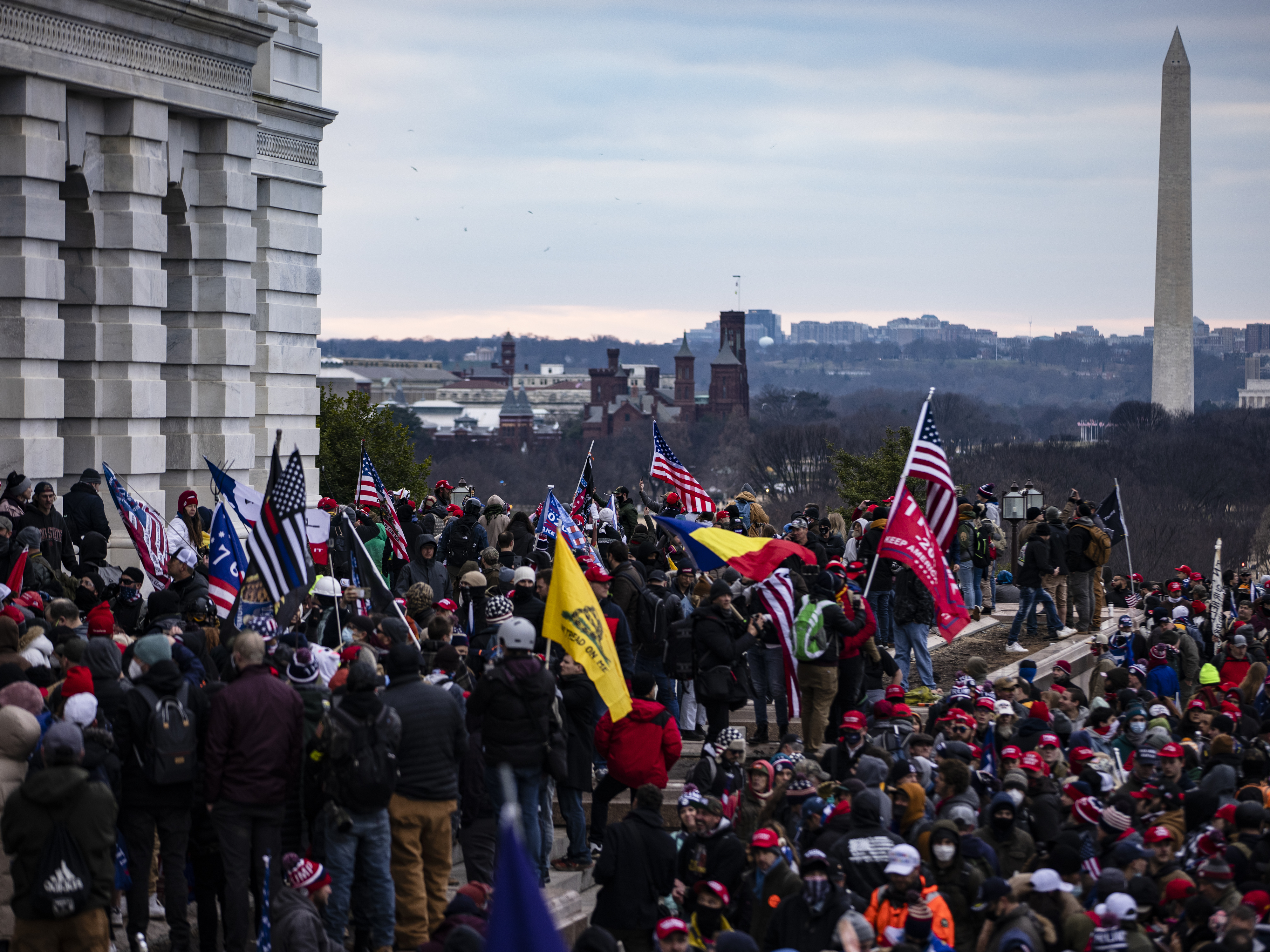
That’s because of Trump’s efforts to overturn his 2020 election loss, and the events of Jan. 6, 2021, when Trump supporters stormed the U.S. Capitol to try to stop Congress from certifying the results.
Liberal groups have since tried unsuccessfully to apply the amendment to block several well-known Republican members of Congress from running for reelection over their involvement in Jan. 6.
While the activists said they intended to eventually target Trump if he sought the presidency again, and have laid the legal groundwork to do so, actually keeping him off the ballot is likely a longshot.
That’s despite the House panel that investigated the Jan. 6 attack last year blaming Trump as its “central cause,” and a grand jury indictment on four federal counts related to efforts to overturn the 2020 election.
The special counsel’s probe is one of several criminal cases facing now-candidate Trump, who continues to dominate the Republican primary race.
And in recent weeks, a growing chorus of legal scholars and voters’ rights groups have argued that the clause should disqualify him from the ballot.
“I think there is consensus in the legal field that it is worth looking into,” Gardner says. “The questions that are difficult are exactly how that would happen.”
Because the presidential election happens nationwide yet is so decentralized, individual state officials could theoretically make their own determinations about whether Trump should be on the ballot, based on their state statutes.
Election administrators in several states, including Michigan, New Hampshire and Georgia, have already said Trump’s name will be on the ballot unless a court rules otherwise.
Gardner — who personally would like to see Trump disqualified from ballots nationwide — says the issue would ideally settled by the U.S. Supreme Court in time for the upcoming election cycle.
“I think that the situation that would be most fraught is if the state courts in New York and California throw him off, but the state courts in Alabama and Georgia keep him on,” he explains. “So then you’d have a disagreement among perfectly well-authorized judicial systems. … It needs to be decided by the Supreme Court for everybody.”
Trump supporters storm the U.S. Capitol on Jan. 6, 2021. (Samuel Corum/Getty Images)
People disagree about whether it would be worse to ignore or confront the question, Gardner says. He believes any decision will be fateful for the U.S. as a civic society, especially in the broader context of the democratic backsliding happening here and elsewhere around the world.
Here’s what else to know about the clause — how it’s been used before, why it’s so divisive and what might happen next.
“No person shall be a Senator or Representative in Congress, or elector of President and Vice-President, or hold any office, civil or military, under the United States, or under any State, who, having previously taken an oath, as a member of Congress, or as an officer of the United States, or as a member of any State legislature, or as an executive or judicial officer of any State, to support the Constitution of the United States, shall have engaged in insurrection or rebellion against the same, or given aid or comfort to the enemies thereof.”
The wording of the clause opens it up to a slew of definitional questions, including the meaning of insurrection, what constitutes engagement and “aid or comfort,” and whether the presidency is really an “office.”
For his part, Gardner argues Jan. 6 was clearly a violent insurrection against the U.S., citing the loss of life and destruction of property.
The degree of Trump’s involvement is a question that people view as more murky, he says, pointing to examples like Trump’s rousing speech beforehand and the Jan. 6 committee’s revelation that he wanted to go to the Capitol himself.
Trump has not been charged with or convicted of insurrection, which some legal experts say weakens the case for using the provision to disqualify him. Others, like Gardner, argue a conviction isn’t a prerequisite.
Gardner says Trump’s March 2024 election interference trial tackles different legal issues — namely, whether he violated particular criminal statutes, not whether he violated a provision of the Constitution.
“It may be that in those trials, evidence would be produced which would be relevant to the constitutional question,” he explains. “But they’re really not connected.”
When has it been used before?
The clause has never been invoked against a presidential candidate. It got what Gardner calls “the biggest workout” in the period immediately following the Civil War.
“What happened was Southern states, once they were readmitted, began trying to send ex-Confederate leaders to Congress,” he says. “And there was a long period where Congress was refusing to seat those people.”
Fast forward a century and half later to 2022, when a county official in New Mexico was removed from office because of his involvement in Jan. 6.
A judge ruled that Otero County Commissioner Couy Griffin, a Trump supporter, was disqualified from holding public office — because he violated Section 3 of the 14th Amendment — after he was convicted of entering a restricted area of the U.S. Capitol.
The liberal-leaning Citizens for Responsibility and Ethics in Washington (CREW), which sued on residents’ behalf, said Griffin’s was the only successful case to be brought under Section 3 since 1869. (Congress also excluded a House member after World War I, before his conviction was overturned and he was seated after winning election again.)
Another liberal group, Free Speech For People, sought to disqualify additional Trump allies, including Reps. Marjorie Taylor Greene of Georgia and Madison Cawthorn of North Carolina.
Greene remained on Georgia’s ballot — and eventually won reelection — after a state administrative judge said the plaintiffs failed to prove she engaged in insurrection. And while Cawthorn lost his primary race after a string of scandals, an appeals court ruled as part of that case that participants in an insurrection against the U.S. can be barred from holding office.
Who is talking about it?
The idea to use this clause to bar Trump from the presidential ballot started gaining new traction in August, largely but not exclusively in liberal circles.
And voters’ rights organizations in two states filed lawsuits to that effect in as many weeks.
CREW is seeking to ban Trump from the ballot in Colorado, alleging he violated his oath of office by “recruiting, inciting and encouraging a violent mob that attacked the Capitol” (Trump denounced those leading the effort as “deranged … slime balls”). Free Speech For People filed a separate, similar lawsuit in Minnesota shortly after.
And a federal judge recently rejected one such challenge by a tax attorney in Florida, saying he lacked legal standing.
One of Trump’s most outspokenly critical primary challengers, former Arkansas Gov. Asa Hutchinson, said in August that Trump’s actions on Jan. 6 likely violated the amendment, adding, “I’m not even sure that he’s qualified under our Constitution.”
“What they’re doing is, it’s called election interference,” he said. “Now the 14th Amendment is just a continuation of that. It’s nonsense.”
What are the arguments for and against?
The main argument for using the clause to bar Trump from reelection, legal scholar Gardner says, is “a consequence of application of the plain language of the Constitution to his behavior.”
He says there are two main arguments against doing so. One is a set of technical legal arguments and factual questions that explain why his behavior might not be covered. The other is a set of concerns about what barring Trump would mean for civic peace.
“Trump supporters have now a long history of personally, viciously attacking electoral officials who do things that they don’t want them to do, and this is a decision that’s going to be controversial even among reasonable people,” Gardner says. “So yeah, it’s full of risk. And you’d have to be a pretty brave person to decide that the law requires you to disqualify Trump and then go ahead and do it.”
Kim Wehle, a constitutional law scholar at the University of Baltimore who raised the 14th Amendment question in a Politico piece last year, acknowledges such a move could cause “tremendous civil unrest.”
But, as she told Morning Edition in September, there is a “textual commitment in the Constitution” that should be reckoned with now, given the stakes if Trump is reelected.
“That would be, in my mind, the end of American democracy, given his stated plans for what he will do to the federal government with a cadre of loyalists making very clear that they’re not willing to adhere to the electoral process in the Constitution with fidelity in the way that federal officials have to date,” Wehle added.
David Frum, a former speechwriter for President George W. Bush who now writes for The Atlantic, argues that using the 14th Amendment would just perpetuate existing problems — like making it harder for secretaries of state to safeguard elections or for the public to accept their results.
“It’s a reckless project, and it distracts people from the real work they have to do, which is to make sure that you are signed up to drive your friends and neighbors to the polls to save your country from a threat to democracy that isn’t going to be stopped by magic words,” Frum told Morning Edition.
Gardner says it boils down to this: Do we put the issue aside because the potential consequences could be so divisive and disruptive for democracy, or do we confront it because democracy means applying the rule of law to everyone, even the president?
His answer: “I wouldn’t want to be a secretary of state right now making any decisions any more than I’d want to be a justice on the U.S. Supreme Court.”
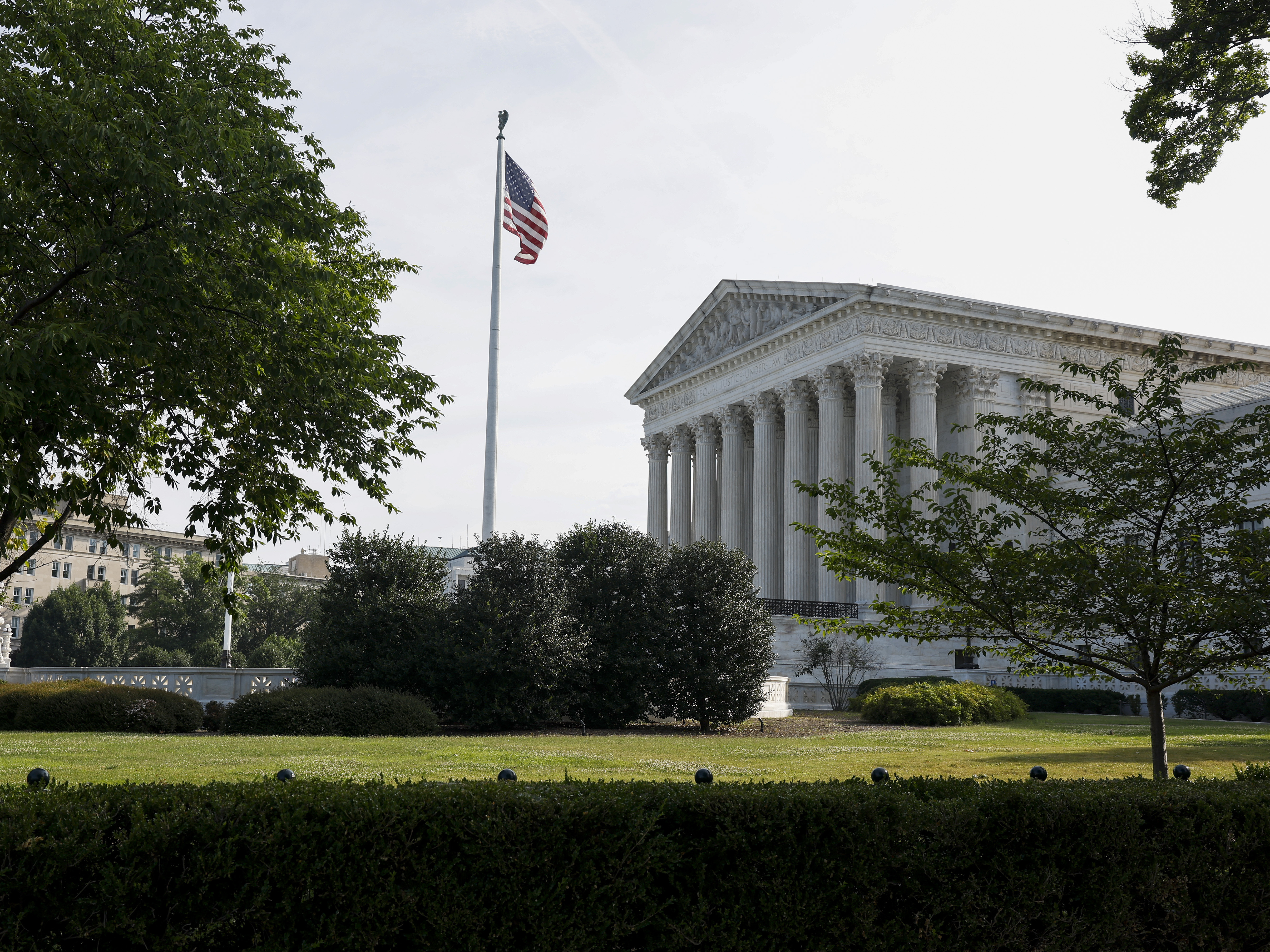
The U.S. Supreme Court building, pictured in June. Legal experts and election officials say the 14th Amendment question is likely to end up in the courts. (Anna Moneymaker/Getty Images)
What might happen next?
Secretaries of state are starting to get questions — and pressure — from voters, leading some to affirm publicly that they plan to keep Trump’s name on the ballot unless a court says otherwise.
In New Hampshire, for example, a group of GOP lawmakers wrote to Secretary of State David Scanlan, also a Republican, countering the 14th Amendment argument and asking him to ensure Trump will be on the ballot.
“Now it is time for the great leaders of the Granite State to ensure that their constituents have access to a free and fair primary election by standing against the misinterpretation and politicization of our Constitution,” they wrote in the Sept. 12 letter.
The following day, Scanlan — whose state is just months away from its traditional early presidential primary — held a press conference to dismiss claims that he has the power to take Trump’s name off the ballot. Doing so on a state-by-state basis would bring “chaos, confusion, anger and frustration,” he said, adding that the proper venue to decide that question is the U.S. Supreme Court.
Gardner, like many, expects the issue to be resolved in court.
He says the “procedurally more solid way” to get it there would be for an election administrator to say Trump is disqualified, which would likely spark an immediate lawsuit — either from Trump, his campaign or his supporters in that particular state.
And he says it’s hard to predict how the Supreme Court might rule, even with its conservative supermajority.
There is precedent for it acting quickly in an election dispute, as it did during Bush v. Gore in 2000 — but its reputation took a hit after it was perceived as meddling in the outcome. And, he adds, it could decline to intervene at all, as it did in several cases related to election procedures ahead of 2020.
Copyright 2023 NPR. To see more, visit https://www.npr.org.
President Biden promised to create the Climate Corps during his first week in office. It’s a program meant to appeal to young climate activists. (Jim Watson/AFP via Getty Images)
The White House on Wednesday unveiled a new climate jobs training program that it says could put 20,000 people to work in its first year on projects like restoring land, improving communities’ resilience to natural disasters and deploying clean energy.
The American Climate Corps is modeled after a program that put millions to work during the Great Depression. President Biden’s climate policy adviser Ali Zaidi told reporters that the program has broader goals beyond addressing the climate crisis.
“We’re opening up pathways to good-paying careers, lifetimes of being involved in the work of making our communities more fair, more sustainable, more resilient,” Zaidi said.
The program will pay participants, and most positions will not require previous experience. The administration is also proposing new regulations aimed at making it easier for participants to enter the federal public service after the program.
The announcement has been in the works for some time
Biden first called for the government to find a way to establish a “civilian climate corps” in an executive order during his first week in office. The president said that he hoped the corps would “mobilize the next generation of conservation and resilience workers and maximize the creation of accessible training opportunities and good jobs.”
The idea of a climate corps began with progressive environmental activist groups, including the youth-led Sunrise Movement.
“We need millions of people, especially young people, employed to do the essential work of averting climate catastrophe and building a fair and equitable new economy,” said Varshini Prakash, the group’s executive director, who has advised the White House on climate issues.
“I am thrilled to say that the White House has been responsive to our generation’s demand for a Climate Corps and that President Biden acknowledges that this is just the beginning of building the climate workforce of the future,” Prakash told reporters.
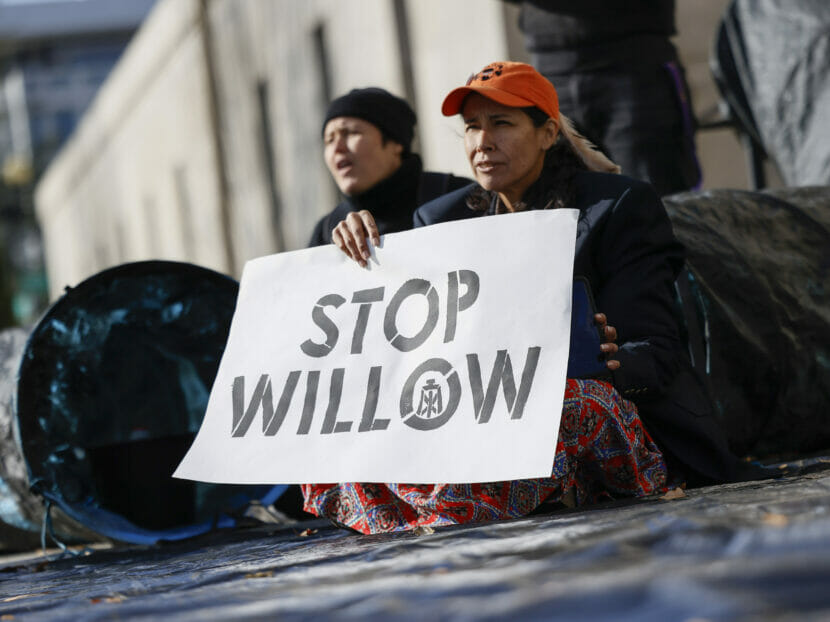
Climate activists hold a demonstration to urge President Biden to reject the Willow project on Nov. 17, 2022. (Jemal Countess/Getty Images for Sunrise AU)
Biden has been criticized by young climate activists
When he took office, Biden named tackling climate change as one of his top four priorities, and announced a goal of slashing U.S. greenhouse gas emissions to half of 2005 levels by the end of the decade.
His 2022 Inflation Reduction Act — some $369 billion in climate incentives and spending — is expected to get the country close to that goal.
But Biden has faced intense criticism from some factions of the environmental movement, particularly after he approved a large-scale drilling project known as Willow in northern Alaska. That decision directly contradicted a campaign pledge to bar all new drilling on federal lands, and polling showed a decline in his approval ratings on climate.
Since then, Biden been barred federal drilling on millions of acres of federal property, a measure aimed at wooing back the young, climate-conscious voters who played an important role in his electoral coalition.
The Climate Corps is more modest than some had hoped
Democratic lawmakers including Rep. Alexandria Ocasio-Cortez, D-N.Y., and Sen. Ed Markey, D-M.A., had pushed for more funding for the climate corps program, but that did not transpire, meaning the program is likely to be smaller in scope than early proposals.
It’s also much smaller than its predecessor: the Civilian Conservation Corps, a New Deal-era program that ran for ten years and employed millions restoring public lands and building infrastructure for the country’s national parks.
There is another key difference, too. While the Conservation Corps primarily employed young, white men, the White House says that the American Climate Corps is designed to attract participants from disadvantaged communities disproportionately impacted by the changing climate.
Copyright 2023 NPR. To see more, visit https://www.npr.org.
The city of Derna, Libya on Wednesday, Sept. 13, 2023. Floods from extreme rain killed thousands of people and washed entire neighborhoods into the sea. (Muhammad J. Elalwany/AP)
Catastrophic floods in eastern Libya killed at least 5,100 people, according to local authorities. The disaster comes after a string of deadly floods around the world this month, from China to Brazil to Greece. In every case, extremely heavy rain was to blame.
The enormous loss of life on multiple continents reinforces the profound danger posed by climate-driven rain storms, and the need for better warning systems and infrastructure to protect the most vulnerable populations.
Climate change makes heavy rain more common, even in arid places where the total amount of precipitation is small. That’s because a hotter atmosphere can hold more moisture. Everyday rainstorms, as well as bigger storms such as hurricanes, are increasingly dangerous as a result.
In Libya, a storm called Daniel swept in from the Mediterranean over the weekend and resulted in a jaw-dropping 16 inches of rain in just 24 hours, according to the World Meteorological Organization. That is far too much water for the ground to absorb, especially in an arid climate where the soil is dry and is less able to suck up water quickly.
The massive amount of rain caused widespread flash flooding, and overwhelmed at least one dam near the coastal city of Derna. That unleashed torrents of water powerful enough to sweep away entire neighborhoods.
While it was clear to global meteorologists that the storm was powerful and was headed for the Libyan coast, it’s not clear that residents of Derna were warned about the severity of the potential flooding. Libya is governed by two rival governments, and years of war means dams and other infrastructure haven’t been well-maintained.
Before it got to Libya, the storm called Daniel also devastated Greece and Turkey with enormous amounts of rain. Some parts of Greece received more than two feet of rain in a three hour period last week, according to local authorities. And in Hong Kong last week, a record-breaking 6 inches of rain fell in one day. That caused flash flooding in the dense, hilly city, carrying away cars and flooding underground rail stations.
In Brazil, flooding from a cyclone last week killed more than 20 people and left a swath of southern Brazil underwater.
The disasters in the last two weeks also underscore the vulnerability to climate change of people who are not wealthy or who live in places that are at war. While extreme rain has caused floods around the world recently, the death toll is significantly higher in places where there isn’t money or political will to maintain infrastructure and adequate weather warning systems.
Copyright 2023 NPR. To see more, visit https://www.npr.org.
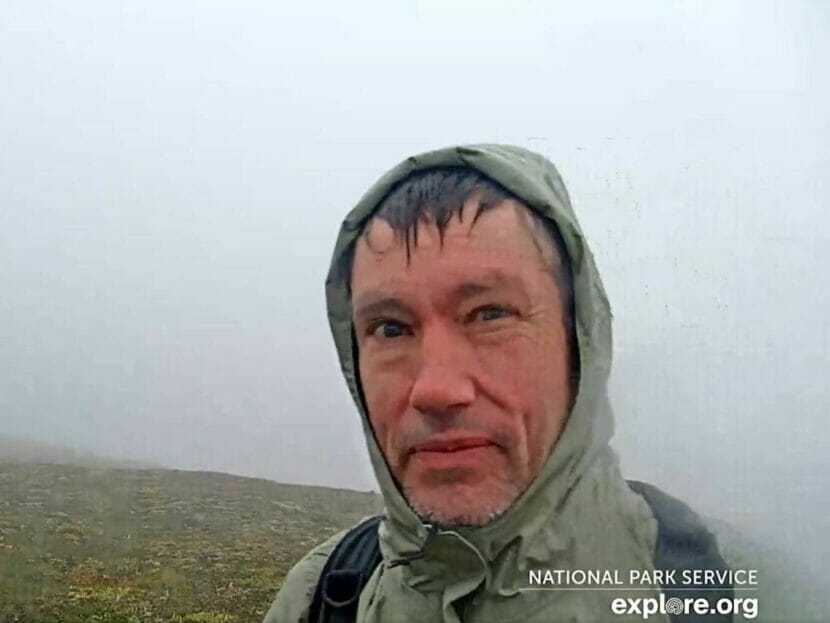
A livestream set up by Explore.org in the Katmai National Park for bear enthusiasts captured a missing hiker pleading for help on Sept. 5. (Screenshot by NPR/Explore.org)
A handful of wildlife enthusiasts were probably hoping to catch a glimpse of Katmai National Park’s famous brown bears when they logged on to a livestream of a remote Alaska mountaintop last Tuesday. But the resident celebrities were nowhere to be seen when a distressed hiker walked into view instead and pleaded for help.
The scene unfolded on the Dumpling Mountain livestream, one of 12 camera views operated by Explore.org inside the Katmai National Park.
Around 3:30 p.m. local time on Sept. 5, a man in a green rain jacket, wet and disheveled, appeared on screen and looked straight into the lens, clearly mouthing the words “help me.” He returned a few minutes later, giving a thumbs-down signal.
“There is someone distressed on the camera,” one viewer posted in the rolling comments beneath the stream. That message was seen by a volunteer chat moderator, who in turn messaged a Katmai park ranger.
After reviewing the footage, the ranger mobilized a search and rescue team, which found the man just about three hours later, not far from the site of the web camera.
Bear Cam saves a hikers life! Today dedicated bear cam fans alerted us to a man in distress on Dumpling Mountain. The heroic rangers @KatmaiNPS sprung into action and mounted a search saving the man. – more details to come. pic.twitter.com/JzgfApK371
The man was ultimately unharmed, Cynthia Hernandez, a spokesperson for the National Park Service, told NPR in an email. She added that the rangers were notified of the distressed hiker directly thanks to the concerned viewers.
When the chat moderator shared this news with the viewers, there was a flood of kind words and a sweet celebration.
“Aaaand I’m crying because I’m so relieved,” posted the user who originally flagged the man’s appearance. “Those rangers made it up there fast!”
Dumpling Mountain isn’t typically a popular livestream
The cameras have been around since 2012, but really started to take off in 2014, with the advent of Fat Bear Week — a delightful man-made tournament in which the public votes on which of the park’s bears has grown the most rotund as preparation for their winter hibernation. (This year’s Fat Bear Week has yet to be announced, but the competition usually lands in early October).
Roughly 10 million people tuned in to the Katmai live streams last year, according to Mike Fitz, a naturalist with Explore.org who previously worked as a ranger at the park.
But most of those views went to the cameras trained on Brooks Falls, where the bears make daily stops during salmon spawning season.
Sitting about 2,200 feet above sea level, the Dumpling Mountain camera is more of a “scenery cam than a wildlife cam,” Fitz said.
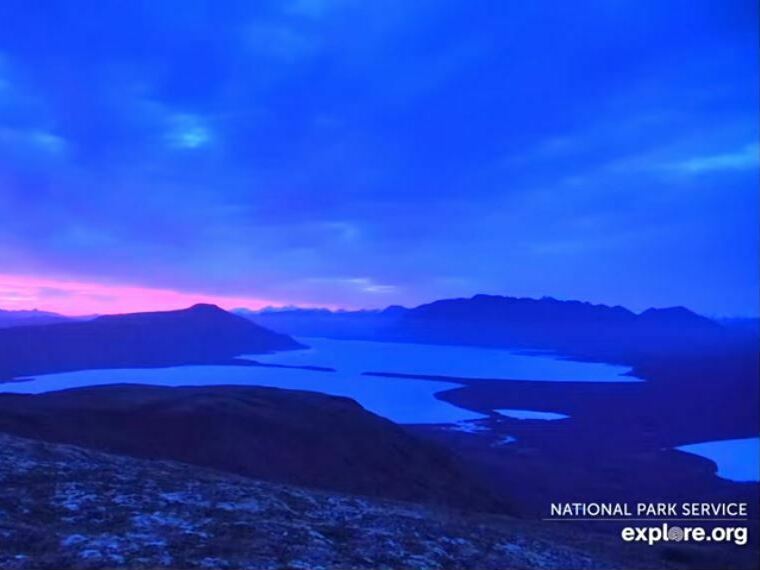
Stunning sunsets, like this one highlighted by Explore.org, are a main reason to tune in to the Dumpling Mountain live camera. (Screenshot by NPR/Explore.org)
The camera auto-pans across a sweeping vista: Colorful alpine tundra shrubs dot the landscape while the largest lake in a U.S. national park (Naknek) stretches out in the foreground. Some of Katmai’s 14 active volcanoes are visible in the distance.
But that height comes with tempestuous weather, which can often obscure the view and offers little in the way of shelter and food for the kind of big-ticket animals viewers crave. When NPR checked the stream on Friday morning, only 12 people were watching.
The camera itself is about 2 miles away from the nearest trail, which is described by the National Park Service as a “strenuous hike” featuring “steep portions” and some overgrown areas.
The climb rises 800 feet over 1.5 miles and ends about 2.5 miles from the actual summit of the mountain, but an unmaintained footpath continues on for a while before petering out.
Fitz says that makes it “a great place to find some quick solitude away from the river, away from the bears,” but also shrouds the path in danger.
It’s still unclear how the hiker found the remote camera
Cell service and shelter can be hard to come by on the rounded and short-shrubbed mountain peak.
And, during poor conditions, like the kind that set in on Sept. 5, “You really have no sense of direction,” Fitz said. “The landmarks you saw on the way up disappear when the clouds come down.”
The 4.1-million-acre Katmai National Park is tucked between the Pacific Ocean and the Bering Sea, making it a prime spot for storms in any season.
Rain and wind were detectable on the camera Tuesday. Due to fog, the visibility appeared to be about 50 feet or less.
It’s still unclear how the hiker found the camera installation. Fitz says the collection of solar panels and wind turbines sticks out amid the short vegetation, but it still isn’t huge — maybe about 20 to 30 square feet total.
“This was certainly a first for us,” Fitz said of the hiker asking for help, though wildlife viewers around the world have flagged pressing emergencies before, like an injured elephant at a Kenyan wildlife sanctuary.
“Our webcam viewers, collectively, are very sharp-eyed and they don’t miss much,” he added.
That was evidenced again on Sunday, when Dumpling Mountain’s viewers, still recovering from the stress of seeing the hiker, caught sight of a big thing in a slim six seconds of the stream: A brown bear, rambling across the camera’s view, miles away from his typical hangouts.
Copyright 2023 NPR. To see more, visit https://www.npr.org.
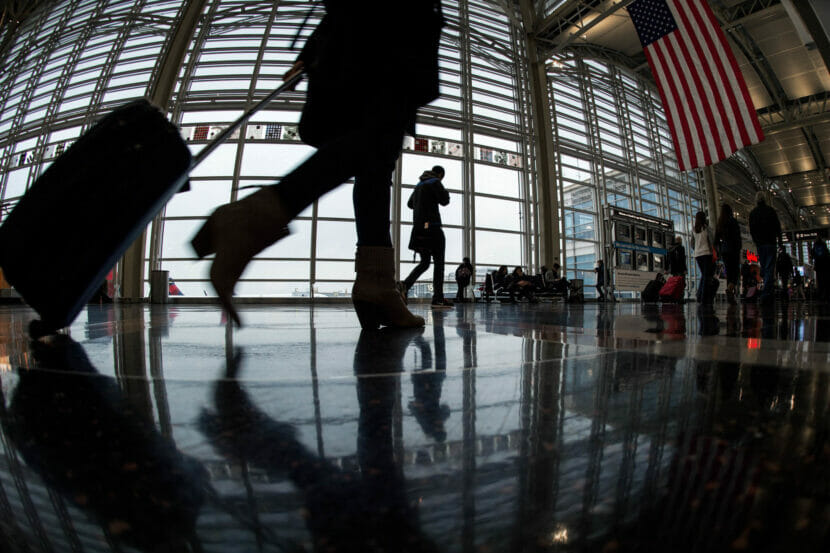
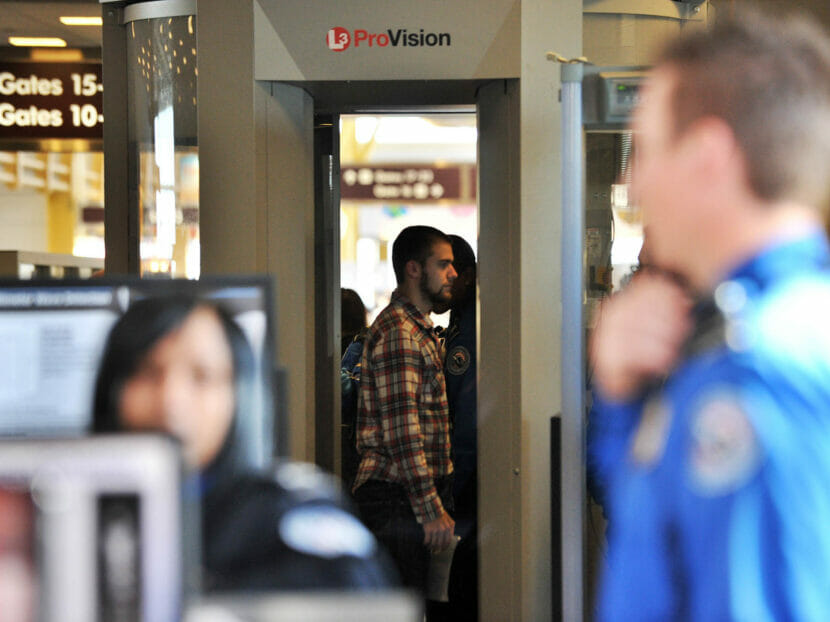
A traveler at Ronald Reagan Washington National Airport walks to a Transportation Security Administration checkpoint on Nov. 26, 2014. (Paul J. Richards/AFP via Getty Images)
It’s hard to fathom now, but we used to be able to arrive at the airport just minutes before a flight. We’d keep our shoes and coats on as we went through a simple metal detector, and virtually anyone could go right to the gate without a boarding pass or even showing an ID.
The 19 al-Qaida-affiliated terrorists who hijacked four commercial jetliners on Sept. 11, 2001, knew that and exploited lax airport security measures, strolling through metal detectors at four airport security checkpoints with ease, with deadly weapons in hand. This allowed the hijackers to commandeer those airplanes and use them as jet fuel-filled missiles as they flew them into the twin towers of the World Trade Center, the Pentagon and a field in Shanksville, Pa., killing nearly 3,000 people.
“It was so easy — a lot of us were surprised it hadn’t happened sooner,” says Jeff Price, who was assistant security director at Denver International Airport on Sept. 11, 2001, and is now an aviation security expert at Metropolitan State University of Denver.
Airport security at that time was carried out by private contractors, usually hired by the airlines, with few federal standards. Those security contracts usually went to the lowest bidder.
“Before 9/11, security was almost invisible, and it was really designed to be that way,” Price says. “It was designed to be something in the background that really wasn’t that noticeable and definitely did not interfere with aircraft or airport operations.”
“You could walk up to the gate at the very last minute. You did not have to have a boarding pass,” Price says. “All you had to do was go through the security checkpoint — no questions asked, no ID needed.”
That forever changed on Tuesday, Sept. 11, 2001.
Now, travelers often stand in long lines at security checkpoints with wait times that can exceed an hour. We take off our shoes, empty our pockets and take laptops and other devices out of carry-on bags before stepping into high-resolution, full-body scanners, while our bags go through 3D-imaging X-ray machines. And don’t forget to take your liquids of 3.4 ounces or less out of your carry-on.
Some of us enroll in known- or trusted-traveler programs such as PreCheck, surrendering some of our privacy in an effort to have a smoother expedited screening process.
Aviation security experts acknowledge that prior to 9/11, no one envisioned suicide terrorists wanting to use commercial airplanes as weapons and being willing to kill themselves in order to kill hundreds of innocent people.
Now, counterterrorism and homeland security officials in the federal government work to imagine the unimaginable and enhance defenses to prevent the ever-changing and growing threats to aviation security.
Here’s a look at how airport security has evolved over the past 20 years.
Sept. 11, 2001: Terrorists hijack and crash four passenger jets
The 19 hijackers checked in for their flights at the airport in Portland, Maine, at Boston’s Logan International Airport, at Liberty International Airport in Newark, N.J., and at Dulles International Airport in the Washington, D.C., area.
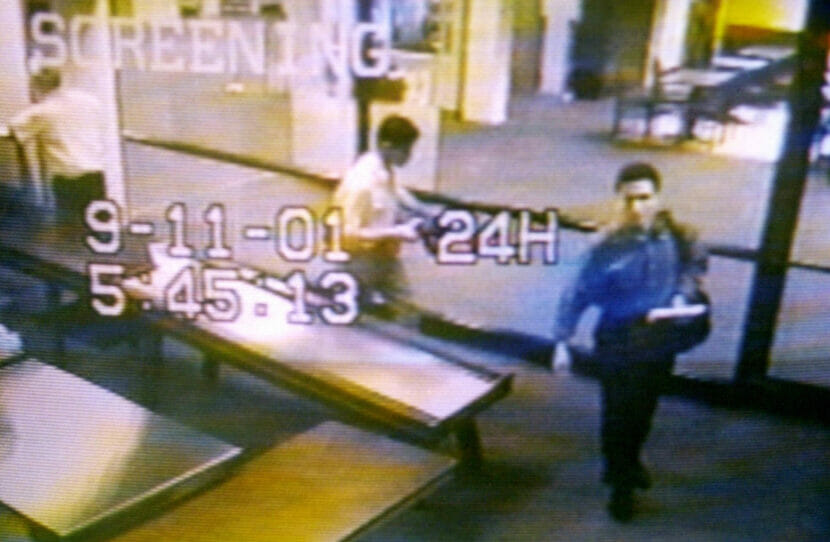
Two men identified by authorities as hijackers Mohamed Atta (right) and Abdulaziz Alomari (center) pass through airport security on Sept. 11, 2001, at Portland International Jetport in Maine in an image from airport surveillance tape released on Sept. 19, 2001. (Reuters/Portland Police Department)
When Mohamed Atta checked in at the Portland airport with a fellow hijacker for their short flight to Boston, he was selected for additional scrutiny under what was then known as CAPPS (Computer Assisted Passenger Prescreening System). But according to The 9/11 Commission Report, “Under security rules in place at the time, the only consequence of Atta’s selection by CAPPS was that his checked bags were held off the plane until it was confirmed that he had boarded the aircraft. This did not hinder Atta’s plans.”
Several of the other hijackers were flagged by CAPPS at the other airports, but none was questioned and they were allowed to board in the same way Atta was — without much additional scrutiny. As they strolled through metal detectors at the airports, a couple of the hijackers set off alarms, but they were quickly cleared and sent on their way after going through a second metal detector or being scanned by a hand-held wand. It’s not clear what exactly set off the alarms, but according to The 9/11 Commission Report, the hijackers used knives and/or razor blades in their attacks, which they likely had on them or in their carry-on bags. Even if those weapons were detected, it wouldn’t have mattered.
“The FAA allowed knives of up to 4 inches in length on board an aircraft,” says Price, the aviation security expert. “So even if the hijackers would have been caught with their knives prior to boarding the plane, the screeners would have handed it right back to them. “By 8:00 A.M. on the morning of Tuesday, September 11, 2001, they had defeated all the security layers that America’s civil aviation security system then had in place to prevent a hijacking,” The 9/11 Commission Report states.
September and October 2001: enhanced airport security, fewer Americans flying, longer wait times in airport security lines
After the planes hit the twin towers and the Pentagon, the Federal Aviation Administration immediately ordered all remaining commercial aircraft still in the air to land at the nearest available airport. All flights remained grounded until Sept. 14. But when air travel did resume, very few Americans were willing to fly. Nonetheless, in the days and weeks after the stunning terrorist attacks, airport security immediately intensified.
Armed National Guard soldiers joined local and state police in some cities to help patrol airports and screen travelers. Knives, box cutters, razors and other types of blades were banned, and the list of other items prohibited on aircraft grew significantly.
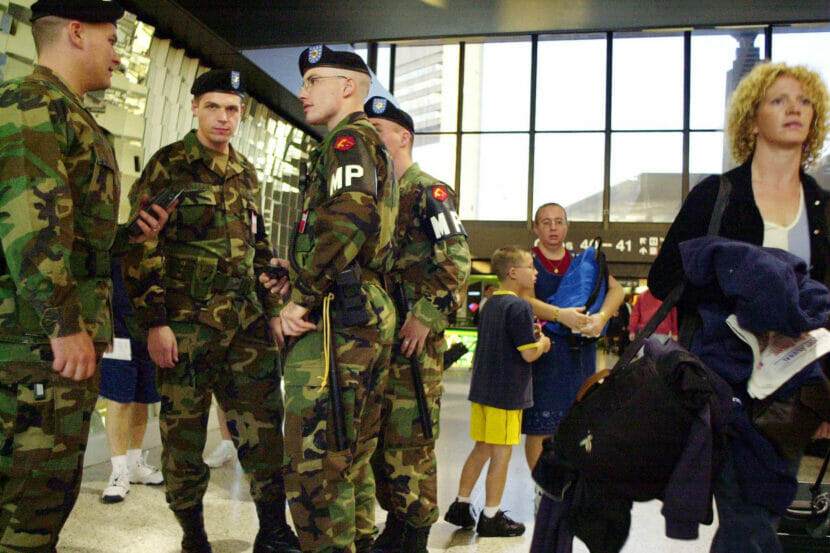
Military police from the Massachusetts National Guard on their first day of duty at Boston’s Logan International Airport on Oct. 5, 2001. Several thousand National Guard troops were called up around the U.S. to ensure airport security in the wake of the 9/11 attacks. (John Mottern/AFP via Getty Images)
Airport security officers began searching through carry-on bags and patting down passengers, and that, according to Price, is when wait times in airport security lines started to grow longer, even though few Americans were flying. He says authorities were “slowing down the lines at the checkpoint to do a more thorough search of passengers and baggage.”
November 2001: The Aviation and Transportation Security Act creates the TSA; checked baggage screened by X-rays
Congress passed and President George W. Bush signed the law that would create the Transportation Security Administration, which would become part of the newly created Cabinet-level Department of Homeland Security.
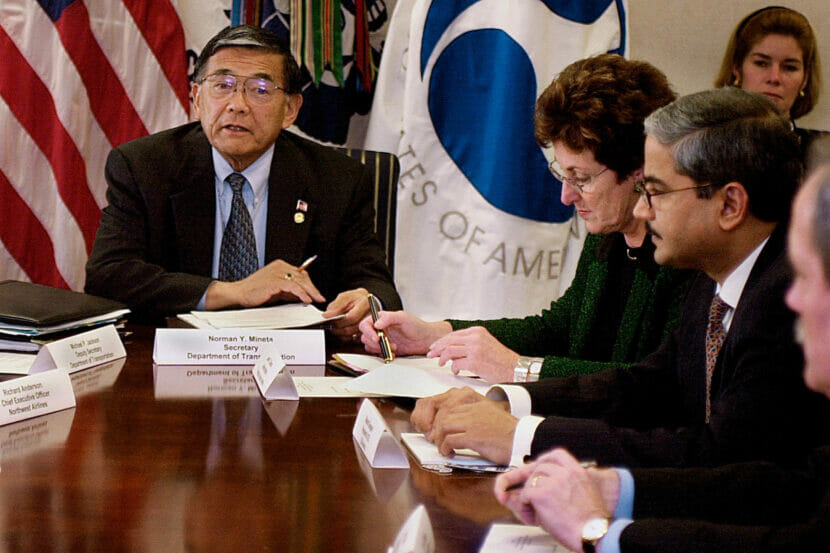
Transportation Secretary Norman Mineta (left) meets with the CEOs of major U.S. airlines, including U.S. Airways CEO Rakesh Gangwal (right), and Federal Aviation Administration Director Jane Garvey on Nov. 15, 2001, at the Department of Transportation in Washington, D.C. Mineta called the meeting to discuss improvements in airport security. (Shawn Thew/AFP via Getty Images)
In addition to creating the TSA, the Aviation and Transportation Security Act required 100% of all checked baggage to be screened by X-rays, the Federal Air Marshal Service was expanded to put more armed air marshals on many more flights, and the law required airlines to reinforce cockpit doors on their aircraft to prevent attackers from entering.
The law also mandated that the TSA oversee security for all modes of transportation, such as passenger rail (including Amtrak) and intercity bus travel. Experts say the TSA was a major step forward in improving security.
December 2001: the shoe bomber and how shoe removal at airport security checkpoints started
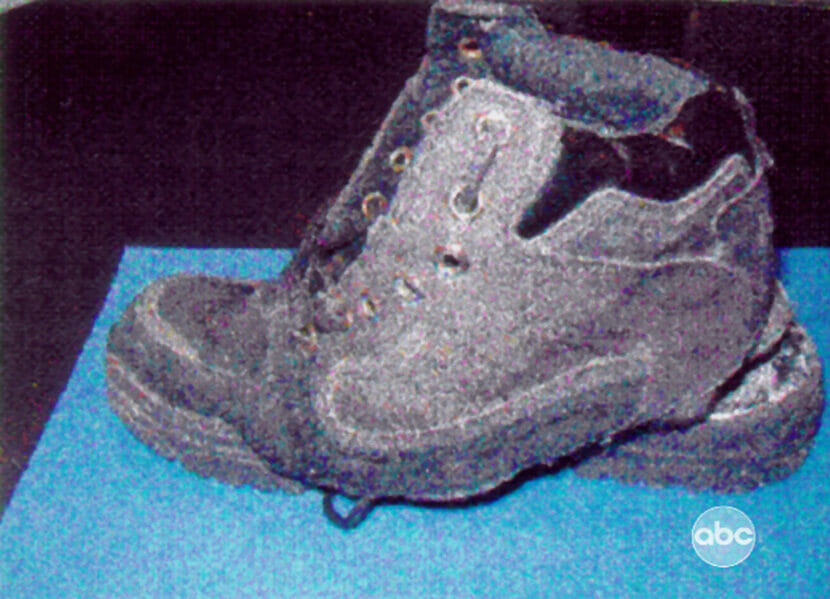
On Dec. 22, 2001, on an American Airlines flight from Paris to Miami, British-born terrorist Richard Reid tried to detonate explosives that he had packed in his shoes. Passengers subdued and restrained Reid as the flight was diverted to Boston, the closest airport.
This still frame from television footage obtained by ABC News and released Feb. 7, 2002, shows a shoe worn by shoe bomber Richard Reid. (ABC News/Getty Images)
Investigators later said that Reid had enough explosive material to blow a hole in the fuselage of the plane, but that rainy weather and Reid’s foot perspiration made the fuse too damp to ignite. Reid pleaded guilty to eight terrorism-related charges in October 2002 and was sentenced to three consecutive life sentences and 110 years, with no possibility of parole. The incident led to the TSA and airlines asking passengers to voluntarily remove their shoes when going through screening at airport security checkpoints.
December 2002: deploying explosives detection systems, very detailed 3D images
The TSA meets the mandate to screen 100% of all checked luggage by deploying machines that can scan bags for explosives and other dangerous weapons in every airport in the country.
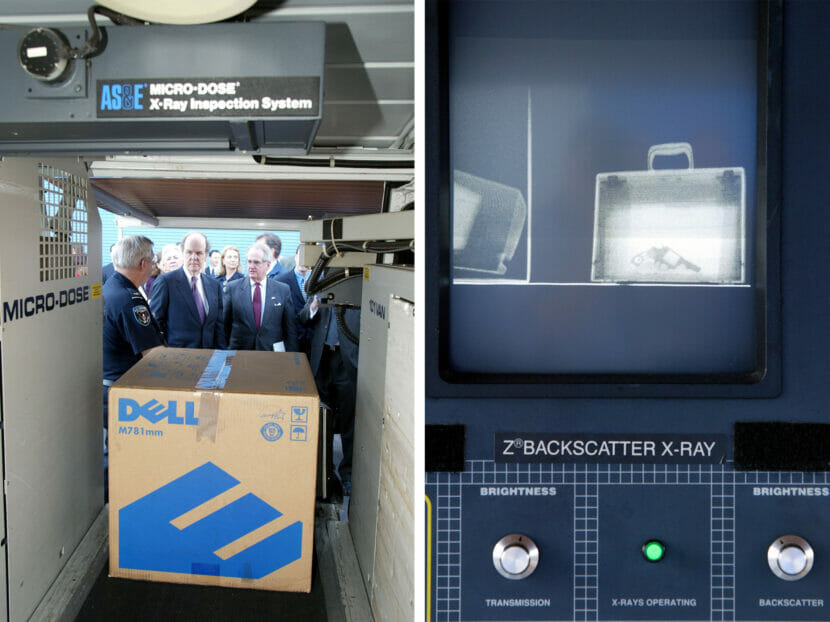
The technology used in these screening systems has improved greatly over the intervening years, according to Deb Scovel, a TSA baggage and checkpoint supervisor at Chicago O’Hare International Airport, who says today’s X-ray scanners are similar to CT scanners used in hospitals.
Left: On Jan. 24, 2002, at Port Everglades in Florida, customs inspector Lance Howard (left) demonstrates the operation of the American Science and Engineering Micro-Dose 101 X-ray machine to Customs and Border Protection Commissioner Rob Bonner (center) and Immigration and Naturalization Service Commissioner Jim Ziglar. Right: A handgun inside a briefcase is displayed on the machine’s screen. (Joe Raedle/Getty Images)
“The X-rays take images of it from all sides,” says Scovel, “so it does an all-around picture of whatever goes inside so you see it from every point of view.” She says the 3D images are so detailed that “I can tell you the difference between Irish Spring and Dove soap — yes, I can. And officers that have been here a while can do the same thing. You can tell the difference between an Apple and a Dell laptop; they’re very detailed.”
April 2003: Pilots start to carry firearms on board flights, and other cockpit protections
The first pilots certified under a voluntary program allowing them to carry handguns were on board flights. Bush signed the Arming Pilots Against Terrorism Act into law in November 2002, and the TSA began training flight deck personnel on how to use firearms on board, if needed, soon after.
Participants in the first class of commercial airline pilots who volunteered to carry handguns learn defense tactics on April 17, 2003, in Glynco, Ga., as part of the TSA’s federal flight deck officer training program. The inaugural group of federal flight deck officer candidates spent the week learning how to use a handgun and defensive tactics. (Gary Wilcox/Getty Images)
Also in April 2003, the TSA announced that all airlines had met the requirement to reinforce cockpit doors on their entire fleets of planes.
Pilots and their unions continue to push for additional cockpit barriers and fortifications to protect them from possible attacks from outside the cockpit.
August 2006: liquids banned, shoe removal mandated and more air marshals added
British authorities disrupted a terrorist plot to detonate liquid explosives on board 10 commercial aircrafts bound from London to various cities in the U.S. and Canada. U.K. prosecutors alleged the would-be bombers prepared to disguise the explosives as soft drinks in 500-milliliter branded plastic bottles.
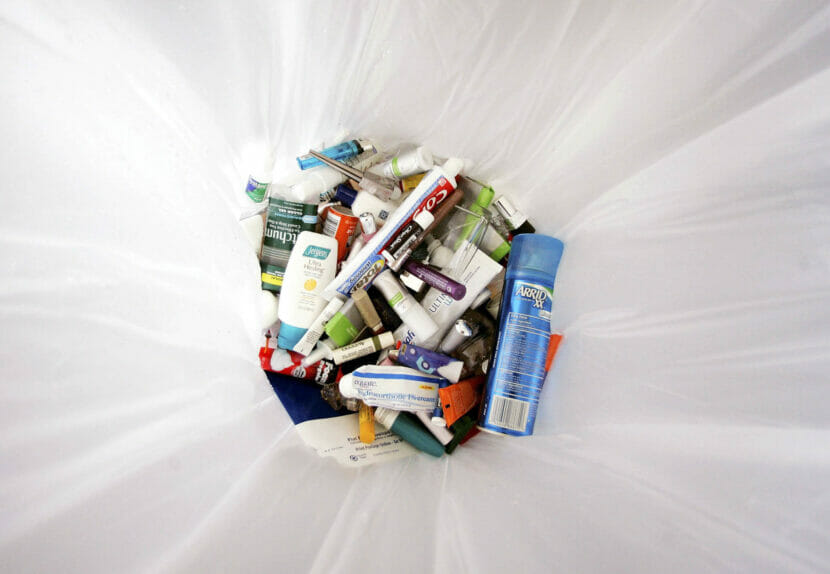
As a result, the TSA banned all liquids, gels and aerosols from passenger carry-on luggage.
Containers holding liquids and gels that were taken from passengers lie in a trash can at Dulles International Airport near Washington, D.C., on Aug. 10, 2006. (Mark Wilson/Getty Images)
A month later, in September 2006, the TSA lifted the ban on liquids and amended its rule to allow airline passengers to carry liquids, gels and aerosols in containers of only 3.4 ounces or less in a single, clear, resealable 1-quart plastic bag that had to be removed from carry-on baggage when going through security screening.
August 2006 is also when the TSA began to require that all travelers remove their shoes so footwear could be screened for explosives at airport security checkpoints.
The TSA also began deploying more federal air marshals, including on international flights.
March 2008: Canine units join airport security forces
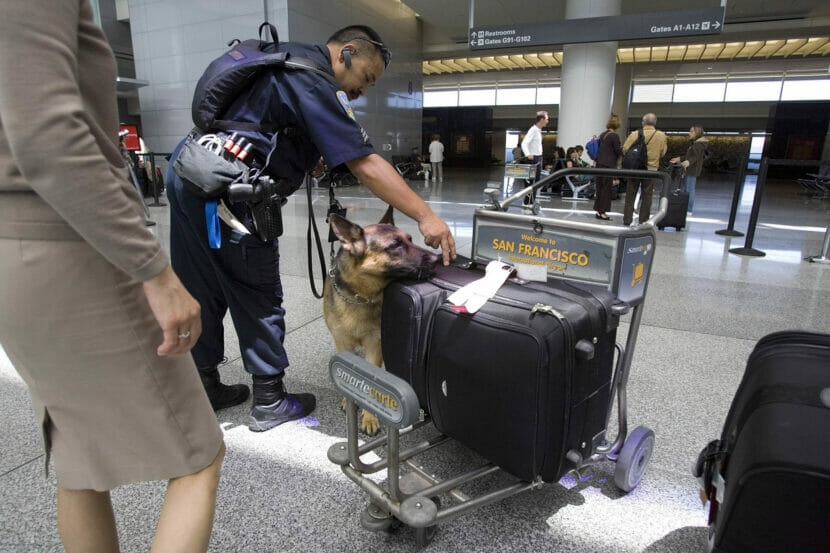
Although bomb-sniffing dogs were already being used in a limited capacity as part of transportation security, the TSA began deploying canine teams to specifically aid in the screening of cargo loaded onto passenger aircraft at U.S. airports.
The program later expanded to use dogs to detect possible explosive materials on passengers and in checked and carry-on baggage.
Sgt. Cliff Java of the San Francisco Police Department and his dog, Jacky, check luggage at San Francisco International Airport on July 3, 2007. (David Paul Morris/Getty Images)
December 2009: the “underwear bomber” and the installation of full-body scanners
On Christmas Day 2009 on board a Northwest Airlines flight from Amsterdam to Detroit, al-Qaida extremist Umar Farouk Abdulmutallab tried to detonate an improvised explosive device that he had hidden in his underwear.
Abdulmutallab later told FBI agents that he had been following the jetliner’s flight path on his seat back’s screen, as he wanted to blow up the plane over U.S. soil. Inside his briefs, he had explosive chemicals that would ignite when mixed. After going into the plane’s lavatory to make final preparations, he returned to his seat and pushed a plunger to mix the chemicals.
But the volatile mix didn’t explode as he intended, possibly because of excess moisture after the chemicals were inside his pants for so long. The mixture only caught fire, seriously burning Abdulmutallab, who tried to get his burning pants off before fellow passengers and crew members subdued him.
Abdulmutallab later pleaded guilty and was sentenced to life in prison.
A passenger goes through a full-body scanner at Reagan National Airport in Washington, D.C., on Nov. 24, 2010. (Jewel Samad/AFP via Getty Images)
In response to the failed attack in which a terrorist was able to sneak dangerous explosives through security, in March 2010 the TSA began installing hundreds of full-body scanners that used advanced imaging technology.
December 2011: TSA PreCheck begins, vetted travelers pay to go through shorter security lines
With hundreds of millions of travelers passing through the TSA’s airport security checkpoints each year, the agency wanted a better way to discern who was and who wasn’t a serious threat. So it started its known- and trusted-traveler PreCheck program to provide expedited screening for those willing to pay for it and undergo a more detailed background check.
The TSA says it makes risk assessments about passengers prior to their arrival at airport checkpoints via these thorough background checks. Vetted travelers pay $85 for a five-year membership and get to go through a shorter security line where they no longer have to remove shoes and belts.
The TSA, meanwhile, says it is able to focus resources on more high-risk and unknown passengers.
June 2015: TSA flunks undercover tests
The TSA’s inspector general reported that 95% of the time, TSA officers failed to detect weapons, explosives and other prohibited items that undercover agents smuggled through various airport security checkpoints.
The astronomically high failure rate led to the reassignment of Melvin Carraway, who was then the TSA’s acting director. It also prompted significant changes in TSA training and procedures, including enhanced screening and increased random searches.
March and June 2016: attack outside Turkish airport security perimeter, concerns about soft targets
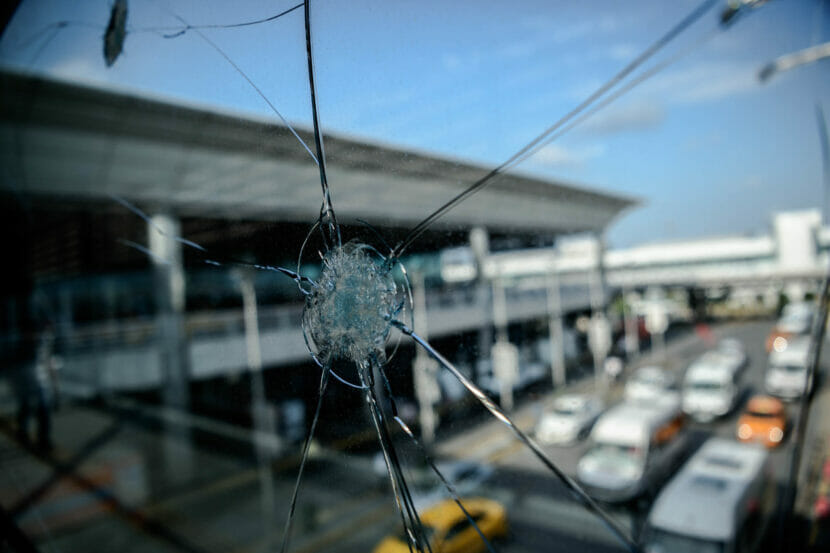
In June 2016, three suicide bombers who had been turned away at an airport security checkpoint opened fire with semiautomatic weapons before detonating explosive belts at Ataturk Airport’s international terminal in Istanbul, killing themselves and 45 other people, while injuring more than 200.
Bullet impacts mar a window at Ataturk Airport in Istanbul on June 29, 2016, the day after a suicide bombing and gun attack targeted the airport, killing 45 people. (Ozan Kose/AFP via Getty Images)
That deadly assault followed a similar coordinated terrorist attack just three months earlier that killed 32 people and injured more than 300 at an airport terminal and subway station in Brussels. The incidents raised concerns about what security experts call soft targets — the areas outside the hard security perimeter where large groups of people wait at baggage claim, line up at check-in counters and kiosks or queue up to go through security checkpoints.
Some critics, including counterterrorism expert Tom Mockaitis at Chicago’s DePaul University, say it exposes a flawed approach to security.
“I’ve seen, in this country, us waste literally millions of dollars on what I call placebo security — highly visual measures like armed guards strutting up and down in our airports, you know, creating a feeling of well-being and a feeling of security without providing any real added benefit,” Mockaitis told NPR in July 2016.
March 2017: the laptop ban
The Trump administration, citing threats gathered from credible intelligence sources, prohibited travelers from certain countries from bringing laptops, tablets and other large electronic devices into the cabin on commercial flights to the United States.
John Kelly, secretary of homeland security at the time, said the intelligence indicated that terrorists were developing bombs powerful enough to bring down an airplane but small enough to be hidden inside those devices. The laptop ban affected travelers from 10 airports in eight countries with majority-Muslim populations.
“We didn’t feel at the time that overseas airports had the kind of security initially that could give me a comfort that they could detect this device, the airports in those countries,” Kelly said a couple of months after the ban was imposed.
The laptop ban was lifted in July 2017.
June 2017: facial recognition, biometric screening and privacy concerns
In 2017, some airlines, in collaboration with the TSA, began trials of facial recognition software that allows passengers’ faces to be their boarding passes.
The system takes a photo and matches it with one on file with the airlines, speeding up the passenger-screening process and providing greater customer convenience. And because users of the system must be enrolled in the federal government’s known-traveler program, it provides an extra layer of security.
But this and other biometric-screening methods, which could allow the government to track your whereabouts at home and abroad, raise significant privacy concerns, as NPR’s Asma Khalid reported.
Aviation security experts say the TSA’s efforts to expand the use of facial recognition and biometric screening was significantly delayed by the COVID-19 pandemic but could begin to ramp up again in the next couple of years.
September 2021: still room for improvement but layers of hard and soft security
TSA officials say aviation security continues to evolve to address ever-changing threats, with a layered approach that involves surveillance, intelligence and technology. The agency has 65,000 employees and spends billions of dollars each year in an effort to stay one step ahead of potential foreign and domestic terrorists.
“People are very creative. The threats are very creative,” says Louis Traverzo, the TSA’s deputy federal security director. He adds: “It’s up to us to anticipate that, and it’s up to us to look at those things and try to come up with ideas to counter methods” that terrorists may come up with.
There hasn’t been a successful attack against commercial aviation in the U.S. in the 20 years since 9/11, and outside experts agree that while there is still room for improvement, the TSA has been effective in preventing another terrorist attack.
Copyright 2023 NPR. To see more, visit https://www.npr.org.
Close
Update notification options
Subscribe to notifications
Subscribe
Get notifications about news related to the topics you care about. You can unsubscribe anytime.

9(MDEwMjQ0ODM1MDEzNDk4MTEzNjU3NTRhYg004))
9(MDEwMjQ0ODM1MDEzNDk4MTEzNjU3NTRhYg004))
9(MDEwMjQ0ODM1MDEzNDk4MTEzNjU3NTRhYg004))

9(MDEwMjQ0ODM1MDEzNDk4MTEzNjU3NTRhYg004))
9(MDEwMjQ0ODM1MDEzNDk4MTEzNjU3NTRhYg004))