NPR News

KTOO is the NPR member station in Juneau. NPR offers its members radio and digital stories.

Hotter climate means a never-ending fire season for the National Guard

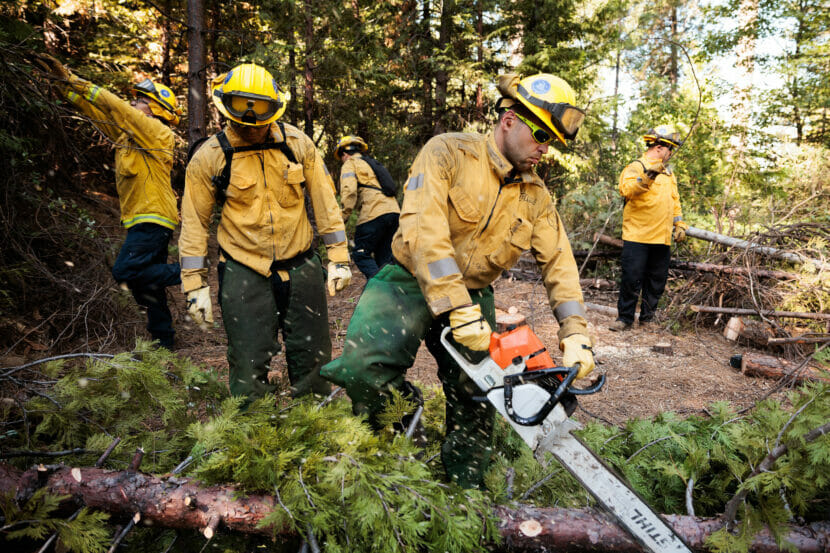
Members of the California National Guard’s Task Force Rattlesnake clear brush and small trees to reduce the likelihood of a high-intensity wildfire. (Max Whittaker for NPR)

NEVADA CITY, Calif. — Jaleel Brown had only been on the job a few weeks, chainsawing for California’s Task Force Rattlesnake, when he raised his hand to fight the Jones Bar Road fire.

“I didn’t know I was getting myself into. And that’s probably the craziest fire we’ve ever had here. And I had to ask the captain like, ‘Hey, this is how every fire is?’ ” he says.

A Guardsman for almost a decade, Brown had been considering leaving the military when he learned of the Task Force — and a different kind of soldiering.

That wildfire burned 705 acres west of Nevada City, Calif., in August of 2020, one of 8,648 fires in the state that year. What made it crazy for Brown was the terrain.

“We had to hike into the fire. We ended up at the bottom of the [river] drainage. We had to cut uphill and uphill — it went like forever cutting uphill,” Brown said, looking exhausted just from the memory.

Endless fire season

Recent images from Maui have shocked Americans with the worst death toll from a wildfire in over a century. But they’re familiar to communities of Western states, where a warming climate has made fire an existential threat. After California lost over 4 million acres to fire in 2020, the state funded Task Force Rattlesnake, to assist the California Department of Forestry and Fire Protection (Cal Fire).

“Fire season is almost a thing of the past. It’s year round,” says Carl Trujillo, a Sgt. 1st Class in the California Army National Guard.

“Even if there’s not fire, it’s prepping for fire and it’s treating the landscape to try and mitigate the impact that the fire has when it does come because it is going to come,” he says.

Cal Fire used to rely on prison inmates for firelines, which involved a lot more supervision. With the Task Force Rattlesnake guardsmen, it’s a military operation, with a practiced chain of command. After setting up the program as an emergency response in 2019, it’s now grown to 14 crews of National Guardsman who are salaried year round.
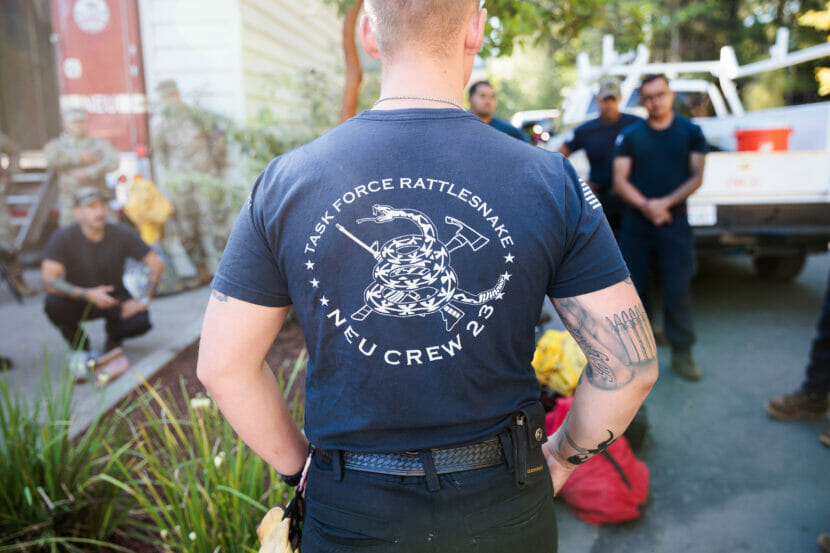
Members of the California National Guard’s Task Force Rattlesnake gather in Nevada City, Calif., to begin their day. (Max Whittaker for NPR)
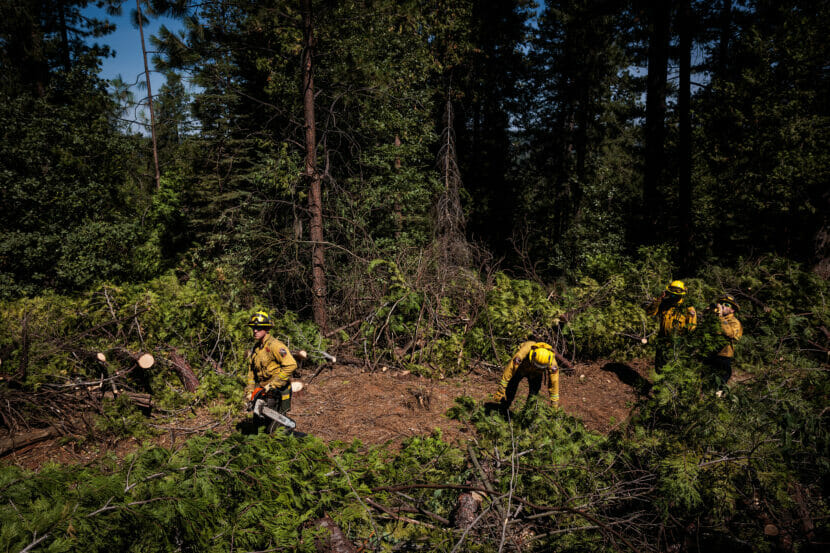
Members of the National Guard’s Task Force Rattlesnake clear brush and small trees to create a fireline, to deprive any fast-moving fire of fuel. (Max Whittaker for NPR)

“In the past, [Cal Fire] could depend on the National Guard to step up when they were called on and help fill any gaps. But as climate change has taken hold and changed fire behavior, there’s been a need to lean forward more proactively, and that’s a big role that Task Force Rattlesnake plays,” says Trujillo.

With the strain of COVID emergencies, civil unrest around the country, and the Guard’s regular overseas duties, the creation — and funding — of the task force has actually helped provide a degree of structure and reliability.

Nonetheless, climate change disasters are straining Guard troops nationwide, not just in California.
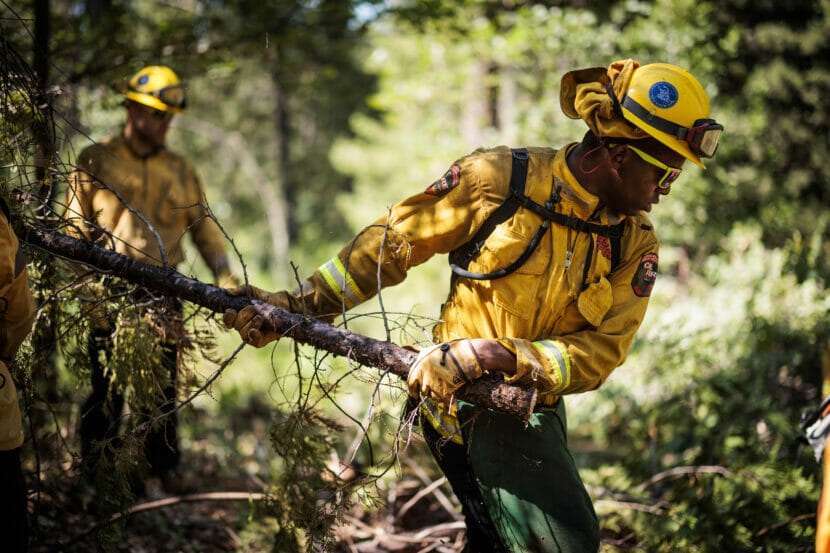
California National Guard Sgt. Jaleel Brown tosses a small tree aside as Task Force Rattlesnake work on fire prevention. (Max Whittaker for NPR)
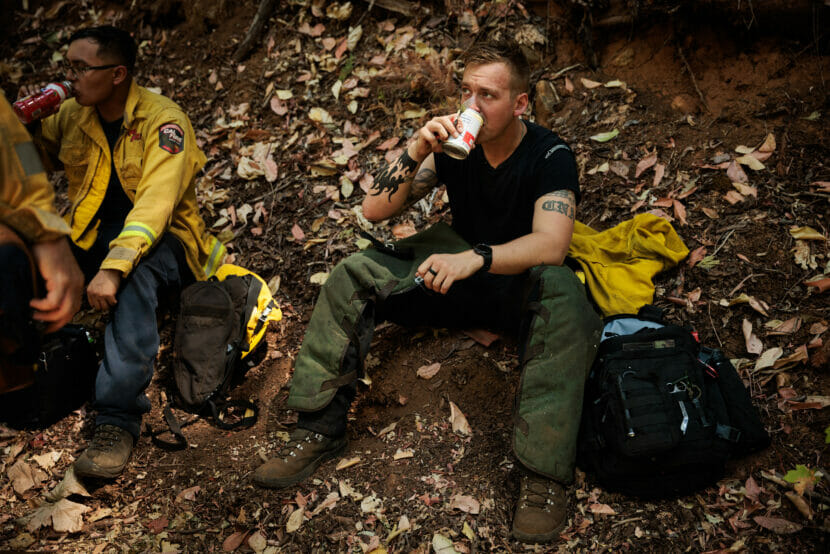
California National Guard Sgt. Tyler Bingham pauses for lunch while brush clearing with Task Force Rattlesnake. (Max Whittaker for NPR)

“In 2021, the National Guard spent 172,000 personnel days fighting fires, and that’s compared to about 18,000 personnel days in 2019. So it’s gone up significantly,” says Erin Sikorsky with the Center for Climate and Security. She tracks how climate is engaging military forces worldwide, including the U.S. Army National Guard. The strain on the Guard makes her wonder what would happen if the U.S. were at war.

“Many of those same troops are the ones that would be called upon in case of a conflict,” she says. “There would be a challenge there if they were being deployed at the levels they have been in recent years domestically and needed on the front lines.”

Fighting fires before they happen

In California it’s been a mercifully quiet year so far, which means more days for Task Force Rattlesnake to work on prevention.

Just outside Nevada City, a crew walks up an abandoned logging road that smells of red cedar and damp earth. They’ve been reopening the road for weeks, for access and also as a potential fire-break to protect the houses further up the hill. With chainsaws axes and chippers they remove deadwood that could fuel a fire, and cut down “ladder trees” the short 10 or 20 footers, that could help a fire climb up to the giant cedars and ponderosa pines that seem to touch the sky.
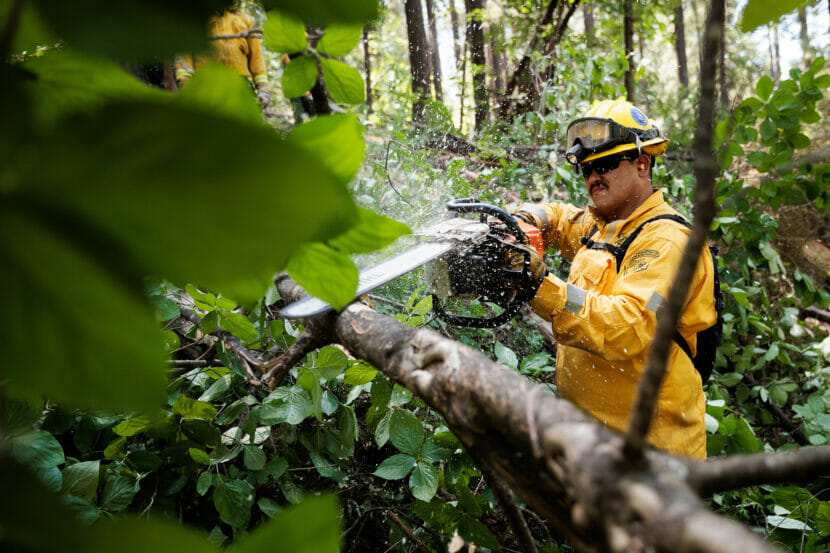
California National Guard Specialist John McMahan working on fire prevention as part of Task Force Rattlesnake. (Max Whittaker for NPR)
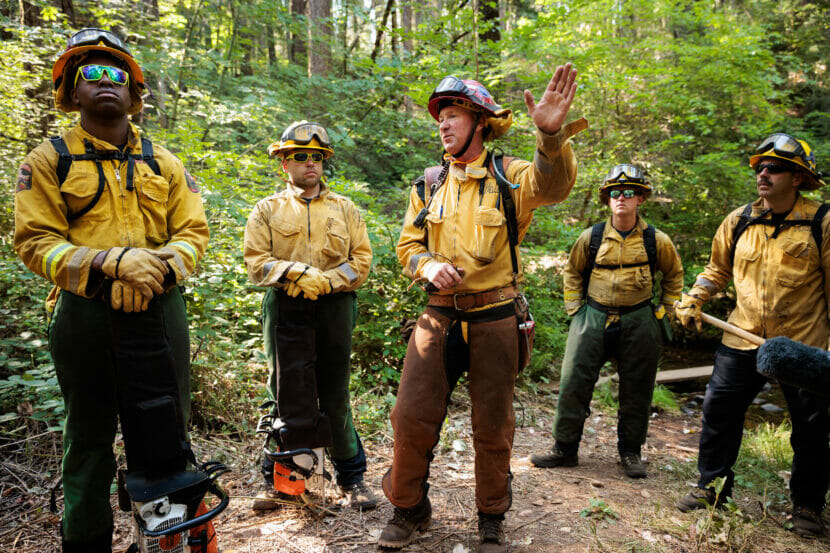
Cal Fire Captain Eric Ayers briefs members of the California National Guard’s Task Force Rattlesnake before they spend the day clearing brush and small trees, all part of fire prevention tactics. (Max Whittaker for NPR)

Capt. Eric Ayers has worked 34 years with Cal Fire, and he’s supervising the Task Force on this summer’s day.

“If we were to have fire in here today, without this fuel reduction being done, the fire would be too intense, and it’s going to ladder up these trees and all the timber in here is going to be fully consumed,” he says.

Ayers is a third generation woodsman. His grandfather logged these woods. Centuries before that, Native Americans did controlled burns to keep the forest healthy. But now after decades without either, and with houses built further and further into the woods, Ayers says the job is urgent — and endless — across California.

“It’s kind of like painting the Golden Gate Bridge. You do the initial paint, you get to one end and you gotta go back and redo it,” he says.

But it’s work these guardsmen say they enjoy. Brett Carl joined Task Force Rattlesnake in 2020, after two years of doing COVID response for the National Guard. Sawing trees and lugging brush until he’s dog tired is more what he had in mind when he joined.

“It’s manly right? Can’t get more manly than that!” he says with a laugh. “I feel better about myself mentally, physically every day once we get out here running the chainsaw.”

Carl says the Task Force is an attractive transition from the military as well, setting up a possible career in fire fighting, which appears to be a growth industry as North America keeps posting record high temperatures.
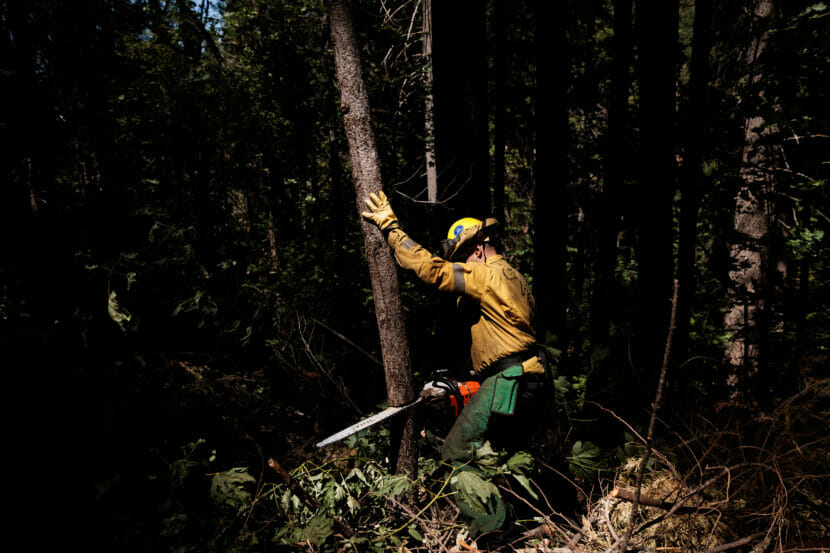
California National Guard Specialist Brett Carl cuts down a small tree while working on fire prevention with Task Force Rattlesnake. (Max Whittaker for NPR)
Copyright 2023 NPR. To see more, visit https://www.npr.org.

After the fires on Maui, one home shelters 87 people

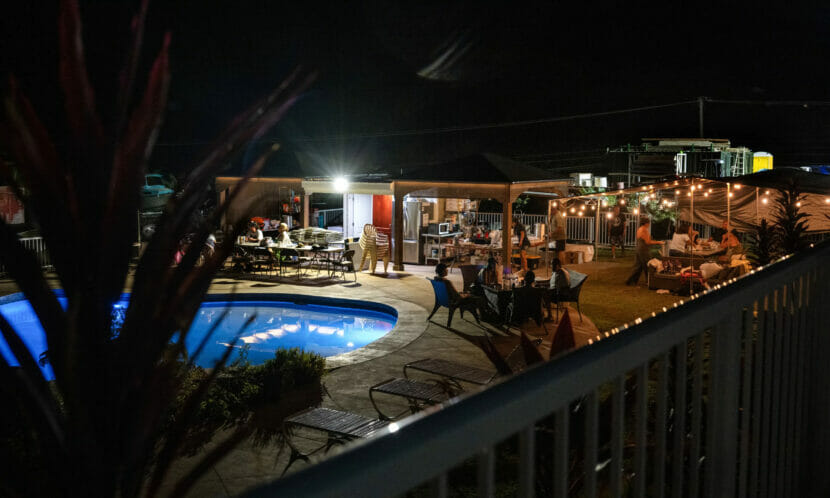
Up to 87 people have been staying in one house in Maui after they all lost their homes in the Lahaina wildfire.
Deanne Fitzmaurice for NPR

MAUI, Hawaii — Two weeks after a wildfire destroyed the historic community of Lahaina, and damaged other areas, most people whose homes are gone have found temporary housing. Nearly 2,400 people have moved into hotel rooms. Many others are staying with family and friends — stopgap accommodations while they look for longer-term housing.

The stepfather of one Lahaina woman has opened his property up to her and her husband’s extended family — a fluctuating group of cousins, aunts, uncles, grandparents, and some friends. At times, the number of people being housed in this compound (including a house, large garage and other buildings), has been as high as 87.

On a recent evening, there are more than a dozen cars in the gravel parking area. Near the house, a large group of kids are playing.

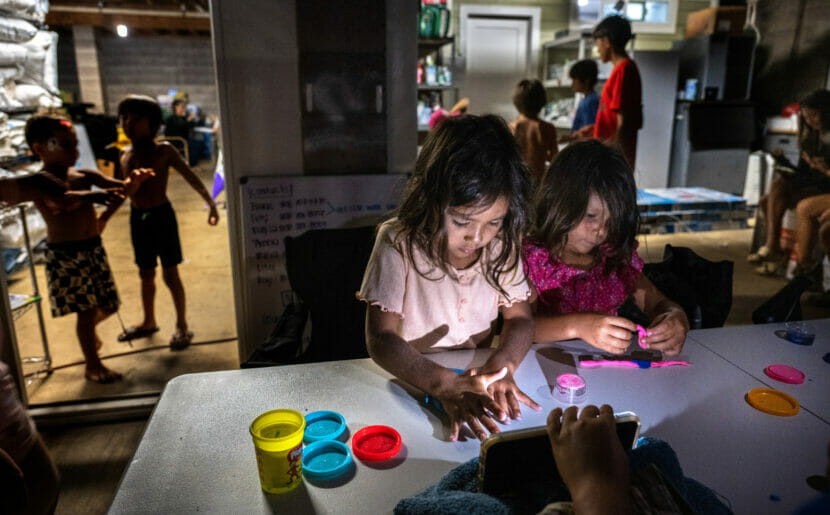
In the wake of this disaster, about 25 to 30 children have been staying here, and as many as 50 or 60 adults. That’s a lot of people. But Travis Cabanilla Okano, who is here with his wife, three kids and other relatives says it’s really not that unusual.

“This is life in Hawaii,” he says. “We grew up sleeping in our cousin’s house. We grew up sleeping with 20 of us in one little room… Letting our kids and us be together like that brings a lot of comfort for me.”

Many are still processing the disaster they just lived through. Recalling the fire, Okano’s partner, Haley Miller says the wind that day was whipping in a way she hadn’t seen before. By mid-afternoon she smelled smoke. Okano jumped on a bike and rode toward the mountains to check it out. Within a few minutes, Miller says, “We were just engulfed in embers and black smoke.” She soon saw her husband on his bike and a neighbor running back. “And they’re like…’C’mon, let’s go, we’ve got to go.'”

They grabbed their kids, jumped into their car and immediately were caught in a traffic jam as residents and tourists scrambled to escape the approaching fire. Miller says by the time they made it to Okano’s parents’ house in another part of Lahaina, the fire had spread. She says it sounded like a series of bombs going off. “It was the propane tanks blowing up,” Miller says. “And, the junkyard, all the cars, the gas tanks. It was literally like every…ten seconds, boom, boom, boom.”

Okano’s sister, Nikki Hollern also had a harrowing escape, but eventually made it out of Lahaina. She, her partner and her kids spent the night in their car. The next day, they made contact with other family members and reunited in a Walmart parking lot. Hollern says her oldest son usually doesn’t show much emotion. “But when he saw the family, like all of us, it was just relief, to greet everybody and know they were okay.”

Up to 87 people have been staying in one house in Maui after they all lost their homes in the Lahaina wildfire. (Deanne Fitzmaurice for NPR)

Remarkably, everyone in Okano and Hollern’s extended family got out safely. Haley Miller called her mother who lives with Miller’s stepfather on the other side of the island. Her mother invited Miller, and her husband and kids to stay with them, but Miller said she needed a place for all her and Okano’s family members.

“We’ve been through the fire together. Every single one of our family members is homeless. There’s nothing but what we have on our backs,” Miller told her mother. Twenty minutes later, Miller says, her mom called back and said everyone was welcome.

In the two weeks since the fire, this large family and others who are staying here are finding a new rhythm as they think about how they’ll rebuild their lives. At night, they gather and talk. And sometimes with friends like Max Louis, they have music.

Travis Cabanilla Okano says the kindness of his wife’s stepfather has meant a lot to his family. But, he adds, “this is not home.” Okano says his family is part of Lahaina, a close-knit community that’s now dispersed. He’s anxious to get back to his burned home to get photos of his property, and start planning for the future.

The properties in Lahaina, including Okano’s and those of most of his family, are in an area that’s now toxic. There will have to be extensive work, removing debris and contaminated soil before rebuilding can begin.

Hawaii Governor Josh Green has said at least nine months of housing will be made available to those displaced in the fire. But Haley Miller says the only housing she’s heard of is for the short-term. Other members of her family are in a hotel. “They need to be gone by the 30th,” she says. “You might be able to just take a couple of days of downtime to get back on your feet and find a solution. But really, where is there to go?”

Even before the fire, Maui had a severe housing shortage. Travis Cabanilla Okano is hoping his family can find a long-term rental. And despite the challenges, he’s confident that the community where he grew up and his family has lived for generations, will be back. “Lahaina is going to prevail in all of this,” he says.

“God will help us to be Lahaina strong.”

Copyright 2023 NPR. To see more, visit https://www.npr.org.

Alaska Airlines flight makes hard landing during California storms

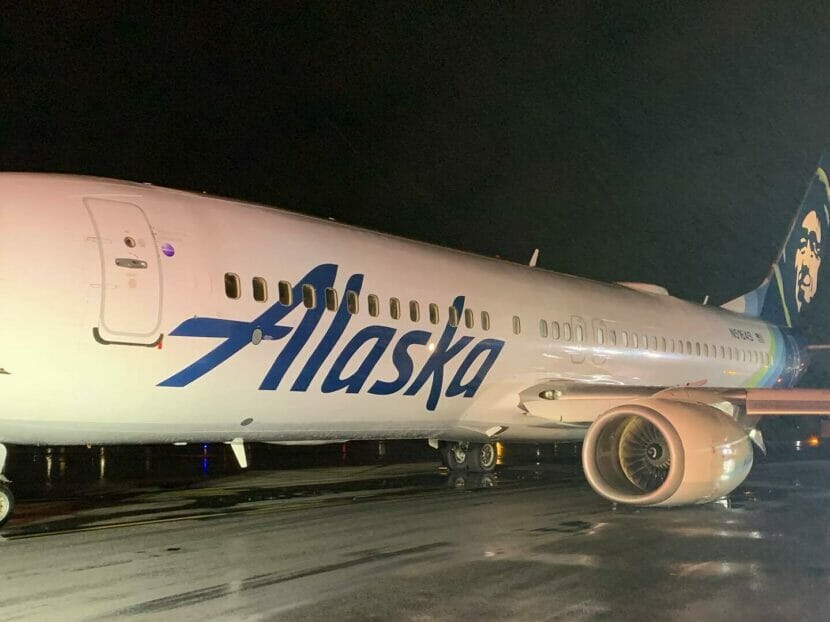
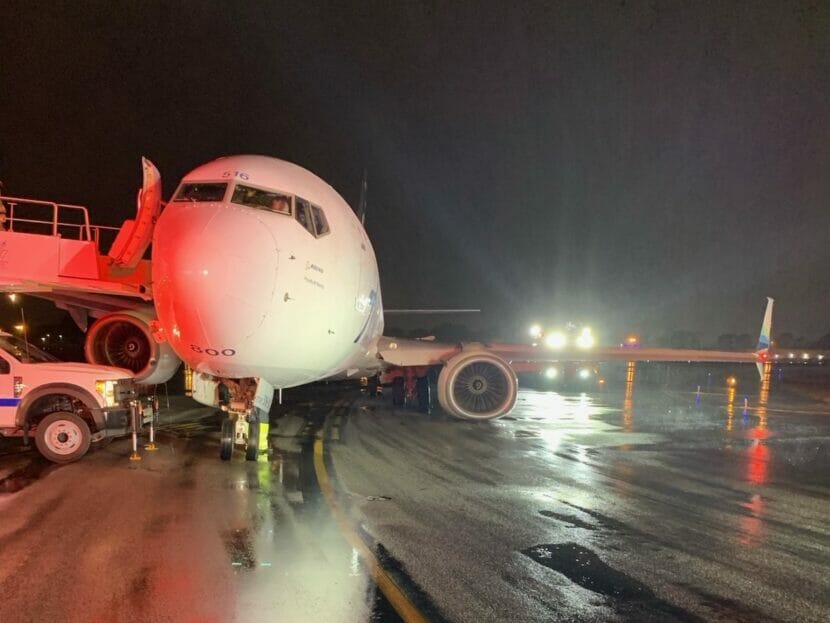
Alaska Airlines Flight 1288 experienced issues with the aircraft’s landing gear while taxiing to its gate at John Wayne Airport in Orange County, Calif., on Sunday night. (Orange County Fire Authority)

An Alaska Airlines flight made a hard landing amid Tropical Storm Hilary late Sunday, sending sparks flying into the night sky at John Wayne Airport in Southern California.

Flight 1288 was traveling from Seattle to Santa Ana in Orange County, when it appears to have hit the ground, dragging its left wing down the short tarmac, according to a video posted to social media.

Passengers on board can be heard screaming during the minute-long video as the plane makes sharp contact with the ground. Meanwhile, bright white and orange streaks can be seen out of a left-hand passenger window.

“There’s sparks outside! Why are there sparks outside?,” one person can be heard saying.

Alaska Airline officials explained that the plane “experienced an issue soon after landing” in the rain at 11:15 p.m. local time.

“The aircraft was unable to taxi to the gate due to an issue with its landing gear,” officials said in a statement, adding that the Boeing 737 “parked on a taxiway, where it remains.”

The flight was carrying 106 passengers and six crew members, who were safely deplaned and transported by bus to the terminal. No one was injured.

Rain and winds gusty winds were reported at the time

At the time of the landing the weather overhead was overcast and rainy, and the entire region was experiencing its first tropical storm in 84 years. According to the National Weather Service winds were gusting up to 30 mph.

Photographs taken by the Orange County Fire Authority, which responded to the emergency, show the off-kilter plane with the left engine resting on the runway.

Additional photos posted to X, the platform formerly known as Twitter, show some of the damage sustained by the left wing.

The FAA says it is investigating the incident. (Orange County Fire Authority)

Airport design makes for scary landings

John Wayne Airport has an unusually short runway, measuring just 5,700 feet. By comparison, the shortest runway at Los Angeles International Airport is just under 9,000 feet.

The short distance means pilots must take off near full power to get the necessary momentum to get off the ground quickly. Similarly, landings are especially bumpy because pilots have to hit the brakes hard to slow the plane on the short runway.

Copyright 2023 NPR. To see more, visit https://www.npr.org.

This video from a humpback ‘whale spa’ shows skin care is serious — and social

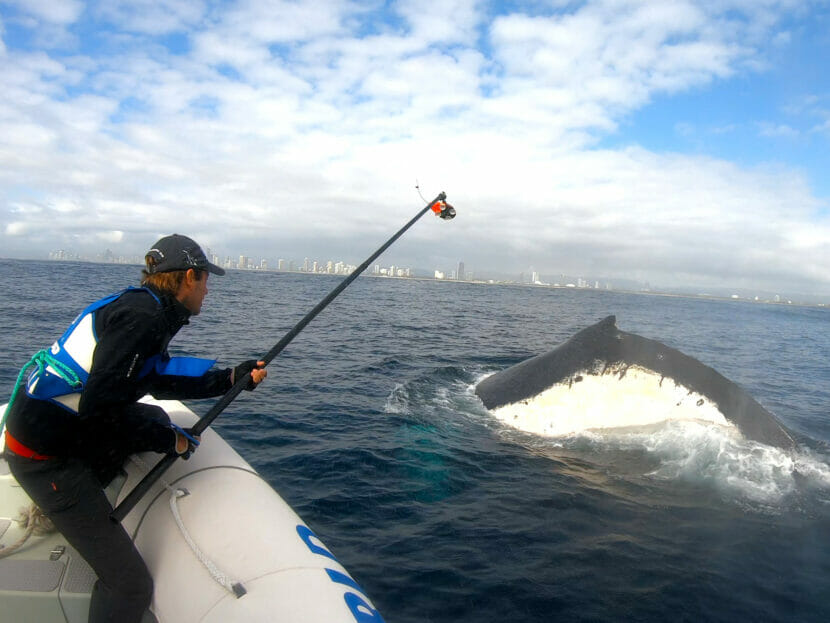
Marine scientists Jan-Olaf Meynecke attaches video-enabled tracking tags to humpback whales near Brisbane, Australia. While collecting data for a larger project on the whales’ migration patterns and climate change, Meynecke and his colleagues discovered a new behavior they call “sand rolling.” (Jan-Olaf Meynecke)

Studying what whales do underwater has always been hard, but thanks to new video and geolocation technology, scientists are now able to snag little glimpses of life beneath the sea and bring them to the surface.

And what they’ve seen can be surprising and delightful — like humpback whales exfoliating themselves on the shallow ocean floor.

“There was definitely no intention to capture whales rolling in sand,” says Jan-Olaf Meynecke, who described the behavior in a recent paper in the Journal of Marine Science and Engineering. “The best thing about science is that you never know what you’re actually looking for.”

The new discovery reveals how innovative deployment of more precise instruments can help expand our understanding of elusive marine species. Behaviors once hidden from sight, like the humpbacks’ “sand rolling,” will help paint a more complex picture of their health needs and social life — and could help inform policy debates about offshore habitat conservation.

Meynecke did not set out to study cetacean skin care regimes. The marine scientist has been tracking the migrations of humpback whales since 2010, from his scientific home base at Griffith University in Brisbane, Australia.

It’s difficult and expensive work, often requiring long hours in boats under rough conditions.

In 2019, Meynecke and his colleagues started attaching tracking tags called CATS cams to humpbacks for brief periods, as they swam along the Australian Gold Coast, either heading north to warmer tropical waters for breeding, or south toward the colder waters off Antarctica, where they feed.

At a basic level, the digital data prove that migrating whales don’t travel in a straight line, coming up only to breathe or breach every once in a while. They’re busy under the water, doing all sorts of mammalian things: courtship, friendship, fights over females, and simply hanging out.

“We’ve seen whales that are just, you know, swimming around each other,” Meynecke says. “And they’re in no rush because they’re actually just spending some time together.”

The tags can capture a humpback’s fine-scale movements underwater, helping Meynecke and other researchers build a more accurate model of how the humpbacks backtrack, detour, and meander on their migrations. Through that, they can understand more about what habitats they frequent, and how much energy they spend along the way.

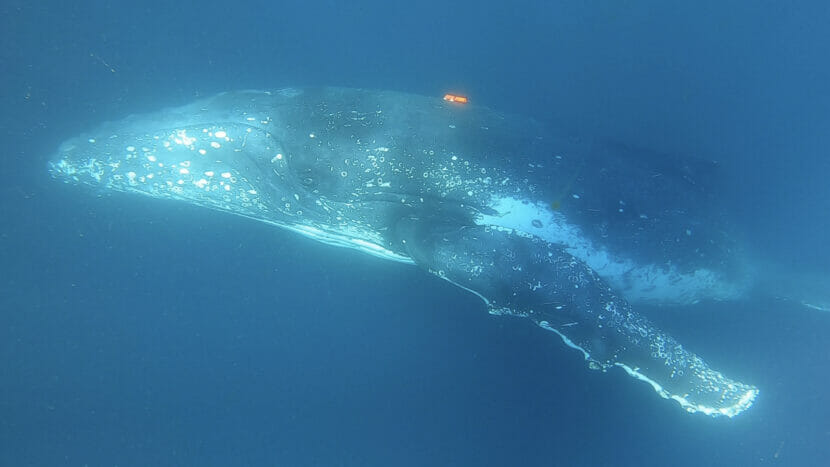
A humpback with the CATS cam digital tracker attached. The tags can be set to detach after a few hours of collecting data, and can then be retrieved. (Jan-Olaf Meynecke)

Meynecke explains that this research is critical because climate change will begin to impinge on their usual patterns: “The tropical waters will get too warm (above 28°C is not suitable for humpback whales) and Arctic waters will have less food to offer.”

Meynecke is project manager for an international research consortium, the Whales and Climate Research Program.

It’s serious, data-driven work. But in a serendipitous surprise, video footage from these digital trackers revealed a previously unknown new behavior: humpback whales rolling and rotating in the sand and gravel in Australia’s Gold Coast Bay.

What were the humpbacks doing?

Although visually exciting, the video footage isn’t the focus for this particular project. Meynecke referred to the footage as a useful “add-on” that helps verify the other data, such as the whale’s speed and direction, and the depth and temperature of the water.

The team first caught the whales engaged in “sand rolling” while reviewing some footage from August 2021.

“I remember sitting there with my colleagues and we were laughing about it,” says Meynecke, “Like, what? What are the whales doing? Like, why are they rolling on the sand?”

At first Meynecke wondered if the whale was trying to scrape the digital tag off of its dorsal fin. But the camera simultaneously captured another whale nearby, untagged, also spiraling through the sand. So it couldn’t be that.

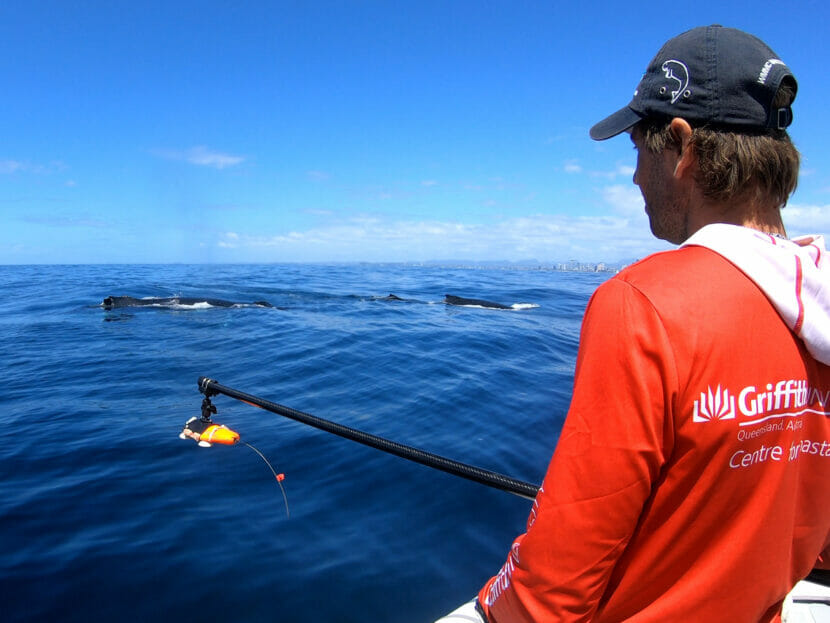
Marine scientist Jan-Olaf Meynecke waits for an opportune moment to attach a modified CATS cam digital tag near the dorsal fin of a migrating humpback off the Gold Coast of Australia. (Jan-Olaf Meynecke)

But what was it?

Video from two later expeditions also revealed humpbacks, both tagged and untagged, engaged in sand rolling.

Pieces of skin could be seen falling off the whales, and in some videos, fish known as silver trevally were observed eating the skin or darting in to pick skin directly off the whales.

The importance of skin care

The oceans are rich with microbes and parasites, as well as larger hitchhikers that ride on whales, like barnacles and remora suckerfish.

“One of the biggest problems for the whales is that there is constant shedding necessary, so that they can reduce infection from bacteria and viruses,” Meynecke says.

Shedding of skin seems to increase as whales migrate between colder and warmer waters. So the sand rolling may be a way for humpbacks to actively speed up that exfoliating process.

But it may also help remove young barnacles from hard-to-reach skin crevices in the head region, according to Meynecke. In the sand rolls captured on video, the whales were “slowly moving forward with their head first into the sand followed by rolling to one side or a full roll.”

One theory of why whales breach is that they’re trying to knock excess barnacles off when they land. Sand rolling might be another technique, Meynecke says

“From my experience, the whales definitely don’t want those barnacles on them,” he says. “They’re a burden when it comes to the dynamics. The swim speed is reduced and it’s weighing them down.”

Marine versus terrestrial mammals

Among terrestrial mammals — even the largest — scratching, rolling and other skin-care behaviors are well known, says Bruce Schulte, a biologist specializing in elephant behavior and conservation, and an associate vice president at Western Kentucky University.

“The epidermis is the largest organ that we have in the body. So you’ve got to take care of it,” he says.

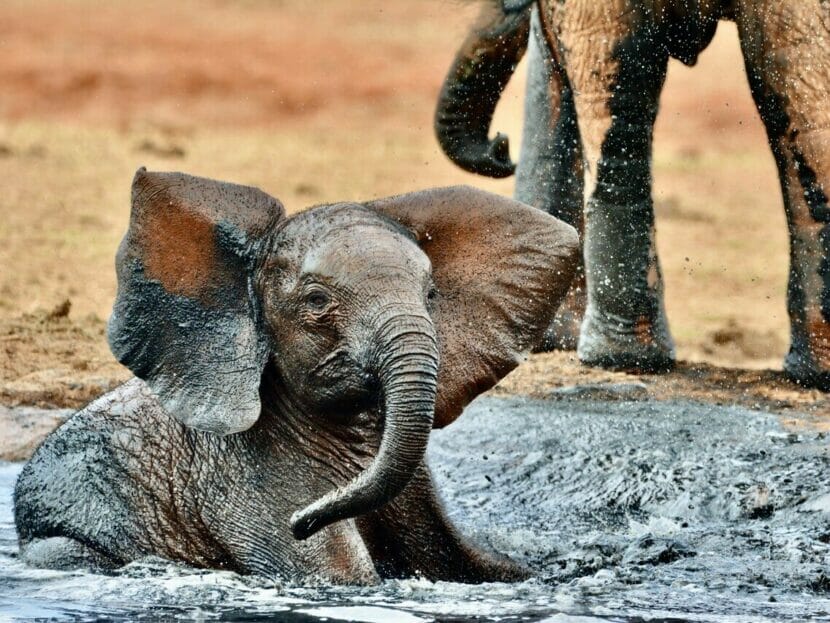
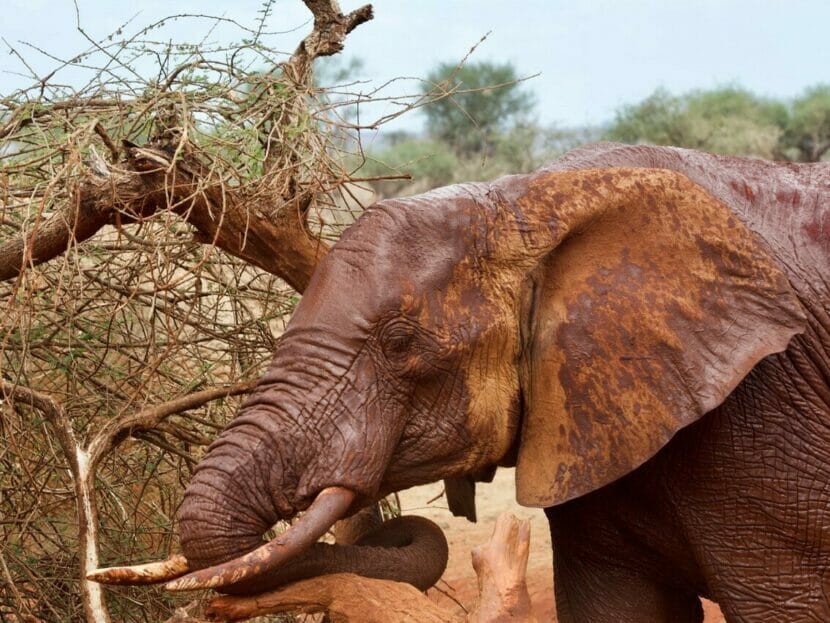
Elephants cope with insects like mites and ticks by water-bathing with their trunk, rubbing against trees, and rolling in mud. The layers of mud help prevent bites, and also shield them from sunburn, Schulte says. If mud isn’t available, elephants, like many other species, will use dust — or add dust on top of the mud, to strengthen the coating.

A young elephant calf frolics in the mud near its family at a waterhole at Voi Wildlife Lodge in Tsavo East National Park, 2019. From an early age calves learn to wallow in the mud which helps with cooling down on hot days and protection from the sun and biting insects. (Lynn Von Hagen/Denver Zoo)

Among marine mammals, orcas have been observed rubbing up against rocky beaches in the Pacific northwest, and bowhead whales “rock-nosing” in the eastern Canadian arctic.

Could whale spas enhance social relationships?

Sand rolling by humpbacks in deeper waters is a newer discovery, and could help inform what scientists know about their social needs, in addition to their health.

“They all were in a similar area where they were rolling,” Meynecke says. “And it was always in a context of socializing as well. So they were not just doing it by themselves.”

The cameras captured a courting male and female sand rolling together, as well as three bulls who went sand rolling after an hour-long fight over a female.

“It was a very severe, heavy fighting with ramming into each other. It looked definitely brutal.”

Meynecke says if those three males sustained cuts or scrapes in the fight, then the sand rolling could help clean out the wounds. It’s a theory, he says.

But the fact that the adversaries dove underwater and went sand rolling together is intriguing, he adds.

“If they have these fights, then it would make sense that they also have a reset moment,” he says, especially considering that humpback whales are a highly social species, compared to other whales.

“It’s not like that they’re upset with each other for the rest of their lives,” he says. “They keep seeing, you know, the same individuals and keep meeting up again over the years. So we’re very certain that there [are] relationships amongst many, many of these individuals.”

These discoveries help underscore that seemingly-simple behaviors can have multiple benefits, says Bruce Schulte, the elephant specialist.

“Does it start out, sort of evolutionarily…to make you feel better, to get parasites off, to make you healthier?” he asks.

“But then because there might be better areas to do this than others, does it also become a bit of a social event?”

Making the case for hygiene habitats

A mud wallow used by elephants, or a coastal area with the right kind of sand for exfoliation, and helpful fishes — these are habitats that may be just as crucial for species health as areas used for feeding, breeding and migrating.

“These types of discoveries, where we find areas that aren’t used a lot, but they’re used critically, are really important for understanding what we need to conserve,” says Schulte.

This bull pauses for a rub on some dead wood after emerging from mudding in a waterhole at Ngutuni Wildlife Conservancy, Tsavo East National Park in 2021. Elephants use all types of objects (including each other) to scratch or rub, often as a way to respond to itches from biting insects. Some objects become favored scratching spots are rubbed smooth. (Lynn Von Hagen/Denver Zoo)

Meynecke agrees, and notes that sand is a major global commodity, and Australia a major sand exporter.

In future research, he wants to continue to map the locations that whales use for sand rolling, to ensure that these “whale spas” are protected and preserved.

“If we started dredging sand in these areas or if we have a lot of boating activity, well, that means the whales can’t go there or they won’t go there,” Meynecke says.

Copyright 2023 NPR. To see more, visit https://www.npr.org.

Yellowknife residents wonder if wildfires are the new normal as western Canada burns

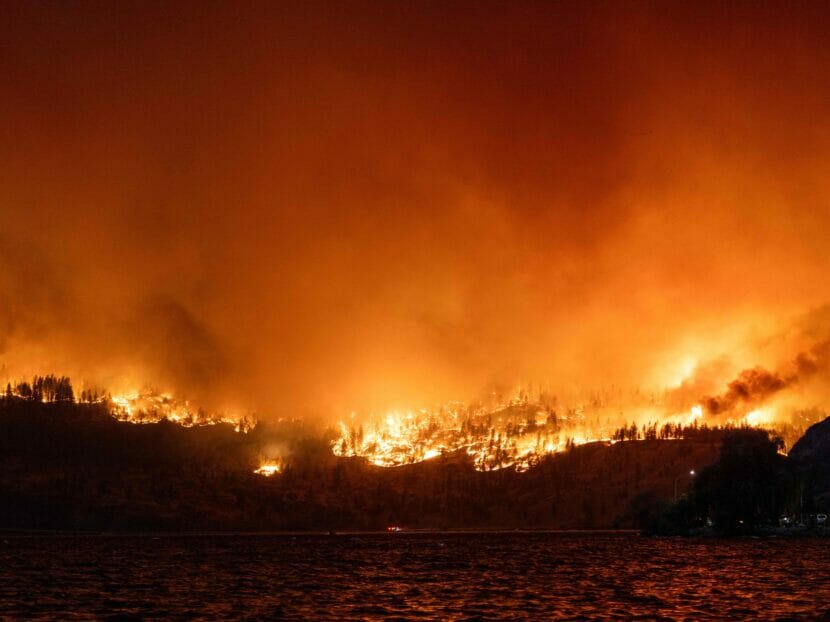
The McDougall Creek wildfire burns in the hills West Kelowna, British Columbia, Canada, on Thursday as seen from Kelowna. (Darren Hull/AFP via Getty Images)

For the past few days, Ollie Williams has been intermittently checking the doorbell camera from his phone to see if his house is still there. Sometimes, he checks the camera that’s normally used to watch the dog when he and his partner aren’t home.

“It’s a rather traumatizing way to check back in,” he admits. “I looked at the camera of our nice living room there — you know, there’s the TV, there’s the sofa, there’s the dog’s bed. And I cried for about five minutes.”

Williams isn’t sure if he’ll ever see it in person again.

He’s currently about 400 miles from his home in Yellowknife, the capital of the Northwest Territories in Canada. He evacuated along with nearly all of the city’s 20,000 residents after a mandatory evacuation order as wildfires rage dangerously nearby.

There are more than 200 fires burning in the Northwest Territories. Nearly 400 are burning in the nearby province of British Columbia. Canada is grappling with its worst wildfire season on record, leaving tens of thousands of people displaced and blanketing parts of that country and the U.S. with thick, choking smoke. All in all, there have been at least 5,790 fires in Canada this year, according to the Canadian Interagency Forest Fire Centre.

In Yellowknife, a mandatory evacuation order went into effect for the entire city Wednesday, creating a chaotic scene as long lines of cars queued for miles to flee along the only road out of town.


View this post on Instagram


A post shared by NPR (@npr)

“It’s one lane in each direction for 600 kilometers. And it’s virtually a dirt road in places,” Williams says.

Williams is the editor of Cabin Radio, an independent internet radio station and online newsroom based in Yellowknife. He and his small team have been tirelessly pushing out text alerts to residents throughout the evacuation — even as they themselves evacuated — trying to get information to people in an area where cell service and resources are spotty. He evacuated with a Starlink satellite dish set up in the back of his truck, propped up between bags of dog food, using the signal to keep updating the community while his partner drove.

“Personally, I’m fully wrecked at this point. I’ve spent most of my week delivering what can only be described as survival updates to 20,000 friends, and I’m mostly doing my job because it spares me from having to think about anything else,” Williams says.

It’s not just people who are being displaced by the flames — wildlife is also being forced to relocate. On Friday, the city of Yellowknife tweeted that a bear was spotted on the streets.

Yellowknife is one of eight communities in the Northwestern Territories evacuated in the past week, mayor Rebecca Alty told NPR’s All Things Considered, calling it “unprecedented.” She said that this was Yellowknife’s first evacuation.

“The last two fires that were kind of big in our region were in ’98 and 2014, but nothing that threatened Yellowknife so much that we even had to consider an evacuation, let alone actually issue an evacuation,” she said. “It’s been a tough, tough couple days and, I’d say, a tough month. That’s when the fire first started.”

South of Yellowknife, closer to the border with the United States, a surreal wall of flames hugs the picturesque Okanagan Lake in West Kelowna, British Columbia. At night, the hillsides are alight with the blaze, a stark backdrop to the city of a more than 30,000, as firefighters from all across the province battle to hold the fire at bay.

“It’s tough to characterize. It sounds like a rushing river. And day turns to night,” West Kelowna Fire Chief Jason Brolund told the CBC, after a particularly long night fighting the flames. “The funny thing was, last night — and I say funny with the utmost respect — but the funny thing was that night turned to day and the orange glow was like nothing that I’ve ever experienced.”

Speaking at a press conference Friday morning, Brolund looked weary, saying that several structures had been lost.

“We knew it was going to be bad. But it was exponentially worse than we had expected,” he said. “Somebody described it to me last night in the heat of the battle as it was like a hundred years of fire fighting all at once in one night. And I really think that it was true. We fought 100 years worth of fires.”

A potential new normal

It’s part of a natural cycle for Canada’s boreal forests to burn, and at a certain level it’s beneficial for the ecosystem.

“Some people are like, ‘Well, this is climate change. This is terrible. We’ve never seen this before.’ That’s wrong. We’ve seen this plenty of times. But it is [also] climate change, and it is much worse than we’ve seen before,” Daniel Perrakis, a fire research scientist with the Canadian Forest Service in British Columbia, told NPR.

Climate change makes large, destructive wildfires more likely because of hotter temperatures and drier vegetation. Higher average temperatures are increasing the length of the fire season, the amount of land burned, and the number of places where fires can occur. In recent years, fires have expanded in the Arctic and even in some rainforests.

For Ollie Williams, waiting to see if his house — and his community in Yellowknife — is OK, he says he’s worried that fire seasons like this might just be the new normal: “I think, the scariest thing is that this year is an outlier, but it might not be an outlier in future. It might just be a regular summer. And then what do we do?”

But he also says it’s hard to think about the future when there is so much to worry about from day to day.

And then he gets a message from someone fighting the fires back in Yellowknife, and he hangs up to update the community, now scattered, waiting to go back home.

Copyright 2023 NPR. To see more, visit https://www.npr.org.

Priceless connections to Hawaii’s ancient past were lost when cultural center burned

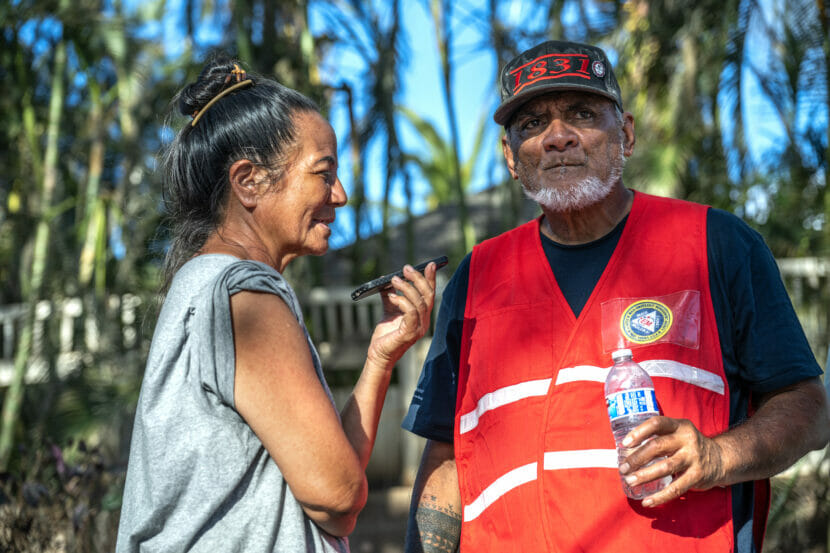
Uilani (left) and Keeamoku Kapu run the Na ‘Aikane o Maui Cultural and Research Center which was burned to the ground in the wildfires so they set up this grassroots community distribution center in Lahaina. They are on the phone here taking a call from Oprah about supplies she will be delivering. (Deanne Fitzmaurice for NPR)

MAUI, Hawaii — It could be a long time before the full extent of human loss is known after the wildfires. The official death is more than 110 and expected to keep growing.

While people are grappling with that news, they’re still trying to understand the loss of priceless artifacts and their connections to the island’s ancient past.

The Na ‘Aikane o Maui Cultural and Research Center was home to vestiges of Ancient Hawaii, before European colonization. “Old documents. Maps. Genealogy. Books that were actually signed by our kings,” said Ke’eamoku Kapu, the center’s steward. “Our cultural center was the hub for a lot of our Native Hawaiian people longing for the past.”

For Kapu, the center meant even more than the rare, tangible treasures of his ancestry. It was where his community gathered. “It was a place of worship. A place of traditional cultural, protocols.”

The center was on the main thoroughfare in Lahaina, which was once the capital of the ancient Hawaiian Kingdom. Kapu returned to the rubble two days after the fire to see what was left of the town. “Oh, man. All my neighbors gone. Our churches are these apartment buildings that flourish with families. With generations of families gone.”

He also went to the site of the cultural center with the hopes of recovering some artifacts. But he found very little. “Carving images made out of stone. That made it, one of them. And a stone that was given to me personally by different chiefs from the South Pacific, New Zealand, Tahiti, Samoa, so a great loss.”

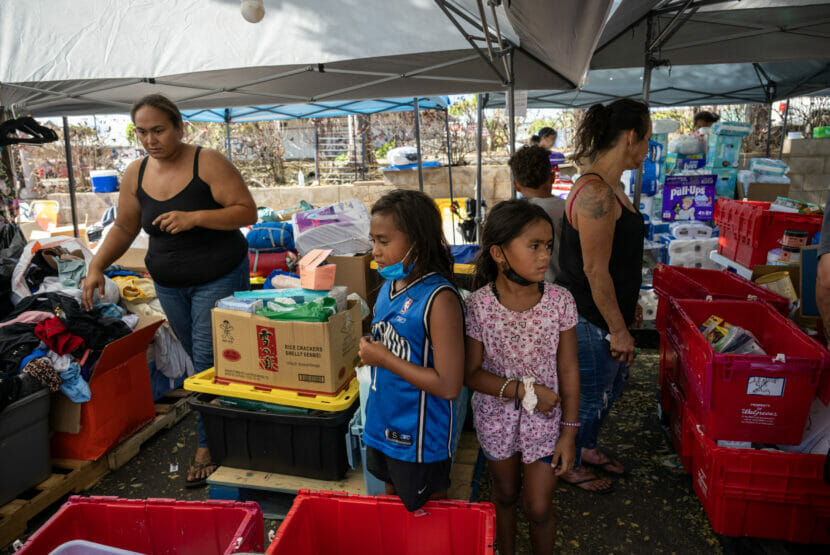
This grassroots community distribution center has been set up by a Hawaiian community in Lahaina. (Deanne Fitzmaurice for NPR)

Some of the rare books and documents preserved at the center weren’t just history — they were instructive materials for Indigenous people fighting for ownership of the land and water that belonged to their ancestors. Kapu himself was involved in litigation that ended up at the state Supreme Court and won him the rights to hold on to the land that his family has owned since the days of the Hawaiian kingdom. He brought that knowledge to other community members at the cultural center.

“That was a great advantage of the center to bring families in and teach them what I’ve done in order to help them get their lands back and has been working all the documents. All those documents are gone.”

As he talked, Kapu points his finger to his right temple.

“All I have is what I have in here. I just cried. Like we got erased.”

Kapu said he still hasn’t had time to process the loss. He’s already been through three other fires on Maui before this one. “I cannot sleep. I wake up with nightmares. Wake up thinking everything is fine, only to wake up and see it’s not. But I guess that’s a reason why I’m doing what I’m doing. Because I got to stay busy.”

What he’s doing is working with Maui’s Emergency Management Agency – helping to run one of the distribution centers in Lahaina with several members of his family. He’s getting food, supplies and water to those affected by the fire. Kapu says Indigenous people bring a unique understanding to this work.

“We know exactly what the general community is feeling now. Because we know about trauma. We know about being displaced.”

Kapu is also serving as a liaison between the local government and Indigenous community. He’s on an advisory council to the mayor as the county navigates the response to this fire. “There’s a lot of distrust right now, and our responsibility as advisors in the community is to alleviate that distrust, because if we don’t, it is going to be chaotic.”

He plans to keep working with the government as the recovery and rebuilding process continues. He’s wary of the potential for payouts for property that was lost and is encouraging community members to try to hold on to their land.

“What is it going to take to rebuild the capital of the kingdom once again? What is it going to take? This is our legacy we’re talking about. What is the payout for losing that?”

Copyright 2023 NPR. To see more, visit https://www.npr.org.

Site notifications
Update notification options
Subscribe to notifications