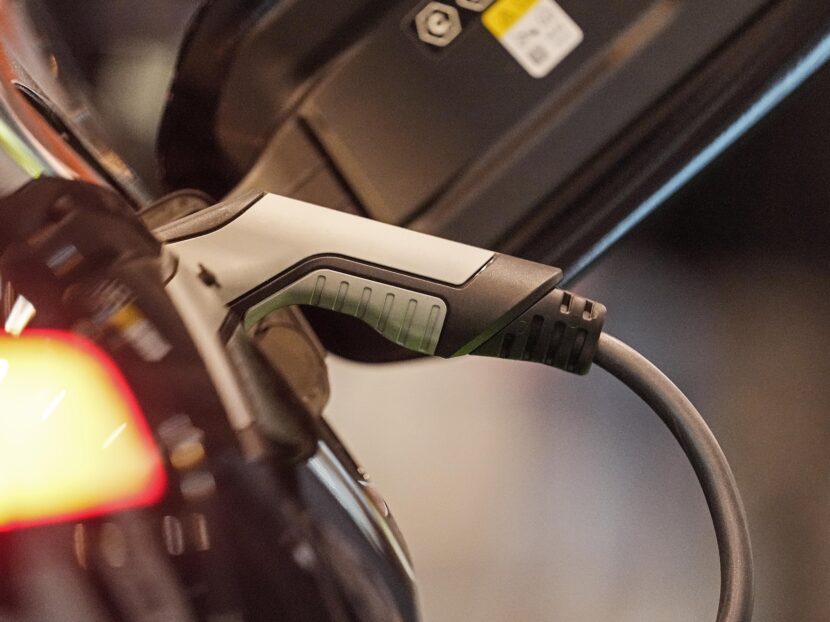
An electric car is charged at the Motor Show in Essen, Germany, Thursday, Dec. 2, 2021. Charging may soon be easier across the U.S. with seven car companies banding together to create a charging network. (Martin Meissner/AP)
Seven of the world’s largest carmakers are launching a new electric vehicle charging network, in an unusual display of cooperation that’s designed to address one of the major deterrents for would-be electric vehicle purchasers.
The goal is to open 30,000 new high-speed fast-chargers in North America, powered by renewable energy. If achieved, that would be significantly larger than Tesla’s current Supercharger network, and would nearly double the number of fast chargers available in the U.S. today. (In this case, a “charger” refers to an individual plug. A charging station at a single location often has multiple chargers.)
But building a charging network of that scale will be a very high mountain to climb.
Ionity, a similar network in Europe launched as a joint venture between many of the same automakers, has built only 2,600 chargers since 2017.
In the U.S., Electrify America — bankrolled by $2 billion that Volkswagen paid as part of the Dieselgate settlement — has installed 3,600 in five years, and those chargers struggle with reliability.
Meanwhile Tesla, the undisputed leader in this space, has spent a full decade building 17,000 chargers.
The newly announced network, which has not yet been named, is a partnership between BMW, GM, Honda, Hyundai, Kia, Mercedes-Benz and Stellantis (formerly known as Fiat Chrysler).
Automakers frequently pair up in joint ventures to to defray costs of research and development or new vehicles. However, a joint venture like this between seven carmakers of this size is — as the automakers’ press release notes — unprecedented in North America.
Carmakers getting involved in building fast chargers, on the other hand, has a very clear precedent: Tesla.
The electric car pioneer calculated that having a network of fast chargers was essential before Americans would be willing to buy EVs, so Tesla built its own. The reliability of that network played a key role in Tesla’s meteoric rise.
For many years Tesla’s network was only open to Tesla owners. But recently, in a deal with the White House, Tesla opened up some chargers to all EV drivers. And in a cataclysmic shift, rival car companies are embracing Tesla technology in exchange for access to its Supercharger network.
Other individual automakers have also explored building chargers directly, some closed to just their customers (like Rivian’s) and others open to all (like one Mercedes-Benz announced this year).
But nothing rivals the scale of the new 7-automaker alliance.
These chargers, the group says, will be open to all EV drivers. The companies would not identify any suppliers they plan to work with to build out chargers, or break down the amount of funding being provided by each automaker. The group plans to access federal and state incentives for fast chargers to help cover the cost of building the network.
“Each site will be equipped with multiple high-powered DC chargers, making long-distance journeys easier for customers,” the automakers wrote in a joint statement. “In line with the sustainability strategies of all seven automakers, the joint venture intends to power the charging network solely by renewable energy.”
Most electric vehicles, most of the time, charge on much slower chargers; that’s cheaper, more convenient and easier on the battery. But the availability of fast chargers remains a significant concern for shoppers. According to surveys by J.D. Power, access to chargers in public is the #1 concern keeping would-be buyers from going electric.
Copyright 2023 NPR. To see more, visit https://www.npr.org.
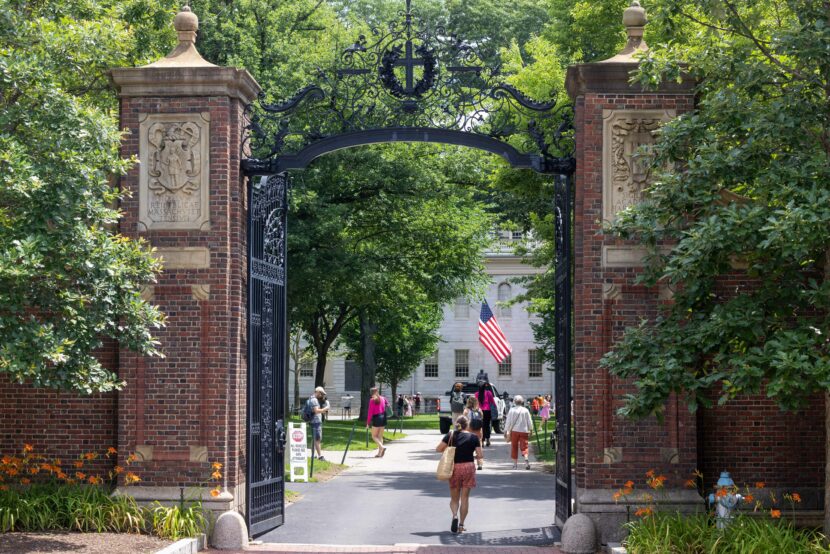
CAMBRIDGE, MASSACHUSETTS – JUNE 29: People walk through the gate on Harvard Yard at the Harvard University campus on June 29, 2023 in Cambridge, Massachusetts. (Scott Eisen/Getty Images)
Affirmative action for minority kids may now be dead. But a blockbuster new study, released today, finds that, effectively, affirmative action for rich kids is alive and well. They may or may not always do it on purpose, but a group of the most prestigious private colleges in America are handing a massive admissions advantage to rich kids over less affluent kids — even when they have the same SAT scores and academic qualifications.
The study is by Raj Chetty and David J. Deming, of Harvard University, and John N. Friedman, of Brown University. We at Planet Money have already dubbed Raj Chetty the Beyoncé of Economics because of his long list of popular hits in empirical economics. And, let me tell you, this is another ***Flawless classic in his catalog. I mean, not only is the study eye-opening, but Chetty is also kind of sticking his neck out here, by shining a spotlight on the admission practices of his employer, Harvard. But they can’t fire Beyoncé! (He has tenure).
Among a number of other discoveries, the economists find that kids from the richest 1% of American families are more than twice as likely to attend the nation’s most elite private colleges as kids from middle-class families with similar SAT scores. The silver spoon these wealthy kids are born with can, apparently, be used to catapult them past other equally bright, but less privileged kids into some of America’s best colleges.
Chetty and his colleagues provide compelling evidence that fancy schools are promoting a kind of neo-aristocracy, with admission programs that help to perpetuate a family’s class privilege from one generation to the next. The advantages they grant to rich kids are about more than just legacy admissions, a practice in which elite colleges give preferential treatment to kids of alumni and donors. The economists find that other types of evaluation and recruitment play important roles in giving rich kids a leg up, as well.
Going further, the economists find evidence suggesting that reforms to the admissions policies at these prestigious schools could really make a big difference in the life trajectories of less affluent kids, and make America’s elite less of an exclusive club for people born into privilege.
Silver spoon-fed schools
Chetty, Deming, and Friedman focus their study on what they call the “Ivy-Plus colleges”: the eight Ivy League schools — Harvard, Princeton, Yale, Columbia, Brown, Cornell, Dartmouth, and UPenn — as well as Stanford, MIT, Duke, and the University of Chicago.
Less than half of 1% of Americans go to these prestigious private colleges. “Yet these twelve colleges account for more than 10% of Fortune 500 CEOs, a quarter of U.S. Senators, half of all Rhodes scholars, and three-fourths of Supreme Court justices appointed in the last half-century,” the economists write. These schools, in other words, appear to be an important gateway to the American elite, which makes their admission policies relevant for all of us.
Rich kids obviously have a bunch of advantages that help them bolster their academic credentials — like great private schools, SAT tutors and so on. Indeed, Chetty and his colleagues have already amassed a tonofevidence that the environment — even the zip code — in which kids grow up has a huge impact on their chances of climbing the economic ladder.
But these childhood advantages are not what this study is about. In this study, the economists compare rich kids and their less affluent peers who have achieved roughly equal academic credentials (measured by SAT scores and GPAs). Yet, even then, the rich kids are still way more likely to get into elite colleges. It’s pretty shocking when you consider how much harder it is for a less well-off kid to measure up academically to a rich kid, who, from a young age, has benefited from tremendous resources aimed at bolstering their academic credentials.
[Editor’s note: This is an excerpt of Planet Money’s newsletter. You can sign up here.]
The economists pull together a range of large data sources that enables them to thoroughly analyze the admission decisions of America’s most elite colleges. They got internal admissions data from a bunch of schools, allowing them to see which kids applied and which ones got in. They have SAT and ACT test scores. And, equipped with IRS data, the economists are able to see how rich these kids’ families were when they applied to college, and how much money the kids earned after they graduated. They focus primarily on students admitted between 2010 and 2015, which gives them enough of a postgraduate track record for the researchers to see how they’ve done in their careers.
With this treasure trove of data, the economists then embark on a rigorous analysis. First, they establish the overwhelming reason why rich kids are disproportionately attending these schools: admissions. Yes, they find, their less affluent peers are a bit less likely to apply and enroll, but the main reason for the disparity is colleges are systematically admitting more rich kids than less well-off ones.
As previously mentioned, the economists find that wealthy children, even when they have comparable SAT and ACT scores to less affluent kids, are much more likely to get into these elite schools. A student from the richest 1% of American families (from families earning over $611,000 per year) is twice as likely to attend an elite private college as a middle-class student (from a family earning between $83,000-$116,000 per year) with the same academic credentials. The economists find this disparity can only be found at elite private colleges: they find no such advantage for rich kids at America’s flagship public universities, like UC Berkeley or the University of Michigan.
“I think implicitly what we’re finding in the data is that — whether intentionally or not — we currently have a system that appears to have affirmative action for kids from the richest families, the top 1% in particular, which gives them a substantial leg up in admissions relative to other kids,” Chetty says.
Why rich kids are getting admitted more
The economists find three factors that give rich kids this huge admissions boost. The first is legacy admission programs. They calculate that 46% of their admissions advantage comes from programs that give them preferential admission due to their parents being alumni.
One defense for these legacy kids might be that they’re smart, hard-working, and ambitious, so they’d be able to get into another Ivy-Plus college if they wanted to. But the economists find these same legacy kids see no advantage when they apply to schools their parents did not go to. “So, in other words, that legacy impact is totally non-transferrable across colleges, which strongly suggests that it’s not that these kids are just kind of stronger applicants in general,” Chetty says. “It’s actually about literally being a legacy at this college.”
The second reason that rich kids get an admissions advantage is athletic recruitment. The economists calculate that 24% of the admission boost for students from the richest 1% of families comes from the fact that they excel at some sort of sport. That may be somewhat surprising, because if you watch pro sports, the stars usually don’t come from privileged backgrounds. The economists are unable to do a sport-by-sport analysis, but, Chetty says, it’s likely that kids are finding a recruitment advantage in expensive, elite sports, such as fencing, tennis, rowing or lacrosse. Elite private colleges, after all, are generally not known for their stellar football or basketball teams.
The last reason rich kids are more likely to be admitted is because they tend to have higher non-academic ratings that make their applications pop. Think extracurricular activities, compelling letters of recommendation, and guidance counselors who help them engineer perfect resumes and personal statements. This explains about 30% of their advantage.
Chetty says the rich-kid advantage in non-academic ratings is almost entirely driven by the fact that they are much more likely to attend elite private high schools. “If you’re coming from an elite private school, you tend to have much higher non-academic ratings,” Chetty says. “Now, of course, kids from high-income families are much more likely to attend these schools.”
Why the particular college you go to might matter, after all
So, yeah, rich kids are much more likely to get into fancy colleges than less affluent kids. But does that necessarily mean that it really matters for future outcomes? It’s possible that going to one of these elite schools doesn’t have a large effect on a person’s later career. Indeed, there have been some influential economicstudies that suggest that the choice of college by similarly qualified students doesn’t have much of an effect on how much they end up making, on average.
The reason for this, economists have long figured, is that elite colleges are highly selective. The kids they admit are smart, hard-working, highly ambitious — and apparently much more likely to come from rich families — which means they have a solid shot at success, whether they go to a particular school or not. Economists call this “selection bias.” The idea is, basically, schools are just selecting winners — not necessarily making winners. Which is why the causal effect of a particular school on a kid’s outcomes might not actually matter very much.
But that’s not what this new study finds. They find that going to these Ivy-Plus colleges makes kids a lot more likely to become tremendously rich and successful. This is especially the case for less affluent kids. “Attending an Ivy-Plus college instead of the average highly selective public flagship institution increases low-income students’ chances of reaching the top 1% of the earnings distribution by 60%, nearly doubles their chances of attending an elite graduate school, and triples their chances of working at a prestigious firm,” the economists write.
So why are these economists finding that the particular school that kids attend matters a great deal, while previous studies have suggested that it doesn’t? Chetty and his colleagues do a bunch of statistical work backing up and double-checking this finding. For example, they use one technique in which wait-listed kids serve as a kind of quasi-experiment. In some cases these kids are admitted from the waitlist for a somewhat random reason, and other times they are not let in. This enables the researchers to compare outcomes of statistically similar students, some of whom went to Ivy-Plus colleges, some of whom went to flagship public colleges. The economists are now able to see what happened to those students over time.
Chetty says that, consistent with previous findings, the data shows that the particular school these students attend doesn’t matter much when it comes to their average earnings. If a bright kid goes to UC Berkeley instead of Harvard, they’ll still make good money working in tech or law, or whatever. Compared to similar kids who did go to Harvard, their earnings, on average, usually won’t look much different.
However, Chetty says, their data is much richer than previous studies, which relied on small surveys instead of the massive administrative datasets that Chetty, Deming and Friedman use in this study. As a result, the economists are able to zero in and see “upper-tail” outcomes like the likelihood of these kids reaching the top 1% of income earners. Previous studies couldn’t see outcomes in the same detail. And that’s where Chetty and his colleagues are finding significant advantages when kids go to these elite private schools.
“These colleges have a huge causal effect on getting you access to the upper tail — to positions of influence, to becoming a leader,” Chetty says. We’re talking about elite positions like corporate executives, U.S. Senators, top professors, Supreme Court justices. “I think what these colleges do is really open doors for some folks to get to a set of positions that they really would not have had much access to had they not gone.”
As a result, Chetty says, reforming admission practices at these schools could have a meaningful impact on what America’s elite looks like. One potential reform they highlight: just use the same admissions criteria as America’s flagship public universities, where it’s more about raw academic credentials, and wealthy children don’t have the same overt admissions advantage.
Admissions in a world after race-based affirmative action
Mind you, Chetty and his colleagues studied admissions data before the recent Supreme Court decision, when most of these schools had some sort of race-conscious affirmative action program. Even in this world, as Chetty and his colleagues found in a previous study, kids from the richest 1% of American families were 77 times more likely to attend an Ivy League college than those from families in the bottom fifth of the income distribution.
Now, with race-based affirmative action dead, it’s plausible that the underrepresentation of lower and middle-class families at these schools could look even worse in coming years, because race is strongly correlated with income and wealth.
In the wake of the Supreme Court decision, we’ve begun to see a national debate about admissions policies at America’s elite schools. Just days after the ruling, a group of advocacy organizations filed a complaint against Harvard for their legacy admissions policy, arguing that it primarily benefits the kids of wealthy, white families. President Biden criticized legacy admissions and other similar policies that “expand privilege instead of opportunity.” And a wave of universities, including Wesleyan and Carnegie Mellon, have begun ending their legacy admission programs.
But many schools, including the majority of the Ivy-Plus colleges, are still clinging to their legacy admission programs. If their goal is to have their students go on and make a significant impact on society, Chetty and his colleagues find, that doesn’t make a lot of sense. They find that rich kids who are admitted because of their legacy status or their athletic background or their non-academic ratings are actually a bit less likely to see outsized success after graduating, compared to middle- or lower-class kids who don’t have those credentials. The economists find that raw SAT and ACT scores — and, more generally, academic ratings like GPA — are much more predictive of future success than anything else.
Of course, these colleges may still be reluctant to end their programs that give a leg up to the richest kids in America. The colleges assert that legacy programs help build community and school loyalty. Probably more relevant is the importance of legacies to these fancy private colleges’ business models: rich kids are more likely to pay tuition — and their parents are more likely to give donations and pad their endowments.
As for concerns that diversity at these schools is about to plummet because of the end of race-conscious affirmative action, Chetty has some ideas to promote both racial and socioeconomic diversity that may survive judicial scrutiny.
It would be an admission process that would take into account “kids who come from neighborhoods that have particularly low levels of upward mobility and use that as a measure of adversity,” Chetty says. This would not be explicitly focused on race itself, but it would pick up “the adversity in childhood environments that is correlated with race.”
Call it zip code-based affirmative action. After all, if you grow up in a poverty-stricken neighborhood and manage to score a 1500 on the SATs, you’ve jumped over a much higher hurdle than your silver-spoon-fed competition.
Copyright 2023 NPR. To see more, visit https://www.npr.org.
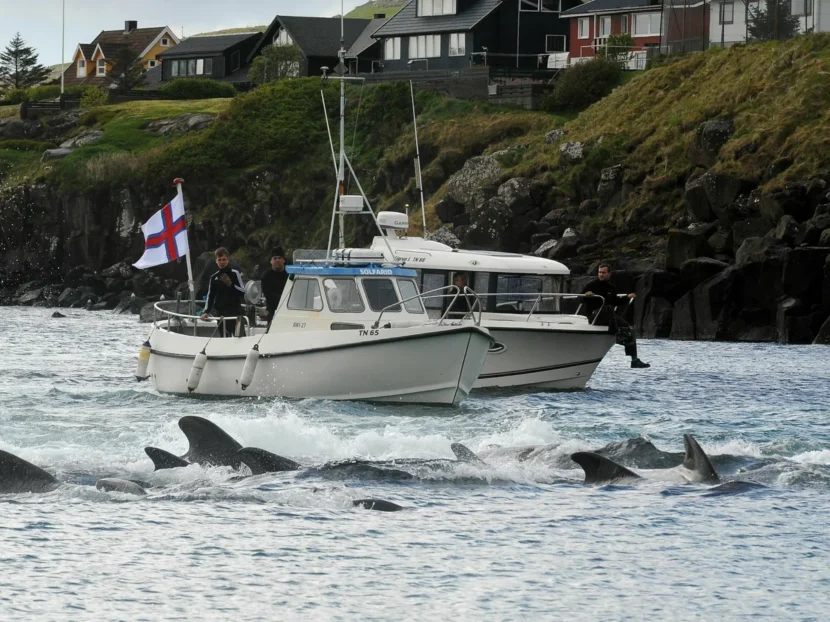
A group of fisherman drive pilot whales towards the shore during a hunt in the Faroe Islands in May 2019. (Andrija Ilic/AFP via Getty Images)
A cruise line is apologizing to passengers who witnessed the killing of dozens of pilot whales near their docked ship this week in the Faroe Islands.
Passengers aboard the cruise ship Ambition, owned by the U.K.-based Ambassador Cruise Line, had just arrived Sunday in the port of Tórshavn in the Danish territory when they caught the spectacle, part of a long-standing and highly scrutinized local tradition.
Among those passengers were conservationists with ORCA, a marine life advocacy group that seeks to protect whales and dolphins in European waters. Since 2021, Ambassador has paid for ORCA staff to join their cruises in order to educate tourists on marine wildlife and collect data on the animals.
In an account shared by ORCA and confirmed byAmbassador, the conservationists said over 40 small boats and jet skis herded the whales to a beach where 150 people worked to haul the animals ashore with hooks and slaughter them with lances.
In total, the hunt lasted about 20 minutes, ORCA said. Some of the animals, which included nine calves, took over 30 seconds to die.
Ambassador Cruise Line said it was “incredibly disappointed” that the hunt unfolded near the ship and that it continues to “strongly object to this practice.” The companyasks their guests not to support the hunters by purchasing local whale and dolphin meat.
“We fully appreciate that witnessing this local event would have been distressing for the majority of guests onboard,”Ambassadorsaid in a statement to NPR. “Accordingly, we would like to sincerely apologise to them for any undue upset.”
A representative for the Faroe Islands government did not immediately respond to NPR’s request for comment on Sunday’s hunt.
Long-finned pilot whales, which are technically a species of dolphin, are a medium-sized marine mammal that dwells in the North Atlantic, known for their bulbous head and sickle-shaped flippers. They’reprotected under the Marine Mammal Protection Act, but not currently listed as an endangered species.
The mammals live in social pods of up to 20 individuals, organized into a larger school of hundreds of animals — a social structure that makes them easy targets for whalers, according to the National Oceanic and Atmospheric Administration.
In the Faroe Islands, the hunting of pilot whales is known as the “grindadrap” or “grind.” The Faroese view the tradition as central to their cultural identity and a sustainable way to gather food, according to a local government website.
The government says the killing is not highly commercialized. Each catch is “distributed for free in the local community” but “in some supermarkets and on the dockside, whale meat and blubber is occasionally available for sale.”
Multiple hunts can occur throughout the year, and each is carried out by people with a required license and supervised by elected officials. Local legislation stipulates the killing must be carried out as “quickly and efficiently as possible.”
The government says the average catch is around 800 animals, an insignificant impact on the overall pilot whale population, which it says is around 778,000 animals.
But a record single-day killing of more than 1,400 white-sided dolphins in 2021 brought the practice into intensified scrutiny. The chairman of the Faroese Whalers Association told the BBC that the size of that killing was purely accidental.
That Sunday’s slaughter unfolded near the cruise ship made it seem as if the whalers were “flaunting the hunt and taunting the tourists,” many of whom were hoping to catch a glimpse of marine life in the wild, ORCA CEO Sally Hamilton said.
“It defies belief that the Faroese authorities allowed this activity to take place in clear sight of a cruise ship packed with passengers,” she wrote in a statement shared with NPR. “At some point, the Faroese authorities will have to decide if its marine life is a more attractive tourist proposition when it is alive than when it is being killed.”
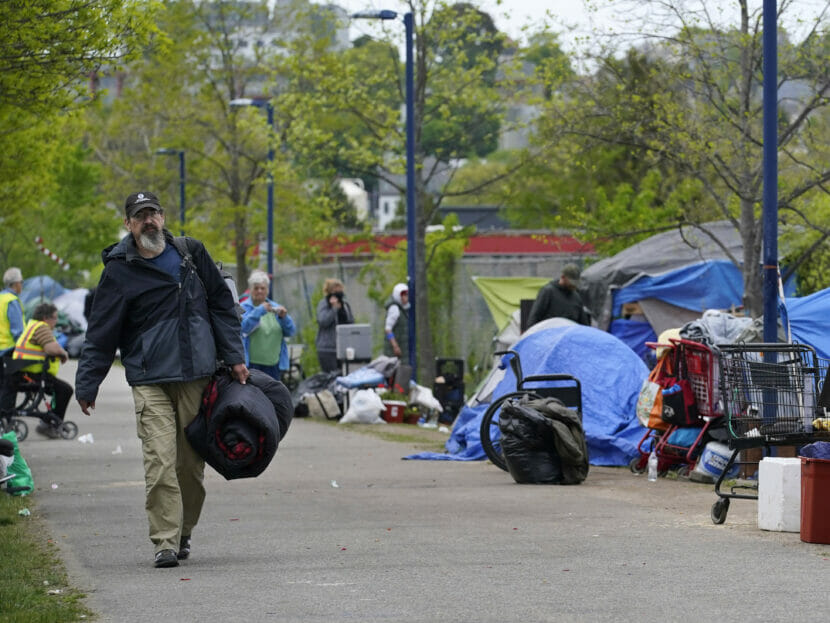
A man carries a sleeping bag at a homeless encampment in Portland, Maine, in May, before city workers arrived to clean the area. State officials say a lack of affordable housing is behind a sharp rise in chronic homelessness. (Robert F. Bukaty/AP)
When Los Angeles Mayor Karen Bass campaigned last year on reining in homelessness, she laid out bold proposals with a budget of hundreds of millions of dollars. In April, she told NPR she hoped for a “very significant reduction” this year, especially of people living on the street. But on Monday, Bass said it’s become clear that there’s simply no end in sight.
“We really need to normalize the fact, unfortunately, that we’re living in a crisis,” she said at a press conference announcing a renewal of her emergency declaration on homelessness.
The shift in tone comes after both LA and New York City recently declared a record level of homelessness, and other cities have also seen their numbers continue to climb despite considerable attention and spending to give people shelter. It’s part of a steady rise around the country since 2016, after years of successfully driving down the number of people without housing.
So what’s going on? Advocacy groups and researchers say a big driving force is the decline of affordable housing, a problem decades in the making but one that has grown significantly worse in the past few years. Here are a few ways it’s playing out.
1. More people than ever are being housed — but an even higher number are falling into homelessness
About a third of the U.S. homeless population is in California, and the state faces mounting questions about why billions of dollars spent in recent years hasn’t reduced the number of people living in cars and encampments. A bipartisan group of lawmakers has asked the state auditor to investigate. A key program in Los Angeles to move people from hotels into permanent housing appears to be struggling.
CalMatters reports that officials across the state are asking how they can do better, even traveling to Texas for guidance.
And yet, those in California and other places around the country can also argue they are helping more people than ever. The Los Angeles Homeless Services Authority says it has placed more than 20,000 into permanent housing for five years in a row — a significant boost from a decade ago — and that it’s doing this faster than it has in the past. Nationally over that time, the inventory of permanent housing available has increased 26% — and it’s more than doubled since 2007.
“We’ve done a lot” to improve how people are placed into housing, says Steve Berg, chief policy officer at the National Alliance to End Homelessness. But he says that’s only half the equation. “The other half is people losing their housing … and we have not had any kind of extensive or organized effort on that,” he says.
The upshot is that, in Los Angeles and elsewhere, even as record numbers of people are being housed, a greater number of them are falling into homelessness.
Berg says one key reason is that only 1 in 4 Americans who qualify for a federal housing subsidy actually get it, and that’s been the case since he was in law school decades ago. The vast majority of low-income renters must rely on market-rate housing, but the U.S. hasn’t built enough housing for more than a decade, since the market crash of 2008. And the shortage is most acute for the lowest income renters — by more than 7 million units, according to the National Low Income Housing Coalition.
That tight market, combined with the worst inflation in a generation last year, has led to double-digit rent spikes in many places around the U.S.
2. Rents are out of reach for many, and millions of affordable places have disappeared
A landmark new report surveyed thousands of people in California about how they came to be without housing, and researchers conducted in-depth interviews with hundreds of them. For most, high rental costs were crucial.
“People just ran out of the ability to pay, whether it happened quickly or slowly,” says lead investigator Margot Kushel of the University of California, San Francisco.
Some said they’d had their work hours cut. Others lost a job because of a health crisis. Many crowded in with relatives or friends, who were also likely to be poor and struggling. “And we found that those relationships, when they fell apart, fell apart quickly,” Kushel says. “People only had one day’s warning” to leave. Even those with their own lease had on average just 10 days to move out.
Their median monthly household income in the six months before they became homeless was $960, she says. The median rent for a one-bedroom apartment in California is $1,700. Around the country, Kushel says, homelessness rates are highest in places where there is both poverty and high housing costs.
That gap has been growing for decades, as rents have risen faster than wages. Nationally last year, the share of renters spending at least 30% or 50% of their income on housing reached a record high. And some markets have seen a major share of their low-cost rentals disappear.
Over the past decade, the number of rentals under $600 fell by nearly 4 million, according to an analysis by Harvard’s Joint Center for Housing Studies. The losses happened in every state, because either rents increased, the units were taken off the rental market or buildings were condemned and demolished. Among slightly higher priced rentals, up to $1,000 a month, some 2.5 million more units were lost.
Even with inflation cooling, rents remain too high for many — and are continuing to increase in some places.
3. Zoning laws and local opposition make it hard to build housing for low-income renters
Voters around the country approved spending for more affordable housing last year, and a record number of apartments are under construction. More places are also loosening zoning laws — some of which date back to segregation — to allow more multifamily buildings in residential neighborhoods. Housing experts say all this is needed to help ease the tight market and bring down prices over time.
With a shortage in the millions of units, though, that could take a very long time. And in most places it’s still a major challenge to build affordable housing. “Neighbors will say, ‘We don’t want low-income people living here,’ and they’ll stop the housing from being built,” says Berg, with the National Alliance to End Homelessness.
Even housing that does get built and is billed as affordable, he says, isn’t always cheap enough for those who need it most. “It’s really about having enough deeply affordable housing so that people with the lowest incomes can move into the housing,” Berg says. “And if they lose that housing, they can find another place to live.”
4. Pandemic aid programs that helped keep many people housed are winding down
An annual count last year did find a pause in the relentless rise of homelessness. Biden administration officials, among others, credit the sweeping array of pandemic aid programs that limited evictions, helped people pay rent and boosted other financial supports. Princeton’s Eviction Lab calculates such policies cut eviction filings in half.
Those programs have largely ended in many places and are winding down in others. Beyond having to pay current rent, it means some people also may be expected to pay down rental debt that accumulated during the COVID-19 emergency. Many link the end of such protections to a recent rise in evictions, well above pre-pandemic levels in some places.
Of course, there are other reasons. Some 19% of those surveyed in the UCSF study became homeless after leaving institutions such as prison, and finding employment and housing with a criminal record is difficult. Advocates say there’s also need for more addiction and mental health treatment, though it’s most effective once someone is safely housed.
But again, the overriding problem, they say, is the dire lack of places low-income people can afford to live.
“There’s really no way to solve homelessness without seriously addressing this,” says Kushel, the UCSF researcher. “Otherwise, we’re going to be compelled to continue to spend huge amounts of money managing an increasingly out of control crisis.”
Copyright 2023 NPR. To see more, visit https://www.npr.org.
On the morning of September 21, 1938, The New York Times published a run-of-the-mill weather forecast that rang no alarm bells for its readers.
“The indications are for rain and cool weather today and for cloudy and continued cool weather, probably with rain, tomorrow, according to the map charted at the United States Weather Bureau at 7:30 o’clock (EST) last night,” the paper wrote.
In the days before, the U.S. Weather Bureau — the predecessor to the National Weather Service — had been tracking a hurricane that was threatening the coast of Florida. The storm ended up changing course and veering away from the Florida coast. And, despite the warnings of one junior forecaster, the agency decided the system would continue spinning away and die in the middle of the Atlantic Ocean. It deemed the cyclone as posing no threat.
The New York Times, in its same edition on September 21, even praised the weather agency for its work in tracking the storm. “If New York and the rest of the world have been so well informed about the cyclone it is because of an admirably organized meteorological service,” the paper wrote.
But that very same morning, off the coast of Long Island, the angry vortex of water and 120-mph winds was already barreling back towards land. At around 2:30 pm, it made landfall. The impact of the tidal surge was so strong that it registered on seismographs as far away as Alaska.
The Great Hurricane of 1938, or “The Long Island Express” as it was also called, would become one of the most destructive hurricanes in American history. It destroyed more than 63,000 homes. It injured thousands. It killed more than 600 people. And — because of bad forecasting — many of these victims were taken completely by surprise.
1938 Hurricane Damage at Crescent Beach in Connecticut. (National Archives)
Weather forecasts have come a long way since the 1930s. Back then, to make forecasts, meteorologists “relied on the 16th-century thermometer, the 17th-century mercurial barometer, and the medieval weather vane,” writes the historian William Manchester. Newfangled airplanes were becoming more important in helping to make forecasts, but forecasters were still heavily reliant on random ships in the sea to inform them about weather patterns, like the track of hurricanes.
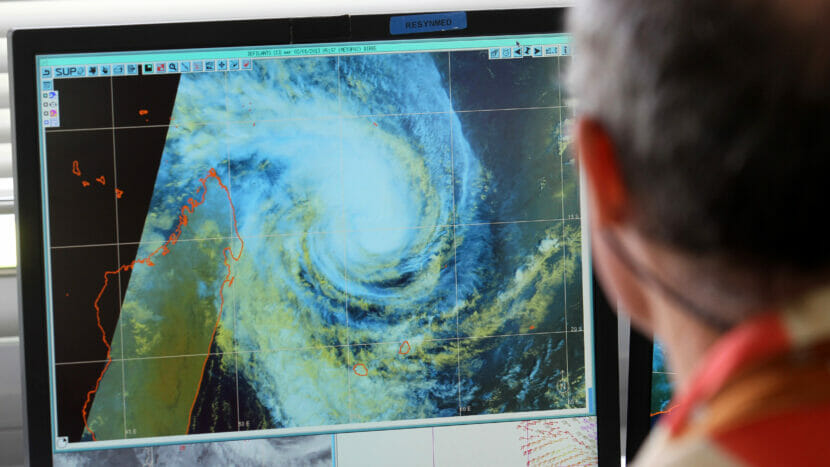
Today, forecasters are equipped with a stunning array of technology to make weather predictions. Doppler radar towers detect precipitation and wind patterns. Radiosondes, attached to weather balloons, float through the upper stratosphere, gathering data on temperature, humidity, air pressure, wind speed and direction. Automated surface-observing systems provide real-time data about conditions on land. Satellites circle the earth, beaming in valuable imagery and data. And supercomputers and advanced statistical models aggregate all this data and help forecasters put together a vivid picture of what’s going to happen to our weather in the future.
Equipped with all this technology, meteorologists have been making stunning progress:
Today, a five-day weather forecast is as accurate as a one-day forecast was back in 1980.
The two-day forecast for heavy rainfall is now as good as the same-day forecast was back in the mid-1990s.
Flawed predictions about the path of hurricanes are about half as likely as they were just a few decades ago.
Back in 1990, forecasters could only provide a relatively accurate prediction of weather seven days in advance. Now they can make relatively accurate forecasts ten days in advance.
They may be one of the many things we take for granted in the modern world, but more accurate weather forecasts — and our ability to access them anytime on our smartphones — have tremendous value for our economy. They help farmers make decisions about crops. They help construction crews make decisions about building. They help the tourism industry predict tourist flows. They help countless people take precautions for the future, literally saving lives.
While weather forecasts clearly have value, it’s proved hard for economists to determine just how valuable they can be. But a group of economists recently tried. In a new working paper, “Fatal Errors: The Mortality Value of Accurate Weather Forecasts,” the economists Jeffrey G. Shrader, Laura Bakkensen, and Derek Lemoine focus on the value of one important aspect of predicting the weather: how hot or cold it’s going to be.
How Valuable Is It To Know Future Temperatures?
Recently, Bakkensen and Lemoine joined me on a Zoom call from Tucson, Arizona, on a day when their city was — quite appropriately for our interview — under an excessive heat warning. Both are economists at the University of Arizona.
By their estimates, thousands of Americans die every year due to extreme temperatures. But, before conducting this study, Lemoine says, he wasn’t confident temperature forecasts actually make a huge difference.
“It’s actually not obvious when forecasts have value,” says Lemoine. “If on some days an error in forecasting means that there are fewer deaths, and other days errors mean that there are more deaths, these things could kind of statistically wash out.” Moreover, he says, meteorologists have made such incredible progress in making forecasts more accurate in recent decades that it wasn’t clear whether the errors that remain still have sizable effects.
To see whether inaccuracy in temperature forecasts has an effect on deaths, the economists combine data on the real weather and weather forecasts from the National Weather Service with data on fatalities from the Centers For Disease Control and Prevention (CDC). They focus on one-day-ahead forecasts of temperature over a 12-year period. “We’re trying to compare the same county, essentially the same people, same temperature day, but this day had an accurate forecast, this day had a slightly inaccurate forecast, and see how that impacts mortality,” Bakkensen says.
Sure enough, the economists find that errors in forecasts can have big effects on how many people die. “We see effects of even errors of just a degree or two,” Lemoine says. “We can see in the data that deaths are higher, and we weren’t expecting it to be that sensitive.”
The economists find that making accurate forecasts is particularly important for hot days. While people also die due to the cold, Lemoine says, research suggests that people are more likely to die quickly from heat. So it makes some intuitive sense that a bad forecast in advance of a hot day — in particular a forecast saying it’s going to be colder than it really ends up being — could be particularly deadly.
Bakkensen says their data shows that people clearly use forecasts to take life-saving precautions. For example, they may buy an air conditioner, or cancel a medical appointment, or plan their days to avoid being in the direct sun. Municipalities may also do things like open public pools or increase hospital capacity.
“Well-forecasted days when they’re hot don’t have that much of an effect on mortality,” Lemoine says. “It’s the inaccurately forecasted hot days that have a big effect. So you can trim a lot of those effects just by having better forecasts.”
The economists calculate that “making forecasts 50% more accurate would save 2,200 lives per year.” Furthermore, they estimate, “the public would be willing to pay $112 billion” over the remainder of the century to make that a reality. Mind you, this is just the economic benefit of more accurate temperature forecasts in lowering deaths; it’s not a calculation of the total economic benefit of better weather forecasts in general. “I would expect that this number we’re calculating is a big lower bound on the benefits of overall more accurate forecasts,” Bakkensen says.
The annual budget for the National Weather Service is only a little bit more than $1 billion per year, and Lemoine says their analysis suggests that Americans would see considerable benefits from investing more in the agency in coming years.
Making weather forecasts more accurate is particularly important, both the economists say, because our nation and the world is projected to get hotter and subject to more extreme weather due to climate change. “As climate change shifts us more toward hot days, it’s implicitly shifting us toward days where accurate forecasts matter more,” Lemoine says. An important part of adapting to climate change, he says, will be investing in better forecasting.
Bakkensen says that, between 2005 and 2017, the National Weather Service’s forecasts got around 30% more accurate, so making another 50% improvement is in the realm of possibility. That’s especially the case since meteorologists have begun to turn to Artificial Intelligence to make their forecasts better, and we may already be seeingthe beginnings of another quantum leap in greater forecast accuracy.
Copyright 2023 NPR. To see more, visit https://www.npr.org.
The U.S. is on track to surpass the record-setting 22 million passports issued last year. (Joe Raedle/Getty Images)
Dakotah Hendricks from Virginia Beach, Va., made sure she did everything right in order to visit her husband, who is deployed overseas, this summer.
She filed an application for a new passport months in advance and paid for expedited processing. She spent hours on the phone with the passport hotline and even sought help from her local congressman. But four months later, Hendricks had no choice but to miss her flight.
“I applied for this with enough cushion room for there to be delays,” she told NPR. “But that didn’t matter.”
Across the country, long-awaited reunions and hard-earned vacations are being upended by what the State Department described as an “unprecedented demand for passports.”
In March, the department said standard processing time for a new or renewed passport could take up to 13 weeks. But many passport seekers are finding that the wait is well beyond that — leaving trips abroad compromised and travelers scrambling for refunds on airfare and lodging.
The State Department says it receives about 400,000 applications each week
The stubborn passport delays are, in part, a consequence of the pandemic. As the health crisis has waned, interest in international travel has picked up in turn — causing a surge in applications for new or renewed passports.
As of July, the State Department receives about 400,000 applications each week, which is only slightly lower than the record-setting volume of 500,000 applications received per week between January and May.
Last year, the U.S. issued 22 million passports, a historic high — and is expected to once again surpass the record this year.
A spokesperson for the State Department said they are hiring more staff and authorizing overtime to keep up with the demand. The department also plans to launch a website for online passport renewal applications by the end of the year. The online option is expected to help process about a quarter of applications.
Long wait times and thousands of dollars lost
Keisha Peterson from Maryland spent a year saving up over $3,000 for a vacation in the Bahamas — her 9-year-old daughter’s first trip abroad. They planned to leave on Sunday.
But instead of packing, Peterson said she is finding out whether she can get a voucher or credit for their flights, because her daughter’s passport did not come in time.
“I’m feeling disappointed, devastated, frustrated and just emotionally drained,” she told NPR. “It should not be this hard to get a passport.”
Peterson filed her daughter’s application in March. Two weeks ago, she learned that she was missing some paperwork. After submitting the proper documents, Peterson learned on Friday that the department made a mistake about which documents they needed.
The only silver lining, Peterson said, was that her daughter did not know about the trip or that it was canceled, because it was meant to be a surprise.
“What she doesn’t know can’t hurt her,” she said.
Meanwhile, Hendricks rescheduled her flight to a Mediterranean country, where she and her husband planned to meet, for mid-July. Up until recently, Hendricks, a former member of the U.S. Navy, did not need a passport because service members do not need one when they are sent abroad.
Hendricks said if she does not have her passport by then, she will have lost about $2,500 and will be unable to see her husband until he returns from deployment at the end of the year.
“It’s my only chance,” she said. “The way his schedule works, I don’t get a redo.”
Copyright 2023 NPR. To see more, visit https://www.npr.org.
Close
Update notification options
Subscribe to notifications
Subscribe
Get notifications about news related to the topics you care about. You can unsubscribe anytime.

9(MDEwMjQ0ODM1MDEzNDk4MTEzNjU3NTRhYg004))
9(MDEwMjQ0ODM1MDEzNDk4MTEzNjU3NTRhYg004))
9(MDEwMjQ0ODM1MDEzNDk4MTEzNjU3NTRhYg004))

9(MDEwMjQ0ODM1MDEzNDk4MTEzNjU3NTRhYg004))

9(MDEwMjQ0ODM1MDEzNDk4MTEzNjU3NTRhYg004))