NPR News

KTOO is the NPR member station in Juneau. NPR offers its members radio and digital stories.

A year after victory in Dobbs decision, anti-abortion activists still in fight mode

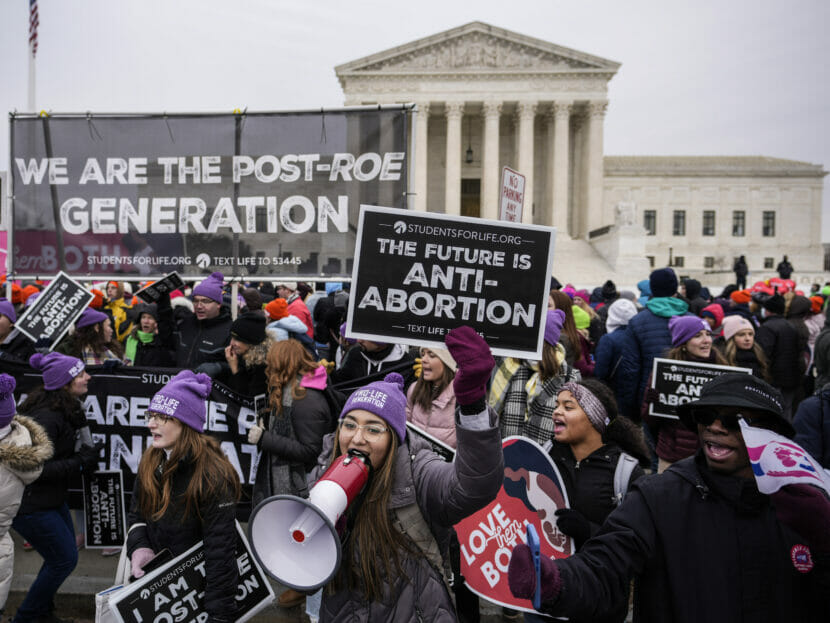
Anti-abortion activists rallied outside the U.S. Supreme Court during the 49th annual March for Life rally on January 21, 2022 in Washington, DC. The rally activists called on the U.S. Supreme Court to overturn the Roe v. Wade decision, which it did a few months later on June 24, 2022. (Drew Angerer / Getty Images)

National Right to Life is one of the nation’s oldest and most prominent anti-abortion organizations, and every summer its annual convention is held in a different U.S. city.

Last year, members were gathered in Atlanta on the very day when the news broke that the Supreme Court had overturned Roe v. Wade with the historic Dobbs ruling.

The room erupted with “a lot of tears of joy, cries of excitement,” recalled Carol Tobias, president of the National Right to Life Committee. “And then it was kind of impressive. Everybody sat back down, kept on going with the general sessions and the workshops because we knew we had work to do.”

That buckle-down and keep-at-it approach also pervaded this summer’s convention, held in Pittsburgh at an airport hotel. There were few overt victory laps. Attendees acknowledged the gains they had made in the year since the Dobbs ruling. But they were more focused on states where abortion remains legal or the societal forces that they believe contribute to women ending pregnancies that they might otherwise keep.

“We know we have a lot of challenges ahead, but our hands are untied,” Tobias told conference attendees. “This is a great day.”

Abortion opponents don’t think they’re winning

The workshops and talks at the gathering June 23-24 reflected the changed political landscape, with titles such as “Political Messaging in Post-Dobbs America” and “Pro-Life Success in the States: Strategies for the Post-Roe Era.”

There was a sense of excitement at this year’s conference due to the new legal reality, said attendee Frank Pavon: “The battle is really engaged. We no longer have that feeling of being, like, constricted, tied up.”
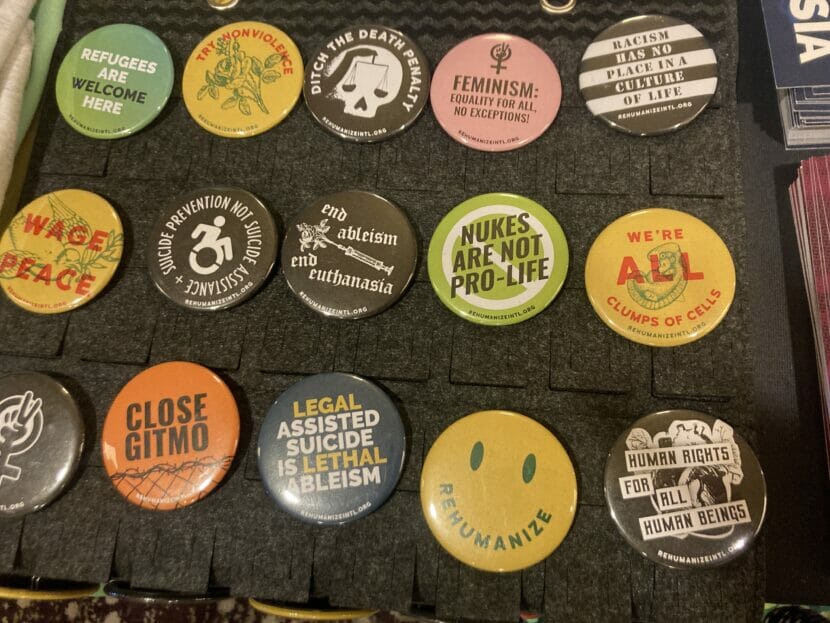
Buttons at Rehumanize International’s table at the National Right to Life conference in June. The group seeks to end “aggressive violence against humans” and espouses a mix of right- and left-leaning positions. (Sarah Boden / WESA)

Dobbs demolished a federal right to abortion, and its legality currently rests with each state. This has created a patchwork of laws that have made legislation designed to stop abortions less effective in some parts of the country.

To put a stop to this, Pavon — a controversial figure who leads the Florida-based Priests for Life — wants Congress to pass a federal ban. But he’s concerned that even the anti-abortion lawmakers in Congress appear reluctant to act. He suspects they are afraid of such a polarizing issue, so they are letting states take the lead in implementing bans. A recent NPR/Marist poll found that six in 10 Americans support abortion rights.

“Let’s look at the makeup of the next Congress,” said Pavon. “We have to see who we have and how far are they willing to go.”
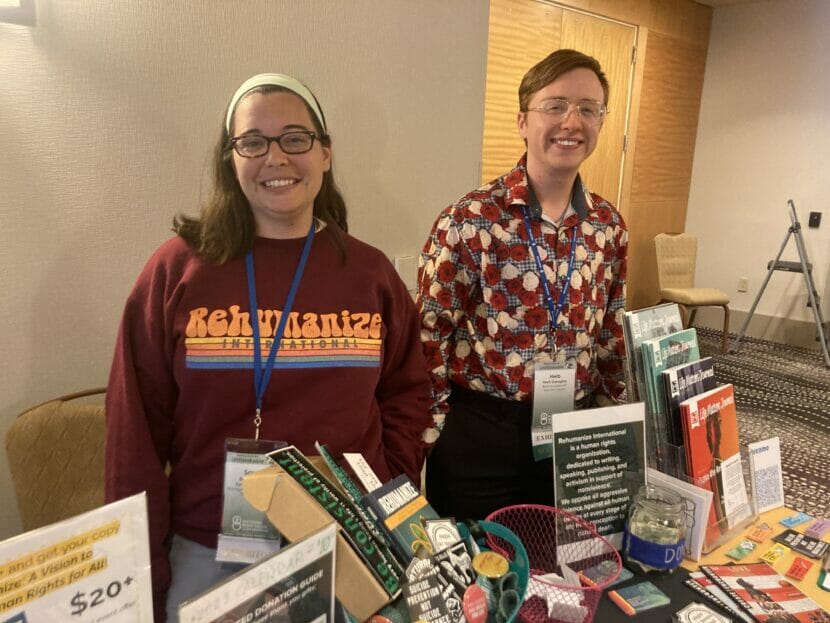
Sarah Slater (left) and Herb Geraghty are members of Rehumanize International. It’s a Pittsburgh-based secular organization that opposes abortion, as well as police brutality, capital punishment and embryonic stem cell research. (Sarah Boden / WESA)

The gathering’s keynote address was delivered by James Bopp Jr., general counsel for the National Right to Life Committee. He expressed frustration by the lack of progress in preventing actual abortions, in the year since Dobbs v. Jackson Women’s Health. Since that decision, abortions — with narrow exceptions — have been banned in 14 states. An estimated 25,000 fewer terminations occurred in the nine months following the ruling. That’s meager progress, according to Bopp, when one considers that before Dobbs, by some estimates the number of abortions was more than 900,000 a year.

“What went wrong? And how can we do something about that?” Bopp asked while speaking to a pensive crowd of anti-abortion activists in the hotel ballroom.

Bopp complained that some Democratic prosecutors refuse to enforce laws designed to curtail abortion access, while health care providers continue to stand up clinics in places like eastern Oregon and southern Illinois, just across the border from states where the procedure is illegal or more restricted.

“We have to face the reality that the world has changed, and it is strange and dramatic,” said Bopp.

Looking for new strategies in a post-Roe landscape

Abortion care has changed in the half-century since Roe first conferred a federal right to abortion up until the point of viability. Now, slightly more than half of abortions are achieved through oral medications that induce a miscarriage — usually through a two-pill regimen, which people can receive through the mail, or travel to neighboring states to pick up before returning home to terminate a pregnancy.

Bopp is infuriated by the websites, volunteers, and travel networks that have sprung up to disperse the medications to states that now ban abortion, or to help patients get to appointments at out-of-state clinics: “[There is] this incredible network of people and organizations, both financial, ideologically, who are supporting illegal abortions in your state, trafficking your women and girls,” he said.

As Bopp describes it, the anti-abortion movement is still embattled. And while Dobbs is a useful tool, it has fragmented the cause across 50 states, creating multiple fronts.
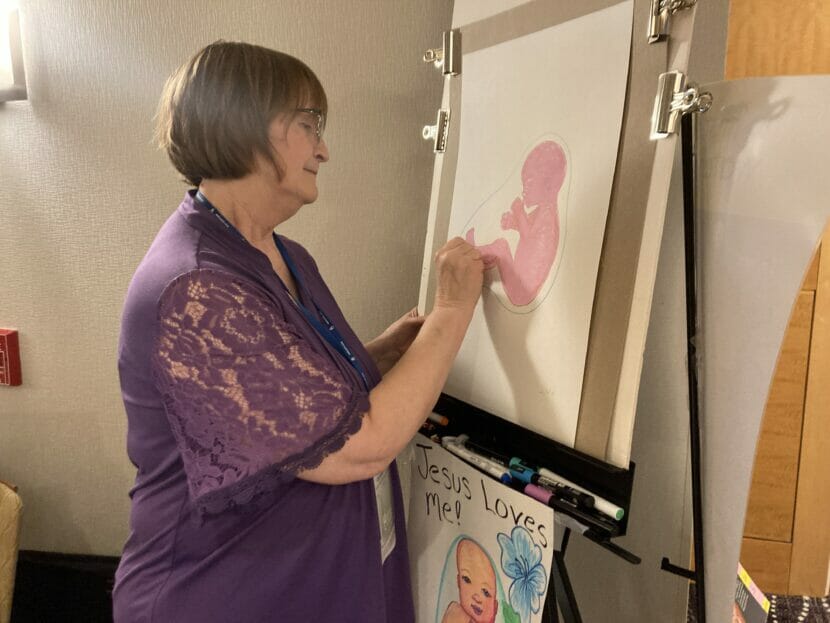
Retired art teacher Catherine Jacobs runs an anti-abortion group called Teachers Saving Children. During the conference, she created drawings of fetuses that then became raffle prizes for people who donated to her organization. (Sarah Boden / WESA)

Many of the attendees in Pittsburgh pointed out that abortion remains legal in 36 states and D.C., though gestational limits on how late in a pregnancy that an abortion can be performed vary drastically from state to state.

And legality does not equate accessibility: A researcher at Middlebury College recently found that the average American must travel 86 miles to the nearest abortion provider.

Abortion opponents also feel they have lost ground in states that strengthened abortion rights and added protections for doctors or nurses who provide abortions.

For example, New York passed legislation in June to prohibit law enforcement from cooperating with any cases that might seek to prosecute New York-based doctors who use telehealth services to deliver abortion care to patients who reside in states where the procedure is less accessible.

Those changes have been especially frustrating for anti-abortion activists living in those states.

“I don’t like to tell people I’m from New York when I’m in a pro-life venue, but I am,” said Catherine Jacobs. She lives in New York’s Chemung County, just north of the Pennsylvania border.

In the hallway outside the conference rooms, Jacobs had set up a table for her group Teachers Saving Children, a network of anti-abortion educators.

In between chatting with other attendees, Jacobs, a retired art teacher, sketched fetuses in an oversized notebook propped on an easel. These drawings then became raffle prizes for people who donate to her organization. The images were large and vivid, colored in pink and blue — Jacobs depicts some of the fetuses smiling or sucking on their thumbs.
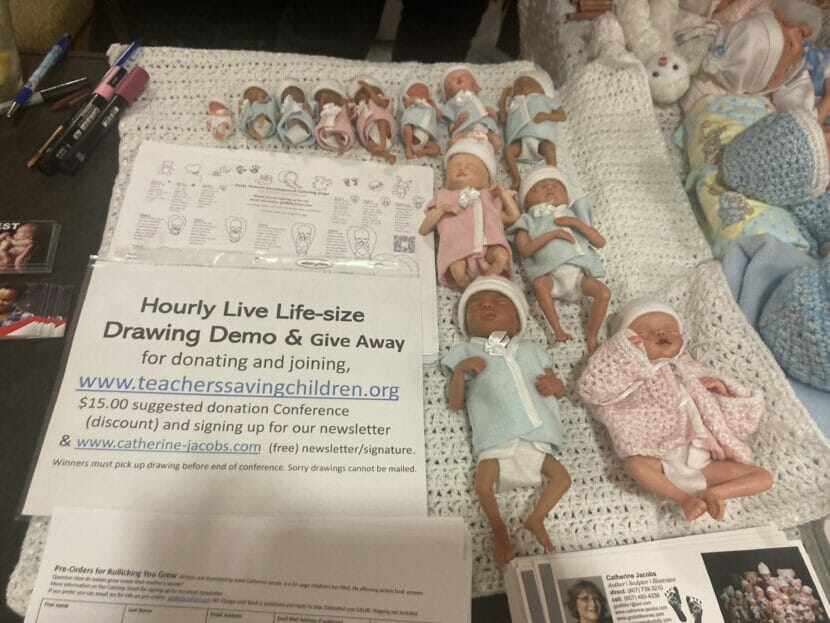
Anti-abortion activist and artist Catherine Jacobs displays some of the fetal models she makes, which are made of resin and based on figures she sculpted with polymer clay. (Sarah Boden / WESA)

Her table also exhibited fetal models at various stages of development; each wore a diaper paired with a blue or pink top. The pieces, poured from resin, are based on figures she sculpted using oven-baked clay.

Jacobs told NPR she started the project after a high-risk twin pregnancy. She also had a miscarriage before that. “I lost a baby that size. I held it in my hand,” said Jacobs, gesturing at the models. “I grieve for that child.”

Jacobs appeared heartbroken that, in her view, babies are still being killed in the U.S., despite Roe’s toppling. Through her art, she tries to show the individuality of each fetus, and maybe even convince others that abortion is a sin. There’s little else she can do in upstate New York, she said, where physicians will continue to provide abortion care for the foreseeable future.

Is a stronger safety net is key to ending abortion in the U.S.?

While a total and national prohibition of abortion is a goal for many at the conference, attendees like Destiny Herndon-De La Rosa, are focused on other strategies.

The founder and CEO of New Wave Feminists, Herndon-De LA Rosa stood out from the conference crowd in her all black outfit and straight black hair. She remembers that when the Dobbs decision was released last year, she didn’t join in with the hugging and high-fiving. Instead, she went to her hotel room and cried; she was overwhelmed by the change, she said, and also felt empathy for her friends who support abortion rights, because they felt hurt and scared by the ruling.

Herndon-De La Rosa is from Houston and describes herself as a “pro-life feminist.” In keeping with the standard anti-abortion view, she believes life starts at conception and that abortion is violence against unborn children. But she is most focused on the fact that people will continue to terminate unwanted pregnancies as long as systemic injustices — such as lack of affordable housing or health care disparities — persist in the U.S.

“Right now, fertility is absolutely a liability for females. Still. Nothing has changed other than the law,” she said.

Herndon-De La Rosa supports condom use and access to hormonal birth control, though she would like to see the development of more male birth control options, so that the burden doesn’t completely fall on women.

Herndon-De La Rosa also believes that new state laws must make room for instances when abortion is medically necessary. She’s upset with what she calls “sloppy” legislation that has been enacted without consulting physicians.

“Women will die from that,” she said.

Many other attendees also brought up the need for a stronger social safety net. One speaker, who operates a chain of state-funded anti-abortion pregnancy centers in Pennsylvania and Indiana, said the goal is to remove the “crisis” from an unplanned or so-called “crisis pregnancy,” by giving a person the support and resources they need to have the child.

In addition to more taxpayer-funding for these pregnancy centers, Maria Gallagher, the legislative director for the Pennsylvania Pro-Life Federation, said people also need to be able to earn a living wage, and have access to educational opportunities and health care.

“We need to have those conversations now because we’re in the post-Roe era,” said Gallagher. “If we don’t have them now, when are we going to have them?”

Copyright 2023 90.5 WESA. To see more, visit 90.5 WESA.

Researchers found a rare octopus nursery off the coast of Costa Rica

Researchers found Muusoctopus nursery grounds on a low-temperature hydrothermal vent off the shore of Costa Rica. (Schmidt Ocean Institute)

Scientists working off the coast of Costa Rica say they’ve discovered the world’s third known octopus nursery.

The international 18-person research team found the site nearly 2 miles below sea level and believe that in the process they may have also discovered a new species of Muusoctopus, a genus of small to medium sized octopus lacking an ink sack.


View this post on Instagram


A post shared by NPR (@npr)

“The discovery of a new active octopus nursery over 2,800 meters beneath the sea surface in Costa Rican waters proves there is still so much to learn about our Ocean,” Dr. Jyotika Virmani, executive director of the Schmidt Ocean Institute, said in a statement.

According to a press release, researchers witnessed Muusoctopus eggs hatch. They said it demonstrated that the area, known as the Dorado Outcrop, was hospitable to young octopuses.

Scientists working off the coast of Costa Rica say they’ve discovered the world’s third known octopus nursery. (Schmidt Ocean Institute)

When the Dorado Outcrop — an area roughly the size of a football field — was first discovered in 2013, researchers believed octopuses couldn’t grow there because they didn’t observe any developing embryos at the site.

Scientists said the discovery also indicated that some deep-sea octopus species brood their eggs in low-temperature hydrothermal vents, such as the one where the nursery was discovered, where fluid heated in the Earth’s crust is released on the seafloor — like hot springs.

Researchers found Muusoctopus nursery grounds on a low-temperature hydrothermal vent off the shore of Costa Rica. (Schmidt Ocean Institute)

The research vessel for the trip was provided by the Schmidt Ocean Institute, a nonprofit research organization founded by former Google CEO Eric Schmidt and his wife, Wendy.

The trip was led by Beth Orcutt of the Maine-based Bigelow Laboratory for Ocean Sciences as well as Jorge Cortes of the University of Costa Rica.

According to the researchers, areas like the Dorado Outcrop are still vulnerable to human activities such as fishing, and some Costa Rican scientists on the trip were trying to discern if the underwater seamounts should be legally protected.

“The information, samples, and images are important to Costa Rica to show its richness and will be used for scientific studies, and outreach to raise awareness of what we have and why we should protect it,” Cortes said.

Copyright 2023 NPR. To see more, visit https://www.npr.org.

Men are hunters, women are gatherers. That was the assumption. A new study upends it.

A group of young women from the Awa people in Brazil hold their bows and arrows as they return from a hunt. A new reexamination of ethnographic studies finds female hunters are common in hunter-gatherer societies. (Scott Wallace/Getty Images)

For decades, scientists have believed that early humans had a division of labor: Men generally did the hunting and women did the gathering. And this view hasn’t been limited to academics. It’s often been used to make the case that men and women today should stick to the supposedly “natural” roles that early human society reveals.

Now a new study suggests the vision of early men as the exclusive hunters is simply wrong – and that evidence that early women were also hunting has been there all along.

Specifically, the new research upends one of the key strands of evidence that scientists have relied on to infer what life was probably like during the period that started roughly 200,000 years ago, when homo sapiens first emerged as a species.

Direct evidence is limited because that phase ended about 9,000 years ago, as people slowly began to develop agriculture and settlements. But all over the world, there have been groups, often in remote areas of low- and middle-income countries, who still live a hunting and foraging life. So scholars look to them as a sort of window into humanity’s past. Anthropologists and other specialists have gained these groups’ permission to live alongside them and have produced detailed observational reports.

Until now, the general sense among scientists has been that these accounts overwhelmingly pointed to men mainly hunting and women mainly gathering, with only occasional exceptions, says Robert Kelly, professor of anthropology at the University of Wyoming and the author of influential books and articles on hunter-gatherer societies.

But Kelly says that the views he and others held of the typical gender divisions around hunting were based on anecdotal impressions of the reports they’d been reading, combined with the field work many had engaged in personally. “No one,” says Kelly, had done a systematic “tally” of what the observational reports said about women hunting.

Enter the researchers behind the new study: a team from University of Washington and Seattle Pacific University. “We decided to see what was actually out there” on hunting, says the lead researcher Cara Wall-Scheffler, a biological anthropologist.

A fresh look at old evidence

Wall-Scheffler and her collaborators combed through accounts from as far back as the 1800s through to present day. And rather than relying on summaries of those accounts – as scientists often do when analyzing large numbers of them – Wall-Scheffler notes “our goal was to go back to the original ethnographic reports of those populations and see what had actually been written about the hunting strategies.”

Their findings — published in the journal PLOS One this week — is that in 79% of the societies for which there is data, women were hunting.

Moreover, says Wall-Scheffler, this wasn’t just opportunistic killing of animals that the women happened upon. The vast majority of the time, she says, “the hunting was purposeful. Women had their own toolkit. They had favorite weapons. Grandmas were the best hunters of the village.”

In other words, “the majority of cultures for whom hunting is important train their girls and their women to make their tools and go hunting,” she says. Wall-Scheffler says she was expecting to find evidence of women hunting – but not to this extent. “That piece has just been really underappreciated,” she says, “even though it’s right there in literature.”

The implications of these results are potentially enormous, says Kimberly Hamlin, a professor of history at Miami University in Oxford, Ohio who specializes in ways that evolutionary science has figured in the wider culture.

“I think that next to the myth that God made a woman from man’s rib to be his helper, the myth that man is the hunter and woman is the gatherer is probably the second most enduring myth that naturalizes the inferiority of women,” says Hamlin.

It has fueled the idea, she says, that “men are supposed to be violent, they’re supposed to be aggressive – one of the core elements in the soup of toxic masculinity” used to excuse damaging male behaviors, including rape.

The popular narrative of man as the sole – or at least almost exclusive – hunter has also been used implicitly and even explicitly to argue for policies that prioritize men’s role as the “natural breadwinner” – and that also limit them to that role by, for instance, denying them paternity leave, adds Hamlin.

By the same token, she maintains, “this idea that somehow women are naturally preordained to be caretakers and maternal figures, whether they like it or not,” often underlies policies that effectively “force motherhood on women” – including policies that restrict access to abortion and contraception.

So the new study’s findings are “thrilling,” concludes Hamlin. “It’s really going to encourage us to call into question a lot of these ideas about what men and women are supposedly naturally like.”

For scientists, a shifting narrative about hunters

As to how consequential the study’s findings are for science, scholars say they add to a body of evidence that has been building for years.

Kelly says that notwithstanding the endurance of stereotypes around early human hunting in popular culture, scientists had already moved to a more nuanced picture.

As far back as the mid-1960s, says Kelly, scientists were coalescing around evidence that most of the diet in hunter-gatherer societies has come from plant food gathered by women. “People were saying, ‘We should call them ‘gatherer-hunters’ to emphasize that.’ ”

By the 1980s, adds Kelly, many more women had entered the field of anthropology. Compared to their male predecessors, these women scientists were often able to gain more access to women in foraging societies. The result was a slew of new descriptions of women’s activities – including more accounts of women hunting.

So Kelly’s initial reaction to Wall-Scheffler’s study is that, while its organization and tabulation of the data is “genuinely new and useful,” when it comes to the picture it paints of the hunting practices of women, “there wasn’t anything that struck me as eye-opening. I sort of knew all of this.”

Yet one finding did stick out to Kelly. He says that the current consensus view holds that even when women do some hunting, they engage in a very different form of hunting than the kind done by men.

“The general pattern is that men intentionally go out to hunt large game,” says Kelly. “And women intentionally go out to gather plant food and also intentionally or opportunistically will hunt the smaller, more reliably-gathered game” – meaning animals like lizards and rabbits.

By contrast, the new study found that in a third of societies for which there is data, the women hunt large game. In other words, they do go after the kind of big mammals associated with the stereotype of male hunters.

“I would consider that something new,” Kelly concedes, adding “I’d really like to go look at those ethnographies” that were the source.

Vivek Venkataraman of the University of Calgary is another anthropologist expressing doubts.

He notes that Wall-Scheffler and her colleagues had to limit themselves to societies for which there were explicit accounts of not just hunting practices, but precisely who was doing the hunting. The result is that the study is based on observations of 63 groups.

“But of course there are several hundred foraging societies,” says Venkataraman. “We need to know what’s going on there before we can draw any sweeping conclusions.”

Key clues that were overlooked

Randy Haas disagrees with the critics of the study. An anthropologist at Wayne State University, Haas notes that the societies Wall-Scheffler’s study analyzes are well distributed across the globe. Furthermore, says Haas, “more data is not always better. My sense is that [the evidence used in the study] is a well-structured, high quality sample that is actually more likely to yield a reliable result than a larger sample of lower quality observations.”

What’s more, Haas says, his own experience illustrates how the “near universal” view of men as the sole big-game-hunters may be warping researchers’ ability to recognize data to the contrary. In addition to creating blind spots in the understanding of modern hunter-gatherer societies, Hass says it also appears to have led scientists to overlook key clues from the other main source of evidence on early humans: ancient burial sites and the human remains and artifacts found there.

In 2018 Haas was part of a team in Peru that found a 9,000-year-old person buried with an unusually large number of hunting tools. “We all just assumed this individual was a male,” he recalls. “Everybody is sitting around, saying things like, ‘Wow! This is amazing. He must have been a great hunter, a great warrior. Maybe he was a chief!’ ”

Haas didn’t even think to question the person’s gender until about a week later, when a colleague who specialized in analyzing bone structure arrived and delivered a bombshell assessment: The remains seemed to be female.

The team then used a technology newly available to the field. Scraping the enamel from the teeth found in the grave, they found proteins that confirmed it unequivocally: This apparent master hunter was female.

Stunned, Haas and his collaborators decided to review the records of similar finds across the Americas over the previous 70 years. In 27 gravesites of individuals found with hunting tools, they found 11 cases in which the person was female.

They ran a statistical analysis that finds that this ratio is associated with the probability that between 30-to-50% of individuals buried with hunting tools in ancient American gravesites are female. In other words, says Haas, “Large mammal hunting during this time in the Americas was a gender neutral activity, or at least nearly so.”

Why did this take so long?

Why hadn’t these findings commanded the world’s attention sooner?

Haas says in one of the excavation records he and his collaborators re-analyzed – the 11,000-year-old remains of a female found in the 1970s with a pointy stone tip laid under her head – the scientists who had originally uncovered the grave had effectively ignored their own discovery.

Says Haas, “They had written something to the effect of, ‘Had this [pointy stone] been associated with a male we would have assumed this to be a hunting weapon. But given its association with a female, its use as a kitchen tool would make more sense.” Haas and his co-authors decided it should be reclassified as a hunting tool.

Yet what’s even more notable, says Haas, is that in all but one other case, his team did not need to revise the conclusions of the original excavators: Those scientists had already determined that the individuals they’d found were females buried with hunting weapons. Just as with the findings in Wall-Scheffler’s study, the archaeological evidence had been available the whole time – hiding in plain sight.

“Everybody had just taken this man-the-hunter hypothesis for granted. So no one really decided to evaluate it,” says Haas. “It wasn’t really a question on a lot of people’s minds.”

But Cara Wall-Scheffler had seen Haas’s findings, and they were precisely what prompted her to launch her review of the modern-day accounts.

Wall-Scheffler says the episode offers a reminder of why it’s so important to ensure the scientific community includes people of diverse backgrounds.

“The preconceptions that we all have when we look at a data set really shape the outcome,” she says. “I’m really hoping that people take second looks at some of the data that they already have to see what new questions we can ask.”

Copyright 2023 NPR. To see more, visit https://www.npr.org.

Supreme Court guts affirmative action, effectively ending race-conscious admissions

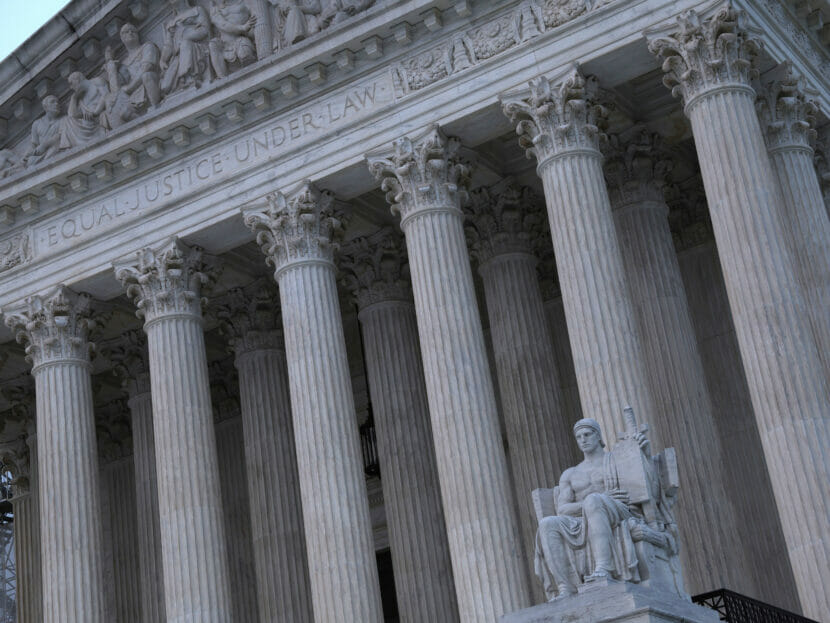
A view of the U.S. Supreme Court in Washington, D.C., on June 5. (Alex Wong/Getty Images)

Follow NPR’s live coverage for the latest updates and reaction to this ruling

The U.S. Supreme Court has found that Harvard and the University of North Carolina’s admissions policy violated the equal protection clause of the 14th Amendment.

The decision reverses decades of precedent upheld over the years by narrow court majorities that included Republican-appointed justices. It could end the ability of colleges and universities — public and private — to do what most say they still need to do: consider race as one of many factors in deciding which of the qualified applicants is to be admitted.

Chief Justice John Roberts, a longtime critic of racial preferences of any kind, wrote the court’s majority decision saying that the nation’s colleges and universities must use colorblind criteria in admissions.

“The Court has permitted race-based college admissions only within the confines of narrow restrictions: such admissions programs must comply with strict scrutiny, may never use race as a stereotype or negative, and must—at some point—end,” the court wrote in its majority opinion. “Respondents’ admissions systems fail each of these criteria and must therefore be invalidated under the Equal Protection Clause of the Fourteenth Amendment.”

The ruling in the UNC case was 6-3 along ideological lines; in the Harvard case, it was 6-2, with Justice Ketanji Brown Jackson recusing.

The majority added: “At the same time, nothing prohibits universities from considering an applicant’s discussion of how race affected the applicant’s life, so long as that discussion is concretely tied to a quality of character or unique ability that the particular applicant can contribute to the university. Many universities have for too long wrongly concluded that the touchstone of an individual’s identity is not challenges bested, skills built, or lessons learned, but the color of their skin. This Nation’s constitutional history does not tolerate that choice.”

Chief Justice Roberts explicitly exempted military academies from this ban on race-conscious admissions “in light of the potentially distinct interests” they may present.

In furious dissents, the court’s liberals pilloried the majority’s reasoning and its view of racial reality in the United States.

“The Court subverts the constitutional guarantee of equal protection by further entrenching racial inequality in education, the very foundation of our democratic government and pluralistic society,” Justice Sonia Sotomayor wrote.

Added Justice Ketanji Brown Jackson: “With let-them-eat-cake obliviousness, today, the majority pulls the ripcord and announces ‘colorblindness for all’ by legal fiat. But deeming race irrelevant in law does not make it so in life. And having so detached itself from this country’s actual past and present experiences, the Court has now been lured into interfering with the crucial work that UNC and other institutions of higher learning are doing to solve America’s real-world problems.”

Thursday’s decisions are likely to cause ripples throughout the country, and not just in higher education, but in selective primary and secondary schools like Boston Latin in Massachusetts, Thomas Jefferson high school in Virginia, and Bronx High School of Science in New York. Similarly, the decision will almost certainly facilitate legal challenges to minority scholarship and fellowship programs, and ultimately, effects will be felt on a much larger scale in employment, and elsewhere. Indeed, almost every business or institution in America has some sort of a race-conscious program, at least to facilitate race relations.

But Edward Blum, who for decades has been a one-man crusader against everything from the Landmark 1965 Voting Rights Act to affirmative action in higher education, plans to challenge some corporate boards on racial preference grounds, and he says he knows of other plans to challenge minority scholarship and fellowship programs.

“It’s going to open a Pandora’s box across the country and across institutions and industries,” said Harvard co-counsel Bill Lee in an NPR interview last fall.

The court’s decisions came in cases involving two elite institutions, one the oldest public university–the University of North Carolina–and the other, the oldest private university, Harvard. Blum, the anti-affirmative activist, likely chose these highly visible schools as his legal targets precisely because of their elite status.

UNC did not admit Black undergraduates until 1955, and then only after it was ordered to by the federal courts. Harvard, by contrast, became the model for affirmative action programs in 1978 when the Supreme Court cited the school’s consideration of race as similar to other traits the school relied on to ensure a diverse student body. Thus, the court said back then that race could be one of many factors that the school considered, just as other characteristics were considered– geography, or being raised on a farm, or special achievements in everything from science to athletics, or being a so-called “legacy student,” the son or daughter of someone who attended Harvard.

That system, reaffirmed twice by the Supreme Court, has remained in place not just at Harvard, but at most of the institutions of higher learning across the United States. Until Thursday, when the court, as it did last year in the abortion case, upended decades of its own precedents.

The court’s conservatives said that the Constitution and the nation’s civil rights laws bar both public and private colleges and universities from using any consideration of race in choosing which students are offered admission.

The court majority made clear that it agreed with Students For Fair Admissions, which sued Harvard and UNC, claiming, among other things, that the schools discriminated against Asian American students who had SAT and grade scores higher than any other racial group, including whites, and who made up, at Harvard, for instance, 29% of the entering class last year. SFFA asserted that the number should have been higher than that, though Asians are just 7.2 per cent of the U.S. population.

Harvard, in defending its current iteration of affirmative action, noted that each class has only 1,600 slots, but, by the numbers, it has thousands of equally qualified applicants. In the class of 2019, for instance, it had 35,000 applicants, 3,700 of them with perfect math SAT scores; 2,700 with perfect verbal SAT scores, and more than 8,000 with perfect grade point averages. There are no similar figures for the most recent incoming class at Harvard, but the number of applicants in 2023 has nearly doubled in the last four years.

The reaction to Thursday’s decision may be consternation in some quarters, but public opinion on affirmative action is not like abortion, a subject on which virtually every poll shows the public completely at odds with the court. Public opinion on affirmative actions is more nuanced and more mixed. Polls on the subject conflict: some show upwards of 60% approval for affirmative action programs, and others show less than 50% support.

Indeed, in liberal California, for instance, 57% of voters in 2020 cast their ballots against reinstating affirmative action in the state’s public colleges and universities.

Generally, polls show that public support for affirmative action has grown in recent years, but voters are conflicted on the subject, with the outcome depending on how the question is asked. A recent Washington Post-Schar School Poll found that 6 in 10 Americans say race should not be considered in college admissions. But when the question was asked a slightly different way, the numbers showed big majorities endorsing programs to boost racial diversity on campuses.

And yet no alternative to affirmative action has worked as well as some consideration of race.

College admission administrators say schools that have tried to raise the numbers of black and Latin0 students without any consideration of race have found that no other criterion — class, or economic status, or programs like a guarantee of admission for students in the top 5 or 10% of their high school class–works as well.

“The research is exceptionally clear,” University of Texas professor Stella Flores, whose specialty is higher education and public policy, told NPR in an interview last fall. “There’s no other alternative method that will racially diversify a student body, other than the use of race as one factor of consideration.”

Copyright 2023 NPR. To see more, visit https://www.npr.org.

Global heat waves show climate change and El Niño are a bad combo

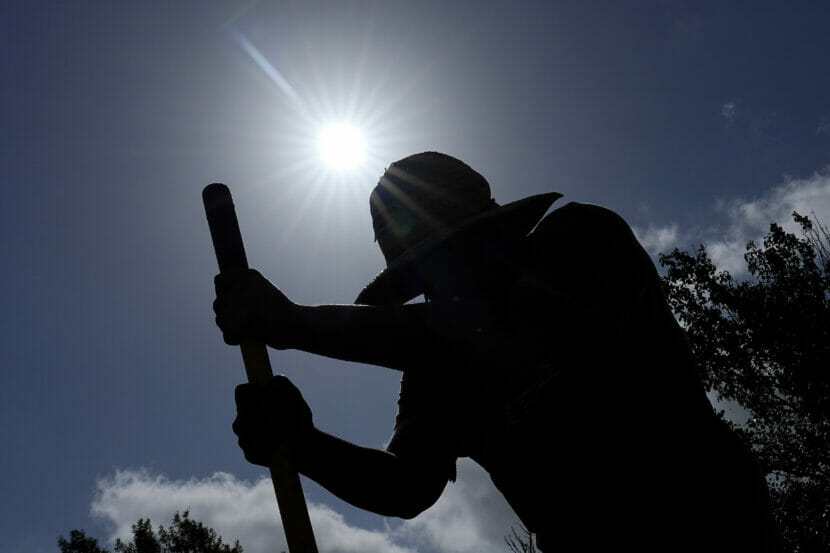
Outdoor workers are vulnerable to prolonged heat waves like the one hitting Texas, which climate scientist warn are becoming more common. (David J. Phillip/AP)

If there’s one kind of weather extreme that scientists clearly link to climate change, it’s worsening heat waves.

“They are getting hotter,” says Kai Kornhuber, adjunct scientist at Columbia University and scientist at Climate Analytics, a climate think tank. “They are occurring at a higher frequency, so that also increases the likelihood of sequential heat waves.”

In Texas, the Southern U.S. and Mexico, a three-week heat wave has gripped the region with temperature records falling for days in a row. Extreme heat has also hit India, China and Canada, where widespread wildfires are burning.

“Most of the world’s population has experienced record-breaking heat in recent days,” says Daniel Swain, climate scientist at the University of California-Los Angeles.

This year, something else is adding fuel to the fire: the El Niño climate pattern. That seasonal shift makes global temperatures warmer, which could make 2023 the hottest year ever recorded.

Longer heat waves are more dangerous

Heat waves are already the deadliest weather-related disaster in the U.S. Not only do extreme temperatures cause heat exhaustion and severe dehydration, it also raises the risk of having a heart attack or stroke. Those risks are even higher in neighborhoods that are lower-income and communities of color, where research has found temperatures are hotter than in white neighborhoods.

Temperatures in the weather report also don’t tell the whole story about the danger. With higher humidity, the toll that heat takes on the human body is much more taxing. Weather forecasters try to capture that with a heat index warning, which shows what the temperature actually feels like. But that’s only calculated for someone sitting in the shade, underestimating the risk for outdoor workers and others in the sun.

In recent years, scientists have done rapid assessments to determine how heat waves are being influenced by climate change. In several, they found the extreme temperatures were nearly impossible without climate change, like in the Mediterranean in April, in the Pacific Northwest in 2021, and in the United Kingdom in 2022.

El Niño is the exclamation point

This year, the planet also made a seasonal shift to an El Niño pattern. It starts when the ocean in the central and eastern Pacific warms up. That extra heat alters weather patterns, raising the temperatures globally.

“That’s its role in the global climate system – is moving some of the energy up from depth and dumping it into the atmosphere,” Swain says.

With El Niño just getting started this year, it’s likely the full effect isn’t being felt yet in heat waves or rainfall patterns. Typically, the Southern U.S. gets wetter and the Northern U.S. gets drier.

“That lag is because it takes some time for that extra heat near the surface of the ocean to actually make it into the atmosphere and be moved around by wind currents,” Swain says.

Climate experts say signs point to a strong El Niño this year, which could break global temperature records. The past 8 years have already been the hottest since record-keeping began, and 2016, the hottest ever recorded, was also a year with a powerful El Niño.

“Even if it’s not going to be the hottest on record, we’re certainly seeing the warmest decade so far,” Kornhuber says. “That alone should already be worrying enough.”

If the world continues emitting fossil fuels, these kinds of heat events are expected to become far more likely. Even if the world can meet its goal of limiting warming to 1.5 degrees Celsius (2.7 Fahrenheit), extreme heat waves still are likely to be more than eight times more common than they once were.

“The long-term driver is human-caused climate change where we’re sort of stair-stepping up along that inexorable upward trend,” Swain says. “El Nino represents the exclamation point on that trend.”

Copyright 2023 NPR. To see more, visit https://www.npr.org.

US pedestrian deaths reach a 40-year high

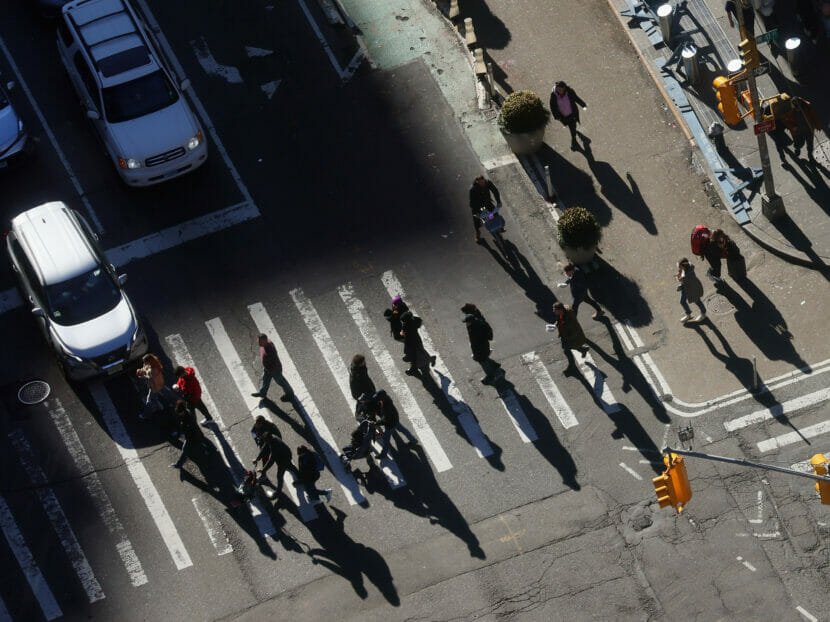
In 2022, drivers struck and killed the highest number of pedestrians since 1981. (Bruce Bennett/Getty Images)

A new study paints a grim picture of American roads: every day, 20 people walk outside and end up killed by a moving vehicle.

“There are more pedestrians being killed today than in decades,” Russ Martin, the senior director of policy and government relations at the Governors Highway Safety Association, told NPR.

The organization, which tracks pedestrian deaths in the U.S., estimates that more than 7,500 pedestrians were killed by drivers last year — the highest number since 1981. The final tally may be even greater given that Oklahoma was unable to provide data due to a technical issue.

Pedestrian deaths have been climbing since 2010 because of unsafe infrastructure and the prevalence of SUVs, which tend to be more deadly for pedestrians than smaller cars, according to Martin. When the pandemic arrived, there was an even greater surge as empty roads gave way to speeding and distracted driving.

The pandemic has waned, but cases of reckless driving — and subsequently the number of Americans killed while walking — has not. The new data, released on Friday, shows the U.S. continues to lag in its effort to improve road safety, even as experts say some solutions are within reach.

States below the Sun Belt ranked as having the highest rate of pedestrian deaths in 2022

For the seventh year in a row, New Mexico was ranked as the most dangerous state for pedestrians.

Arizona and Florida were also placed in the top spots for having high rates of pedestrian deaths in GHSA’s estimates.

It is not a coincidence that all three states are situated below the country’s Sun Belt. Martin said Southern states tend to see more traffic deaths but it is not exactly clear why.

There are multiple theories: in bigger states, communities are more spread out and as a result, people need to drive more to get around, he said. Another possibility is that Southern states have better weather and people spend more time outside.

“This is all just conjecture, but I think it’s certainly worthwhile to take a closer look into what’s going on in those states,” he added.

Local lawmakers can implement traffic calming measures today

Traffic safety has been an uphill battle in the U.S. for years but there are strategies at lawmakers’ disposal to address the crisis today, according to Peter Norton, a professor at the University of Virginia who has studied the history of driving in America.

“The best things we can do will take years, but there are some things we can do now, they don’t cost much money and they make a big difference,” he said.

For instance, implementing sharp corners instead of round curves at the end of roads forces drivers to slow down to turn and therefore prevents speeding. That technique, along with adding pedestrian islands and large sidewalk bulb-outs, is known as “traffic calming.”

Norton said installing speeding and red light cameras can also be effective if they work properly. Adding bike lanes can also keep drivers more alert on the road.

Lowering speed limits is also an important step but only if it is enforced and used alongside other safety measures. Norton warned that roads with a mix of different vehicle speeds tend to be more dangerous.

There are also some local and regional measures the GHSA pointed to that could help prevent deaths.

In Hawaii, police officers are stationed in areas that have seen a higher volume of crashes or foot traffic to look out for reckless driving.

And in Idaho, the state’s highway safety office gave out walk audits for community members to identify safety concerns on the street. Local officials then use the results to improve the walkability of neighborhoods.

Copyright 2023 NPR. To see more, visit https://www.npr.org.

Site notifications
Update notification options
Subscribe to notifications