Local crime and crime prevention are the subjects of a meeting city officials are hosting for the public Tuesday night.
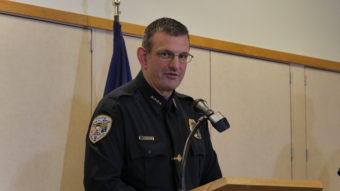
At the meeting, Juneau Police Chief Bryce Johnson will discuss some of the driving forces behind crime in the community, and how the police are responding.
Residents and business owners will also get advice on how to protect their property.
The meeting is at 7 p.m. Tuesday in Assembly Chambers at City Hall. Contact the City Manager’s Office at 586-5240 for more information.
Jayme Johns is a CCFR engineer and he's the department's water rescue team lead. He led the workshop Saturday. (Photo by Quinton Chandler/KTOO)
The CCFR water rescue team prepares to demonstrate how to escape from a hole in the ice. (Photo by Quinton Chandler/KTOO)
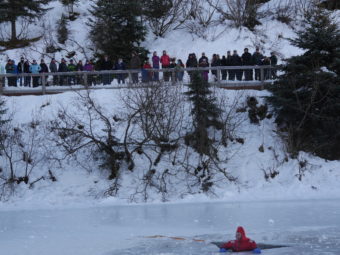
Two members of the CCFR water rescue team simulate an escape from a hole in the ice at the Mendenhall Glacier Recreation Area on Saturday. (Photo by Quinton Chandler/KTOO)
Visitors walk on the frozen Mendenhall Lake. (Photo by Quinton Chandler/KTOO)
Visitors walk across the frozen Mendenhall Lake, Saturday. (Photo by Quinton Chandler/KTOO)
Avoid thin ice. That’s the first piece of advice. But if you do fall through and find yourself in ice water, Capital City Fire/Rescue Engineer Jayme Johns wants you to keep a cool head.
“Stay calm. It is very hard to stay calm, especially in that water, it’s going to take your breath away,” Johns said. “If you remain calm, your chance of survival is a lot better for rescue to come get you if you’re still conscious.”
He relayed this to a full auditorium inside the Mendenhall Glacier Visitor Center on Saturday afternoon.
Thin ice is a common danger during winter and surviving a fall through it isn’t as simple as just pulling yourself out.
For at least the past five years, Juneau’s Capital City Fire/Rescue has used a special workshop to warn people about walking over frozen water and they’ve demonstrated how to escape a fall.
In the dead of winter when the water looks frozen solid, crossing Mendenhall Lake outside the visitor center is a tempting shortcut to an up close look at Mendenhall Glacier and its stunning blue ice caves.
But, it can also be a perfect nature-trap.
The audience at the CCFR ice safety training at Mendenhall Glacier Visitor Center on Saturday. (Photo by Quinton Chandler/KTOO)
During the presentation, the audience learned they have just a few minutes to escape freezing water under their own steam before their energy is drained.
They were advised to return to the place they fell in, level out their bodies, kick the water hard to help push themselves onto solid ice and roll away instead of standing up immediately.
But Johns said if someone can’t escape by themselves, they should focus on staying above water and waiting to be rescued.
“(The) state of Alaska has numerous cases of people that have been submerged in water or hypothermic for hours — clinically hypothermic, core temperature way down in the low 90s and they made a full recovery,” he said.
Johns said this winter, CCFR has heard several reports of people breaking through ice, but the department hasn’t come out to rescue anyone, yet.
Sheila Fullbright, left, and Karen Smith, right. (Photo by Quinton Chandler/KTOO)
Karen Smith came to the workshop with a friend and she wasn’t too embarrassed to admit she’s been rescued by CCFR. Twice.
“Trying to get to the ice caves, unfortunately. Once our boat turned over and once (because) our daughter has a heart condition,” Smith said. “So, I always want to learn as much about safety as I can, because they’ve helped us a lot. Alaska can be a very dangerous place for sure.”
In both of those rescues, Smith said the lake wasn’t frozen but the water was still cold.
“I think it was still 30 something, maybe 40 degrees. It was very cold. I can see why people could die very quickly,” she said.
Smith and her friend Sheila Fullbright were both impressed by the amount of useful information they got from the workshop.
Fullbright said, “I didn’t know about when you get out, rolling out and going the direction that you came. That’s a really good thing because I would’ve been like, ‘Yeah, (I’m) just getting out.”
Smith added, “Also about watching for the layers of ice and about how it’s really unsafe, I knew at the face of the glacier, I knew at the waterfall, but I didn’t know that Skater’s Cabin was really unsafe, with the rocks heating up from the sun.”
“She just made me go to Skater’s Cabin, like last week,” Fullbright said.
“I was like, ‘Girl …!’”
A member of the CCFR water rescue team voluntarily went into the icy water to demonstrate how to escape. (Photo by Quinton Chandler/KTOO)
Outside the visitor center, a CCFR water rescue team demonstrated how to escape a hole in an icy pond alone. They also showed how others can help by using rope or a long object like a branch.
As a parting piece of advice, Johns asked people to stay away from weak ice.
“The ice is always unsafe at the face of the glacier, at Nugget Falls, and out by the lake where it dumps into the Mendenhall River,” Johns said.
He said if you’re unsure about a patch of ice, trust your gut and turn back the way you came.
When asked if she would keep walking on the ice after attending the workshop, Karen Smith laughed and said, “I did this morning.”
She said it was her fourth attempt but she finally made it out to the ice caves.
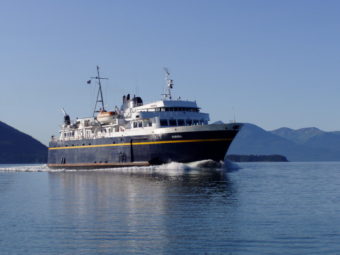
Weekend ferry service from Juneau to Haines and Skagway has been disrupted by windy conditions in Lynn Canal.
Alaska Department of Transportation spokesman Jeremy Woodrow said scheduled sailings for the ferry Aurora on Friday and Sunday were canceled after forecasts for high winds.
“Those high winds bring with (them) freezing spray and that provides danger to the life rafts on that vessel,” Woodrow said.
The National Weather Service reported wind speeds up to 55 knots in Lynn Canal this weekend with heavy freezing spray and seas reaching 15 feet.
Friday’s cancellation prevented the Thunder Mountain High School basketball team from reaching a tournament in Skagway.
Woodrow said the ferry Kennicott will sail to Haines and Skagway, Monday. He said the Kennicott is better suited to travel in high winds and seas.
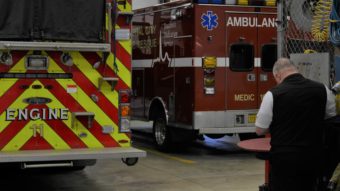
Capital City Fire/Rescue Assistant Chief Tod Chambers in the apparatus bay of the Juneau Fire Station in downtown on Saturday. (Photo by Quinton Chandler/KTOO)
At the Juneau Fire Station downtown on Saturday, Assistant Chief Tod Chambers politely agreed to show and tell. Chambers said the station was minimally staffed; two people for the fire engine, two for an ambulance.
“So if we were staffed to meet the national standards, we could get by with two on the ambulance, we’d have four on the truck, four on the engine,” he said.
That’s 10 people – and Juneau can’t afford that. He said it’s the same at a lot of stations.
The real problem is Capital City Fire/Rescue has seen modest growth in emergency calls for years and 2016’s increase ballooned to almost 12 percent. By the new year, CCFR officials expect to have responded to about 500 more calls than last year.
The numbers on CCFR calls by category. (Table courtesy CCFR)
CCFR calls by category for 2016. (Graphic courtesy CCFR)
The additional calls are pressing CCFR to its limits.
“Emergency medical incidents, structural fires, fire alarms; some of the stuff we’ve seen go up, go down, but overall we’re up and that’s a dramatic increase,” Chambers said.
Most of that increase came from medical calls, but Chambers doesn’t know what’s driving it. Fire alarms are one of the areas the department saw a significant decrease in.
Chambers used to work in Fairbanks and he said when his department was overburdened, they’d ask for help from neighboring communities. But that won’t work in Juneau because of its isolating geography.
Volunteer firefighters help, but Chambers said there aren’t enough people who can give the time.
That means Juneau’s firefighters just have to grit their teeth and get stretched thin, sometimes too thin.
Chambers said stacked calls are one of the downtown station’s biggest problems.
“For instance last week, in a 10-minute span, we had six calls in a row – in 10 minutes,” he said.
“We have two ambulances, and these are all medical calls. So, there’s no way we could meet the demand.”
Assistant Chief Tod Chambers at the Juneau Fire Station downtown on Saturday. (Photo by Quinton Chandler/KTOO)
Juggling the station’s resources in situations like that is Chambers’ job. He said they try to put the most serious calls first.
“And that’s why stacked calls are problematic,” he said.
“If we have a series of stacked calls and they’re all priorities, who gets it first? Then you have to go to first come, first serve and people wait.”
Stacked calls on top of a structure fire are Chambers’ nightmare. The department responded to 30 structure fires this year.
That’s not a lot, but Chambers said when a building lights up, the department needs all hands on deck to handle it safely. If a medical call comes in during a fire, it could get dicey.
“We’ve dodged some bullets there, absolutely, and been fortunate we didn’t have multiple calls stacking up on top of a fire. It happens though and it’s not good,” Chambers said.
He is fully aware that the community pays CCFR to serve them.
“We take that very seriously, but we simply are running out of resources to do it,” he said.
Fire Chief Rich Etheridge at the Juneau Fire Station in downtown on Tuesday. (Photo by Quinton Chandler/KTOO)
Fire Chief Rich Etheridge said he needs to put one additional ambulance in play to fight the increase. He has the ambulance. To run it every day, he needs six more firefighters.
“So you’re looking at $600,000 just in staffing,” he said.
But it’s hard for the City and Borough of Juneau to come up with that money. Etheridge said CCFR has an $8 million budget.
He’s working with the state to get more federal money into Alaska to cover medical costs fire departments can’t recover from patients.
“So what this program does is it allows us to bill the federal government for those unrecoverable costs,” he said. “Looking at some preliminary numbers, we think we could bring another million dollars back into the Juneau CBJ budget.”
Etheridge said that would make it a lot easier to pay for more staff.
He said the department will have its annual report for 2016 finished soon. He hopes to find the reason for the higher call volume in it.
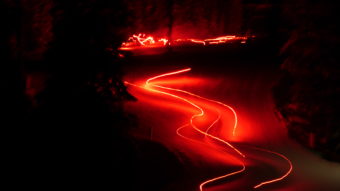
Skiers participate in a torchlight parade down the slopes at the Eaglecrest Ski Area on Christmas Eve. An extended exposure creates the light streaking effect. (Photo by Quinton Chandler/KTOO)
Kerri and Buck Willoughby, and their 5-year-old Paxton are geared up in the family car, ready to go find the snow.
Kerri says last year the family enjoyed some good skiing early in the season, but later the snow petered out.
“Had a couple of really awesome days last year, but it’s definitely really exciting to have so much snow this early in the year this year,” Kerri said.
Buck says the family has already broken in their poles.
“We’ve all been out together and were just out yesterday,” Buck said. “It was really fast. They had groomed a lot and it was cold, so the snow was really quick, so it was wonderful.”
Buck Willoughby, left, and Kerri Willoughby, right, at the Eaglecrest Ski Area on Christmas Eve. (Photo by Quinton Chandler/KTOO)
On Christmas Eve, skiers like the Willoughbys celebrated the holidays and the start of their season at the Eaglecrest Ski Area with arts and crafts, a visit from Santa and the annual torchlight parade.
Tom Ainsworth with the National Weather Service in Juneau said so far this month, Eaglecrest has seen about double the snow the ski area got last December. He said it “looks like snow heaven” compared to the last couple of years.
In the Eaglecrest parking lot, the Willoughbys are unloading their bright red sled, and they’ve already bumped into more snow lovers.
The crowd of ski buffs are about to walk in on the end of kids’ arts and crafts — just in time for the annual parade of skiers who will glide down a mountain slope carrying red emergency flares.
“Well and then after that, they let the little kids have some little lights and they go up the bunny hill and do their own torchlight parade, maybe a little less organized,” Buck Willoughby said.
He said Paxton plans to be in the kids’ parade.
Below the Hooter Chairlift, a couple of dozen people … maybe more, wait in the cold with their eyes glued to the slope. Then at the top tiny dots of sparkling red light ignite, and down the skiers come with flares at their sides.
Joey Roters finished near the back of the parade. He says he was just trying his best not to trip.
Several skiers after they finish the torchlight parade. (Photo by Quinton Chandler/KTOO)
“Yeah, I don’t want to ruin Christmas,” he said.
Doug Sanvik also took part. He’s been participating for years and says this year was especially good.
“(The) snow was excellent. This is probably the fastest we’ve come down from on top of Hooter. It was very smooth, very nice, just excellent snow, a good time,” Sanvik said.
Music to the Willoughbys’ ears.
Buck hopes this start to the season isn’t just another tease like last year. But, right now he’s happy. Now that the adults’ parade is over, Paxton is up, and then the Willoughbys will be ready for the finale – a visit from Santa Claus.
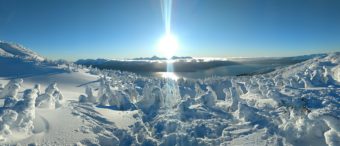
The view from Pittman’s Ridge on Douglas Island looking southwest toward Admiralty Island on Dec. 23, 2016. (Photo by Mikko Wilson)
A storm system is expected to reach Juneau on Christmas, with snow beginning that afternoon. Through Monday morning, Juneau could see up to 7 inches.
“Probably the greatest snowfall totals will be Christmas evening,” National Weather Service meteorologist Wes Adkins said.
Adkins said the storm system is over the eastern Aleutians moving east and it could affect travel plans this weekend.
“So we’re looking for snowfall to spread eastward and northward through Christmas afternoon and we’re looking at the potential for a significant snow event at the tail end of (the) holiday weekend,” Adkins said.
He said he’s very confident it will snow, he just isn’t sure how much. There’s also a possibility the snow could give way to rain, which could make surfaces even more slippery.
“So at this point, we’re in a La Niña pattern, which promotes normal snowfall conditions with maybe cooler and somewhat drier climate for us through about February and then things start to change for us and go the other direction,” he said.
Adkins said the weather service releases a new climate forecast every month. So long-term predictions could change, but he says it looks like after winter Juneau will see a warmer than normal summer and then another warm winter next season.
He stressed that people should keep a sharp eye on this weekend’s weather. The National Weather Service will release more information on the storm as it comes in.