A multiple choice exam. (Creative Commons photo by Alberto G. )
The Juneau School District is one of the first in Alaska to make the AP District Honor Roll, a prestigious recognition for districts that increased the percentage of students who took and passed Advanced Placement tests.
Juneau School District Superintendent Mark Miller explained how the tests work.
“(A) student takes a college level course that we give at high school and at the end they take a test,” Miller said. “If they score a three, four, (or) five, typically colleges will give them credit.”
Five is the highest score.
The College Board, the organization that offers AP tests, has an honor roll for districts. To make the list, a district has to meet three criteria over three consecutive years.
“One, increase the number of AP tests given – meaning more students are taking more tests,” Miller said. “Second, while you increase the number of students taking tests, you also increase the scores … average scores of students taking the tests.”
Juneau School District’s percentage of students who took the exam had to go up by at least 11 percent. Larger districts have to increase participation by 4 to 6 percent.
For its third requirement, the district had to increase or maintain its percentage of minority students who scored at least a three on at least one exam.
Miller believes having two separate high schools has made it easier to schedule students into AP courses. He also thinks the achievement is a result of training more teachers to teach AP classes, and the administration’s work to make the tests available to as many students as possible.
“It’s really about pushing for equity, pushing to make sure all of our students succeed, pushing students to do their best regardless of their background or where they come from,” he said.
Miller said the AP courses and tests prepare students for college-level classes and if they score well, they could save thousands of dollars in college tuition.
The honor roll dates back to 2011. According to the College Board, Juneau School District is the second Alaskan school district to make the list. The Anchorage School District made last year’s honor roll.
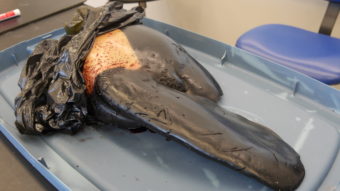
Thursday in a lab at UAF’s Lena Point facility, the new DEMBONES class is shown part of the carcass of a baby orca that they will harvest bones from. (Photo by Quinton Chandler/KTOO)
Shannon Atkinson is in a lab showing a Thunder Mountain High School class part of the body of a baby orca, also known as a killer whale.
“This animal happened to be a neonate – meaning it was just born. Its teeth hadn’t even erupted,” she said.
Atkinson is a University of Alaska Fairbanks professor who works out of Juneau. Her specialty is marine mammals.
Thanks to the Juneau School District and a local donor, in a few weeks this class of mostly juniors and seniors will cut into two orcas and take out their bones.
“And ultimately create a museum-quality skeleton articulation,” Atkinson said.
About 50 students will take the college-level marine biology class — and the skeletons will be put on display in their school.
“We’re going to hang a skeleton in the high school. And we’ve got a bunch of them there already,” Atkinson explained. “So when we articulate something we’re basically putting those bones back together.”
Professor Shannon Atkinson introduced her new class to DEMBONES, Thursday. (Photo by Quinton Chandler/KTOO)
For the past seven years, Atkinson has taught a class called DEMBONES, an acronym for Distinctive Education in Motion Biodiversity of Nature and Environmental Stewardship.
It’s a college-level course for Thunder Mountain High’s marine biology class. The animals they use are usually found dead on the beach.
She said the class gives high school kids a unique opportunity to learn more about marine mammals.
“Everything from anatomy and physiology, ecology of the species, cultural uses of the animal, marine policy …,” Atkinson said.
This school year’s DEMBONES class watched a video of a previous class on Thursday. (Photo by Quinton Chandler/KTOO)
But earlier this year, she was afraid DEMBONES wouldn’t happen. After the state cut funding to the University of Alaska, UAF officials decided they couldn’t pay for the class.
“What is so wonderful is that between the Juneau School District and this community at large, they are so supportive of education that they have found the funding for us to be able to continue the class,” Atkinson said.
At its last meeting, the Juneau School Board voted to add $11,000 to its budget specifically for DEMBONES. Atkinson said the class is also getting new money from a local nonprofit. Most of the new funds will offset tuition and fees.
“My understanding at this point is the tuition for Spring Semester is $192 per credit and this is a two-credit class,” Atkinson said.
With fees, she said the class would cost about $400 per student and she said in the past, students have only paid about $50 of that tuition.
The program also usually gets grant money to take care of miscellaneous expenses.
“We also have costs associated with transporting carcasses, the chemicals that we use to clean them up, the time that it takes for technicians to help us prepare the skeleton,” Atkinson said.
Her past students have reconstructed harbor seals, a Cook Inlet beluga whale and a walrus.
Atkinson said the orca class will start in January and it will take about 13 weeks to put the skeletons together.
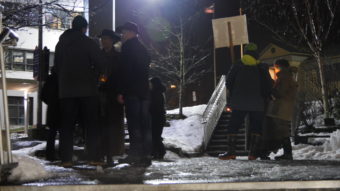
A few participants mill in front of the state Capitol building on Sunday, after a vigil asking Alaska’s electors not to vote for Donald Trump. (Photo by Quinton Chandler/KTOO)
It was cold and dark in Juneau when protesters met on the slippery pavement in front of the empty state capitol Sunday to ask this year’s Electoral College not to vote for Donald Trump.
Evelyn Bass counted between 50 and 60 people in the crowd. She helped organize the vigil to sway electors away from Trump.
“Some probably want to vote for Donald Trump, but some, I’m going to imagine there’s a lot of them that didn’t expect Donald Trump to win the Republican endorsement, and didn’t expect him to win the presidency, and are debating right now what they want to do,” Bass said.
Bass said the Electoral College was created to make sure unqualified candidates aren’t voted into the presidency.
She said similar vigils are being held across the country, but she doesn’t know if they will affect any electors’ votes. If they don’t, she thinks it’s still important to send a message.
Bass said she doesn’t know if it would hurt U.S. democracy if electors ignored the majority vote in their states. She said it’s an important question to consider.
She hopes Sunday’s vigil and a second one planned for Monday, when electors are scheduled to cast their votes, will make people ask whether they want to keep deciding presidential races through the Electoral College.
University of Alaska Southeast’s Juneau campus on Tuesday, Nov. 15, 2016. (Photo by Quinton Chandler/KTOO)
The University of Alaska is bringing its three colleges of education under one roof at the University of Alaska Southeast.
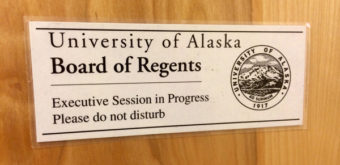
The University of Alaska’s Board of Regents voted unanimously Wednesday morning for UAS to lead the College of Education — though originally the regents planned to vote whether to give University of Alaska Fairbanks authority over the college.
City and Borough of Juneau Assembly member Jesse Kiehl said UAS is the obvious, best choice.
“Roughly as many teachers use University of Alaska Southeast programs as the other two universities put together and in some categories, even more than that,” Kiehl said.
City and Borough of Juneau Assembly member Jesse Kiehl in May, 2013. (Photo by Casey Kelly/KTOO)
Kiehl, the Assembly’s liaison to a UAS campus advisory council, said UAS has already been leading the University of Alaska in innovative education programs and not being chosen would’ve have been devastating.
“That College of Education is nine-tenths of the graduate degrees that the University of Alaska Southeast offers. … Without a leadership role in one of the major missions of the university system statewide, UAS was in terrible danger,” Kiehl said.
The regents’ decision means the College of Education’s administrative services will be based at UAS but all three branches in Anchorage, Fairbanks and Southeast will still offer academic programs on their campuses and online.
UAS Chancellor Rick Caulfield said after a board meeting in September that the decision is part of a larger cost savings strategy called Strategic Pathways.
“Our hope is that in the end, we’re going to be a leaner university, we’re going to reduce costs, we have to, we know that,” he said. “But at the same time that we can continue to focus on quality in our academic programs.”
For months the University of Alaska has been considering what its branches in Anchorage, Fairbanks and Southeast should specialize in.
Caulfield said UAS was uniquely qualified to lead the College of Education.
“UAS has long had a really robust array of teacher education training programs,” Caulfield said.
University of Alaska Southeast Chancellor Rick Caulfield listens to a presentation by President Jim Johnsen in the Egan Lecture Hall on Tuesday, Sept. 13, 2016. (Photo by Quinton Chandler/KTOO)
Kiehl said UAS is a key economic and cultural driver for Southeast Alaska.
Recently the City and Borough of Juneau and the Juneau Community Foundation decided to give the school’s College of Education a $1 million endowment.
The next academic programs Strategic Pathways teams are scheduled to evaluate for consolidation are social sciences, arts and humanities, physical sciences and mine training.
Caulfield said he is “grateful” to many Southeast residents and elected officials who voiced support for UAS to take this new leadership role.
He believes that support was largely why President Jim Johnsen eventually recommended the regents give the College of Education to UAS.
The district is already guaranteed more state funding after about 180 unexpected students showed up for classes this year and because the district is getting more money from the state, the City and Borough of Juneau is allowed to increase the amount it gives.
“It’s kind of a double dip Sunday if you will, and I like that,” said Juneau School District Superintendent Mark Miller.
He said the district will ask for $650,000 dollars. That’s in addition to the near $25 million appropriation the assembly has already agreed to give for this fiscal year ending in June.
A breakdown of the FY17 operating fund revenue the Juneau School District budgeted for in June this year. The CBJ appropriation is on the second line. (Courtesy of Juneau School District)
Miller said there’s plenty to spend that on.
“We have about … $300,000 worth of facility repairs that (we) need done,” he said. “Hot water heaters, boilers, things that keep us warm and dry, and allow us to wash dishes that are wearing out. We’d love to replace those this year.”
Miller said the district also needs to buy supplies as early as possible for a new science curriculum it’s launching, and they want to pay for IT upgrades. In all, he said the list would cost over a million dollars.
“We know we can’t do it all, but we just ask them to do the best they can so we can do the best we can, and (we) appreciate that they do that year after year, after year,” said Miller.
He said the CBJ usually chooses to give the district as much as state law allows.
The school board is also discussing the list of issues they want legislators to consider in the upcoming legislative session. Miller said those priorities are mostly related to funding, but they will also ask legislators to “clean up” language in some bills that already passed.
He said those priorities will be finalized during the next school board meeting on Jan. 10.
In the meantime, he’s hoping the Juneau Assembly will be in the spirit to give.
A pile of blankets in the doorway of a business on Franklin Street in downtown Juneau. (Photo by Quinton Chandler/KTOO)
Three people walk into the Glory Hole on Monday. (Photo by Quinton Chandler/KTOO)
Meal preparation at the Glory Hole. (Photo by Quinton Chandler/KTOO)
Patrons at the Glory Hole on Sunday. (Photo by Quinton Chandler/KTOO)
Glory Hole visitors eating breakfast on Monday. (Photo by Quinton Chandler/KTOO)
It’s cold in Juneau. Earlier this month, the city saw one its heaviest snowfalls in at least a couple of years and, according to the National Weather Service, temperatures ranged between the teens and the mid-20s.
Karli Phillips was sleeping outside.
“Oh my gosh, so that storm, we were actually sleeping way under a dock and it just got drenched,” Phillips said. “This is like 3, 4 o’clock in the morning. We’re soaking wet, shivering and everything (was) just gushing water.”
Phillips is homeless and she regularly comes to the Glory Hole, one of Juneau’s few homeless shelters, for food and to get warm. She said that night she didn’t even go to sleep.
“So, I ended up just shivering in a doorway under some sheets I found,” she said. “I feel bad because I think I took them from somebody but, I didn’t sleep that night because I was afraid I would die.”
Winter months are an especially dangerous time for Juneau’s homeless population.
Rose Lawhorne said if you’re sleeping outside on a night like Phillips just described, dying isn’t far-fetched.
“Weather and temperatures down around zero or in the teens like we’ve had them, or with lots of snow, or wind … even damp clothes really contributes to life-threatening hypothermia,” Lawhorne explained.
She is a nurse and supervisor in the Emergency Department at Bartlett Regional Hospital.
She said during winter, homeless people can get hit hard.
“More affected, colder, more illness during the winter months,” Lawhorne said. “We’ll start seeing them multiple times in a day, hungry and cold just looking for a way to get out – out of the elements.”
Rose Lawhorne is an registered nurse and supervisor in the Bartlett Regional Hospital Emergency Department. (Photo by Quinton Chandler/KTOO)
Lawhorne doesn’t know how many people come into the ER for exposure because those cases aren’t always captured in the hospital’s records.
“But what I can tell you is we get many patients every day who are brought to us by either Rainforest Recovery,” she said. “They walk in themselves, they’re brought by friends or family who are concerned, or JPD brings them to us and that is multiple times per day,”
Lawhorne said the range in conditions is huge. Some people are just cold and hungry and some are literally freezing to death.
At the Glory Hole, Executive Director Mariya Lovishchuk said the shelter has 40 beds for overnighters and during the winter they’re usually over capacity.
“We don’t turn anybody away for the lack of beds,” she said. “So last night we had 46 people sleeping here, so if we don’t have beds we put people on the floor.”
Glory Hole Executive Director Mariya Lovishchuk in November 2013. (Photo by Lisa Phu/KTOO)
Lovishchuk said they give breathalyzer tests every night so people who have a blood alcohol level over 0.1 aren’t allowed in that night. People can also be suspended for longer periods.
“When people commit violent offenses or exhibit behavior that is really frightening toward other patrons or staff, they do get suspended from here,” Lovishchuk said. “I think we have two or three people who cannot get any services here.”
She said the Glory Hole is the only short-term shelter that takes men, women and children in Juneau, so unless suspended people and people who choose not to sleep in the dorms have somewhere else to go, they’ll end up outside. Phillips chooses not to sleep in the shelter.
“I actually haven’t gotten sick from sleeping outside. I’ve gotten sick from sleeping in here,” Phillips said.
She claimed the dorms’ air quality is poor and they get overcrowded.
“People don’t regularly bathe or wash themselves,” she said.
Another person said they didn’t sleep in the shelter because they kept getting into fights and being outside was easier even though it’s clearly dangerous. Phillips and others said when they’re outside, they have to wear a lot of layers and sleep under multiple blankets, sleeping bags and comforters – anything to stay warm.
Recently there was a rumor that a homeless man died sleeping on the street. An officer in the Juneau Police Department has said it’s just a rumor. Lovishchuk said she spent three hours trying to confirm it and now also thinks it’s just a rumor, but she said it definitely could happen.
Close
Update notification options
Subscribe to notifications
Subscribe
Get notifications about news related to the topics you care about. You can unsubscribe anytime.