Quinton Chandler, KTOO

Lawmakers want new rules for testing sexual assault kits

A statewide audit of sexual assault kits that most law enforcement agencies participated in a year ago, revealed there are several thousand kits that haven’t been tested.

If you’re picturing stacks of hundreds of kits sitting in a line to be examined with police wringing their hands waiting to find out who did it, you’d be wrong.

Alaska Public Media reported that at the end of last year there were actually about 117 kits waiting for testing at the state crime lab.

Capt. Dan Lowden with the Alaska State Troopers said the audit turned up about 3,600 untested kits statewide and those are mostly kits that were never sent to the crime lab. He said the kits are just one piece of evidence used to close a case.

“So the kit by itself only establishes who might have committed this assault. In most of the sexual assaults in Alaska, we already know who did it,” Lowden said.

He said many times consent is the unknown variable and a sexual assault kit can’t help with that.

“If the kit is only there to help us with the who and we already know that, a lot of times agencies won’t submit the kit for examination because they already know that and it’s an expense that they don’t need to go through,” Lowden said.

There is an argument for testing kits even when you know the who, but more on that later.

Lowden also said sometimes evidence is collected in the kits but then the complainant decides they don’t want to go through an investigation. This is called anonymous reporting.

Law enforcement will hold onto the kits in case the person changes their mind.

Rep. Geran Tarr addresses the Alaska House of Representatives on April 7, 2014. Tarr and Andy Josephson will replace Benjamin Nageak (seated) and David Talerico as the co-chairs of the House Resources Committee. (Photo by Skip Gray/360 North)
Rep. Geran Tarr addresses the Alaska House of Representatives on April 7, 2014. (Photo by Skip Gray/360 North)

House Bill 31 would require that agencies send all sexual assault kits to labs for testing within 18 months of receiving them.

State Representative Geran Tarr said agencies would also create a system to track those kits and to monitor which ones go untested. Tarr, an Anchorage Democrat, introduced the bill during a House State Affairs Committee meeting.

“We want to keep track of this. We want to know on (an) annual basis what our backlog is, what kind of job we’re doing,” Tarr said. “What this effort to end the backlog has shown across the country is (a) very dysfunctional system – not working. Victims are not getting the justice they deserve and dangerous criminals are out on the street to commit other crimes.”

Tarr said the bill’s provisions will cost about $200,000.

HB 31 would go into effect Jan. 1, next year. She said that date is meant to give the Department of Public Safety time to chip away at the number of untested kits and time to adjust to a new protocol.

The bill would require that law enforcement and other state agencies report the status of the untested kits by Sept. 1, this year.

Capt. Lowden said in principle, he agrees that testing more kits could help law enforcement, but he doesn’t know if it will lead to a dramatic rise in solved cases.

“A lot of jurisdictions have gone through what we’re going through. They go back, they’ve retested thousands and thousands of kits and they prosecute one or two new cases,” Lowden said.

Still, he said it was important to get the additional evidence in those cases.

“If one person (or) perpetrator was caught, then that’s a success story,” he said.

Lowden said law enforcement around the country are rethinking the way they use kits. He said many times investigators get in the habit of solving one case with one kit.

“However, we recognize that there are serial predators out there and by testing the kit, even if we know who did it this time, we might be able to solve previous cases that were unknowns,” he explained.

But there’s still the question of whether every kit should be tested, even the ones collected from people who don’t want to go through an investigation and potential court proceedings.

Tarr believes the evidence from the kits can be used while respecting the victim’s wishes.

Orin Dym, forensic laboratory manager with the state crime lab gave a very rough cost estimate for testing kits. He said it varies, but a kit tested by the state lab could cost about $1,000 and a kit contracted out to a private lab could cost about $1,500.

Dym said usually kits are examined in-house, but the state will have to use private labs to process most of the 3,600 untested kits.

An official with the governor’s office said a $1.1 million federal grant from the Department of Justice will help pay for tests on almost 1,000 sexual assault kits held by the Alaska State Troopers.

The money will also pay for a cold case investigator and a prosecutor to work the cases.

The Alaska State Crime Lab in Anchorage. (Photo courtesy of the Alaska Department of Public Safety)

Charity for school kids just underneath fundraising goal

National Honor Society students helped serve food at the pancake dinner at Thunder Mountain High School on Sunday, Jan. 29, 2017. (Photo by Quinton Chandler/KTOO)
National Honor Society students helped serve food at the pancake dinner at Thunder Mountain High School on Sunday, Jan. 29, 2017. (Photo by Sharon Lowe)

Feeding Juneau’s Future raised more than $900 from about 72 people by the end of a pancake dinner in the Thunder Mountain High School commons.

The group hoped the event would be the last push they needed to reach their goal.

Cindy Gaguine, a coordinator with the group, said the Benito and Frances C. Gaguine Foundation, which her husband runs, has promised to match their donations up to $10,000.

“And with a Go Fund Me that we have going on right now and local donations, we have raised $8,000. So we’re getting close to our goal,” Gaguine said.

Counting the money raised at the dinner, that’s almost $9,000 total.

Feeding Juneau’s Future is a group that gives food to school kids who might not eat regularly at home. They’re nearing the end of their first “big fundraiser” just short of their $20,000 goal.

The group spends almost $2,000 per week on a couple of their programs for school kids of all ages.

According to Sharon Lowe, another of the charity’s coordinators, one of their most expensive efforts is the backpack program.

“We do the backpack program, which is a nationally recognized program, where we send home food over the weekend to kids who have been identified in the schools by either the school nurse, the counselors or their teachers as having food insecurities,” Lowe said.

Lowe said the program had modest beginnings in Juneau about three and a half years ago and just began operating citywide last school year.

She said the bags of food can help keep kids in school and paying attention.

“And not worried about when lunch is going to be because it’ll be the first time that they might have been fed, or they haven’t gotten enough over the weekend and they’re waiting for the school lunch to appear,” Lowe said.

The group also serves breakfast in Dzantik’i Heeni and Floyd Dryden Middle Schools, which Lowe said don’t get the same free breakfast Juneau School District gives most of the elementary schools.

She estimates they feed 40 to 50 kids breakfast at the two middle schools every day and they give out over 400 bags of food every week.

The group also stocks pantries in the two main high schools.

Craig Tribal Association’s land-into-trust application approved

The Department of the Interior announced approval of Craig Tribal Association’s land-into-trust application on January 13.  This is the first application from Alaska to be approved since the Interior Department issued a revised rule in 2014 expelling the “Alaska exception.”

Craig Tribal Association’s application places a 1.08-acre parcel into federal Indian trust status. Tribal president Clinton Cook Sr. says the association applied for the status change to protect CTA’s government and homeland.

“Signing the land over to the government protects us from taxes. If (there were) any future losses, our building and our land would never be taken away from us.”

The land cannot be sold, alienated or transferred without federal approval. Status also expands eligibility for federal programs and services. Development is subject to federal regulations. Offices and a town hall are located on the site. Cook says there are no plans at this time to make any changes, now that the land is in trust.

“The building will remain the same. It will house our tribal headquarters. We do rent space out to businesses in the Craig area.”

The federal government gave notice of the application in October of last year, and comments were accepted through December. One respondent was the City of Craig. Among other requests, the city asked for more time to research land-to-trust issues, and for a written agreement between the city and CTA regarding municipal and tribal authorities.  Craig City Manager Jon Bolling says with the new status, some city powers may still apply, and others may not.

“I met with the tribal president and administrator to talk about coming up with a document that eliminates any ambiguity about how the city’s authority might apply to the property, and how the tribe’s authority might apply now that the property is in trust – which does change how some of those authorities do apply to the property.”

CTA’s application for land-into-trust is the first approved in the state since the “Alaska exception” was removed. Richard Peterson, president of Central Council Tlingit and Haida Indian Tribes of Alaska says he’s pleased the application was approved.

“As a federally-recognized tribe, we also have applications in. We’ve been strong advocates of getting this through and seeing the benefit for all tribes in Alaska. Really we need to commend the Craig Tribal Association for their leadership and determination in seeing their application through the process.”

Peterson says he’s hopeful that with the first application approved, more land-to-trust applications throughout the state will be successful.

Two days, two Capitol protests and two very different turnouts

An anti-abortion crowd listened to a series of speeches against abortion on Friday. (Photo by Quinton Chandler/KTOO)

Two protests were held on the steps of the state capitol this weekend. The first on Friday, called for an end to abortion. Then Saturday, hundreds came out for the “Women’s March on Juneau” to show support for women’s rights.

The two protests were different in tone, message and especially in size.

On Friday, a little more than a few dozen anti-abortion supporters – including a number of state legislators – lined the Fourth Street sidewalk in front of the Alaska Capitol building.

Then on Saturday, hundreds filled the same street to demand equality for women.

The two protests had very little in common other than it was cold.

“I was worried that it was going to be a lot colder when we came,” said Sid Heidersdorf, president of Alaskans for Life. “It was windy when we first came. That’d be one of the worst things, that cold wind.”

His group and its supporters rallied at noon Friday for their annual protest of the Roe v. Wade Supreme Court decision. Sunday is the anniversary of the case that largely legalized abortion in the U.S.

“We’re basically trying to show that we object to that and that’s wrong, and we’d like to see it changed,” Heidersdorf said.

The event’s handful of speakers echoed Heidersdorf’s feelings. The keynote speaker, Camille Pauley, is president of Healing the Culture, a Washington state anti-abortion nonprofit.

Pauley said anti-abortion advocates would stand up for what is right no matter what, that all human beings are valuable and that abortion can never lead people to happiness.

Ted Deats attended the protest and said he’s been coming with his wife since she was pregnant with their son 30 years ago. He hopes the results of this last election year will mean serious change for U.S. abortion law.

“I think the change we would count on would be Supreme Court justices that believe in the equality of all men — born and unborn, and whatever they are,” Deats said.

Deats and Heidersdorf also hope the state Legislature will pass more anti-abortion laws. Heidersdorf said the courts struck down or severely weakened anti-abortion laws from the past.

On Saturday, the location was the same but the scene had changed completely.

Protesters wave signs at the Alaska State Capitol for the Women's March on Saturday January 21st, 2017 in Juneau. (Photo by Mikko Wilson/KTOO)
Protesters wave signs at the Alaska State Capitol for the Women’s March on Saturday in Juneau. (Photo by Mikko Wilson/KTOO)

Hundreds of protesters carried signs calling for goals like the fair treatment of women, the protection of abortion rights, the protection of the disenfranchised and an end to gender violence.

Mandy Cole, deputy director of AWARE in Juneau, said the idea for the March on Juneau started with an AWARE employee and eventually the entire organization pitched in to help launch it.

AWARE is a women’s advocacy group. Cole said the march was a show of solidarity with other women’s marches around the country and the world.

“Well part of it is just capturing the energy of people who want to do well and want to help all of us live together peacefully and with care for our neighbors,” Cole said.

She was “incredibly pleased” with the turnout, but wasn’t sure how many people showed up.

A panoramic composite image of protesters gathered at the Alaska State Capitol for the Women's March on Saturday, Jan. 21, 2017, in Juneau. The image contains some distortions from combining multiple exposures. (Image by Mikko Wilson /KTOO)
A panoramic composite image of protesters gathered at the Alaska State Capitol for the Women’s March on Saturday in Juneau. The image contains some distortions from combining multiple exposures. (Image by Mikko Wilson/KTOO)

“Maybe 500, 600, I’m not sure.” (I’m) bad with gauging crowd sizes, I think,” Cole said.

According to the march’s Facebook event page, about 840 people said they went, but that number hasn’t been confirmed.

A Juneau police officer said he didn’t know how many people attended either protest. He said organizers for the women’s march estimated 400 people would attend and he guessed they probably met that mark easily.

Theo Houck addresses protesters at the Alaska State Capitol for the Women's March on Saturday January 21st, 2017 in Juneau. (Photo by Mikko Wilson/KTOO)
Theo Houck addresses protesters at the Alaska State Capitol for the Women’s March on Saturday. (Photo by Mikko Wilson/KTOO)

Before the actual march, a handful of supporters gave speeches and one recited a poem about the societal problems they wanted to change and their own visions for the future.

Afterward, the crowd hauled their signs to the Juneau Arts and Humanities Council building where community organizers were waiting.

Cole said they were “community agencies and organizers that are looking for volunteers to help give services, to help recruit others, to continue this type of energy of women’s rights are human rights.”

Marlowe Dunker followed the crowd. She carried a sign that said “Love trumps all” on one side. On the other, she had a list.

“‘Women’s rights, black lives matter, Planned Parenthood, the Muslim community, climate change, equality, our children’s future and not my president.’ And that is why I march,” said Dunker.

She said her sign had a lot on it, but she felt like there was a lot at stake.

That feeling might be the number one thing Friday and Saturday’s protesters had in common.

Police chief: Crime bill flaws and budget cuts fueling local burglaries

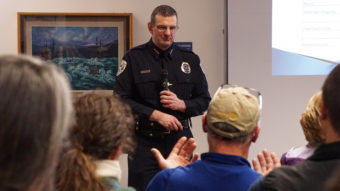
Fritz Moser asks JPD Chief Bryce Johnson a question.
Downtown restaurateur Fritz Moser asks Juneau Police Chief Bryce Johnson a question about crime. The police department held a public meeting on the topic at City Hall for residents Tuesday. (Photo by Jeremy Hsieh/KTOO)

Property crime is up across the board in Juneau, but according to Juneau Police Chief Bryce Johnson, the biggest increases are in burglaries.

“So in 2015 we saw a significant increase in burglaries. We have seen that continue,” he said. “So during 2016 up until November, which is the last month I have numbers for, there’s been a 75 percent increase in burglaries over the 2015 numbers.”

Johnson believes the city’s property crime spike is a result of flaws in a criminal justice reform law passed by the Legislature last year and steep budget cuts.

He was sipping a Diet Coke Tuesday night, after leading a discussion on crime for about 40 people at City Hall.

He explained that last year’s Senate Bill 91 reduced the punishments for nonviolent crimes like burglary with hopes of putting more people in treatment and fewer people in prison.

State officials envisioned the law would help people struggling with drug addiction and mental illness, so fewer would break the law again after their release.

Johnson took a swig of Coke and said the problem is those rehabilitation tools haven’t been developed yet.

“Our traditional tools for working on this problem, they’ve been taken away by law,” he said. “The new tools that are supposed to come are not here yet, so we’re kind of in a limbo stage.”

On top of that, he said state prosecutors were hit with budget cuts, and the court system adopted new guidelines that made more arrestees eligible for release without a cash bail.

“Even if Senate Bill 91 said we could incarcerate someone, the bail schedule has them incarcerated for less time pre-trial,” Johnson said. “You layer on top of that the reductions in the District Attorney’s office where they’re declining more and more cases and cases that are perfectly good cases they just can’t take.”

Simply put, Johnson said thieves’ risk of punishment has gone down and as a result, police are seeing a “cascading effect” of increased property crime.

Jahna Lindemuth was named Alaska's attorney general by Gov. Bill Walker. (Photo by Graelyn Brashear/Alaska Public Media)
Jahna Lindemuth was named Alaska’s attorney general by Gov. Bill Walker in June. (Photo by Graelyn Brashear/Alaska Public Media)

Attorney General Jahna Lindemuth raised some of those same concerns in a December news release. She called the problem facing the criminal justice system a “perfect storm.”

Johnson is part of the Alaska Association of Chiefs of Police and based on what he has learned from other law enforcement agencies, he believes crime is increasing around the state.

He was careful to say he doesn’t believe SB91 was a bad idea.

“Getting people diverted out of jail into treatment is a sound principle,” Johnson said. “I think you need to have the treatment available before you do that and I think you need to have a sanction in place if people choose not to go to that treatment as well.”

In other words, he said the criminal justice system needs its “sticks” and its “carrots.”

Johnson said Juneau has seen about a 5 percent drop in violent crime and he predicted that property crime will continue to go up until there are some structural changes.

He told the audience that he believes the Legislature will reevaluate some of SB91’s provisions this year.

Clarification: An earlier version of this story suggested changes in the bail schedule were a result of Senate Bill 91. While SB 91 does revise the bail statutes, those changes don’t go into effect until Jan. 1, 2018. The Alaska Court System independently promulgated a new statewide bail schedule last year. The bail changes in SB91 were the result of the Alaska Criminal Justice Commission’s work studying and recommending reforms; the court’s changes were also related to the commission’s research and the legislature’s adoption of SB91. 

Finance committee weakens school district funding request, sends to next step

The Juneau School District may get an extra $250,000 for school facilities maintenance from the City and Borough of Juneau.

It’s a fraction of what the district asked for, but Juneau schools Superintendent Mark Miller said it’s enough to pay for one item on the school district’s wish list.

“They said, ‘Well you were going to spend about $250,000 of that on facility maintenance’ – repairing water heaters, carpets and that kind of thing,” Miller said. “‘And so we’ll go ahead and give you that money, but we’re going to give it to you in a fund that you can only use to spend it on facilities.’”

District officials had asked the Assembly to increase local funding to the full amount allowed by state law to help pay for building repairs, and science and computer equipment.

A near $3 million increase in state funding, triggered by unexpectedly high enrollment, allows the CBJ to spend up to an additional $650,000 on Juneau schools.

Miller said he is grateful to the Assembly because some money is better than no money, and the district needs to make the repairs. But, he said the district will have to put its other needs on hold.

“Unfortunately we can’t make that decision now. So right now, we just simply have to put it on hold and hope that the numbers improve a little bit next year so we can afford to do it,” Miller said.

Assemblywoman Maria Gladziszewski, one of the four assembly members who voted against the change, said the funding request should have waited until later this spring when the Assembly focuses specifically on budgeting.

The Juneau Assembly’s Finance Committee voted to draft an ordinance for the extra money on Wednesday last week. If the Assembly moves quickly, Assemblyman Loren Jones said the funding ordinance could be introduced at its Jan. 23 meeting and voted on in February.

Site notifications
Update notification options
Subscribe to notifications