Quinton Chandler, KTOO

Residents talk class sizes and other needs at school district budget meeting

Nicole Wery is really hoping class sizes and school counselors aren’t affected by the school district’s budget for next school year. She has three kids in Juneau schools: two at Juneau-Douglas High School and one at Glacier Valley Elementary.

“PTR (Pupil-Teacher Ratio) is over 30 kids in classes. It’s so hard to be able to teach because we have kids that come from all facets of the world,” Wery said. “Some people are really advanced and some people aren’t, so just the knowledge base that a teacher has to teach to is large.”

Wery said it’s also critical that the district can bring drug and alcohol counseling into schools, and keep the regular school counselors it has on duty. She believes they play a huge role in preparing kids for the future.

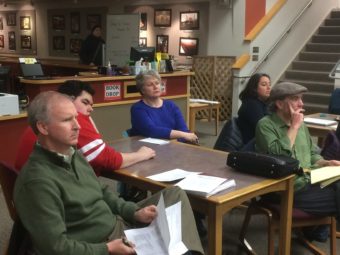
School Board President Brian Holst, left, and other audience members listen during the meeting.
School Board President Brian Holst, left, and other audience members listen during the meeting on Tuesday, Feb. 7, 2017. (Photo by Quinton Chandler/KTOO)

The Juneau School Board is working on a months-long budget process and board members decided to give the public a chance to comment. Almost a couple of a dozen people attended one of two school district budget meetings on Tuesday, Feb. 7.

Seven people spoke during the meeting. Nearly all of them said they were most worried about class sizes.

Superintendent Miller, left, and Director of Administrative Services, David Means, right, during the budget meeting on Tuesday, Feb. 7, 2016.
Superintendent Mark Miller, left, and Director of Administrative Services David Means during the budget meeting on Tuesday, Feb. 7, 2017. (Photo by Quinton Chandler/KTOO)

District Superintendent Mark Miller said he doesn’t think class sizes will grow for the 2017-2018 school year.

“Well, we’ve been financially conservative. So what I’m expecting is that we will have enough in carryover and what we get from the state to not have to make cuts for the first time in years,” Miller said.

He said in the last couple of years, cutting administrative positions and increasing class sizes were the only ways to balance the budget. But, he says it’s a balancing act.

“As I say, ‘When you find yourself at the bottom of a hole, stop digging.’ So we’re going to work really hard this year, I believe, to make sure that we don’t make the problem any worse,” Miller said.

He added that there is a little bit of money that the district might be able to use to reverse past cuts, but he stressed that compared to the overall budget, it’s a very small amount.

Some people attending the meeting also asked for more counseling staff, electives and vocational classes. Several said the district should pay for renovations at Mendenhall River Community School right away. They complained about plumbing problems and accessibility for special needs students.

Two women with the Mendenhall River Community School Parent Teacher Organization speak to the school board during the budget meeting.
Two women with the Mendenhall River Community School Parent Teacher Organization speak during the budget meeting. (Photo by Quinton Chandler/KTOO)

While Miller doesn’t think the district will have to make cuts, he said there’s probably not going to be money for big renovations.

He said, “right now we’re in Band-Aid mode and we’re going to continue in Band-Aid mode until the state helps, comes back and helps us out with major bond debt reimbursement so we can afford major repairs.”

Last June, Gov. Bill Walker vetoed more than $30 million for school construction debt reimbursement and over $10 million for rural school construction funding from the state budget. In 2015, the Legislature also decided not to reimburse schools for any new construction debt until July 2020.

Four principals and a volunteer from local schools also spoke at the budget meeting. They all said one of their top priorities was lowering or maintaining class sizes. They asked the board for more special education specialists, pre-school programs, resources for electives, building renovations for Mendenhall River Community and Dzantik’i Heeni Middle School and counseling staff; including career counselors, drug and alcohol counselors.

And almost all of them asked for special teacher training ahead of implementation of the district’s new science curriculum.

The school board will send a budget to the City and Borough of Juneau at the end of March. Miller said a lot will depend on the solutions the state finds for its own financial dilemma.

And Nicole Wery said she’ll be watching the Legislative session to see whether the district will get the money for those counselors she’s rooting for.

Update: Coast Guard says 2 men missing after skiff capsizes near Ketchikan

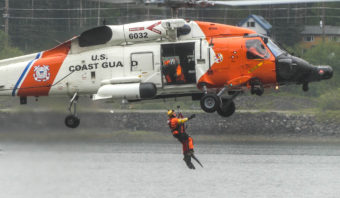
U.S. Coast Guard search & rescue demo at the 2016 Juneau Maritime Festival (Photo by David Purdy/KTOO)
The U.S. Coast Guard demonstrates a search and rescue practice at the 2016 Juneau Maritime Festival. (Photo by David Purdy/KTOO)

Update | 3 p.m. Monday

The Coast Guard is still searching for Troy Smart and Timothy Staples whose 16-foot skiff capsized near the southern end of Gravina Island sometime between Saturday night and Sunday morning.

Smart, 45 and Staples, 38 are from Metlakatla according to the Alaska State Troopers.

Coast Guard Lt. Jennifer Ferreira said the Coast Guard Cutter Maple was sent to help with the search.

“We have a response boat-medium from Station Ketchikan searching,” Ferreira said. “There’s a Jayhawk helicopter also from Sitka. The fire department from Metlakatla is involved in searching and Ketchikan’s volunteer rescue squad is doing shoreside searches as well.”

Lt. Ferreira said the Coast Guard has not decided how long they will keep searching, but she said they will discuss that.

Original Story | 11:30 p.m. Sunday

The Coast Guard is searching for two men whose 16-foot skiff capsized near the southern end of Gravina Island sometime between Saturday night and Sunday morning.

Petty Officer Bill Colclough said two helicopter crews from Air Station Sitka and two boat crews from Coast Guard Station Ketchikan are conducting the search.

“So right now Coast Guard crews are saturating (a) search area of about 200 miles that encompasses Nichols Passage and Tongass Narrows, as well as the entrance to George and Carol Inlets, Colclough said. “Again, with two helicopter crews and two boat crews to locate the two men.”

Colclough did not have the names of the two missing men or the towns they are from, but he said they were 45 and 38 years old. He said they left Mountain Point near Ketchikan either late Saturday or early Sunday.

The fiancée of one of the men expected them to arrive at Cowboys Camp on Annette Island shortly after their departure.

When they didn’t make it on time, she called the Coast Guard.

Colclough said, “We’re searching throughout the night and the Coast Guard Cutter Maple is expected to arrive on scene tomorrow morning, and they will be conducting search efforts throughout the day.”

He said the Coast Guard was able to make a quick response because they were called shortly after the men went missing.

He added that having information about the vessel, the time and place of departure and the location they were trying to reach is critical in a search and rescue.

Colclough doesn’t know what caused the vessel to capsize but he said it will be investigated.

Happiness is orange at Hoonah City Schools

Hoonah City Schools Superintendent PJ Ford Slack, right, sits in on the Orange Frog training, Tuesday, Jan. 10, 2017.
Hoonah City Schools Superintendent PJ Ford Slack, right, sits in on the Orange Frog training, Tuesday, Jan. 10, 2017. (Photo by Quinton Chandler/KTOO)

This story starts with Superintendent of Hoonah City Schools, PJ Ford Slack. Hoonah is a small village on Chichagof Island in Southeast Alaska.

Slack came here as an “emergency replacement” for the district’s last superintendent and when she got to work, she noticed something.

“The adults were really not happy. That didn’t mean they actively knew that, but they seemed to be down,” Slack said.

Hoonah’s community does feel a lot of stress.

The isolated town’s commercial fishing and processing industries dried up years ago, the school district is under heavy financial strain and drug and alcohol dependence are growing concerns.

Slack believes a teacher’s attitude has a powerful impact on the kids they teach. So she started researching something called the Happiness Advantage.

It’s an idea based on research that points to a link between a positive mindset and success.

“It seems to make sense that would make a difference if the kids and the adults all learned a little bit about this and learned happiness is a choice,” Slack said.

The district used about $20,000 in grant funding to pay for a training based on the work of author and motivational speaker, Shawn Achor.

It’s called the Orange Frog Project. The project was supposed to teach Hoonah’s high school and middle school students how to choose happiness every day.

The adults went through it months ago and Slack says it has already changed some their lives.

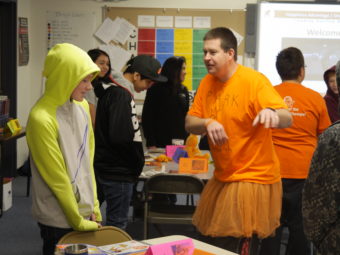
Devin Hughes at the front of the class during the Orange Frog training.
Devin Hughes at the front of the class during the Orange Frog training. (Photo by Quinton Chandler/KTOO)

“Whoo! You’re awesome, bam let (them) know, let’s go,” yelled Devin Hughes, chief inspiration officer for the International Thought Leader Network.

Hughes ordered a round of high fives as he explained that he would teach the room full of high school kids to be outwardly positive even if it means being the weird one.

He said, “my whole mission, my tenet, is to go around and inspire, motivate others to achieve happiness and joy and optimism. It’s pretty cool.”

Hughes used a comic book to jumpstart the training. It’s a story about a bunch of sad green frogs and a happy frog, who slowly turns orange.

A high school student sketches a form line frog based on the main character from the Orange Frog comic book.
A high school student sketches a formline frog based on the main character from the Orange Frog comic book. (Photo by Quinton Chandler/KTOO)

The more the orange frog does to make himself happy, the better he gets at catching flies, and the more orange he turns. Eventually, the other frogs copy him: they get happier, they catch more flies and they start turning orange too.

Hughes said his company travels to corporations around the world and to schools teaching people to be orange.

“So right now, I think schools are probably the fastest growing segment within our business,” Hughes said. “Because if you can get a kid, whether it’s a kid that’s 6 or 16, and start to rewire their brain and doing these things more often and feeling pretty good, behavior issues go down, test scores go up.”

But let’s walk this back. Hughes said he’s being paid to teach people to be happy. Doesn’t anybody question that?

“Oh, all the time. I mean people are like, ‘Really, really,’” Hughes said.

“Because, if you think about it when I ask you the question, ‘Did you have anyone in your life when you were a youngster teach you, give you the secret sauce to happiness, tell you something prescriptive, something actionable that you need to do to work on this, your mojo and your mindset? Universally nobody raises their hand.’”

He said after the initial skepticism, people usually jump in, because, “who doesn’t want to be happy?”

The high schoolers seemed to embrace Hughes’ message. All around the room kids wore bright synthetic orange wigs, frilly orange necklaces; they had streaks of orange marker on their faces — any kind of orange prop or clothing they found, they wore it.

Hughes told the kids to keep it positive. Throughout the day, he had them share the best things happening in their lives with other people.

“First rule (of) Orange Frog, if something good happens you have to talk about it,” he said.

He asked them to run the halls delivering what he called “joy bombs” to people all over the building so the kids gave people unexpected high fives and hugs and told them that they were awesome.

Jerry White III answers a question during the Orange Frog training.
Jerry White III answers a question during the Orange Frog training. (Photo by Quinton Chandler/KTOO)

Hughes told them to think about how to stop their problems from keeping them down.

He told them to think about changing behaviors that affect everyone, things like bullying or ignoring kids they usually don’t hang out with.

At the end, Hughes asked the kids to spend time thinking about how they can remember to keep doing this after he leaves.

Some of the kids said Orange Frog definitely changed their school’s atmosphere, but will it last?

Senior Kelsey Thein isn’t sure.

“I think that only time will tell with that one. I can see that a lot more people are upbeat than normal and if it stays, it stays,” Thein said.

Other kids said optimistically that they can easily turn their school orange in the long term.

Superintendent Slack hopes so too.

“I’m hoping that this will help them as they go through their life know that they can make some choices and that those choices are tough sometimes,” Slack said.

“Life is tough. But, there are ways that we can turn the frown the other way around and make it a smile.”

She doesn’t see this as some kind of silver bullet. She hopes learning about Orange Frog will help them develop better coping skills to handle whatever life throws their way.

UAS faculty offers support and criticism to university president

President Jim Johnsen explains Strategic Pathways at University of Alaska Southeast's Egan Lecture Hall Tuesday, Sept. 13, 2016.
President Jim Johnsen explains Strategic Pathways at University of Alaska Southeast’s Egan Lecture Hall Tuesday, Sept. 13, 2016. (Photo by Quinton Chandler/KTOO)

Lisa Hoferkamp is president of the University of Alaska Southeast Faculty Senate. She sent a letter to University of Alaska President Jim Johnsen that plainly said faculty have mixed feelings about Strategic Pathways – a cost-saving measure Johnsen launched last year and is spearheading.

Johnsen has billed Strategic Pathways as an attempt to make the university leaner and more efficient. It is part of the University of Alaska’s answer to steep budget cuts from the state Legislature.

Hoferkamp said some UAS faculty understand what Strategic Pathways is supposed to do and they even support it.

“But there’s a sizable faction that are uncomfortable with what they see as intrinsic flaws to the process,” Hoferkamp said.

The UAS senate’s letter sits at the top of a growing pile of complaints against the university system’s cost-saving strategy.

Faculty senates in Anchorage and Fairbanks announced they have no confidence in Johnsen’s leadership.

Hoferkamp said faculty feel left out of a lot of decision making and many are worried that some decisions could hurt the university.

“Faculty believe that the university is built on shared governance,” she said. “It involves a two-way conversation and that the Strategic Pathways started out with almost none of that.”

Hoferkamp said it got a little bit better as Strategic Pathways progressed, but faculty across the university still feel left out.

Fallout from College of Education decision

She said a prime example of the frustration is the Fairbanks Faculty Senate’s reaction to a decision to eliminate the administrative parts of the Anchorage and Fairbanks schools of education per Johnsen’s recommendation.

The decision makes UAS the new headquarters for the College of Education.

The Fairbanks faculty senate felt so strongly that faculty weren’t consulted, they passed a resolution that said they have no confidence in the process for that decision. They also voted to declare no confidence in Johnsen’s leadership and so did the Anchorage senate.

Hoferkamp said originally, Johnsen was going to recommend the headquarters go to Fairbanks.

He changed his mind after multiple Southeast Alaska residents and elected officials asked him to recommend UAS, and the City and Borough of Juneau promised to donate a $1 million to the university.

Johnsen has also said he heard from multiple faculty members.

Hoferkamp said, “UAF and UAA feel like that whole process epitomizes the flaws, the inherent flaws in the Strategic Pathways process.”

She said some UAS faculty also question the way the school of education decision was made, but she stressed that they object to the process, not the final decision.

Johnsen says faculty were involved

Johnsen told the Senate Education Committee today that 250 faculty, staff, students and community members have participated in Strategic Pathways; and 89 faculty members were on the teams that studied the pros and cons of academic programs and administrative services that were identified for potential cuts and changes.

“Going forward there will be two rounds of consultation with every affected organizational unit in phase two,” Johnsen said. “So yours truly is going to be all over the place prior to my even reviewing the options with the Board of Regents in March, I will have had meetings with every faculty (and) staff member affected by the options that are being considered.”

Johnsen said the university is already using some faculty suggestions to improve Strategic Pathways and last year the university held public forums.

“On a couple of our campuses, we had roughly 400 people show up to these public forums,” he said.

He said during the forums in Fairbanks and Anchorage people mostly spoke about sports.

Finally, Johnsen said that change is hard and he can’t wait to make decisions after Legislative budget cuts. He said decisions have to be made quickly.

Faculty want financial analysis

Besides participation, faculty across the state are worried no one has done a financial analysis to find out what should and shouldn’t be cut.

Maren Haavig is an assistant professor of accounting at UAS.

She said, “So many faculty are concerned that the options developed and the decisions that have been made, really don’t account for the cost of these decisions, nor the effects on the student outcomes, or the long-term effects to the university, including faculty morale.”

A University of Alaska spokesperson said a financial analysis will be done after the Strategic Pathways options are presented to university leadership.

Hoferkamp said there are a number of UAS faculty who would also vote to declare no confidence in Johnsen, but they aren’t the majority. She said most want more inclusion, which is what she asked for in her letter.

Editors Note: A University of Alaska spokesperson said members of the public can call into the February 21 Board of Regents call-in session and share their thoughts on Strategic Pathways.

School board invites public to budget meetings

This week the Juneau School Board is inviting the public to give their take on the school district’s budget for the next fiscal year.

Kristin Bartlett, the Juneau School District chief of staff, said the district adds items to its budget one piece at a time.

Juneau School District Chief of Staff Kristin Bartlett at the Jul. 9 School Board Meeting.
Juneau School District Chief of Staff Kristin Bartlett at the Jul. 9 School Board Meeting. (Photo by Quinton Chandler/KTOO)

“Rather than cutting, which is a process that was used in the past,” Bartlett said. “So, what the school board starts with is prioritizing programs and spending lists so that they can build this budget in an organized fashion.”

There will be two budget meetings – one at 6 p.m. Tuesday in the Juneau-Douglas High School library and one at 6 p.m. Wednesday in the Thunder Mountain High School library.

A Juneau School District news release said the board wants to hear the community’s opinions on funding priorities and on what works in local schools.

Principals from district schools will share their recommendations at both meetings.

“On Tuesday, the school board will be hearing from Auke Bay, Mendenhall River, Gastineau, Harborview, Dzantik’i Heeni and Juneau-Douglas High School,” Bartlett said.

On Wednesday, she said principals from Montessori Borealis, Yakoosge Daakahidi, Riverbend, Glacier Valley, Floyd Dryden and Thunder Mountain will speak.

Bartlett said the school district will submit its budget to the City and Borough of Juneau at the end of March.

She said the district doesn’t expect revenue from local, state and federal governments to increase, but it does expect an increase in operating costs and a slight enrollment increase.

The district’s budget documents are on its website.

If you can’t make it to the meetings, you can email your thoughts to budgetinput@juneauschools.org.

Police and CCFR rescue man pinned in a car

(Photo by Tripp J Crouse/KTOO)

Juneau Police Department and Capital City Fire/Rescue rescued 48-year-old Juneau resident Lance McVay who was found pinned inside a vehicle Sunday morning.

Police wouldn’t release McVay’s name, but his family identified him in messages to KTOO.

McVay may have gone off the road, crashed into some trees on Saturday and spent the night in his car, Juneau police Sgt. Shawn Phelps said.

The accident was at the end of North Douglas Highway.

“This morning we had received a report from concerned family members stating that they were unable to locate a family member, he wasn’t responding to any phone calls,” Phelps said. “Later in the day, we received a notification from some hikers that they had heard a man yelling for help.”

Police found McVay pinned in a vehicle, unable to get out.

“We called for Capital City Fire and Rescue to respond and they assisted in extracting him from the vehicle and getting him transported for medical treatment,” Phelps said.

Capital City Fire/Rescue said in a Facebook post that the vehicle was 130 feet from the road.

CCFR had to remove the vehicle’s top to free McVay, and then responders put him in a litter and carried him out of “dense vegetation.”

According to a police news release, McVay said he was very cold and had been in the car all night.

Phelps said the vehicle was totaled.

He said he didn’t know the extent of McVay’s injuries, but believed he may have broken some bones. 

McVay was taken to Bartlett Regional Hospital. A spokeswoman for the hospital said he was in stable condition and would be medevaced to Harborview Medical Center in Seattle. 

Phelps said police are still investigating what caused the accident, but he added that a responding officer thought medical issues might have contributed.

Site notifications
Update notification options
Subscribe to notifications