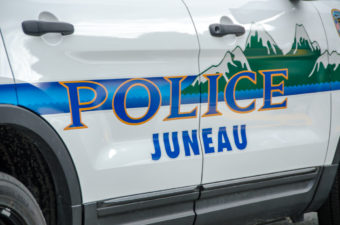
Quinton Chandler, KTOO

Juneau man medevaced to Anchorage after Saturday night shooting

(Photo by Heather Bryant/KTOO)

A 32-year-old Juneau man was shot near Lemon Creek on Saturday night.

In a news release, the Juneau Police Department said it received several reports of multiple shots fired in the 5200 block of Glacier Highway at about 9:50 p.m.

Police said a preliminary investigation indicates that the victim and shooter are friends who “got into an altercation.”

Police said the 21-year-old shot the victim three times.

Both men were taken to Bartlett Regional Hospital. Later, the man who was shot was medevaced to Anchorage.

The alleged shooter was treated for minor injuries and then released.

The news release said alcohol was a factor. The investigation is ongoing.

Frozen spruce make for extra dangerous woodcutting

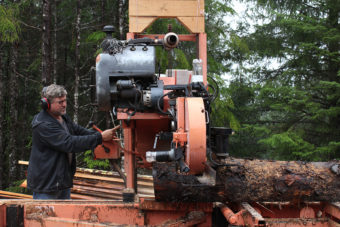
Bucking a 44–inch–diameter Sitka spruce on the Tongass National Forest in 1991.
Bucking a 44–inch–diameter Sitka spruce on the Tongass National Forest in 1991. (Courtesy U.S. Forest Service)

This first real cold snap in several years around Kodiak has got a local tree expert raising an alarm over tree cutting and log splitting. Dennis Symmons, a tree surgeon when he’s not tending to borough business as an assemblyman, says when the local Sitka Spruce tree freezes, it can become dangerous to handle.

“When it turns to plastic and peanut brittle from the cold, and it’s the one thing that even a professional forgets. And I was reminded yesterday, ‘Oh yeah, they’re not trees anymore.’ They’re giant sticks of celery. And when I attach my body to that, 60-feet off the ground, it takes on a whole different persona. Now, throw into the mix of these frozen sticks of celery, rotten cores, cancered bases, and they’re not trees anymore.”

He said the tree is more like “a sweaty stick of dynamite” at that stage, and the scenario could turn ugly quickly when topping or felling a tree.

“So here’s the novice and the professional putting that deep face, like he would into a green tree. Now that person’s coming through the back cut, and already making the first mistake, because all of that weight is getting smaller and smaller concentrated on one spot. The mistake’s realized, too late. Now that all that weight’s shifting on that little teeny stick, if a climber’s off the ground, that little stick is right in his face and he’s got nowhere to go.”

Symmons said that very thing happened to him some years ago when he was working on a tree.

“It looked like a really simple job … about a 90-foot spruce tree on its root wad. I just walked up it. I’m about 14-feet off the ground, with my sharpest, fastest-running chainsaw. And I zipped the top off really quick. And I step back, and without even computing what I just did, you know, leaving the frozen top, I slowly started cutting on that. And theoretically, the elasticity would just peel me to the ground. You now, kind of a show off mood,” he said.

“Well, I got three-quarters through that, seven-eighths through that, and realized – by that time it was too late – that it hadn’t moved. And then it exploded and it launched me upside down, into the air, feet-first. My experienced ground-man logger from Oregon thought I was showing off, doing some kind of stunt.”

Bucked Sitka spruce.
Bucked Sitka spruce. (Public Domain photo courtesy Wikimedia Commons)

He said the outside couple of inches have the most moisture and freeze the hardest. He says the dangers with cutting Sitka Spruce are present even when bucking up logs for firewood.

“(You) go to sink that saw and, ‘Wow, this is really weird, I know I just sharpened this thing, and it seems really dull.’ And about the time I punches through that inch-and-a-half frozen layer and grabs that soft wood, by then a person has already backed off and relaxed. Now the saw’s kicking back, coming at them, and the log’s trailing it,” Symmons said. “I’m trying to draw a real ugly scenario because that’s what it is – it’s an accident waiting to happen.”

And when the next windstorm hits and temperatures plummet to the single digits, what does Symmons recommend homeowners do if a tree in their yard starts to look threatening?

“I think the best thing to do is to get it secured. No matter what the conditions are, get the thing tied down. That’s a big deal. That’s why a tree gets topped, it stops its momentum,” he said. “Step one, if they’re in doubt, tie the thing down.”

Temperatures are expected to hover around the freezing point all week, but even when it thaws, Symmons cautions that the frozen ring around the Sitka Spruce could stay frozen for weeks afterward.

In Reversal, Gambian President Rejects Loss And Calls For New Election

Gambian president Yahya Jammeh (center) has his finger inked before casting his marble in a polling station in a presidential poll, in Banjul on Dec. 1, 2016. Marco Longari/AFP/Getty Images

After publicly conceding electoral defeat last week, President Yahya Jammeh of Gambia has reversed course and is calling for a new election.

Jammeh has ruled the tiny West African country since seizing power in a coup in 1994, and his public concession to President-elect Adama Barrow on Dec. 2 led to hopes of the first peaceful transition of power in Gambia since it became independent from the U.K. in 1965.

On Friday, Jammeh said the Independent Electoral Commission made errors in vote tallies.

“In the same way that I accepted faithfully the results, believing that the IEC was independent and honest and reliable, I hereby reject the results in totality,” Jammeh said in a televised speech.

He also said there were other irregularities and problems in the electoral process.

“Our investigations reveal that in some cases, voters were told that the opposition has already won and there was no need for them to vote,” Jammeh said.

Last week, supporters of the opposition took to the streets to celebrate Barrow’s win. Jammeh’s allegations are now “plunging Gambia into confusion and uncertainty,” NPR’s Ofeibea Quist-Arcton reports.

President-elect Barrow responded, telling reporters, “The outgoing president has no constitutional authority to reject the result of the election and order for fresh elections to be held,” Reuters reports. “I urge him to change his current position and accept the verdict of the people in good faith for the sake of the Gambia, our homeland, whose people deserve peace and freedom and prosperity,” he added to The Associated Press.

The U.S. joined international bodies in condemning the announcement.

“This action is a reprehensible and unacceptable breach of faith with the people of The Gambia and an egregious attempt to undermine a credible election process and remain in power illegitimately,” State Department spokesman Mark C. Toner said in a press release.

The Economic Community of West African States, the U.N. and African Union echoed the sentiment in a joint statement:

“They call on the government of The Gambia to abide by its constitutional responsibilities and international obligations. It is fundamental that the verdict of the ballots should be respected, and that the security of the president -elect Adama Barrow, and that of all Gambian citizen be fully ensured.”

Wire services report the streets of the capital Banjul were calm Saturday, with a heavy presence of police and soldiers. Gambians closed down shops and stayed home out of fear of violence.

Human rights groups have criticized Jammeh for abuses during his 22-year rule. In its 2016 report, Human Rights Watch said his government “frequently committed serious human rights violations including arbitrary detention, enforced disappearance, and torture against those who voiced opposition to the government,” creating “a climate of fear within Gambia.”

On Saturday, the organization retweeted a statement from deputy program director Babatunde Olugboji saying they were “deeply concerned.”

Diplomats told Reuters that it’s unclear what international organizations plan to do, but there is a precedent for military intervention. In 1981, they note, the surrounding country of Senegal sent in troops to stop a coup in Gambia.

Opposition leader Mai Ahmad Fatty urged calm. “We are working round the clock to restore sanity,” he told the AP. “We have the full support of our people. The world is with us.”

Copyright 2016 NPR. To see more, visit http://www.npr.org/.

State: Western Alaska had most sexual assaults per capita in 2015

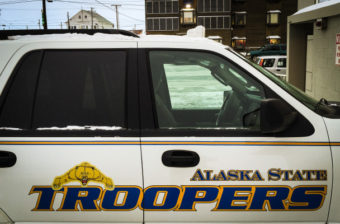
An Alaska State Trooper cruiser parked on Nome’s Front Street in January 2015. (Photo by Matthew F. Smith/KNOM)

In 2015, Western Alaska had the highest rate of sexual assault in the state per capita. By far. That’s according to a first-of-its-kind study from the Alaska Department of Public Safety that compiles reports of sexual assault from all state law enforcement agencies.

Three-hundred seventy people out of every 100,000 were survivors of sexual assault in Western Alaska last year. Megan Peters is the spokesperson for the Alaska State Troopers, one of the agencies that responds to sexual assault cases.

“The average victim age is 15-years-old, and it would be a female. And for the suspect information, the most likely suspects are male 22-year-olds,” said Peters.

In the majority of cases, the victim knew their offender. They were often an acquaintance, a friend, or a family member, and in most cases, the offender physically overpowered the victim. The majority of assaults occurred in the home of either the victim or the assailant.

In over half the cases, either the victim or the suspect was Alaska Native or American Indian. The most commonly reported charge was sexual assault in the first degree, which includes, among many things, penetration without consent.

Though Western Alaska had the most sexual assaults per capita last year, the Anchorage area had the highest number overall. There were 659, compared to Western Alaska’s nearly 275 cases. The Anchorage data only included the number of cases reported. It did not report other information, such as weapons used, type of sexual assault reported, location, and information on the victim or offender.

Peters, with the State Troopers, says future reports will allow for better comparison.

“The report was done this year for the first time because a couple years ago the legislature mandated that we study this a little more and put out what the findings were. This is the first year that we’ve had sufficient information to put it out,” said Peters.

Also, Peters says the report only includes felony level cases that happened in the state, and it can’t be compared with national statistics – or even Alaska’s statistics – in the FBI’s Universal Crime Reporting system, because the numbers are calculated differently.

The over 1,300 felony-level sex offenses included in the study reflect only reported cases, not convictions. For more information on the study click here.

Retired Coal Miners At Risk Of Losing Promised Health Coverage And Pensions

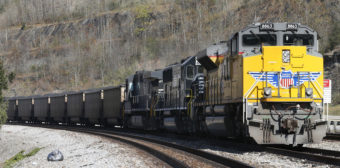
Retired coal miners could face the loss of health benefits if Congress doesn't implement a fix by Friday. Steve Helber/AP

Retired coal miners could face the loss of health benefits if Congress doesn’t implement a fix by Friday. Steve Helber/AP

Without congressional intervention, about 16,000 retired miners in seven states will lose their health care coverage by the end of the year.

A proposal to temporarily extend the benefits is working its way through Congress. But two Senate Democrats, who are advocates for a more comprehensive plan, say the temporary provision isn’t enough.

They are threatening to hold up a spending bill that needs to pass by Friday night to keep the government running.

Coal mining is dangerous work. For many miners, a government-backed promise of lifelong health care for them and their dependents made the risk worth taking.

Roger Merriman, 65, worked in the coal industry for 28 years.

“When we all started in the mines, we were promised health care for life – cradle to grave,” he says. Merriman’s employer, Patriot Coal, filed for bankruptcy in 2012, then again in 2015. He is now slated to lose his pension and benefits. Merriman says that possibility of losing health benefits for his wife, who is younger than he is (at 65, he qualifies for Medicare), and their pension, is devastating.

“We’ll have to make a choice of whether [we’re] going to the doctors and buying prescriptions or paying bills and eating. It’s a life and death situation realistically is what it is,” he says.

In 1946, the United Mine Workers of America and the U.S government agreed that union miners who put in 20 or more years would get lifelong pension and health benefits. Patriot is one of six major coal producers in the U.S. that has sought bankruptcy protection in the last few years, a process that often includes an attempt to drop retiree benefits.

After the Patriot bankruptcy in 2012, the UMWA negotiated a $400 million payment in bankruptcy court for retirees benefits. Existing companies pay into a UMWA fund for retirees, but as those mines close, there is less money going into the pot and the number of retired miners who are drawing from it is increasing. The fund is about to run out of money.

The UMWA’s hope was that the $400 million would give federal lawmakers the time they needed to pass legislation that would protect the miners.

Senate Democrats have been working for years to pass the Miners Protection Act — a bill that would move money from the Abandoned Mine Lands Reclamation Fund into a fund to pay for the pension and health care benefits of tens of thousands of coal miners and retirees.

West Virginia Sen. Joe Manchin, a Democrat, is frustrated by the benefits Band-Aid. “We’re asking for a permanent fix, we have a plan to pay for a permanent fix — it’s the excess that we have, the surplus in the AML money,” he said Tuesday on the Senate floor.

Manchin and colleague Sherrod Brown, D-Ohio, are trying to block a key government spending bill on the Senate floor until miners get their full health care and pension money.

“I haven’t ever used this tactic before, but I feel so compelled that I said we are going to do whatever we can to keep this promise,” he said Tuesday.

But the Miners Protection Act has met with resistance from Senate Republicans, who are wary of bailing out unionized workers.

Senate Majority Leader Mitch McConnell, R-Ky., proposed a temporary fix — tacking on $45 million taken from the existing UMWA fund to the continuing resolution that is needed to fund the federal government through April 2017.

The continuing resolution must be approved by Friday. Manchin and others are frustrated that it is only a solution for a few months and that it doesn’t include any money for pensions.

Critics of the Miners Protection Act say there are many struggling pension and benefits funds and that a government bailout sets a bad precedent.

This story is part of a reporting partnership with NPR, West Virginia Public Broadcasting and Kaiser Health News.

Copyright 2016 West Virginia Public Broadcasting. To see more, visit West Virginia Public Broadcasting.

Police: Schools no longer in danger from shooting threat

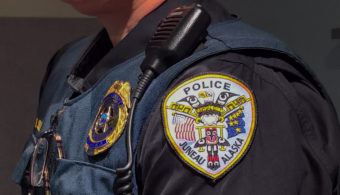
Juneau Police Department badge logo
An arm badge for the Juneau Police Department on Lt. Kris Sell’s uniform, April 1, 2016. (Photo by Jeremy Hsieh/KTOO)

The Juneau Police Department said in a Facebook post Monday night, the student who made a possible shooting threat against Thunder Mountain High School is no longer a danger.

Lt. David Campbell with the police said they are trying to quash rumors that the 17-year-old boy was missing Monday night.

“What we were hearing was a lot of conjecture on social media saying that the student that had made the threat was unaccounted for and people were still worried,” Campbell said. “As of last night, we knew that conjecture was not accurate.”

Campbell said the police knows the boy’s location and that he cannot hurt anyone.

He said he can’t reveal the boy’s location or explain why he isn’t a threat because of the sensitive nature of the case.

“Given the juvenile, his age and the nature of the situation, unfortunately, we’re prohibited from telling exactly what did take place last night,” Campbell said. “But, I can safely say the necessary steps were taken to assure the safety of the student and the community.”

Juneau police said officers will maintain a presence in local schools “in the coming days.”

Campbell said it’s now as safe as any other day for parents to take their kids to school.

Site notifications
Update notification options
Subscribe to notifications