Quinton Chandler, KTOO

Feds call out Juneau schools website for inaccessibility to people with low vision, deafness

The federal government is cracking down on the Juneau School District because its website discriminates against people with disabilities. People living with conditions like low vision and deafness use special features on their computers to make surfing the web possible.

The Juneau School District was called out by the U.S. Department of Education’s Office of Civil Rights after receiving a complaint about the district’s website.

“A complaint had been filed with them because certain pages of its website were not accessible to people with disabilities,” said school district spokeswoman Kristin Bartlett.

The department found similar problems with 10 other schools and education groups in seven states including the Montana School for the Deaf and Blind.

The Rehabilitation Act of 1973 and the Americans with Disabilities Act prohibit government agencies and any entity that gets federal money from discriminating against people with disabilities.

In a settlement with the Department of Education, the district and the other education groups agreed to fix their sites.

“In July we’ll be transitioning to a new website and that service provider operates by what’s called the web content accessibility guidelines,” Bartlett said.

Bartlett said those guidelines are like best practices for web building.

The Department of Education lists examples of problems disabled people might have with a website in a press release. It might be hard to understand, so we found somebody who could show us.

Brin Marx
Brin Marx builds websites for the Alaska Department of Environmental Conservation. He uses high-contrast accessibility features and reading software to compensate for his low vision. (Photo by Quinton Chandler)

Brin Marx works for the Alaska Department of Environmental Conservation. He has low vision and works in IT writing webpages.

At his desk, he works on the agency’s website and other internet applications. He has pretty standard equipment. PC, dual computer screens. It could be any workstation in any office — until you notice his operating system narrating webpages.

To read from a computer screen, Marx turns on special settings that most PCs have. He runs his mouse cursor over words and a narrator reads to him. He also has a backlit keyboard that illuminates the numbers and letters. He bought it back when his sight was normal but now it’s extremely helpful. His most valuable tool is a high contrast display made for people with low vision.

Brin Marx's keyboard
Brin Marx says this backlit keyboard is extremely helpful for helping him deal with low vision. (Photo by Quinton Chandler/KTOO)

“What that means is that most colors are black, and there’s no background images or colors, and the text is just white, and the webpage is very plain – usually just the text and the occasional image. Most of the images are gone,” he said.

Marx had normal vision up until three years ago. He said he has a genetic disorder called FEVR, where causes the retina to detach slightly in the later teen years.

“I’m unable to differentiate a lot of colors, seeing in low light and very bright lights – it’s fairly difficult to navigate, recognize people and faces,” he said.

He said there’s been stem cell research into reattaching a retina to the back of the eye, but it’s still just theory and probably wouldn’t help him anyway. So he’s had to adapt.

Marx visits the Juneau School District’s website and gave us his take.

“So this page is pretty interesting actually because normally if I mouse over these links it would read off what the link says obviously, but in this case they don’t and I’m not sure why it doesn’t. You’d have to go out of your way to turn that off,” he said.

Besides the screen reader-hyperlink problem, Marx said the biggest issue is that the website uses a lot of PDFs. Screen readers can’t read PDFs and the high contrast mode he uses to read doesn’t work with them either.

“A lot of PDFs will just be black text on a white background. Maybe people like white text on a black background and that’s just not possible. They’re not able to enlarge the font size if they need to,” he said.

Marx said it’s pretty common for websites to be designed without considering people with disabilities. He thinks a lot of designers try to make their websites flashy, which can hurt accessibility.

“One of the biggest problems is people using images instead of real content. They tend to put text in images, which really doesn’t work for screen readers. It’ll either be hidden or they simply won’t be able to read what is in the text,” he said.

As part of a deal with the Department of Education, the Juneau School District will eventually have regular compliance audits of its new site.

“A good design should be usable by anyone. That’s really what I strive for. To be good at my job I have to be able to write accessible webpages,” he said.

Marx said government websites have among the worst accessibility, ironic considering the federal government passed the laws that protect people with disabilities from discrimination.


University of Alaska gets $325 million after governor budget vetoes

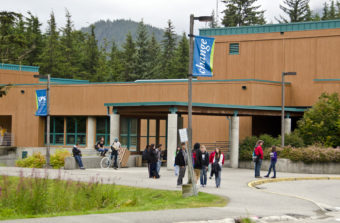
University of Alaska Southeast (Photo by Heather Bryant/KTOO
University of Alaska Southeast Monday, August 19, 2013 (Photo by Heather Bryant/KTOO)

After a Wednesday morning announcement by Gov. Bill Walker, the University of Alaska finally knows exactly how much money it will have for the upcoming fiscal year.

During the legislative session, university officials assumed lawmakers would give them between $300 million and $325 million.

“To that end, we prepared for $300 million. When the legislature completed its work and the budgets were finalized, our budget ended up being at $335 million,” Roberta Graham said. Walker’s $10 million veto brings their final number to $325 million — the most the university originally expected.

Graham is the university’s associate vice president for public affairs.

“While we were hopeful that ($335 million) would be the number, and we then looked at how we would take that $335 million and invest in strategic priorities for the university, we also were mindful that the governor’s action may change that,” Graham said.

She said the university’s strategic priorities include maintenance, research, enrollment, compliance issues and fundraising.

Graham added that the university will take most of the governor’s cut from funds dedicated to its strategic priorities and the rest will be absorbed by cutting about eight staff positions in the university system.

UAS adapts to budget cuts by dropping old programs and launching new ones

The 2015 Governor's Picnic was held at the University of Alaska Southeast. (Photo by Jeremy Hsieh/KTOO)
The 2015 Governor’s Picnic held at the University of Alaska Southeast. (Photo by Jeremy Hsieh/KTOO)

A $6 million cut has made the University of Alaska Southeast reconsider what is really important. UAS is giving up its masters of business administration degree program and some staff positions, but it’s offering a new fisheries and Northwest Coast Arts program.

The University of Alaska Southeast’s budget cut is the result of a near $20 million statewide squeeze on the entire university system. UAS Chancellor Rick Caulfield said the $6 million hit to UAS’ wallet comes with a combination of reduced spending, an increase in costs and re-prioritization at the top.

Officials said they’ve eliminated about 23 positions mostly through attrition. Four people were laid off and three faculty contracts weren’t renewed.

“We’ve worked hard to minimize the impact on our instructional mission and on the student support services so that students will see less of an impact, and if we find savings in any area it will be more in the administrative realm,” Caulfield said.

UAS is also getting rid of at least one degree program. Caulfield said they won’t offer a master’s degree in business administration next school year.

“We did that because our sister institutions to the north at UAA and UAF also offer a master’s in business administration,” Caulfield explained. “We’re having to focus instead on programs where we have the greatest demand and certainly that meet the needs of employers and our communities here in Southeast Alaska.”

Those programs include teacher education, environmental sciences and marine biology.

“We’re also trying to develop our career and technical education programs — especially in mine training, but also in construction technology and diesel technology,” Caulfield said.

Caulfield said UAS is launching a new bachelor’s of science degree program in fisheries with UAF.

UAS also plans to reorganize its art program to focus on Northwest Coast Arts.

“We have great opportunities in Juneau and Sitka and Ketchikan to partner with other organizations that are interested in the economic development of the arts and supporting artists,” Caulfield said.

UAS hired a new faculty member to help expand the art program, he said.

Caulfield added that he wouldn’t be surprised if budget cuts and a reduction in offerings persuade some prospective students to go to school somewhere else. But, he believes affordability and quality will outweigh future students’ worries over studying in Southeast.

Correction: A previous version of this story misstated that UAS is adding a new marine biology degree program. It already has a marine biology degree program and is adding a fisheries degree program.

HUD seeks input on Alaska Native, American Indian housing

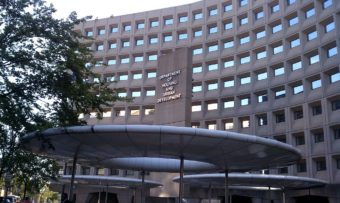
The Robert C. Weaver Federal Building in Washington, D.C., in the United States. As of September 2010, the building housed the U.S. Department of Housing and Urban Development. (Wikimedia Commons)
The Robert C. Weaver Federal Building in Washington, D.C., in the United States. As of September 2010, the building housed the U.S. Department of Housing and Urban Development. (Creative Commons photo by Wikimedia Commons)

The federal government wants to know, among other things, how tribes use federal resources to improve housing.

The U.S. Department of Housing and Urban Development plans to create a special committee to gather that information. Lourdes Castro Ramírez is head of HUD’s Office of Public and Indian Housing. She said her office will bring together people running federal programs and tribal representatives around the country at least twice a year to discuss priorities for Native housing.

“We believe that the creation of a committee that allows for regular feedback, regular discussion — and really, also an opportunity to identify best practices and models that are working across Native American communities — will help further our impact and will also help inform the future of Native American housing programs,” Ramírez said.

There will be up to eight tribal representatives and at least one of them will represent Alaska.

Ramírez said federal funding for housing programs has become scarce and it’s especially important for her agency to have a firm understanding of how Native communities use that money.

The deadline to comment on the agency’s planned Tribal Intergovernmental Advisory Committee is July 23. Comments can be left on the Federal Register website.

Hoonah car crash leaves one dead

Downtown Hoonah.
Downtown Hoonah. (Photo by Ed Schoenfeld/Coastalaska)

The cause of a Friday crash in Hoonah that left one man dead and another injured is still under investigation. According to Alaska State Troopers, 23-year-old Jeffery Turner of Tampa Bay, Florida, was killed after the vehicle he was in rolled over.

A trooper dispatch said Turner’s body would be sent to the state medical examiner for an autopsy. The other occupant, 24-year-old Dylan Wiard of Juneau, was injured in the crash and transported to Bartlett Regional Hospital for treatment.

Juneau charter school avoids budget cut

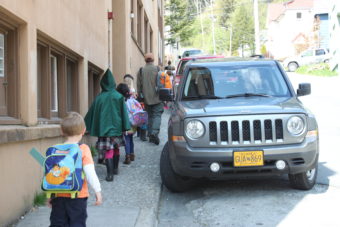
Juneau Community Charter School kindergarten and first grade students on their way to a nature hike up Basin Road. (Photo by Lisa Phu)
Juneau Community Charter School kindergarten and first-grade students on their way to a nature hike up Basin Road on Tuesday, May 6, 2014. (Photo by Lisa Phu/KTOO)

Juneau Community Charter School has dodged a budgetary bullet. Last October, the school’s enrollment dropped to about 74 – down from 100 the year before. That put it one student short of what was needed to prevent a big cut. Ryan Stanley is president of the JCCS academic policy committee.

“When you’re looking at kind of generally decreasing enrollment it’s usually a small number from each grade level. We were looking at a variety of things but certainly letting go of some staff was part of that,” Stanley said.

Stanley didn’t yet know the exact amount that would’ve been cut but said the school prepared for a near $308,000 loss in its worst case scenario. To cope, he said school officials would’ve had to “redesign the program” around the desires of their remaining students’ parents.

JCCS has 95 students enrolled for next school year, putting it well over what it needed to prevent a sizeable cut in state funding. The school has experienced a lot of rapid changes over the last couple of years. Stanley says a previous increase in state funding allowed the school to hire more staff and expand its offerings, but it also saw higher turnover.

“The school itself is basically kind of molting. It grew fairly organically over the years and then around that time, FY14 and FY15, it had to kind of change its organizational structure,” Stanley said.

Stanley believes most of JCCS’ drop in enrollment can be traced back to the impact of that restructuring, competition with other programs, and to some degree, the physical limitations of the downtown building rented by the school.

Stanley is happy to see enrollment back up and said he’s excited to see JCCS continue fulfilling its role in Juneau’s education system.

Site notifications
Update notification options
Subscribe to notifications