Quinton Chandler, KTOO

Juneau man’s thoughts drift home after Turkish coup attempt

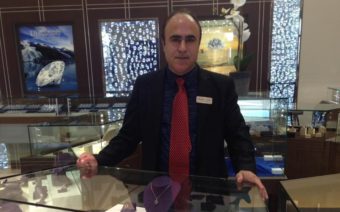
Muzaffer Uyanik at Diamonds International Wednesday, May 11, 2016. (Photo by Mary Uyanik)
Muzaffer Uyanik works at Diamonds International on May 11, 2016. (Photo by Mary Uyanik)

When members of Turkey’s military tried to seize control of their country last week, Turks living overseas – including in Alaska – weren’t immune to fear and uncertainty.

Muzaffer Uyanik is Kurdish and was born and raised in a town in eastern Turkey close to the Iranian and Iraqi borders.

“They call it Lake Van. We have the biggest lake in Turkey, so it makes it easy if you search Lake Van. My hometown is famous with lake and cats,” said Uyanik.

Now, Uyanik is a salesman for Diamonds International in downtown Juneau. He said he was caught off guard by the attempt to overthrow Turkey’s elected government.

“It’s like a shock, you know. It’s a big surprise for most of … Turks let’s say, I consider myself as a Turk,” said Uyanik.

Members of the Turkish military tried to seize control in the middle of the night while Turkey’s president, Recep Tayyip Erdogan, was away on vacation.

The failed coup left more than 290 people dead and more than 1,400 wounded, according to the Turkish Ministry of Foreign Affairs. The Turkish government has arrested more than 6,000 people in connection with the attempt and more than 100 of the people killed have been branded, conspirators.

Uyanik believes some members of his family are safe. His mother, brother and two of his sisters who live in Izmir, in western Turkey, were far from the fighting. He’s less certain about his two sisters and their families who still live in his hometown to the east.

“Their life is more difficult. Eastern Turkey … if you go to eastern Turkey and if you compare it with the center, they have really, really hard life in eastern Turkey,” said Uyanik. “They have big … marching and protests about what happened.”

Uyanik believes the coup was staged by supporters of the same cleric President Erdogan accuses of instigating the power grab – Fethullah Gulen.

Aykan Erdemir, a senior fellow with the Foundation for Defense of Democracy in Washington, D.C., has been following the situation in Turkey very closely.

“I’ve been up non-stop for the last 36 hours – only slept one hour. It’s really non-stop, it’s such a mess as we can see,” Erdemir said.

Erdemir also served in the Turkish Republican People’s Party as a member of parliament between 2011 and 2015. He said the cleric, Gulen, is the central figure of an international network of schools, charities, businesses and media outlets. Erdemir said Gulen and Erdogan were political allies up until 2013, but now they “are almost like archrivals”.

“For the prime minister and president, this is a Gulenist clique within the Turkish military. He calls them a parallel state and he thinks they are out to overthrow him,” he said.

Uyanik said he’s not a fan of president Erdogan, but he’d rather Erdogan’s government remains intact.

“Gulen is more dangerous than him actually. He’s very dangerous. He’ll do anything to have the power even if it’s going to cost people’s lives. He wouldn’t mind, he wouldn’t care,” said Uyanik.

Erdemir doesn’t know if a Gulenist faction was behind the coup. He stressed that he wouldn’t expect Gulen, a spiritual leader, to take a political post.

“The community is not a political movement, is not a political party, but over the course of their history they change allegiances, they support one party or another during their term,” he said.

Erdemir is more curious how Turkey will move forward after the failed coup. He said the president has an opportunity to move Turkish democracy forward by capitalizing on the country’s strong endorsement of the democratically elected government over a military takeover.

But, he doubts that will happen.

“He will probably use this coup d’état attempt, failed coup, as an opportunity to crackdown on dissidents, to consolidate his powers and to push for an executive presidential system which will give him unprecedented powers,” Erdemir said.

Uyanik thinks that, even before this latest crisis, Turkey has been steadily losing western countries’ respect, a trend he is afraid will continue.

“We’re losing it. Turkey is losing the good feelings that Europe and western countries had about Turkey,” said Uyanik.

Editor’s note: After this story was published, Aykan Erdemir downplayed the certainty of his analysis regarding Fethullah Gulen’s possible involvement in the coup. His comments have been revised to be more neutral and less absolute. 

Electrical fire in downtown home extinguished

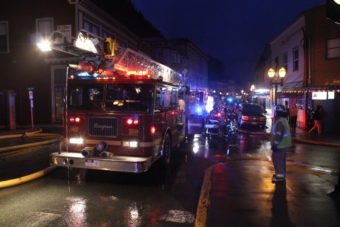
Capital City Fire/Rescue battles Saturday's fire at the Gastineau Apartments building. (Photo by Mikko Wilson/KTOO)
Capital City Fire/Rescue battles fire at the Gastineau Apartments building on Saturday, March 21, 2015. (Photo by Mikko Wilson/KTOO)

An electrical fire caused an estimated $2000 in damage at a home in downtown Juneau Saturday afternoon.

Capital City Fire/Rescue Assistant Chief Ed Quinto said the fire on Carrol Way started around an electrical plug in one of the home’s bedrooms. He said the homeowner put out the fire with a fire extinguisher and kept it from spreading.

All damage was limited to the bedroom.


Turkish Coup Attempt Unravels After A Wild Night Of Shooting, Arrests

Updated at 10:00 am:

A coup attempt by factions in the Turkish military crumbled Saturday as President Recep Tayyip Erdogan made his way to Istanbul and his government began reestablishing control after a long night of widespread violence.

“The people have taken to the streets and voiced their support for democracy,” the acting head of the military, Gen. Umit Dundar, said at a news conference Saturday. “The nation will never forget this betrayal.”

The government and the military were focused Saturday on reasserting control and rounding of troops suspected of involvement in the coup. Prime Minister Binali Yildirim said 2,839 military personnel had been detained so far.

He put the death toll at 265, a figure that included civilians, soldiers and police loyal to the government, and coup plotters. More than 1,400 people were injured, he added.

Erdogan was on vacation on Turkey’s Black Sea coast when the coup plotters launched the revolt late Friday, igniting chaos in the streets and generating rapidly changing accounts of who was in charge.

The president, who has dominated Turkey for more than a decade, apparently escaped an attempt to detain or kill him and made his way to the Istanbul’s Ataturk Airport in the early hours of Saturday, where a huge crowd of supporters greeted him.

“They have pointed the people’s guns against the people,” Erdogan said of the coup plotters. “The president, whom 52 percent of the people brought to power, is in charge.”

The airport, the scene of a terror attack just last month that left more than 40 dead, was closed in the early hours of the coup attempt. But it returned to normal operations on Saturday.

Meanwhile, the fighting scarred a number of places around the country, including the parliament in Ankara, which was badly damaged after rebels reportedly carried out air strikes against the building.

The military chief of staff, Gen. Hulusi Akar, was rescued during an operation at an air base after being taken hostage earlier by pro-coup soldiers. Word that Akar had been taken hostage by the coup plotters was one of the early signs that not all the senior military officers were on board with the revolt.

The Turkish media on Saturday cited two military figures as leading the coup attempt. One was Gen. Akin Ozturk, who retired from the military last year after commanding the air force, though he continued to serve on the country’s Supreme Military Council. The other was Lt. Gen. Metin Iyidil, the commander of combat and support training.

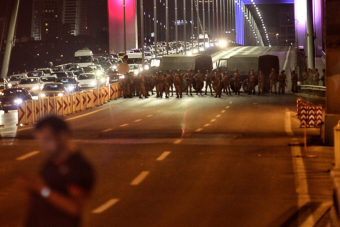
The rebels did seize a number of key locations in Ankara, the capital, and Istanbul, the largest city, in the early hours of the uprising. But as the revolt started to fall apart, they quickly lost control of spots like the Bosporus bridge in Istanbul. Early Saturday, CNN Turk showed video of dozens of coup soldiers surrendering there.

“Our president and government are in charge,” the Turkish Embassy in Washington said in a statement, adding that the coup attempt “was conducted by a clique within the armed forces and received a well-deserved response from our nation.”

U.S. Secretary of State John Kerry said Friday evening that he spoke with Turkey’s foreign minister “and emphasized the United States’ absolute support for Turkey’s democratically elected, civilian government and democratic institutions.”

When the coup attempt began, Erdogan’s exact whereabouts were not clear. But the Turkish president — who has often censored and criticized social media — turned to FaceTime video and called on the Turkish people to resist the military action in an interview on CNN Turk.

“I urge the Turkish people to convene at public squares and airports,” he said. “I never believed in a power higher than the power of the people.”

Thousands of people soon flooded the streets in Turkish cities. TV footage showed large groups of unarmed civilians blocking the way of tanks and other military vehicles.

In a strange twist, Erdogan blamed the uprising on Fethullah Gulen, a prominent Muslim cleric who used to be a close ally of the president. But after they had a falling out three years ago, Gulen left Turkey and has been living in Pennsylvania.

“I have a message for Pennsylvania: You have engaged in enough treason against this nation. If you dare, come back to your country,” Erdogan said Saturday, referring to Gulen.

Erdogan, who has ruled Turkey as either prime minister or president since 2003, has won several elections, most recently in 2014. But he’s had a fraught relationship with the powerful military, which has carried out multiple coups over the past half-century.

Shortly after coup rumors began, a Turkish state television broadcaster read a statement saying members of the military had taken over the country. But from the beginning, it was not clear who within the military was behind the coup attempt, or how widespread support was in the military.

There were frequent reports of gunfire. In one instance, a military helicopter began shooting in Ankara. Reuters reported that a military jet shot down a military helicopter over the city, and that a bomb that exploded at the Parliament building.

The coup attempt raised a host of critical questions at a time when Turkey is engaged in turmoil at home and with neighboring countries.

Roughly half of Syria’s nearly 5 million refugees are in Turkey, straining the country’s resources. Turkey has also been the launching point for many Syrian refugees heading to Europe. And Turkey’s security forces have been fighting Kurdish separatists in the southeast.

The U.S. works with Turkey on multiple crises in the region. To cite just one example, U.S. Air Force planes come and go from Turkey’s Incirlik Air Base as they carry out airstrikes against the Islamic State in Syria. The U.S. military said its operations at the air base were not affected.

The U.S. State Department used Twitter to urge American citizens in Turkey to contact family and friends to assure others of their safety.

This is a breaking news story. We will update this post with further information as we have it.

Copyright 2016 NPR. To see more, visit http://www.npr.org/.

Burglaries up 64% in Juneau last year, trend continues this year

JPD Lieutenant David Campbell at his desk. Thursday, June 30, 2016. (Photo by Quinton Chandler/KTOO)
Juneau police Lt. David Campbell at his desk. (Photo by Quinton Chandler/KTOO)

Anytime someone breaks in somewhere to steal or commit a felony, that’s a burglary. It’s a crime of opportunity that can affect anyone, said Juneau police Lt. David Campbell.

“What I see a lot of is people who are not exposed to crime, and they live in Juneau and think it’s a little crime-free utopia, and they make it very easy for an opportunistic thief to victimize them. They don’t lock their houses. They leave their cars unlocked,” Campbell said.

Campbell sits at his office computer reviewing the history of burglary in Juneau.

JPD has seen a dramatic rise in burglaries in 2015 and, so far, this year the trend is continuing. Victims of break-ins have lost everything from inexpensive belongings to thousands of dollars in valuables. Juneau Police say drug addiction is driving part of the increase.

“So overall, in Juneau, we had basically three years of pretty solid reductions going down and then in 2015, we had a pretty sharp increase,” Campbell said.

JPD’s annual stats for 2015 show reported burglaries increased by 66 cases. It’s an increase of 64 percent.

“So then the question is, ‘OK, well why? What’s doing it,’” Campbell asked. “With burglaries you typically have either a small group of people or a small group of groups that can create a lot of burglaries at one time. In 2015 we also saw a pretty big increase in our issues dealing with people that were dealing with controlled substances.”

Campbell sees a definite correlation between heroin use and other crimes. He said addicts sometimes resort to crime to pay for their addiction.

“But, it would be inappropriate for me to say that’s the sole reason,” Campbell said.

He said JPD has also seen serial burglars, who don’t have a drug problem but repeatedly steal for other reasons. Simply put, he can’t identify every factor contributing to Juneau’s spike in burglaries, and it’s impossible to say who all the burglars are. They cross all sectors of the community.

“What I can pretty much guarantee you is that if someone is a burglar, they’re not going to burgle one place and then stop,” Campbell said.

Campbell said most burglars will continue breaking into places until they are arrested or something else stops them, so property owners need to make their properties too risky to target.

“If somebody really wants to break into your house, or your business, stopping them will be very, very difficult. But, you can make it to the point where, when that really low level cost-benefit analysis happens, the person will choose to go somewhere else as opposed to victimizing you,” he said.

He suggested property owners practice “crime prevention through environmental design.”

“How do you design places so it sends the subconscious message to people that this is not the place that you want to commit a crime in? It’s not just burglary, it could be any crime. We’re talking about natural lighting, lines of surveillance (and) things along those lines,” Campbell said.

He said JPD has posted advice for small business owners on its Facebook page. Suggestions like emptying your cash register and leaving it open and visible to people passing by the front of the store.

“If a thief walks by or a burglar walks by, they’re going to think, ‘Wow, if I go into this place, anybody on the outside is going to see me in there because there’s easy viewing access through the windows and why would I go in there? The cash register is open, there’s nothing in it,’” Campbell explained.

He said people can also try “target hardening”: installing stronger locks, and security systems.

According to JPD’s annual report the department cleared roughly 47 of the 169 burglary cases it investigated in 2015. That’s a higher clearance rate than the national average in 2014. Campbell said property crimes are generally much harder to clear, because most of the time police are dealing with people who don’t know each other.

The report also said the number of vehicle thefts and thefts in general also rose significantly in 2015.

Goldbelt names new CEO

Goldbelt Inc. CEO Elliot “Chuck” Wimberly on July 9, 2016. (Photo by Mary Uyanik)

Elliot “Chuck” Wimberly will serve as Goldbelt’s new president and CEO.
The announcement came during Goldbelt’s 42nd annual shareholders meeting Saturday. Goldbelt Board Member Ben Coronell confirmed the news.

Wimberley was named interim CEO by Goldbelt in a January press release after Richard Irwin left the position at the end of last year.

According to the press release, Wimberly has 10 years experience as an executive with Alaska Native corporations and over 20 years experience in “government service.”

Goldbelt said Wimberly previously served as a top executive for the Southern Ute Tribe in Durango, Colorado, and he is retired from the U.S. intelligence community. According to the Juneau Empire, Wimberly was also CEO of Shee Atika, Sitka’s urban Native corporation.

Serena Williams Wins Wimbledon In Straight Sets For 22nd Grand Slam Title

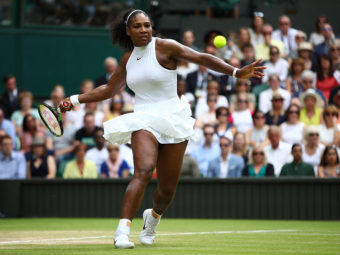
Serena Williams of The United States plays a forehand during The Ladies Singles Final against Angelique Kerber of Germany on day twelve of the Wimbledon Lawn Tennis Championships at the All England Lawn Tennis and Croquet Club on July 9, 2016 in London, England. Clive Brunskill/Getty Images
Serena Williams of The United States plays a forehand during The Ladies Singles Final against Angelique Kerber of Germany on day twelve of the Wimbledon Lawn Tennis Championships at the All England Lawn Tennis and Croquet Club on July 9, 2016 in London, England.
Clive Brunskill/Getty Images

If she wasn’t already one of the best tennis players ever, Serena Williams solidified her case Saturday by winning Wimbledon in straight sets for her 22nd Grand Slam title.

Williams defeated Angelique Kerber 7-5, 6-3 to win her second consecutive and seventh overall Wimbledon title, according to The Associated Press. The two women played against each other in the Australia Open in January, with Kerber taking that win.

But on Saturday, the 34-year-old tennis star celebrated her latest victory by raising two fingers on each hand to symbolize “22.”

“I love playing her,” Williams said of Kerber. “She’s such a great opponent.”

Williams ties Steffi Graf with 22 Grand Slam titles in the Open Era. This seventh title also means Williams is closing in Martina Navratilova’s nine trophy wins.

“It makes the victory even sweeter to know how hard I worked for it,” Williams told ESPN following the match. “I don’t know what else to say. I’m so excited.”

Reuters reported the first set was a fierce back-and-forth battle, but that Williams capitalized midway through the second set for the victory.

“At the end, I was trying everything, but she deserved it today. She really played an unbelievable match,” said Kerber, who hadn’t appeared in a major final until beating Williams in Melbourne. “I think we both play on a really high level.”

Serena Williams, left, and Venus Williams hold their trophies after winning the women's doubles final against Yaroslava Shvedova of Kazahkstan and Timea Babos of Hungary on day 13 of the Wimbledon Tennis Championships in London on Saturday. Tim Ireland/AP
Serena Williams, left, and Venus Williams hold their trophies after winning the women’s doubles final against Yaroslava Shvedova of Kazahkstan and Timea Babos of Hungary on day 13 of the Wimbledon Tennis Championships in London on Saturday.
Tim Ireland/AP

It was a day of wins for Serena. Hours after winning the singles title, she competed alongside her sister Venus in the doubles title match, and the two walked away with their sixth Wimbledon championship and 14th Grand Slam title. The sisters hold the doubles title for 2000, 2002, 2008, 2009 and 2012.

“It’s a privilege, it’s an honour,” Venus said, according to Reuters. “When you enter the doubles draw, you dream of winning. Then we enter the singles, we dream of winning.

“To have Williams on both of those, somehow in 2016, it’s another dream come true.”

The Williams sisters plan to compete in singles and doubles at the Olympics in Rio de Janeiro next month.

Copyright 2016 NPR. To see more, visit http://www.npr.org/.
Site notifications
Update notification options
Subscribe to notifications