Quinton Chandler, KTOO

Since 2008, number of UAS students using disability services quintuple

The Americans with Disabilities Act, or ADA, requires institutions receiving public money or providing a public service, including colleges, offer a level playing field to people who have disabilities.

In 2008, the act was amended to expand the definition of disability. That fall, 23 University of Alaska Southeast students were using disability services. By the spring semester of this year, there were 119. The upward trend is also true at the Universities of Alaska Anchorage and Fairbanks, but it’s not as dramatic.

Number of UAS students using disabilities services between 2010 and 2015. UAS officials provided the number of students for 2008-2009 and 2016 separately.
Number of UAS students using counseling and disabilities services between 2010 and 2015. UAS officials provided the number of students for 2008-2009 and 2016 separately. (Courtesy UAS Disability Services)

Margie Thomson is the coordinator of counseling and disability services for the UAS Juneau campus. She thinks there are a couple of reasons for the increase including the amendment to ADA.

Margie Thomson in her office on Monday, Aug 8, 2016. Photo by Quinton Chandler/KTOO
Margie Thomson in her office on Aug 8. (Photo by Quinton Chandler/KTOO)

“Which includes a lot more other hidden disabilities or temporary disabilities,” Thomson said. “We also have better psychotropic meds and people who may have been ruled out for college because of a mental health issue, are now able to go.”

Thomson said hidden disabilities are conditions that aren’t easy to see like mental health conditions, medical issues, or learning disabilities like dyslexia. She said students’ temporary disabilities are usually the result of injuries, surgeries and other short-term medical conditions.

She was a one-person office when she started in disability services the year the ADA amendment passed. About three years ago the campus hired another person part-time to help out.

“For me it was awesome. I guess I’ve been a disability rights advocate for a long time,” Thomson said. “It’s been a little tricky sometimes working with all the services in the university. It’s involved more collaboration with facilities for physical accommodations.”

Many times, she said, faculty don’t recognize hidden disabilities.

Traci Taylor works in the Juneau campus’ IT department and is considering going to graduate school. She graduated from UAS in May with a degree in marine biology. Thomson said Taylor struggles with a disability that might not have been covered by ADA before the 2008 amendment.

Traci Taylor on Monday, Aug. 8, 2016.
Traci Taylor on Aug. 8. (Photo by Quinton Chandler/KTOO)

Taylor said it was, “Anxiety, I just (was) very stressed out and have a hard time keeping things straightened out in my head and my mind just trails from one thing to the next thing as the list of things just keep piling up and it’s just very stressful.”

A couple of her teachers did notice her struggling and recommended she go to the Disability Services office. She said she did and the staff recommended she use a Livescribe pen, which recorded lectures for her.

“It’s great to be able to go back and listen to whatever I missed during that time,” Taylor said. “I started proctoring … having my exams proctored so that it was just a quieter location and there wasn’t as much noise distraction (and) I could focus better on the exam.”

Test proctoring is just one disability service the university system provides. Taylor said her test scores improved and school got easier. She said other students who think they could have a disability should speak up and get help.

Doug Toelle is with Access Alaska, an independent living center and advocate for the disabled based in Anchorage. He has his own theories for the increase.

“Students entering the University System now grew up with the ADA,” Toelle said. “The ADA was passed 26 years ago in 1990, so they’ve maybe grown up with expectations that previous students didn’t have for accommodation.”

President George H.W. Bush signs Americans with Disabilities Act
President George H.W. Bush signs the Americans with Disabilities Act on the South Lawn of the White House on July 26, 1990. Sharing the dais with the president are, standing left to right: the Rev. Harold Wilkie of Clairmont, California; Sandra Parrino, National Council on Disability; (seated left to right): Evan Kemp, chairman of the Equal Opportunity Commission, and Justin Dart of the Presidential Commission on Employment of People with Disabilities. (Public domain photo courtesy George Bush Presidential Library and Museum)

Additionally, Toelle said there are likely more veterans with “hidden disabilities” coming into Alaska’s universities.

According to the U.S. Department of Veterans Affairs, more than 73,000 veterans were living in Alaska between 2013 and 2014.

No matter the reason, Thomson said it’s a good thing more students are being helped. She believes it’s a “community-wide responsibility to accommodate diversity.”

University officials couldn’t readily produce dollar figures for what it costs to provide disability services. However, citing fear of violating the ADA, they requested an additional $250,000 for disability services earlier this year. The legislature denied it.

New nonprofit seeks awareness and housing for mentally ill

brains
(Creative Commons photo by Neil Conway)

No one knows the challenges of living with a mental disorder better than someone who has been diagnosed with one. That’s the argument the founder of a new nonprofit made to explain why his organization will be effective helping improve life for the mentally ill, starting with housing in Juneau.

“I suffer from a mental illness and have for about 25 years,” said Gregory Fitch, the founder of the Mental Health Consumer Action Network, or MCAN. He has schizoaffective disorder, “Which is minor schizophrenia, I also have bipolar and I have what’s called borderline personality disorder.”

“I got together and started to realize that maybe we need to come together as a people to have our voices heard. That’s what MCAN is about. MCAN is about reaching the top level of policymaking, have our voices and concerns heard, so we can get better benefits from policies that affect us,” Fitch said.

He calls people who, like himself, suffer from mental illness “consumers.” He said the word is already widely used in mental health care and it reduces the stigma attached to the words “mentally ill.”

He first thought of starting MCAN eight years ago while working for another community organizer. He said his battle with mental illness slowed the process for getting MCAN off the ground, but recently he found himself in the right place and decided it was time.

“I got better on the right medications. It’s working and I said, ‘You know what? It’s time to do this.’ So we did it. We incorporated in April.” Fitch said. “Since then we have built a massive organization. We have a major president onboard who (was) the president of ACORN International, his name is Wade Rathke. He supports us. We have a local board of representatives here in Juneau.”

ACORN International is the organization Fitch worked for when he first imagined MCAN. A funding shortage and public embarrassment from an embezzlement scandal forced ACORN to disband in 2010 after 40 years of activism.

Gregory Fitch, founder of MCAN on Friday, August 5, 2016. (Photo by Quinton Chandler/KTOO)
MCAN founder Gregory Fitch on Friday at KTOO. (Photo by Quinton Chandler/KTOO)

Fitch is not a registered lobbyist yet. Under State law, he doesn’t have to register until he gets paid. His first goals on MCAN’s list are to educate people on the issues the mentally ill face and to offer a solution to one of their biggest problems – housing.

Dominic Smith is helping Fitch launch MCAN. He’s also a consumer. He said he has a slew of diagnoses starting with clinical depression and attention deficit disorder.

“I have generalized anxiety disorder. I have panic attacks, sometimes they can be minor and it’s just, you’re irritated, agitated and people think you’re just a jerk. They think you’re angry and violent, but I’m not a violent person,” Smith said.

Also on his list are post-traumatic stress disorder, seasonal affective disorder and insomnia.

“The big thing is when I have anxiety or a panic attack, I cannot function. Sometimes I cannot even breathe,” he said, his voice starting to shake. “Sorry if I get emotional but it’s even been so bad that I have flashbacks to my childhood.”

Smith said he came from Wisconsin after years of saving and planning his move to Juneau. He said he came to town with a place to live, but he was accused of stealing a laptop and had to leave.

“And it turns out that next evening they found their computer,” Smith said.

He lived in hotels for a while, then he started camping in the woods and he said he’s not the only one.

“I have many friends that live in boats, people that live in cars and people that just live in the woods like I do,” Smith said.

Recently he found a place to live but he was camping out long enough to get acquainted with the challenges of homelessness. He said multiple items were stolen from him and he was barred from entering businesses because he looked homeless.

Fitch believes MCAN will be able to help other consumers like Smith so, even if they hit a rough patch, they won’t have to sleep in the woods.

“Possibly a shelter situation for the consumer, by the consumer. We’d like to see the mental health community involved in this definitely. This is a long-term goal of ours,” Fitch said. “We’d like to possibly break ground on this within a year.”

Fitch said MCAN will find a headquarters in a few more weeks and then they’ll start making headway. He said they’re serious, that in four months they went from an idea to a social welfare nonprofit, securing support from community members, state legislators and Gov. Bill Walker.

Long-term, Fitch hopes to take MCAN national.

Melting Ice In Greenland Could Expose Serious Pollutants From Buried Army Base

Buried below the ice sheet that covers most of Greenland, there’s an abandoned U.S. Army base. Camp Century had trucks, tunnels, even a nuclear reactor. Advertised as a research station, it was also a test site for deploying nuclear missiles.

The camp was abandoned almost 50 years ago, completely buried below the surface. But serious pollutants were left behind. Now a team of scientists says that as climate warming melts the ice sheet, those pollutants could spread.

When the U.S. Army Corps of Engineers built Camp Century in 1959, an Army film touted it as an engineering marvel — a cavernous home dug into the ice sheet, big enough for up to 200 people. Some sections were more than 100 feet deep. “On the top of the world,” the film’s narrator intoned, “below the surface of a giant ice cap, a city is buried. Today on the island of Greenland, as part of man’s continuing efforts to master the secrets of survival in the Arctic, the United States Army has established an unprecedented nuclear powered Arctic research center.”

Yes, there was research going on. But what the public did not know about was a secret effort there called Project Iceworm.

Engineers built railways running along huge tunnels. The plan was to test the idea of putting nuclear missiles on tracks below the ice, aimed at the Soviet Union.

But the ice sheet began shifting. The Army realized that the tunnels wouldn’t last, so they abandoned the camp in 1967. Ice and snow continued to accumulate, burying it even deeper.

Five years ago, an arctic researcher in Greenland heard stories about the camp. “When you go to the site nowadays,” William Colgan says, “it just looks like flat white. It looks like everywhere else on the ice sheet, but it’s only when you start to understand what lies beneath the site that it takes on a special significance.”

Colgan is a physical geographer at York University in Canada. He found unclassified records that described what was left behind there — for example, the nuclear reactor was removed, but low-level radioactive cooling water used in it was not. The camp also stored lots of diesel fuel for generators and vehicles. There were very likely PCBs, which are toxic compounds in electrical equipment. And sumps dug into the snow stored human waste.

There’s no record of how much remained. Colgan says the Army figured all of it would be entombed forever. “They thought it would snow in perpetuity,” he says, “and the phrase they used was that the waste would be preserved for eternity by perpetually accumulating snow.”

And in 1967, that was a good bet. Except now, the climate has changed. It’s getting warmer. Greenland’s ice sheet is melting. Colgan and a team of researchers estimated how soon the abandoned camp and its wastes might be uncovered. They published their findings in the journal Geophysical Research Letters. “So our study is saying, ‘Well, we might not be looking at preservation for eternity any longer. It might be like preservation for the next century or so.’ ”

The climate computer models say the camp could be uncovered by the end of this century.

Now, that’s a worst-case scenario, based on an assumption that the world’s governments won’t do much to further reduce greenhouse gases that cause warming. But other things are happening that could spread that waste sooner.

“As you continue to have longer warm periods,” says Jennifer Mercer, “we will definitely start to see more cracks on the Greenland ice sheet.” Mercer is an operations manager for scientific teams working on the ice sheet, such as the National Science Foundation. Most of the equipment is flown in, and knowing where cracks and crevasses are is critically important.

Mercer says water from melting snow will find those cracks and crevasses. Once there, it could percolate down through what Arctic experts call “firn,” the mix of snow and ice that makes up the sheet. The meltwater could easily end up in the buried camp and then carry contamination through under-ice channels to the ocean.

The situation raises some interesting legal questions. Colgan says it’s unclear who owns this waste.

The Army built the camp under a treaty between the U.S. and Denmark, which had jurisdiction over Greenland. Jessica Green, an environmental policy expert at New York University, says it’s a legal dilemma that’s likely to start cropping up more often.

“Climate change is raising a lot of questions about who’s responsible for what. … These are uncharted waters,” she says.

Green cites recent attempts by developing countries to force developed nations to pay for damage from extreme weather, based on the notion that developed countries created the warming problem. And it was recently reported that thawing permafrost in Siberia might have exposed strains of anthrax that now threaten people. Clearly, as the climate changes, finger-pointing and litigation won’t be far behind.

Copyright 2016 NPR. To see more, visit http://www.npr.org/.

Police investigate lewd phone calls to Bartlett Regional Hospital

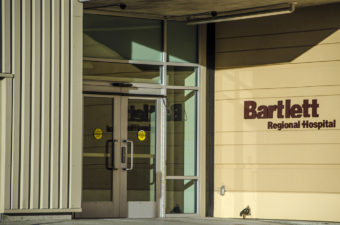
Bartlett Regional Hospital emergency entrance. (Photo by Heather Bryant/KTOO)
Bartlett Regional Hospital’s emergency entrance. (Photo by Heather Bryant/KTOO)

Bartlett Regional Hospital staff told police that an unknown man made dozens of lewd calls to the hospital’s registration desk and emergency room Friday night. Juneau Police Department Lt. David Campbell said the staff counted between 55 and 80 calls. The final call included a threat.

“The gentleman was primarily dealing with stuff of a sexual nature,” Campbell said. “At one point in time, when they were threatening to hang up on the guy if he didn’t come in to get some assistance, he made the comment to a registrar that he might do a violent act.”

Campbell said after the threat was made the hospital went into lockdown and called the police to investigate. Hospital officials did not immediately return requests for comment.

Police worked with the hospital’s IT department, and local phone companies to backtrack the calls to Virginia, but Campbell said they didn’t learn the caller’s identity.

He said it was a relief the calls weren’t being made from Juneau.

“(It) makes it a little bit more comforting to know that a person that’s threatening violence isn’t going to be able to just walk right in,” Campbell said.

But, Juneau police don’t handle crimes that cross state lines. Campbell said JPD may contact the FBI if they get new leads.

Campbell said the case is still open but most of the leads have been followed. If there are no new developments, he said it will probably be suspended.

Tour boat captain fired; naturalist tells of vessel sinking

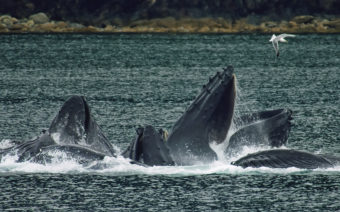
Humpback whales in North Pass between Lincoln Island and Shelter Island in the Lynn Canal north of Juneau. (Creative Commons Photo by Evadb)
Humpback whales in North Pass swim between Lincoln Island and Shelter Island in the Lynn Canal north of Juneau Saturday, August 18, 2007. (Creative Commons Photo by Evadb)

Multiple boats helped rescue 18 people from the Dolphin Jet Boat Tours whale-watching vessel, Big Red, which struck a rock and sank Sunday.

The Coast Guard received a distress call that the tour boat was taking on water at 12:17 p.m. Sunday.

Douglas Ward, the owner of Dolphin tours, said he was shocked by the accident and was grateful everyone made it off the boat safely.

The Big Red’s captain was fired, Ward said.

Mike Clasby, a naturalist with Dolphin tours, said he and the Big Red’s captain were bringing 16 tourists back to Juneau after a tour.

They were between Shelter Island and Aaron Island, passing the southern tip of Aaron Island in Favorite Channel. The boat struck an uncharted rock, according to Coast Guard spokeswoman Lauren Steenson, petty officer 3rd class.

He said the sinking couldn’t have taken more than five to six minutes.

“I was facing the stern of the boat and looking at the passengers and all of the sudden there was this horrific bang,” Clasby said. “I thought we hit a whale. Then I realized that it was a little more than that because I ended up on the floor of the boat.”

Clasby first checked on the passengers and the captain, he said. Then went to see whether the engine compartment was damaged.

“I said, ‘OK, I’ll be right back,’ and I went back and opened the stern (door), and popped open the starboard hatch, and there was water coming in the engine compartment,” he said.

With water coming on too fast, Clasby thought about deploying the life raft but said he instead decided it was more important to get everyone in life vests first.

“The captain and I went towards the back, and then (water) was really coming onboard,” Clasby said. “We made a plan that he was going to try and get the life raft, which was now underwater actually, released.”

That’s when he said they saw a boat.

“I yelled, and yelled, and screamed, and he was waving, and I was waving and all of the sudden this boat called Sea Ya waved back and turned towards us,” Clasby said.

The Sea Ya was the first vessel to reach the Big Red. The Juneau harbormaster’s office said the boat measured about 30 feet long. Clasby said it wasn’t big enough, but they still managed to fit almost everyone aboard.

“Then all the sudden the boat (Big Red) sank,” Clasby said. “It was taking that much water on. There was four of us that didn’t make it onto the Sea Ya, we were hanging on the edge. And the captain, who was the last one off of our boat, had a life jacket and he drifted away, unfortunately, which turned out to be OK.”

Clasby and remaining passengers made it aboard the Sea Ya, he said. The captain later was retrieved from the water.

The St. Herman, Allen Marine Tour’s boat, collected the Big Red’s passengers and returned them to shore.

Capital City Fire/Rescue reported all of the tour boat’s passengers and crew refused medical treatment, including one person who suffered a knee injury.

U.S. Olympian Kim Rhode Takes Her Shot At History To Dispel Stigma

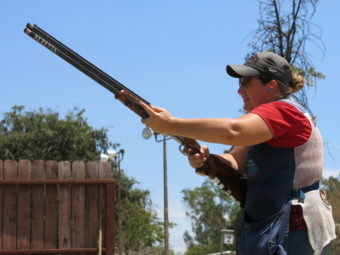
Kim Rhode takes practice shots with the assist of her father Richard Rhode, who's been her coach for 27 years. Nathan Rott
Kim Rhode takes practice shots with the assist of her father Richard Rhode, who’s been her coach for 27 years.
Nathan Rott

It’s pushing 100 degrees outside and the Southern California sun is baking the fields of shattered clay at the Redlands Shooting Range — but it’s a training day for Kim Rhode, so she shoulders her 12-gauge over-under shotgun, dumps a few boxes of shells into her pockets and heads out to the skeet field.

When you’re this close to the Olympic Games, every day is a training day — even if it’s an old, familiar drill.

Rhode has a shot at history this summer in Rio. “No pressure,” she says. With a medal-finish in skeet shooting this year, she would become the first Olympic athlete to medal in six consecutive Summer Games. She won the first — a gold — in Atlanta, just days after her 17th birthday.

Now 37, she’s got more on her mind than just history. Fame and recognition as one of the best shooters in the world has put her in a unique position to become more politically active too.

But for now, she’s got to focus on training. She’s aiming to shoot about 400 rounds today.

“Normally I’d be up at about 800 to 1000,” she says.

Rhode sets up next to the high house on the skeet field and rests the stock of the gun against her hip. Her coach sets up behind her, holding the remote to the skeet thrower. They’ve done this since she was 10-years old. Her coach is her dad, Richard Rhode.

“Singles or doubles?” Kim asks. “Do doubles,” Richard says.

Kim Rhode gives the signal, making a noise that sounds like “bah” and after a second-delay, two saucer-sized discs flash through the air. Rhode shoots both and one explodes into an orange puff.

Some of the clay pigeons — or “birds” — she’s shooting are packed with a few grams of orange powder. They’ll be that way in Rio, Rhode says, “so that when we shoot them, they puff and create a big cloud for the cameras and spectators.”

Kim and her dad are trying to simulate the conditions in Rio as best as they can. Olympic skeet shooting is different than normal skeet shooting in a number of ways. The birds are thinner and faster.

When it gets thrown, an Olympic bird is “moving probably at 54 to 65 miles per hour,” Richard says. “Normal skeet is maybe 35 to 40 miles per hour.”

Olympic skeet shooters have to start with their shotguns at their hips. Normal skeet shooting can be different.

Richard gestures to a group of shooters blasting clays on a separate field at the shooting range. “It’s a game of perfect over there. You shoot a hundred straight and then the game starts,” he says. “This is a lot harder.”

Kim certainly doesn’t make it look that way. She shoots until her gun needs to cool and misses one bird.

“It’s like walking,” she says. “You know when you walk down the street, you don’t think ‘left, right, left, right.” You just do naturally do it. It’s the same thing for us. We don’t really think, ‘hold point, lead, stance.’ It’s very natural for us.”

Kim Rhode started shooting when she was 10 years old. As an avid hunter and outdoorswoman, guns and shooting have always been a part of her life.

And as she’s grown older, becoming one of the most decorated sport shooters in the world, she’s become more vocal about the politics of guns.

It wasn’t entirely by choice. Athletes in shooting sports have to be, she says.

“At the London Games, the first question I got asked when I just won a gold medal in the Olympics wasn’t, ‘Tell us what it’s like to represent your country or what’s it like standing on the podium or what does this medal mean to you?'” she says. “It was: ‘Can you comment on Aurora?'” — a reference to the mass shooting in a movie theater that left 12 people dead.

If Kim Rhode places this summer, she'll become one of the most decorated U.S. summer Olympians. Nathan Rott
If Kim Rhode places this summer, she’ll become one of the most decorated U.S. summer Olympians.
Nathan Rott

The same has happened in the lead-up to the Rio games. Rhode says she’s been asked to comment on recent mass shootings in Orlando and San Bernardino.

“No other sport in the Olympics gets that,” she says. “They don’t ask the swimmers to comment after somebody drowns.”

Rhode is sympathetic to the victims of gun violence. “It’s heartbreaking,” she says. But she feels like much of the legislation that comes out of mass shootings — especially in California — is ill-conceived.

“We have a lot of bills and legislation that are making it very difficult for people to go out and enjoy that sport that I personally love,” she says.

She points to a recently passed law that will require background checks for ammunition sales (“I go through a lot of ammunition,” she says) and another that will put stricter regulations on lending guns. “How is someone supposed to learn how to shoot if you can’t lend them a gun to try?” she says.

More broadly, Rhode says, she’s frustrated by what she sees as a growing stigma against guns.

“Everything we hear [about guns] on the media and news is nothing positive,” she says. “They don’t talk about the scholarships that kids are getting or the shooting teams around the country where kids are learning things like discipline, respect and teamwork — things they’ll use for the rest of their life.”

Rhode wants more people to hear those positive stories about guns and sees the upcoming Olympics as an opportunity to do just that. By medaling in her sixth consecutive Olympics, Rhode could do something no other U.S. Olympian has accomplished. That would be a positive story.

Copyright 2016 NPR. To see more, visit http://www.npr.org/.
Site notifications
Update notification options
Subscribe to notifications