Quinton Chandler, KTOO

Celebration 2016 aims to renew youth engagement in culture

Grand Entrance to Celebration. (Photo by Heather Bryant/KTOO)
A young drummer at the grand entrance to Celebration 2014. (Photo by Heather Bryant/KTOO)

This year, in addition to Celebration’s core goal to engage Native youth, organizers in Juneau are promoting the convergence of multiple generations and cultures.

Every other year several thousand people travel to the state capital for Celebration, a four day event meant to renew appreciation for the Tlingit, Haida and Tsimshian cultures of Southeast Alaska.

The event is rooted in a desire to pass Southeast Alaska Native culture on to future generations.

Rosita Worl, president of the Sealaska Heritage Institute, said Celebration started with a group of elders who didn’t want their culture to be forgotten by their children.

Rosita Worl is president of the Sealaska Heritage Institute.

“They were so wise in knowing that our children were learning our culture in a very different way, not in a traditional clan house around the fire. They were learning it in schools,” Worl said.

Worl said the elders’ desire to adapt led to the start of Sealaska Heritage Institute and the institute, alongside community elders, held Juneau’s very first Celebration in 1982. The event is a party but Worl said it also teaches important lessons, for example:

“Songs are owned by clans. So we’re teaching about our Tlingit property law. We had a legal system that was very well developed and songs are like property. We own intellectual property. Even though you might be seeing singing and dancing, there’s a lot more that’s going on that’s being taught,” Worl said.

Worl said crests, like the designs on blankets, are also owned by clans. She said the crests, songs and stories teach lessons on Native history.

This year Celebration organizers are renewing their efforts to pass on that history to Native youth. There will be an art exhibit made specifically for young people and, Worl said, Celebration goers will see traditional Native clothes integrated into modern fashion.

“We don’t want our youth to think that our culture is a static culture (and) that it doesn’t change,” Worl said.

Worl is also excited for what she calls a promotion of “cross cultural diversity.” The Juneau Symphony will perform for the event and Worl recently found herself asking:

“’How many Tlingits do you know like Irish music?’” And somebody (said), ‘I do,’” Worl said.

An Irish group from Australia is scheduled to play throughout Celebration. Worl said sharing the event with everyone is an especially important part of the experience.

“I want our people to not only see the diversity within Alaska but also within the world,” Worl said.

Worl also hopes to share Celebration with all sectors of the Juneau community and Southeast Alaska.

Live television coverage of Celebration on 360 North and 360north.org begins at 6 p.m. Wednesday. Celebration coverage continues from 9 a.m. to 10 p.m. through Saturday. For more Celebration news coverage, go to ktoo.org/celebration.

Juneau Hydropower a step away from crucial license

electric vehicle
Juneau Hydropower owner Keith Comstock powers up his electric vehicle at Eagle Beach. (Photo by Casey Kelly/KTOO)

A Juneau startup that wants to build its own hydroelectric plant could soon get their rubber stamp from the federal government.

Duff Mitchell, Juneau Hydropower’s managing director, said the Federal Energy Regulatory Commission approved the company’s environmental impact statement, or EIS.

“We’ve gotten good marks, so to say, to make sure that we’re building this project properly,” Mitchell said.

The EIS is proof that environmental concerns tied to building the hydropower plant have been addressed. It stops short of giving the company permission to build its plant but Mitchell said permission is coming.

“The EIS needs to be recorded in the Federal Register and then the document will be submitted for the FERC commission for their final blessing,” Mitchell said.

That final blessing is Juneau Hydropower’s FERC license. Mitchell isn’t sure when that will come but he expects it soon.

Juneau Hydropower started implementing plans about seven years ago to dam Sweetheart Lake southeast of Juneau and build a hydroelectric plant.

The proposed plant would power a district heating system that would remove heat from the Gastineau Channel and pipe it into Juneau homes and businesses. It would also allow the company to sell power to big industries.

Mitchell said the EIS was drafted with input from state and federal agencies including the U.S. Forest Service and the Alaska Department of Fish and Game.

“We actually worked with the agencies to come up with and to negotiate out all of the conditions. So when FERC made its ruling all of those issues were addressed to the satisfaction of agencies involved,” Mitchell said.

A few of the things the company was required to checkout were impacts to fish, marine mammals and water quality.

Tlingit artist protests auction of Native artifacts in Paris

Haida mask. (Photo courtesy of the company Eve)
A Haida mask that went to auction in Paris. (Screenshot)

The Paris auction, orchestrated by the company Eve, wasn’t just about selling old relics. Members of the tribes whose ancestors made these artifacts say they are living beings and the spirits of their ancestors are inside of them.

Crystal Kaakeeyáa Worl was in Paris selling her own artwork when she heard about the auction. Worl, her brother and the owners of the gallery hosting them joined a crowd of about 20 people at the auction house to protest.

Worl said she was allowed to sit in on the auction but was warned she would be removed if she made trouble. She said she wouldn’t and sat down.

“For me to be in that room and see the items, I couldn’t get up close to them, I couldn’t touch them, but to see them from a distance and to let them know that I was there before they went into these private collectors’ homes  — that was meaningful.”

Worl said these sacred objects were made to identify clans and to document their history; they’re still used in special ceremonies today. She believes they are living people.

“Specifically, the Tlingit people, we don’t have a word for art. For our objects that were used for ceremony and objects that were sacred we called at.óow, which is our sacred objects, which the auction was selling a lot of those items,” Worl explained.

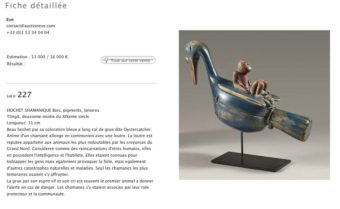
Chuck Smythe is the director of the Culture and History Department at the Sealaska Heritage Institute. He found about 10 Tlingit and Haida artifacts that were put on the auction block. A Tlingit piece was near the top of his stack of printouts. Smythe said it’s a shaman’s rattle.

Tlingit shaman's rattle.
A Tlingit shaman’s rattle that went to auction in Paris. (Screenshot)

“It’s item number 227,” Smythe said. “It was used in the past and continues to be used today as items which brings spirits to ceremonies, particularly helping spirits that benefit people.”

Smythe said, at auction, objects like the rattle typically sell anywhere between tens of thousands and hundreds of thousands of dollars. He’s heard of a war helmet that sold for just under $3 million. These objects may be sacred to Worl and tribes throughout America but, Smythe said, to collectors they’re just pieces of history, and the tribes who made them are dead and gone.

“They’re not aware of the living cultural communities that still use these items and have used them continuously,” Smythe said.

Smythe said, he remembers one instance when a foundation bought a number of Native American artifacts at auction in Paris and then returned them to the tribes. But, he said that was “highly unusual.”

As for international repatriation, he said the United Nations’ Universal Declaration of Human Rights has provisions to protect cultural property. But he said it is weak on enforcement.

In the United States, it’s illegal for federally funded museums, agencies and schools to sell sacred Native American objects. The Native American Graves Protection and Repatriation Act or NAGPRA requires sacred objects be returned to the tribes when they ask for them. The law doesn’t apply to private collectors and it doesn’t mean anything in France.

“What I learned in France is the only way we could withdraw or stall an item from being auctioned is to provide some kind of hard evidence for them that the item was stolen,” Worl said.

Worl said an Acoma Pueblo war shield was proven to have possibly been stolen and it was removed from the auction. As for the Tlingit at.óow, the fact they were in Paris was all the proof she needed.

Acoma Pueblo war shield.
An Acoma Pueblo war shield that may have been stolen was pulled from the Paris auction. (Photo courtesy of the company Eve)

“We would never sell an object like that. That is evidence that these were stolen items,” Worl said.

But that argument probably wouldn’t fly in French court. Worl said the auction house never responded to requests from around the U.S. to halt the auction and it didn’t acknowledge the protesters.

She believes the best way to prevent more Native artifacts from being sold abroad is to teach people about Native culture and explain how important their sacred objects are to them. She said that’s one of the reasons she protested.

“Maybe one of the buyers that was there that saw us, maybe they will decide to return the item they bought to the right community,” Worl said.


NOAA works to free entangled whale

Responders attempt watch as entangled humpback surfaces.
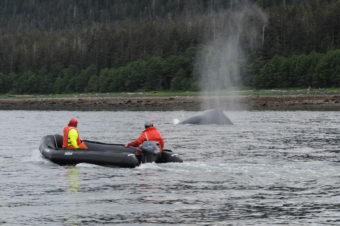
A NOAA team watch as an entangled humpback surfaces Saturday in Gastineau Channel. (Public domain photo by NOAA Fisheries, Permit No. 18786)

The National Oceanic and Atmospheric Administration received a report of a humpback whale dragging an anchor line in the Seymour Canal near Admiralty Island on Wednesday. Saturday, the whale was spotted in Gastineau Channel. Monday morning, it was reported in the Tenakee Springs area.

The whale is still entangled and is dragging a couple of buoys. Julie Speegle with NOAA said whale entanglements have become fairly frequent because whale populations and the number of people on the water are increasing.

“Entanglements can cause a wide variety of problems for whales. (They) can inhibit their feeding, cause them to become fatigued because they’re dragging some extra gear along with their normal weight and sometimes even cause the whale to die,” Speegle said.

NOAA mobilized a team to try and remove the entangled line, Speegle said. They couldn’t remove it all and had to settle on attaching a green satellite buoy to the anchor line in order to track the whale.

NOAA team tries to remove anchor line from entangled humpback whale.
A NOAA team tries to remove anchor line from entangled humpback whale. (Public domain photo by NOAA Fisheries, Permit No. 18786)

Speegle said they’ll keep trying to untangle the line but it’s complicated because there’s a second humpback traveling with the entangled whale and they’re not sure if that whale is tied up, too.

“Today the whale is in the Tenakee Springs area,” Speegle said Monday morning. “Members of our Alaska Marine Mammals Stranding Network are responding. Ocean and weather conditions are good. We’re going to attempt to get some underwater video so we can learn more about that entanglement to see what would be the best way to respond.”

Speegle said NOAA’s team is specially trained to deal with whale entanglements and they have the right tools to do the job. Members of the public are asked to stay away from the whales and not to try and help. Speegle said freeing the entangled whale will be extremely dangerous work.

School district waits for last step in state budget process

Juneau School District Superintendent Mark Miller.
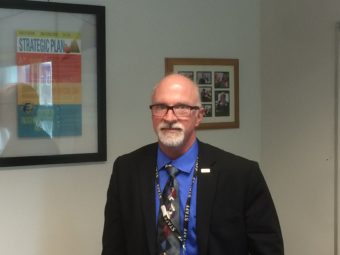
Juneau School District Superintendent Mark Miller. (Photo by Quinton Chandler/KTOO)

A budget passed by the state legislature could give the Juneau School District a $500,000 boost for 2016-17 school year. The spending plan is yet to be approved by the governor.

The Juneau School District is trying to make every penny count. School officials say the district has cut spending on students and laid off teachers over the past five to six years.

The district predicts it will need $82,303,340 to cover expenses next year. And that’s what district Superintendent Mark Miller calls a razor thin budget.

“What we’ve had to do over the last few years is make cuts because the amount of money coming in has been relatively stable but the amount that we have to spend to keep our district running per person is going up. So it’s required pretty massive cuts in the number of personnel,” Miller said.

Since 2011 the district has cut 105 staff positions. Some of those people were laid off, some resigned and some retired.

This year the district will give up about 10 more positions. About nine of those are teachers’ jobs. A district spokesperson said they all either resigned or retired.

The increased expenses the district is absorbing fall under cost of living. Miller said they have to keep up with increasing health care costs and pay raises.

“Teachers typically make a little bit more every year based on the number of years they’ve been teaching, which you would expect. It’s really difficult for a new teacher to do much more than just hang in there on an initial teacher’s salary, but they know that over time they’re going to make more,” Miller said.

Miller said 90 percent of the district’s money goes to salaries, so people are pretty much the only thing they can cut. The district has already committed to keeping a definite number of employees for the next school year, but Miller said they are dependent on that $500,000 increase in funding from the state.

The extra money comes from a bill passed in 2014 that promised to increase school funding for the 2016-2017 school year by about $50 per student enrolled. The legislature had cut that money from its spending bill earlier this year and Miller said he didn’t know what to do.

“To say you’re going to be a half a million dollars short … well, we can’t go back and tell somebody and say, ‘we were just kidding about giving you a job.’ We owe them that job,” Miller said.

Luckily for the district, lawmakers changed their minds and put the money back in the bill, which passed Tuesday.

“Fortunately, I think it played out as well as it could for education, at least for this year. And I appreciate, I think, kind of calmer heads prevailing,” Miller said.

Once the bill becomes law, the district will be safe in a budget that restricts them to larger class sizes, fewer teachers and fewer student activities — at least until it’s time to make a new budget next year.

“School districts in the state of Alaska don’t have the ability to float bonds or do school taxes or generate their own revenue. Other than bake sales and car washes, we really don’t have the ability to raise our own money,” Miller said.

Miller said that means each year the district’s budget is at the mercy of state and local government.

Juneau schools could benefit from knowing graduates’ futures

Thunder Mountain High School Commons
Thunder Mountain High School Commons (Photo by Quinton Chandler/KTOO)

The Rusted Root single, “Send Me on My Way” is the class song for seniors at Thunder Mountain High School. And it’s appropriate when you consider Juneau’s three high schools are all asking the question: send you where?

The Juneau School District will see more than 300 seniors walk across the stage Sunday. Some students seem to know their next steps and are looking forward to the end of high school. But the district might never know if most of them follow through on their plans.

Kelley Olson is a senior at Thunder Mountain High School and she’s on track to graduate. She has decided to study biology this fall at Pacific Lutheran University in Tacoma, Washington.

“I love science so much. It’s definitely one of my favorite things and also biology … I love how different things work and everything,” Olson said.

Kelley Olson (right) with her friend and fellow senior Deanna Hobbs.
Kelley Olson (right) with her friend and fellow senior Deanna Hobbs. (Photo by Quinton Chandler KTOO)

She wants to be a doctor. She doesn’t mind blood, so specializing in surgery is what she’s leaning toward.

“I’m possibly thinking of going into the military and helping them out there or going into (a) hospital,” Olson said.

Olson didn’t randomly stumble onto her dream and her plan to make it real. School counselors helped her rule out options and successfully apply to colleges and scholarship programs.

Without that support Olson thinks it would’ve been much harder and taken her longer to decide on a career path.

Terri Calvin is the career adviser for Thunder Mountain and Juneau-Douglas high schools, and she’s worked closely with Olson. She says junior year is the latest they start talking with kids about the future and right now about 80 percent of her seniors have a general idea of what’s next for them.

“Now and then you get the one who comes in and the week after school we’re spending the week in the career center making some plans but for the most part they’ve had exposure to their choices throughout high school,” Calvin said.

But that doesn’t mean plans are set in stone. The truth is that the Juneau School District doesn’t know where most of their past graduating seniors ended up and they probably won’t ever find out how many of this year’s class sticks to their initial plans.

“Tomorrow, at our practices, each school will do an exit survey and the kids will give me an idea what their plans are for next year. Whether they follow through with that or not is a different story,” Calvin said.

The district gives that survey each year but they don’t follow up on it after kids presumably get jobs, graduate college or do whatever they said they would do. Calvin says the survey helps her office and the district as a whole find out whether they’re giving their seniors what they need, and it helps them improve. But she thinks digging a little deeper to discover where graduates go in the future could help on a broader level.

“They fund this, the governor’s performance scholarship, to keep our students in the state of Alaska to go to school so that they stay here and live. And it would be nice to know if that’s what happening,” Calvin said.

According to the Juneau School District the biggest obstacle to a follow up survey is the cost and resources required. The district would prefer performing the survey in-house if possible, but there are also informal discussions of contracting the work out to a third party.

A district spokesperson said a follow up to the exit survey would be extremely valuable, but there are no official plans to start one.

Olson knows what she’ll put down on the survey, but she’s not naïve about the possibility she’ll change her mind.

“One of my friend’s speeches was, ‘the future is always uncertain.’ And you never know what the future holds for you, so I could go in with (the) expectation that ‘Oh, I’m going to try and major in biology,’ but there’s always the possibility that I’m going to find a different thing that I love and I could go into that,” she said.

No matter what happens, Olson says she’s “excited for what the future holds.”

If they want to know too, the school district may have no choice but to cross their fingers and hope Olson, and other graduates send a thank you note with their story of life after high school.

Site notifications
Update notification options
Subscribe to notifications