Theresa Soley

Conservation interests fear prized yellow cedar may face extinction

yellow cedar
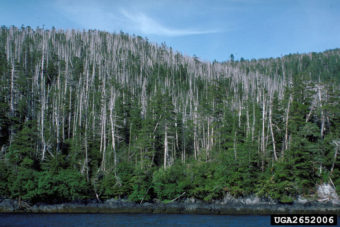
Yellow cedar in Southeast Alaska. (Photo by Paul E. Hennon/U.S. Forest Service via Bugwood.org )

In some areas, yellow cedar trees stand white and empty of needles against a background of green hemlock. The places appear skeleton-like, bare trees standing with limbs exposed, said Paul Hennon, a research forest pathologist with the U.S. Forest Service.

He said in some of its range, 75 percent of mature trees have died.

“Yellow cedar for me is by far and away the nicest wood to cut lines in and shape in,” said Donald Gregory.

Gregory is Tlingit Raven Beaver from Angoon, but was raised in Juneau. He began carving at a young age, inspired by other local artists.

Gregory carves almost exclusively with yellow cedar. Its wood is strong, yet easy to carve, and the tree has natural anti-fungal properties that inhibit decay. It is one of the few local woods that can withstand the elements over time and avoid rot outdoors.

These are the reasons that yellow cedar is valuable in the market.

Research suggests that yellow cedar could live up to 3,500 years. The tree grows slowly and can survive in nutrient-poor soils.  Bears gnaw on yellow cedar bark and deer shelter within the tree for warmth in winter.

In a 2012 paper published in the journal BioScience, researchers identified climate change as a culprit of yellow cedar deaths. A warmer climate has reduced snow cover and created areas with poor soil drainage. With no blanket of snow for protection, roots freeze, causing immense injury to the base of the tree system.  

This has killed swaths of trees prematurely.

Ecologist Lauren Oakes, a researcher at Stanford University, found that yellow cedar has a more difficult time regenerating in areas that have experienced die-off. She said that even in areas with healthy yellow cedar trees, it is often outcompeted by more vigorous species like western hemlock.

Conservation interests have petitioned to protect yellow cedar under the Endangered Species Act. The petition, citing two scientific journals, described yellow cedar’s decline as “the most severe forest die-off ever recorded in North America.” It claims the species will likely be extinct in the next hundred years without protection.

The U.S. Fish & Wildlife Service is reviewing the petition.

Sealaska Corp. has urged against the ESA listing.

ESA petitioners claim logging companies target yellow cedar, but Sealaska said it doesn’t.

While some scientists worry for yellow cedar’s survival, others are confident in the tree’s resilience. Brian Kleinhenz, a corporate forester with Sealaska, said the tree is thriving in parts of its range, despite mortalities  documented elsewhere.

“I’ve seen a lot of, especially in young forests, yellow cedar regeneration,” Kleinhenz said.  “I’m observing yellow cedar being more successful as we move north in Southeast Alaska, and then as you move up the slope, so as you move up to higher elevations, I’m finding a lot more yellow cedar seedlings coming in.”

Yellow cedar branch
A young yellow cedar branch. (Video still by David Purdy/KTOO)

Sealaska Timber Corp. owns land, manages it and clear cuts across Southeast. Kleinhenz said that yellow cedar is the most reliably valuable wood from the region. He said that yellow cedar wood sells at a high price in Asian markets.

Sealaska sold 28 million board-feet of wood from Southeast in 2014, but would not specify how much of it was yellow cedar or what the wood was worth.

Kleinhenz said he is worried that if yellow cedar is protected under the ESA, Native cultural connections with the tree will fade.

Alaska Natives in Southeast highly regard yellow cedar. The Tlingit and Haida transform it into totems, paddles and weave its bark into blankets. It has medicinal and spiritual importance to the tribes.

Native carver Donald Gregory said his favorite pieces to carve are wooden halibut hooks.

Halibut hook by Donald Gregory
A halibut hook made by Donald Gregory. (Photo courtesy of Donald Gregory)

Gregory said the Tlingit have harvested the tree for a very long time, even before saws. His people believe that all living things have a spirit, including yellow cedar.

“When they harvest the wood from the tree they do a ceremony and they thank the tree for the offerings of the wood. It’s just proper to do that,” Gregory said.

Gregory said the price of yellow cedar has gone up, but he has had no problem getting the wood. He thinks that 20 years from now the wood will be more scarce.

Gregory said that culture and carvers will adapt.

A decision on the yellow cedar listing is expected in 2017, according to the U.S. Fish & Wildlife Service. The listing would forbid taking yellow cedar from federal land, but not private land.

Other ramifications of protecting yellow cedar are undefined, but could affect harvests of other tree species such as spruce, hemlock, alder and red cedar if declared “critical habitat.” Fish & Wildlife defines critical habitat on a case-by-case basis.

Meanwhile, the Tongass Advisory Committee and U.S. Forest Service are creating a plan to transition out of logging old growth timber to only second growth.

Why a local skier is busing around the Lower 48 this winter

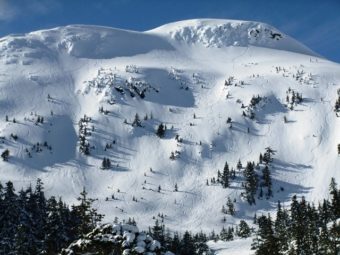
Juneau skiers may be forced to accept a future with warmer winters and less snow.
Scientific data suggests that over the last 30 years, Southeast Alaska has experienced a warming trend, matched with more precipitation, and perhaps, less snowfall.

Skier Ben Lyman has adapted by migrating.

“Well, right now I’m converting a bus into an RV and part of the intention of that is being able to go where the snow is,” he said.

Lyman is in Wisconsin working on “Velda the Wonder Bus,” which he plans to use to follow snow.

Velda the Wonder Bus
Velda the Wonder Bus. Skier Ben Lyman is converting the bus into an RV so he can follow the snow. (Photo courtesy Ben Lyman)

“After last winter being surprised to see snow in North Carolina and New Mexico, makes me think I need to be a little more mobile in the winter,” Lyman said.

According to the U.S. Forest Service, climate change is affecting Alaska more than any other state in the country because of its northerly latitude.

Since 1971, Juneau’s average monthly temperature has warmed 3.54 degrees Fahrenheit, according to a University of Alaska Fairbanks research organization. The Scenarios Network for Alaska and Arctic Planning predicts that this warming trend will continue over the next 84 years.

“You can see the temperature creeping up,” said Rick Fritsch, a meteorologist with the National Weather Service in Juneau.

In the past, the average winter temperature in Juneau at sea level was around 32 degrees, Fritsch said. Now, it seems to be slightly higher than freezing. This could mean more rain and less snow.

Eran Hood, a professor of environmental sciences and geography at the University of Alaska Southeast, agreed. He said Southeast is particularly sensitive to climate change.

“Whereas if you go to the interior Alaska where it’s very cold and you change the temperature by a few degrees you are still going to have snow,” Hood said.

This means unreliability for skiers like Ben Lyman.

Lyman, 38, grew up in Alaska and said he’s always skied. He said some of his earliest memories are riding in a baby backpack while his father was skiing. Lyman began teaching skiing at Eaglecrest when he was 14. Now he just skis for pleasure, but he’s noted some changes in snowfall in his lifetime.

“It certainly seems like overall we get less snow down at sea level and certainly at the base area, although I think we’re still holding pretty well at the top,” Lyman said.  “My memories are definitely of more prolific snowfall than we’ve had in most recent years, although we did have a pretty amazing year in 2007.”

Last winter, Eaglecrest had so little snow that the lifts barely ran.

In 2007 a Juneau climate change panel produced a report forecasting the effects of global warming on the city, including the future of Eaglecrest. It predicts warmer temperatures will work their way from sea level up mountainsides.

The panel asserted that “skiing, sledding, ice skating and other snow-dependent activities will be less available to Juneau residents as the climate warms.”

Over the last year, Eaglecrest has created a connection to a chairlift that will enable skiers to get higher on the mountain, cleared additional ski trails and purchased more snowmaking equipment.

“We did buy another snowmaker which increases our snowmaking ability by 33 percent,” said Matt Lillard, general manager of Eaglecrest.

If Eaglecrest doesn’t adapt, skiers will.

In Wisconsin, Lyman’s bus is a work in progress.

“It’s a 1999 International Genesis, 72-passenger rated capacity, 31,000 pounds, and 39 and a half feet long. We just finished painting her today, midnight blue,” he said.

Lyman said that by the time he finishes his bus, he will know where the snow is.

Weather permitting, Eaglecrest Ski Area is scheduled to open Dec. 5.

No signs of invasive Elodea in Southeast, survey in the works

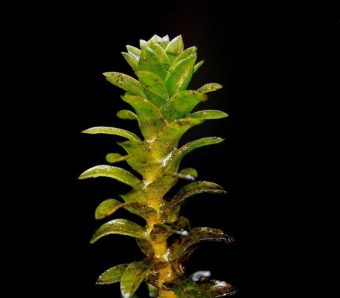
Elodea canadensis
Elodea canadensis. (Creative Commons photo by Frank Vincentz)

One wee fragment of it can flourish into a swath of green growing strands that entangles float planes and boat engines. Across the state, it has been found in 18 freshwater lakes and rivers. Many people decorate their fish aquariums with it.

It’s called Elodea.

Last week, the aquatic plant was a topic of discussion at the Alaska Invasive Species Workshop in Juneau. Researchers have traced the beginning of the invasive plant’s transmission around Alaska to people dumping out their aquariums into nearby lakes. An aggressive hitchhiker, Elodea will cling to float planes and spread further.

Tom Heutte, an aerial survey coordinator with the U.S. Fish & Wildlife Service, described one encounter in Cordova.

“We were flying along and one of our aerial surveyors looked out the window and sees a bunch of weeds stuck to the rudder of the float plane,” he said.

Elodea outcompetes native plants by blocking sunlight and degrades salmon habitat. The plant has been found from Fairbanks to Cordova, but not in Southeast.  Heutte hopes that the region has avoided invasion.

He surveyed the float plane pond at Juneau’s airport for Elodea and found none. Heutte said that saltwater is a likely Elodea killer, one reason Southeast may have avoided the plant invasion. He also believes that lack of a road system, and difficulty of access to remote lakes, may have kept Elodea from spreading here. Over the next two years Heutte plans to survey lakes throughout the region in order to find out for certain.

It all begins with one plant fragment, he said.

Experts discovered a weapon against Elodea called fluridone. The herbicide disrupts Elodea’s capability to photosynthesize.  It prohibits the plant’s ability to produce its own food, killing by starvation, yet harms few native plants. In some parts of Alaska scientists have completely eradicated Elodea with fluridone, said John Morton, supervisory fish and wildlife biologist at the Kenai National Wildlife Refuge.

Elodea is just one front in a battle against invasives.

“We are only at the beginning of the invasion curve for novel species,” Morton said.

You can learn more about invasive species on the Alaska Department of Fish & Game’s website.

Rocky Horror Picture — snake!

A Rocky Horror Picture Show concluded with 6 feet of slithering scales in an Alaskan town where reptiles only survive in heated cages.
Collette Costa, owner of the Gold Town Theater in Juneau, tweeted the incident.

Costa heard a scream, which preceded the snake’s discovery.

“Well, that’s impossible, there are no snakes in Alaska except the ones up in the Capitol,” Costa said.

She tells the tale:

“But he insisted there’s a snake so I came over to look and there was a thing on the ground, and it was between two pieces of furniture so I could only see a bit of it. And it was kind of an incredulous thing to see.  You can’t imagine there’s a snake there of that size.  I mean, it wasn’t a boa constrictor, but it was bigger than a garter snake.  And I said, ‘That can’t be real,’ and so I was going to pick it up and then it slithered.  It moved.  And then I said, ‘That is a snake.’”

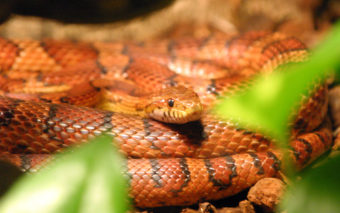
Costa described the snake as red and yellow-banded, longer than herself.  She believes it is a corn snake.

Red corn snake. (Public Domain photo by Mike Wesemann)

Red corn snakes (Pantherophis guttatus) are native to the eastern United States from New Jersey to Florida and Mexico.  They have been introduced to some of the Caribbean islands so their range has expanded with human help.  Red corn snake native populations are considered stable.  The snakes’ habitat is variable, ranging from pine forests to grasslands.

According to Dr. Johanna Fagen, assistant professor of biology at the University of Alaska Southeast, snakes are uncommon in the wild here, but do live in many parts of British Columbia.

Fagen shared a few likely reasons that snakes wouldn’t find this area favorable.  Firstly, Juneau’s recently deglaciated land has not yet been colonized by a wide array of species, including reptiles.  Snakes are common in dry climates, rather than wet ones with many freeze-thaw episodes throughout the winter.

Due to the climate and geological history in Southeast, snakes normally only survive in cages.  This can mean guest appearances after horror films.

Lemon Creek matches Rio Grande in water volume

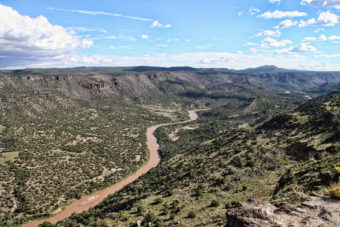
View of the Rio Grande from the Overlook Park at White Rock. (Creative Commons photo by Andreas F. Borchert)

Experts believe water scarcity will become a significant issue across most of the world over the next decade. In Southeast Alaska, it’s a different story.

The volume of water flowing through Juneau’s Lemon Creek at one point Thursday was equal to the volume of water flowing through the coveted Rio Grande in the Southwestern United States, according to Brett Walton, a reporter with the online publication Circle of Blue.

While millions of people are dependent on the Rio Grande as a water source, Lemon Creek doesn’t bear the same burden.

One Alaskan community’s glacial creek is a dry region’s grand river.

“The flow of Lemon Creek yesterday in the afternoon was the same as the flow of the Rio Grande in New Mexico, and the Rio Grande in Texas and Big Bend,” Walton said. “So the Rio Grande, one of these major iconic Western rivers, these are rivers that are large in history, large in our imaginations but are not big rivers. So a creek here flowing in Juneau is the same size as John Wayne, Rio Bravo — that’s the river’s name in Mexico — that is the size of what we’re talking about with Lemon Creek here.”

And every last drop of water in the Rio Grande is allocated amongst governments, farmers and villages.

The river starts in southcentral Colorado in the Rocky Mountains, flows through New Mexico and then serves as the border between Texas and Mexico before emptying into the Gulf of Mexico.

“So a lot of the water, almost all of the water, is diverted for agriculture or municipal uses by the time it reaches El Paso, which is in the very western part of Texas,” Walton said. “So downstream of El Paso the Rio Grande is essentially dry most of the time.”

The volumes of water were reported by the U.S. Geological Survey, where gauges document flow volumes in one location, but vary daily due to changing water flow.

Walton spoke at The Politics of Water last week, a three-day forum hosted by the Juneau World Affairs Council and the University of Alaska Southeast.

Water politics forum begins Thursday

(Public Domain photo)
(Public domain photo)

There are three primary water concerns facing the state: persistent organic pollutants in the Arctic region, loss of freshwater due to increased regional temperatures and ocean acidification, according to Jim Ayers, president of conservation consulting firm Alaska Strategies.

Ayers will discuss these issues Saturday afternoon at the end of a three-day dialogue on water politics hosted by the Juneau World Affairs Council. The event is free and open to the public.

Ayers described one way water issues are directly affecting Southeast Alaska’s ecosystem.

“Sockeye salmon really have that deep red color because their primary diet is krill,” Ayers said.

He explained that ocean acidification is altering krill development, affecting everything that eats krill, from salmon to people.

Experts from across the country will speak about pressing water issues from droughts to wetlands. While water is aplenty in Southeast, its politics are a concern for the state.

The forum kicks off at the UAS Egan Lecture Hall at 7 p.m. Thursday and continues through Saturday afternoon in the lecture hall and Egan Library.

(Editor’s note: location has been corrected)

Site notifications
Update notification options
Subscribe to notifications