Wesley Early, Alaska's Energy Desk - Kotzebue
Kivalina joins four Louisiana tribes in a formal complaint to the United Nations about coastal erosion

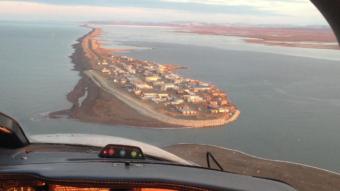
The village of Kivalina is one of several Alaska locales threatened by eroding coastlines and rising sea levels. (Photo by Joaqlin Estus/KNBA)

As climate change hits coastal communities in Alaska, many tribes are being forced to consider moving from their ancestral lands. But it’s not a uniquely Alaska challenge.

Last week, the Native Village of Kivalina joined four Louisiana tribes in a formal complaint to the United Nations. They allege the United States has not done enough to protect the human rights of villagers, as erosion creeps into their communities.

Chief Shirell Parfait-Dardar of the Grand Caillou/Dulac Band of Biloxi Chitamacha Choctaw tribe in coastal Louisiana has advocated for years to get officials to recognize the problems plaguing her community.

“Our food source is declining. Our health is declining,” Parfait-Dardar said. “So we have been fighting for many, many years, trying to adapt to all of these changes, trying to get officials to recognize what’s been going on.”

Thousands of miles away in the Northwest Arctic village of Kivalina, tribal administrator Millie Hawley tells a similar story about her home.

“Our little home is diminishing and losing ground every year,” Hawley said.

Hawley says that the village has had to adapt to changes, including less access to marine mammals for subsistence.

“A lot of food I grew up eating, we don’t harvest anymore,” Hawley said. “I’m eating mainly what we do get and that’s caribou and fish and not much more than the store-bought food.”

Due to coastal erosion, Kivalina has had to move its clinic, its school and some homes to stop them from being washed into the ocean.

“The foundation is so bad, the shifting of the ground,” Hawley said, “when other parts of the island move, it almost caused the home to crack in half.”

These cross-continental concerns are summarized in a formal United Nations complaint filed by Kivalina and four Louisiana tribes last week. Aside from Parfait-Dardar’s tribe, the other three Louisiana tribes are the Isle de Jean Charles Band of Biloxi-Chitimacha-Choctaw Indians of Louisiana, the Pointe-au-Chien Indian Tribe and the Atakapa-Ishak Chawasha Tribe of the Grand Bayou Indian Village.

The complaint alleges that the federal government has “failed to protect the human rights of Tribal Nations in Louisiana and Alaska, who are being forcibly displaced from their ancestral lands.”

Parfait-Dardar with the Grand Caillou/Dulac says that she’s tried in the past to get help from the federal government, but her concerns went unanswered.

“Every single time I ask, it’s the same response,” Parfait-Dardar said. “‘We can’t do that. The (Army) Corps would never do it. We don’t have the funding for that.’ It’s always an excuse.”

The tribes hope that investigators with the UN will light a fire under state and federal agencies to do something. Parfait-Dardar says that she’s hopeful that the UN will listen because it’s not just North America that is struggling with climate change.

“I know that the United Nations is getting many, many complaints from all over the world that are dealing with a lot of the same similar issues that we have been dealing with,” Parfait-Dardar said.

While Parfait-Dardar and Hawley maintain a strong sense of optimism, it’s hard to tell how seriously the federal government will take United Nations recommendations. The Trump administration has not been cooperating with human rights investigators since 2018.

Hawley in Kivalina says that if something isn’t done to help her community, her tribe and tribes across Alaska will lose their traditional way of life.

“We have children and grandchildren that we’re looking out for,” Hawley said. “We want to make sure that they have safe ground, they are able to build homes, able to live in this area where I grew up, where they grew up.”

As they wait for a response, Hawley says the village is moving forward on relocation projects, including a short bridge that is part of their evacuation road. Hawley says it’s set to be completed in October, but the changing landscape means that deadline is still up in the air.

Despite holiday cold snap, 2019 is ‘virtually certain’ to be warmest year on record for Alaska

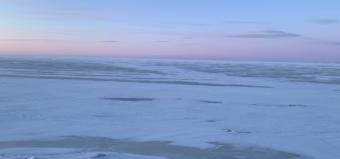
Sea ice on the Kotzebue Sound on Dec. 27, 2019. (Photo by Wesley Early / KOTZ)

Much of Alaska had been frigid this holiday week as temperatures across the state dipped as low as minus 60 degrees Fahrenheit. That’s in stark contrast to a year with record high temperatures and major disruptions of traditionally solid sea ice across the Arctic.

Temperatures in the Northwest Arctic villages of Ambler and Buckland reached 42 degrees below zero on the morning of Dec. 26. The Interior village of Allakaket had the coldest temperature in the state on Dec. 26 at minus 56 degrees. Friday, Dec. 27, saw a low of minus 65 degrees in Manley Hot Springs near Eureka, one of the lowest temperatures for anywhere in Alaska in years.

Simply put, the state was cold this week.

Rick Thoman, a climatologist with the International Arctic Research Center in Fairbanks, says though it’s a dramatic drop from this winter’s balmy start, the weather pattern is normal for this time of year.

“We’ve just gotten so accustomed to these persistent runs of above normal weather that even somewhat below normal for more than a day or two really seems outstanding,” Thoman said.

Despite the drop in temperatures, Thoman says this last-minute cold snap likely won’t change Alaska’s record-breaking climate forecast for the year.

“2019 is, at this point, virtually certain to be the warmest year of record for Northwest Alaska, and the state as a whole,” Thoman said.

While not making much of a dent in the average temperatures for the year, Thoman says the cold snap is helping create sturdy sea ice — which saw record-low growth during this warmer winter.

“The cold weather has helped to finally pretty much freeze over the Chukchi Sea — very late freeze-up — and now starting to work on the Bering Sea,” he said. “So that’s all good news for moving forward as we move into spring.”

That’s good news for a lot of Arctic communities who rely on sea ice for travel and subsistence hunting.

Claude Wilson is on the board of directors for the Iron Dog Snowmachine Race and puts on local races in Kotzebue. He says he regularly checks on the ice.

“You know, trying to keep track of the thickness because we don’t want people taking their vehicles out on the ice unless it’s safe,” Wilson said.

For Wilson, safe for racing means thicker than a foot of sea ice.

“[In] years past it was always a go because we always had more than two feet of ice,” Wilson said.

This spring, Wilson saw ice as thin as five inches, which made him and other organizers nervous. He says the recent cold snap has made him more hopeful that the ice will be thick enough to race this winter. Ice readings earlier this month were 14 inches near shore, and thicker towards the ocean.

Wilson says he wants to continue to see temperatures below zero.

“I think every ten days, it adds an inch to the thickness,” Wilson said. “So we’re hoping it’ll be a little thicker than it was just nine days ago.”

If the ice remains solid, Wilson will be able to put on the annual Knight Rider Snowmachine race in Kotzebue on New Years.

As demand for opioid remedy skyrockets, police train for overdose treatment with Naloxone

Alaska State Troopers Lt. Steve Adams shows how to use Narcan at a training Aug. 18 in Anchorage. (Photo by Zachariah Hughes/Alaska Public Media)

In the ongoing effort to curb overdose deaths from opioids like heroin, police across Alaska are getting trained to use a new tool.

Naloxone — a medication that rapidly reverses the effects of an opioid overdose — has long been used by emergency medics, but now it’s being deployed to police departments and non-profits at the front line of the state’s opioid crisis.

Even with millions of new federal dollars being spent, the demand in outpacing the supply.

A roomful of police listened as Alaska State Troopers Lt. Steve Adams showed them how to use Narcan, a brand of naloxone that comes in a small bottle you could fit inside a purse or jacket pocket. Adams showed how to properly use the nasal spray if someone’s overdosing.

“The signs of an overdose include: their face is gonna be clammy to the touch, the body’s gonna be limp, fingernails and lips turn blue,” Adams said. “What do you do? Turn them on their back, tilt the head back, insert the tip into their nostril — doesn’t matter, left or right, it’s gonna get there. Press it, make sure it’s all out. Call 911, then roll them over into this rescue position.”

Adams works on drug enforcement with the state troopers, but his audience is from a patchwork of agencies.

The training is part of a push to get more doses of naloxone to people who are often the first ones to find somebody overdosing.

“As law enforcement, we’ll find somebody passed out, or we’ll get a call that somebody’s passed out in a public restroom in a stall or passed out in a vehicle in a parking garage,” Adams said.

Naloxone blocks opioid receptors in the brain, and almost immediately counteracts an overdose — although it may take several doses.

There are almost no negative side-effects, even if its given to someone by accident who isn’t on opioids.

The medication has been around since the 1960s, and widely used by medical professionals.

Public health and addiction recovery advocates want to make it as common as defibrillators or EpiPens: a simple medical intervention the public can use.

Adams said state troopers are in a perfect position to help give the mandatory 15-minute training to dispense Narcan in communities across Alaska.

“Our goal is to provide it to every Alaska State Trooper, and to provide it to every other agency — federal, state, and local — who would like to have it,” Adams said.

One of those agencies is the police and fire department at the Ted Stevens International Airport.

Sgt. Daniel Juarez said at least once a month officers will find someone who has overdosed on a nearby roadway or in a terminal bathroom before a flight.

“A lot of times we’re going to be there usually before paramedics, and the sooner we can administer possibly a life-saving treatment we’d like to do that,” Juarez said.

The governor’s disaster declaration on the opioid crisis, along with a legislative bill last year have increased access to the medication.

Non-profits like MyHouse in Wasilla distribute Narcan kits.

The Alaska AIDS Assistance Association, which runs the state’s largest needle exchange, has given out 300 to 400 of the kits, and routinely requests more.

Even nurses and security guards from the Anchorage School District were recently trained.

Narcan isn’t cheap. Over the counter at a pharmacy it costs about $150 for a two-dose pack. But the state buys that same amount $75 with federal money from the Department of Health and Human Services through a $4.2 million five-year grant.

The kits are given to individuals for free.

Andy Jones, who helps administer the state grant, said they originally aimed to distribute five thousand Narcan kits this year.

“Since February 15th we have distributed 6300 kits, and the pace continues to get faster and faster because more and more overdose response programs in communities are coming online,” Jones said.

Gathering the data is difficult. Jones said so far they’ve counted at least 39 saves.

Those figures depend on medics, police, or volunteers submitting a form that says they used Narcan.

Many are likely administering the medication and not generating a record, Jones said.

In 2016, an estimated 88 Alaskans died from opioid overdoses.

In Anchorage, the paramedics with the Anchorage Fire Department remain one of the main bulwarks against overdoses.

According to figures from AFD, since the start of the year they’ve used naloxone an average of 35 times a month — more than once a day although those numbers are skewed slightly by a surge in overdoses in May that are believed to have been caused by heroin laced with the powerful synthetic opioid fentynol.

But they can’t access the federal grant, and are using their budgets to pay for the increasingly used medication.

Fire Department Assistant Chief Erich Scheunemann said last year the department spent just over $14,000 on naloxone. This year, they’d almost hit that amount by the end of the summer.

Site notifications
Update notification options
Subscribe to notifications