Wesley Early, Alaska's Energy Desk - Kotzebue
After a warmer-than-normal April, Utqiaġvik sees first record low since 2007

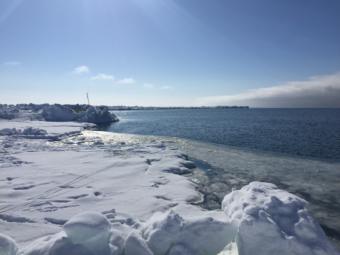
The shorefast sea ice off Utqiaġvik, which local whalers use as a platform for their spring hunt. April 21, 2019. (Photo by Ravenna Koenig/Alaska’s Energy Desk)

For the first time since 2007, Alaska’s northernmost city has recorded a record low daily temperature reading.

On Wednesday morning, temperatures in the North Slope hub community of Utqiaġvik reached 20 degrees below zero, a record low for April 29.

Rick Thoman, a climatologist with the International Arctic Research Center in Fairbanks, said that Utqiaġvik saw all of the ingredients for a cold day on Wednesday.

“At Utqiaġvik, there was some wind, and it’s the direction the wind needs to get really cold, and that’s an offshore wind — kind of a southeast  breeze helping pull in some of that cooler air from the inland to the coast,” Thoman said.

In a tweet, Thoman said Wednesday was also the latest date in the season for a temperature of 20 below or colder in the area. The previous record was a low of  minus 24 on April 28, 1964.

https://twitter.com/AlaskaWx/status/1255564927579779072

Thoman said that the frigid Wednesday temperature doesn’t represent the month of April as a whole for the North Slope, however.

“Of course, the record low is really just one day,” Thoman said. “For April as a whole, this was the sixth-warmest April in the last century at Utqiaġvik.”

Thoman said that while this is the first record low day in Utqiaġvik in just over 12 years, there have been overwhelmingly more record high temperature days in the area.

“One hundred and twelve daily record highs have been set or tied,” Thoman said. “So in a football game, if the score was 112 to nothing, or 112 to one, that would really be quite remarkable.”

Thoman said that current models from the National Oceanic and Atmospheric Administration call for a higher chance of warmer-than-normal temperatures for Utqiaġvik in the month of May.


Despite backlash over coronavirus timing, Alaska’s investment arm puts $35M into fund for Ambler Road

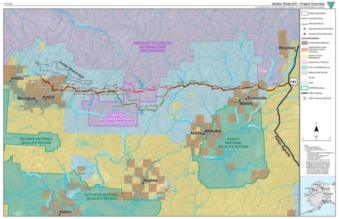
A map of the proposed Ambler Road project. (Graphic Courtesy of HDR for the Bureau of Land Management)

The Alaska Industrial Development and Export Authority board received overwhelming critical public testimony at a board meeting last Friday.

The backlash didn’t stop the board from putting $35 million toward the controversial Ambler Road project. People who testified questioned the timing of the action, amid the coronavirus pandemic.

Susan Georgette of Kotzebue summed up the biggest concern from the public: The coronavirus health crisis is no time to put money into the Ambler Road project.

“The Northwest Arctic Borough is under a shelter-in-place directive right now. The state and country are in the midst of a pandemic and an economic crisis,” Georgette said. “And it’s outrageous, as others have said, that AIDEA is considering these actions right now.”

AIDEA scheduled the emergency meeting to allow themselves to waive certain regulations on their loans, with the intent of getting money out faster to businesses across the state strained by the coronavirus.

The money would go toward contracting with engineers, lawyers, advisers and others in the Ambler Road’s predevelopment phase.

For two hours, Georgette and others testified to the board — almost exclusively against the funding for the project. Many of them took issue with the timing of the meeting. The board scheduled the meeting with three days notice, and some felt there wasn’t time for the public to weigh in on the motions. Public testimony per person had also been reduced from the listed three minutes down to two, which Georgette criticized.

“It does look like AIDEA is using the current crisis to forge ahead with an unpopular project,” Georgette said.

The Ambler Mining District Industrial Access project, known as the Ambler Road project, would stretch from the Dalton Highway to the Ambler Mining District northeast of Kotzebue, crossing into Gates of the Arctic National Park and Preserve.

The road has drawn criticism from environmental groups who don’t want a new road through a national park.

Several village governments, including the village of Kotzebue, have also publicly come out against the project.

“Many people here are more concerned with long-term impacts on caribou, fish and water quality than on the shorter-term economic benefits of the road,” Georgette said.

The Army Corps of Engineers released its final environmental impact statement on the road on Friday. They say all three suggested road routes, including one that doesn’t cross through a national park, could impact air and water quality, wildlife migration and erosion in the region.

Despite the largely negative input from the public, the board ultimately voted unanimously to support the resolution, which categorizes the Ambler Road project as an Arctic Infrastructure project, and also adds $35 million to the fund for those projects. The board would have to take further action to actually put the money into the road.

Board president Dana Pruhs said the investment in the Ambler Road project is important as the state looks past the current health crisis to the economy post-coronavirus.

“I respect the public, and I really respect what they had to say today,” Pruhs said. “But they have to know that we have to look after the future of the state also.”

Board members estimate that the project could bring 100 to 200 jobs to the state.

AIDEA is a public Alaska state corporation tasked with making investments and providing loans to various business interests across the state.

The AIDEA board also voted to grant the Blood Bank of Alaska a six-month reprieve from paying back loans, though the blood bank had requested nine months and an additional $2.5 million in credit, which was not granted.


Citing coronavirus disaster, Alaska’s investment authority wants to bypass regulations to fund Ambler Road Project

Tom Boutin, executive director of the Alaska Industrial Development and Export Authority. (Photo by Skip Gray/KTOO)

Citing Gov. Mike Dunleavy’s coronavirus emergency declaration, the state’s investment authority is looking to bypass regulations to put funding into the Ambler Road Project.

The Alaska Industrial Development and Export Authority (AIDEA) Board of Directors is meeting Friday to vote to allow the group to waive the standard requirements for taking loans from its revolving fund. That would allow them to put $35 million into the a fund that could later benefit the road, which they’re also scheduled to vote on.

Initially, the Board had a resolution to put the money from the revolving fund to the Arctic Infrastructure Development Fund, and then directly into the Ambler Road project. After a special Thursday board meeting, however, the resolution was amended to reflect that the board would have to take additional action to put the money into the Ambler Road.

The Ambler Road would stretch from Dalton Highway to the Ambler Mining District northeast of Kotzebue and cross Gates of the Arctic National Park. Critics say there are environmental concerns over routing through a national park. Others are concerned with impacts to federal subsistence rights.

AIDEA president Tom Boutin says the action by the board will allow AIDEA to issue loans more effectively to offset potential economic issues brought on by the coronavirus disaster. He says they want to ensure funding is secure for rural Alaska projects, like the Ambler Road.

The move has been criticized by environmental groups. The conservation nonprofit Alaska Wildlife Alliance called it inappropriate to fund the road project when there are other more pressing economic impacts facing Alaskans.

A map of AIDEA’s proposed routes for the Ambler Mining District Industrial Access Road. (Image courtesy the Alaska Industrial Development and Export Authority)

Western Arctic caribou populations stable, though officials worry about warming climate

The Western Arctic Caribou herd is smaller than previous estimates of 206,000. (Photo courtesy of Alaska Department of Fish and Game)
Wildlife biologists say the Western Arctic caribou herd numbers have stabilized in the Selawik National Wildlife Refuge near Kotzebue. (Photo courtesy of Alaska Department of Fish and Game)

Wildlife biologists say the Western Arctic caribou herd numbers have stabilized in the Selawik National Wildlife Refuge near Kotzebue.

The most recent count of caribou showed a slight dip from 2017 — from 259,000 to 244,000 — but it’s more than there were in 2016. Caribou biologist Alex Hanson says this winter’s conditions look promising for the herd.

“Looking at the survival-to-date this winter, things are looking pretty good,” Hanson said. “Very few mortalities out there. So hopefully this winter will be good to the caribou and they’ll continue to grow.”

Hanson says that the adult cow survival rate remains low, around 78%. However, there’s a high birth rate among calves, and calf survival rates are stable.

The herd had a peak of around 500,000 caribou in 2002, before a sharp decline occurred, ending in 2016 with about 201,000 caribou remaining. Hanson says they don’t have a direct cause for the decline, but there were a series of die-offs in that time period, and ice conditions prevented some caribou from being able to access their food.

“Certainly weather, predation, disease could come into play as well,” Hanson said. “But the reality of it is the caribou populations are cyclic — they come up and they go down.”

Hanson says the harvest rate for local hunters is about 12,000 caribou, accounting for about half of total caribou harvest in the state. Non-local hunters get about 250 to 300 caribou annually, depending on the year.

Refuge manager Susan Georgette says one of the things that U.S. Fish and Wildlife Service officials are keeping tabs on is the warmer climate in the area, which Georgette says is having an effect on permafrost and vegetation that caribou eat.
“A lot of shrubs are moving into tundra areas, as I’m sure a lot of you have noticed,” Georgette said. “Winter rains have become more common, not this year but the last few years, and that can have a bad effect on caribou. And wildfires are expected to increase.”

Georgette says that at the December 2019 meeting of the Western Arctic Caribou Herd Working Group, a University of Alaska Fairbanks climatologist said that if weather conditions continue on the current trajectory in the region, the village of Ambler could have weather closer to Homer in about 50 years. This could mean changes to eating and migratory habits of the herd.

Dramatic ocean changes are coming ‘a couple decades too early,’ scientists say

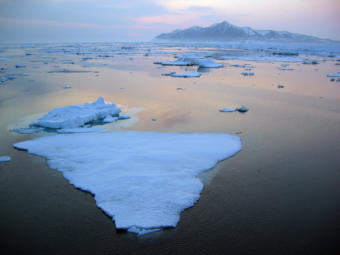
Sea ice floats in the Bering Strait off Cape Prince of Wales. (Photo courtesy of Gay Sheffield/University of Alaska Fairbanks)

Arctic Ocean temperatures are rising at rates faster than previously thought by the scientific community.

That’s the finding of a new study from the University of Alaska Fairbanks, which shows warming waters having an effect on everything from sea ice growth to marine ecosystems.

One researcher says now is a key time for studies on Arctic Ocean conditions, before the hotter temperatures become the new normal.

For UAF oceanography professor Seth Danielson, the record low sea ice and record high ocean temperatures of the last couple years came as a shock.

“It was a bit surprising, because we felt like it came a couple decades too early,” Danielson said.

Danielson is part of a team of researchers that authored a paper discussing the changes to Pacific Arctic ecosystems from warmer ocean temperatures. It lists several observations of the area, including weaker winter sea ice and an early melting period.

More open water conditions mean that there is likely to be an increase in vessel traffic through the region, which Danielson said could have an impact on subsistence. Low sea ice could also change migratory patterns.

“The time of the year that some hunting activities can take place may need to change,” Danielson said. “I think we’ve seen some indications of that already. And the species that people are hunting and fishing for may change as well.”

Katrin Iken, a professor at UAF’s College of Fisheries and Ocean Sciences, measures a brittle star. That data is part of an assessment of the seafloor community, which has shown signs of decreasing biomass in recent years. (Photo courtesy of Seth Danielson/University of Alaska Fairbanks)

Danielson said one of the findings of the paper is that new groundfish species, like Pacific cod, are showing up further north and have the potential to disrupt the native Arctic cod populations — and send ripples up the food chain.

“They’re a focal point through which energy flows to a lot of different components,” Danielson said. “For instance, they’re eaten by the seals. They’re eaten directly by people. The seals are eaten by people and polar bears.”

Danielson said that researchers expected that: As temperatures in the region got warmer, these effects could happen. He said research models show that the heat waves caused by global warming have become more prevalent in the wake of industrial advancement.

“You can be fairly confident in attributing these types of unusual events to human-induced causes,” Danielson said.

Danielson said that the rapid changes to Arctic marine ecosystems are happening in real time, as researchers are studying them. He said these changes likely aren’t going anywhere.

“It’s not gonna be too long before these extremely low-ice years that we’ve just had in the last couple years will be what we consider to be the norm,” Danielson said.

Historically, Danielson said there wasn’t a lot of scientific observation of Arctic waters four-to-five decades ago. He said the rapid warm changes to the environment mean now, more than ever, is the right time to keep tabs on Arctic waters.

“We’re at this interesting spot now, where we know things are changing incredibly rapidly, and now is the best chance for us to go out and make some additional observations,” Danielson said.

Danielson’s research was part of a coalition of scientists with the Arctic Integrated Ecosystem Research Program. The paper was published this month in the Nature Climate Change scientific journal.


Alaska’s largest rural solar project set to break ground in Kotzebue

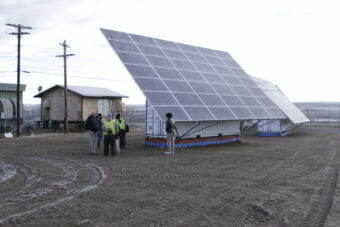
A group of visitors stands next to three new solar arrays in the Northwest Alaska village of Buckland, Oct. 15, 2018. The city of Kotzebue, 75 miles northwest of Buckland, plans to install the largest solar project in rural Alaska, and second statewide to the 1.2-megawatt solar farm in Willow. (Photo by Nat Herz/Alaska’s Energy Desk)

The high costs of diesel fuel to power energy grids has led a lot of rural utilities to offset with more renewable energy. The city of Kotzebue has used wind power for decades to supplement its fuel use, and now it’s about to break ground on a brand new solar project.

Martin Shroyer is the general manager for Kotzebue Electric Association, or KEA, the city’s local electric utility. He said renewable energy is nothing new in Kotzebue.

“It’s been the model since the mid-90s,” Shroyer said. “We were the first wind farm above the Arctic Circle.”

The new solar project will take the place of those older turbines, which Shroyer said are much more expensive to maintain.

“They’re obsolete,” Shroyer said. “They’re hard to get parts and hard to maintain right now, so the solar will help replace some of the energy they generated.”

The 576-kilowatt project will involve the installation of more than 1,400 solar panels in Kotzebue, generating an estimated 700,000 kilowatt-hours or more of power per year. The dual-sided panels will even be able to capture solar power from light reflected off of snow.

It will be the largest solar project in rural Alaska, and second statewide to the 1.2-megawatt solar farm in Willow.

Generating power in rural Alaska is largely driven by diesel fuel, which can be expensive to ship to communities off the road system, like Kotzebue. Shroyer said the city has focused on increasing renewables to keep costs lower. He said while the electric rate for KEA customers would stay the same, they should see a decrease in their fuel cost adjustment.

Kotzebue receives a lot more wind annually than sunlight, which only is reliable for about seven months of the year. Despite that, KEA engineer Matt Bergan said due to the relative installation ease and lower cost of the solar panels, they end up being more cost-effective.

“The energy output from a 60-kilowatt solar array is going to be less annually than a 60-kilowatt wind turbine for our location,” Bergan said. “However, the cost for operations and maintenance for the solar array will be quite a bit less than the wind turbine.”

The new solar project should make Kotzebue about 50%-powered by renewable energy. Bergan said that wind power in Kotzebue isn’t going anywhere anytime soon, and KEA will be utilizing a mix of solar and their newer, more powerful 900-kilowatt wind turbines.

“Installation of those turbines is a rather expensive undertaking, but the amount of energy production and reliability is quite high,” Bergan said. “We see solar as a way to utilize some of our older wind infrastructure, so we’re essentially decommissioning wind and adding solar.”

Alaska Native Renewable Industries, or ANRI, is the general contractor for the solar project. ANRI founder Edwin Bifelt grew up in the western Interior village of Huslia. He said he felt disappointed with how projects were built in rural communities.

“You know, a lot of times you’d see contractors based in Fairbanks or Anchorage,” Bifelt said. “And it’s always kind of challenging, because they come in, they bring in a lot of their own labor and it was always kind of tough for me to see that.”

ANRI focuses on hiring locals for their installation projects. In a recent project in the village of Hughes, Bifelt said the only people not from the community were himself and his electrical administrator.

Construction on the Kotzebue solar project is set to begin at the end of February, with a completion date in April. ANRI is currently looking for 20 temporary local hires, in addition to the people already working at KEA.

Bifelt said they hope to continue their rural solar efforts with a new bid on a solar project in the Northwest Arctic village of Shungnak.

Editor’s note: Matt Bergan, the KEA engineer quoted in this story, serves on KOTZ’s Community Advisory Board. Alaska’s Energy Desk reporter Wesley Early reports for KOTZ.

Site notifications
Update notification options
Subscribe to notifications