Wesley Early, Alaska's Energy Desk - Kotzebue
Federal and state officials sign right-of-way permit for controversial Ambler Road

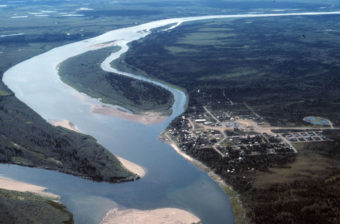
Aerial view of Ambler and the Kobuk River in the summer. (Photo courtesy of the National Park Service via UAF Gates of the Arctic Research Portal)
Aerial view of Ambler and the Kobuk River in the summer. (Courtesy of the National Park Service via UAF Gates of the Arctic Research Portal)

In the latest step in a longstanding dispute between mining advocates and environmentalists, federal and state entities signed a 50-year right of way permit for the controversial Ambler Road project on Wednesday, Jan. 6.

The permit was signed by the Bureau of Land Management, the National Park Service and Alaska’s state-owned development corporation — the Alaska Industrial Development and Export Authority. It allows the privately-owned road to pass through lands controlled by the federal government.

A company called Ambler Metals LLC, a subsidiary of British Columbia-based Trilogy Metals hopes to use the road to access copper, gold, zinc and other mineral deposits in the area, in cooperation with the NANA regional Native corporation.

The road would stretch 211 miles from the Dalton Highway to the Ambler Mining District east of Kotzebue along the Kobuk River. Environmentalists are most opposed to the part of the project that would cross Gates of the Arctic National Park and Preserve.

Bridget Psarianos is an attorney for Trustees for Alaska. The group has filed numerous lawsuits on behalf of conservation groups opposed to the project.

“Putting a gravel road through that area is going to really significantly and negatively impact the environment in that region,” Psarianos said. “The water quality, air quality, wildlife and the communities that are in that region.”

Subsistence advocates have also filed lawsuits over the road, fearful that construction of the project would impact the migration of caribou, a staple of the local Inupiaq diet in Northwest Alaska.

In its environmental assessment released last March, BLM officials flagged potential impacts to local water and air quality, as well as to wildlife migration and erosion.

The project has received millions of dollars in state support. In a statement, Gov. Mike Dunleavy described future efforts in the mining district as responsible resource development that is “key to providing high wage jobs to Alaskans and their families.”

The right-of-way permit came the same day that AIDEA also made the majority of oil lease bids on land tracts in the Arctic National Wildlife Refuge. Considering the pro-resource development attitudes of the waning Trump administration, Psarianos with Trustees for Alaska described these recent decisions as rushed.

“What we’re seeing right now is just a last-ditch, desperate effort by the Trump administration to rubber-stamp as many permits as it can before it leaves office,” Psarianos said.

Psarianos described the decision this week as one of many procedural steps in a lengthy process to get the road built. Construction would still be several years away at the minimum.

Solar project in Northwest Arctic villages set to break ground next spring

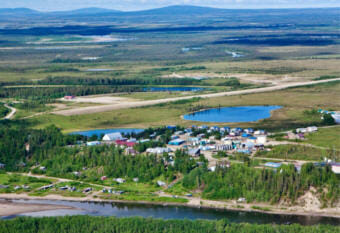
Aerial view of the Native Village of Shungnak
The Native Village of Shungnak (Photo courtesy of Northwest Arctic Borough)

Construction is set to start next spring on a solar battery project in the Northwest Arctic villages of Shungnak and Kobuk. It’s the latest renewable project for a region routinely struck by high energy costs.
It’s always been expensive to provide energy to rural Alaska. With most communities not falling on the road system, locals are forced to barge and fly in diesel fuel to power generators. There is a state program that reduces energy costs but with the state’s budget crisis, it’s unknown how long that program will be around.

Edwin Bifelt said even with state support, energy in rural Alaska remains pricey.

“Even with Power Cost Equalization, people see rates anywhere from 20 cents up to 40 to 50 cents a kilowatt-hour, which is four or five times the national average,” Bifelt said.

Bifelt, who grew up in the village of Huslia, is the founder and CEO of Alaska Native Renewable Industries. The company specializes in providing renewable energy to rural Alaska communities.

ANRI wrapped up the construction of Alaska’s largest rural solar farm in Kotzebue earlier this year, a 576-kilowatt project with more than 1,400 solar panels. Combined with the local electric co-op’s wind turbines, it’s estimated that Kotzebue is about 50% powered by renewable energy.

Now, ANRI is contracted with the Northwest Arctic Borough for just over $2.1 million to construct similar arrays in the villages of Shungnak and Kobuk, the easternmost communities in the borough. Bifelt said he expects the arrays to lower utility bills in the villages.

“Definitely see a decrease in the amount of diesel fuel that they have to fly in every year, but it’s tough to say right now what end effect it’s going to have for residents in the long run,” Bifelt said.

Kobuk and Shungnak combined have about an eighth the population of Kotzebue. Bifelt said the two new arrays will follow a similar design to the Kotzebue project, but they will be much smaller.

“The tentative design we have is for approximately a 38-kilowatt array in Kobuk and a 186-kilowatt array in Shungnak, I believe,” Bifelt said.

Bifelt said rural energy projects aren’t new to the region, though his company puts an emphasis on hiring locals to help with construction rather than fly up workers from larger cities.

“Just to provide some temporary jobs, provide some new skills for people within the community relating to renewable energy, and giving them education and experience with solar,” Bifelt said.

Construction of the solar arrays should wrap up by summer next year.

Moving forward, Bifelt anticipates rural renewable energy will be more important as lawmakers struggle with funding Power Cost Equalization. In 2019, a procedural delay in the legislature held up those funds, and there have been proposals from Gov. Mike Dunleavy and more conservative lawmakers to use funds from the program to help balance the state’s deficit.

Bifelt said the uncertainty over PCE should worry rural Alaskans.

“I guess it’s something we don’t think about enough, just because it’s been around the past 30-plus years,” Bifelt said. “But who knows if it’ll be there the next 10, 15 years, and then what situation communities be in at that point.”

Without PCE, Bifelt said rural Alaska residents could end up paying double for their energy costs.

Over the next decade, he said investing in solar, wind and hydroelectric power could save rural communities from potentially drastic hikes in energy bills. The more positive impact to the environment from these renewable resources is a bonus.

Once again, Arctic Report Card shows the abnormal is now normal

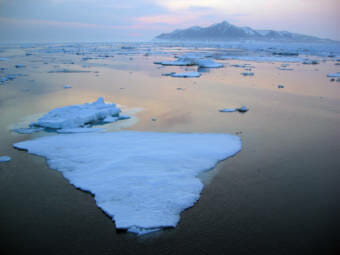
Sea ice floats in the Bering Strait off Cape Prince of Wales. (UAF photo by Gay Sheffield)

The 2020 Arctic Report Card is out, and the results show the Arctic continues to warm at an accelerated rate. This year was the second warmest on record in the Arctic, with impacts to sea ice, erosion and marine ecosystems.
In 2006, the National Oceanic and Atmospheric Administration released its first Arctic Report Card, laying out a timely snapshot of what the coldest parts of the world looked like as the climate warmed.

Rick Thoman is a climate specialist with the University of Alaska Fairbanks.

“Things were starting to change rapidly enough that folks were interested in this near-real time update of a variety of the different parts of the Arctic system,” Thoman said.

Fifteen years later, Thoman is the lead editor of the 2020 Arctic Report Card. He says even though Alaska didn’t have very extreme weather patterns, the Arctic as a whole was impacted.

“Some place in the Arctic every year has some extreme. It varies place to place,” Thoman said. “This year, Siberia, especially Western Siberia was the focus of the warmth, the very early snow melt, the wildfires, some of which were overwinter fires, zombie fires. Last year was Alaska. A couple years ago it was Greenland.”

Thoman says even though Alaska was impacted a little less this year by the warming climate, it still follows the recent trend.

“Whatever the trend is, there’s always going to be years above and years below that,” Thoman said. “We’re at the point now though, for instance with erosion, it wasn’t as much as last year, but it’s always going to be more than it was in the 1950s.”

One of the facets of the Arctic most impacted by a warming climate is sea ice. Thoman says this year followed a trend of shrinking sea ice in the Arctic.

“The lowest it got at any point was the second lowest [on record]. Only the 2012 minimum extent was lower,” Thoman said. “And in the winter, the maximum extent it got on any one day was the 12th lowest.”

Low sea ice extent impacts much of the arctic ecosystem, forcing marine mammals like walruses and seals to haul out on tiny patches of land rather than the thick rich sea ice they’d been accustomed to. Thoman says that bowhead whales in Alaska waters are in a slightly better position than other marine mammals, due to their ability to swim much farther to get to the zooplankton that they eat.

“If their food supply is very far north one year because that’s where the ice is, they have the ability to go and get that food, unlike other species which have a much shorter range,” Thoman said.

While that works well for the whales, Thoman says new feeding routes have the potential to upset subsistence whale harvests from Alaska’s northernmost Indigenous populations.

“From a whale perspective, if they have to go 600 miles of the Alaska coast to find food, for a bowhead that’s not a problem,” Thoman said. “At what point it becomes the whales are there but they’re not accessible for Alaskans, that’s a different question.”

Basically, Thoman says what was once abnormal or unusual in terms of Arctic climate is now normal. The Arctic is transforming, and populations will have to adapt.

Crews working to clean diesel spill in Northwest Arctic village water treatment plant

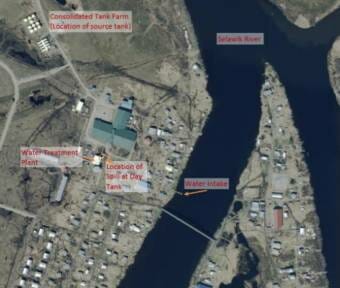
City of Selawik and the location of the diesel spill (Google Earth graphics courtesy of Alaska Department of Environmental Conservation)

A response crew is working to clean up a diesel fuel spill in the Northwest Arctic village of Selawik.

According to a release from the state Department of Environmental Conservation (DEC), the spill originated last Wednesday at a fuel tank for the village’s water treatment plant.

Officials say the fuel was transferred from a city fuel tank to the plant tank, though the transfer was left unattended for about seven and a half hours before the operator was alerted to the spill and shut off the valve at roughly 10 p.m. The spill was reported to DEC at roughly 1:30 a.m. Thursday.
The city tank holds just under 46,000 gallons of diesel and the water plant tank has a capacity of roughly 4,000 gallons. DEC’s Sarah Moore says officials are still trying to determine the total amount of diesel spilled.

“We know that there’s still 35,000 gallons approximately left in the tank following the release, and that source tank itself wasn’t damaged. It was an overfill due to transferring,” Moore said. “So we know that 35,000 gallons is still in the tank and is not threatening to release at this time. So we have a ballpark estimate, but are still working on some more concrete numbers about the volume spilled.”

A response crew has cleared 750 gallons of diesel so far, but due to fresh snow cover, DEC officials say it’s difficult to determine the total amount of diesel or the extent of the spill at this time.

“It can be a bit of a double edged sword,” Moore said. “It takes more work to find out where the diesel is because you have to dig holes in the snow and see if you can find it, but it also helps keep it more contained.”

The spill is about 610 feet from the Selawik River, a water source for the village.

Coast Guard officials arrived in Selawik on Tuesday to help provide safety and response equipment. Moore says, in keeping with pandemic safety mandates, the only people doing the cleanup are people from Selawik.

This story has been updated with comments from the Alaska Department of Environmental Conservation.

Emergency access road opens for Northwest Alaska village facing coastal erosion, rising sea levels

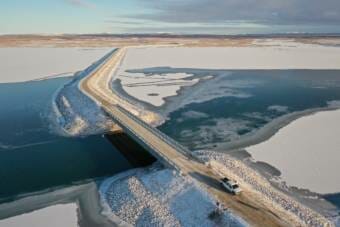
Kivalina Access Road (Photo courtesy of Jonathan Hutchinson, Alaska Department of Transportation)

After two years of construction, the Kivalina Access Road project is now usable by the community. It’s the first step in the process to potentially relocate the entire Northwest Alaska village from the threat of an eroding coast and rising sea levels.

Kivalina sits on a barrier island, surrounded by the Chukchi Sea. The area is prone to heavy wind and rainstorms. The protection of sea ice has become less reliable. Sea levels have risen with climate change, and so the ocean has chewed into the shore.

“It was always eroding,” said tribal administrator Millie Hawley. “We’re on a small spit of land that has diminished in size over the last century.”

The storms also bring the risk of flooding. Hawley said it had been difficult to evacuate people from the village during emergencies.

“According to the U.S. Coast Guard, it takes at least a day or two to come assist us,” Hawley said. “In a state of emergency, that’s just not acceptable.”

The solution was to build an eight-mile gravel road from the northern part of the community near the airport. The road stretches over the Kivalina Lagoon, allowing evacuees to head to a higher ground area known as K-Hill.

After three years of planning and two years of construction, the lion’s share of the road was completed at the end of October. Jonathan Hutchinson is the project manager with the state Department of Transportation.

“The project is substantially complete,” Hutchinson said. “There’s a need to install dust pallets next summer, and without getting into details, minor concrete finish work on the bridge.”

Hutchinson said the road is usable now, though that has brought up a new concern.

“One of the safety concerns that I’ve heard from the community has been lighting the route,” Hutchinson said. “Because you’re crossing the lagoon, everything’s going to be dark. Typically late fall, it’s going to be pretty dark by then when you’re wanting to evacuate on that road.”

With the new road, the community is also looking to relocate its school.

It’s part of a wider conversation to move the entire village and its more than 400 residents. A similar move was made by residents of the Western Alaska village of Newtok.

Residents of Shishmaref near the Bering Sea have discussed a move as well. Some scientists estimate the entire community could be underwater by 2025. Hutchinson said there is already a school site in mind.

“At the very end of the road, we’re putting a staging pad that’s intended to support future development in that area for the construction of the school,” Hutchinson said.

Hawley with the tribe said final inspections on the road are set to happen in early summer. For now, she said locals are getting use out of the new road.

“It’s been used every single day for subsistence,” Hawley said. “We’ve got access to our fishing sites even if the lagoon didn’t freeze over; we’re able to go there.”

As for the school, construction for that project is expected to break ground late next fall.

There’s more sea ice in the Chukchi Sea than last fall, but it’s still historically low

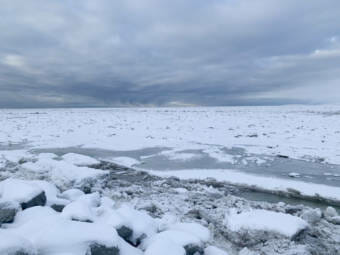
Snow piles on sea ice in the Kotzebue Sound. (Wesley Early/KOTZ)

Researchers track the extent of Arctic sea ice every year — essentially, how far it extends from the North Pole. The Arctic sea ice pack is smallest in the fall, after melting and receding all summer and right before it starts growing again through the winter.

There’s more sea ice this fall in the Chukchi Sea than there was at this time last year. But the ice closer to Alaska’s shores is lagging behind.

Rick Thoman, a climatologist with the International Arctic Research Center in Fairbanks, broke the news about the amount of ice in the waters off the coast of Northwest Alaska this year.

“We have much more, about three times more ice in the Chukchi Sea than we did last year,” Thoman said.

Last year saw the lowest fall sea ice extent in the Chukchi Sea on record. Thoman says this year’s sea ice extent is still way below the historical average, and most of this year’s ice is in waters north of Alaska.

(Courtesy of Rick Thoma/International Arctic Research Center)

“When we talk about the Chukchi Sea here, we’re talking basically to about 78 North,” Thoman said, “so that’s hundreds of miles north of Utqiagvik.”

In the southern Chukchi Sea, Thoman says there’s still a lot of open water. In fact, even though there’s more ice across the entire Chukchi, the ice near Kotzebue and Point Hope is actually weaker than last year.

“Kotzebue Sound is mostly open water at this point,” Thoman said. “So especially on the Russian side, we have even less ice than we had last year at this time.”

Thoman says this year’s forecast calls for storms throughout the coast of Northwest Alaska. Stormy seas make it difficult for sea ice to form.

“We’re going to have a turn towards warmer stormier weather in the Bering and Southern Chukchi Sea,” Thoman said. “We’re going to be very late with starting to form ice south of Point Hope. And we could easily be looking at no ice in the open Chukchi Sea, north of the Bering Strait, well into December.”

Thoman says historically, that ice was formed by mid-November or even as early as October.

Site notifications
Update notification options
Subscribe to notifications