A map of the proposed Ambler Road project (Bureau of Land Management)
In the latest move forward for the controversial Ambler Road project, the Alaska Industrial Development and Export Authority reached an agreement with regional Native corporation Doyon to conduct survey and feasibility studies on the corporation’s lands.
The proposed 211-mile road would stretch west from the Dalton Highway to the Ambler Mining District in Northwest Alaska. The area is rife with mineral deposits, including zinc, gold, silver and cobalt. The road has drawn controversy from environmentalists and subsistence advocates over it crossing Gates of the Arctic National Park and potential impacts to caribou migration.
The land along the road’s route near the highway and the village of Evansville is owned by Doyon, the state’s largest private landowner. The agreement is not a right of way and does not guarantee long-term access to the area by AIDEA or the road project.
In a statement, Doyon President and CEO Aaron Schutt said that the corporation has not changed its position on the project, neither opposing or supporting it.
AIDEA plans to continue its summer field activities along the proposed route. The current budget for those activities totals about $13 million, a cost the state corporation will split 50-50 with Ambler Metals, the primary mining company interested in developing the Ambler Mining District.
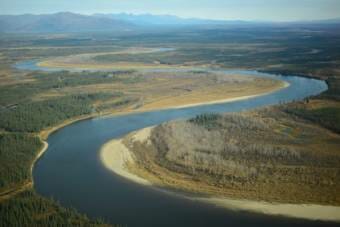
The Kobuk River runs through the Ambler Mining District, where a new road would be built to connect the Northwest Arctic with the Dalton Highway to Fairbanks. (Berett Wilber/Alaska Public Media)
Last month, the state of Alaska’s investment authority agreed to put $35 million towards pre-development work on the Ambler Road project.
The private access Ambler Road would run roughly 211 miles from the Dalton Highway to the Ambler Mining District in the Northwest Arctic Borough.
The funding from the Alaska Industrial Development and Export Authority, or AIDEA, was matched by Ambler Metals, the company that hopes to use the road to access mineral deposits in the Ambler Mining District. The company’s most promising deposit is referred to as the Arctic project.
Ambler Metals will not be an operator of the road. That falls solely with AIDEA.
AIDEA executive director Alan Weitzner said that as part of the contract with Ambler Metals, the company wanted an opportunity to get some of their investment back.
“For their contribution of that $35 million, what they’ve requested is that they get a credit against what would be toll or use volume charges for activity on the road,” Weitzner said. “And we have agreed to that.”
Basically, Ambler Metals would get a credit towards any fees for using the road. They would only get that credit if the road actually gets built. Weitzner said AIDEA hasn’t officially decided to invest in the construction of the road yet. That’s still a few years away.
“We are currently in feasibility and permitting activity,” Weitzner said. “We look to complete this, by latest, by the end of 2024.”
Weitzner said while the financing is still up in the air, it’s not totally clear how much Ambler Metals stands to get back in toll fees, but he said it’s very unlikely that it’ll get the entire $35 million investment back.
“[I] don’t believe that would be the case because of the capital costs of the road itself,” Weitzner said.
Throughout the Ambler Road’s development, AIDEA has drawn a lot of comparisons between this project and the Delong Mountain Terminal. That’s a roughly 52-mile road that leads from the port site near Kivalina to the Red Dog Mine. The zinc and lead mine is owned by the NANA Regional Native corporation and operated by Teck Alaska, formerly known as Cominco.
Weitzner said that Teck and NANA worked together on the pre-development work for the access road, and that ended up lowering the amount of money that the mine needed to make to break even. He said the investment from Ambler Metals for work on the Ambler Road is similar.
“They’re the initial party, the initial user we believe with the Arctic Mine development,” Weitzner said. “And they’re contributing to the final feasibility permitting activities that gets us to the construction of that road as our partner in that case. And ultimately they’re lowering the amount of capital that needs to be financed.”
The Ambler Road has been a lightning rod for controversy for years, with environmentalists concerned over potential impacts to caribou migration from the road’s construction. They also are concerned that the road goes through the Gates of the Arctic National Park and Preserve.
Weitzner sees investment in the project as a benefit to the state economically. He pointed to Red Dog Mine again, which provides a massive percentage of the Northwest Arctic Borough’s revenues.
“What I would highlight is that there’ve been, through three generations, 500 people working at the Red Dog Mine, generating revenues within their communities,” Weitzner said. “It’s that example which is what we’re looking to develop across multiple mines in the Ambler Mining District.”
Weitzner said Ambler Metals will likely be the first commercial user of the road, considering its financial contributions and existing deposits in the Ambler Mining District. However, he said the road will be open to other commercial interests who want to access the mining district, and they will have to pay full fees to use the road.
Editor’s note: A previous version of this story said that Red Dog is a zinc and cobalt mine. It’s a zinc and lead mine. The story has been corrected.
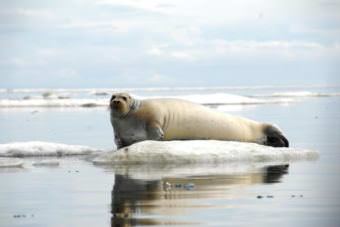
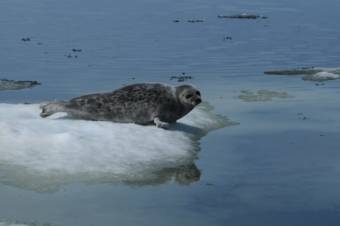
A bearded seal rests on ice in 2011 off the coast of Alaska. (Photo by John Jansen/NOAA’s Alaska Fisheries Science Center)
The federal government is extending the public comment period for proposed critical habitat for ringed and bearded seals. Both species had been listed as “threatened” under the Endangered Species Act during the Obama administration in 2012.
Designating an area as critical habitat means it contains features deemed essential to threatened species. Taking up a large swath of Arctic waters, the chosen area for the seals contains sea ice that they rely on for hunting and nursing their young.
A critical habitat designation does not mean that it’s off limits to human activity. However, if the government makes a decision about the area, they must consult with local biologists to ensure the species and habitat aren’t negatively impacted.
The National Oceanic and Atmospheric Administration proposed critical habitat for the two species of Arctic seals in January.
By law, the critical habitat should have been designated shortly after the seals had been listed as threatened. But the process was delayed by almost a decade, in part due to numerous lawsuits from the state of Alaska, the oil industry and others.
The original deadline for the public to weigh in on the habitat was March 9. It has now been extended to April 8.
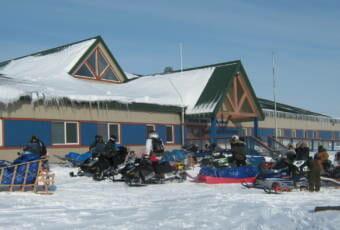
Davis-Ramoth School in Selawik. (Photo courtesy of Northwest Arctic Borough School District)
Several weeks after an outage knocked out power in the Northwest Arctic village of Selawik, officials say it has been restored. However, the outage has exacerbated chronic problems at the local water treatment plant.
On Febr. 14, the diesel generators went out in Selawik, knocking out power at the school, dozens of homes and — perhaps most critically — the village’s water treatment plant. As local, regional and state officials worked to solve the issue, the community of roughly 800 people was without running water and had to conserve power, relying on back-up generators while power was slowly restored.
Tribal administrator Tanya Ballot said officials don’t know for sure what the cause was, but she suspects wear and tear on the engines.
“Just like any regular engine, if it’s not maintained properly it doesn’t work. So that may have been the problem,” Ballot said.
Having power issues during any time of year would be rough on the village, which is about 90 miles east of Kotzebue, but Ballot said the winter weather is making things tougher.
“Mother Nature is not helping us right now,” Ballot said. “It’s 17, 18 below with a 50 below wind chill factor today. We have been cold for the last two weeks.”
Ballot said power was restored to two of three engines this week, and the community no longer has to conserve power or boil water. However, she said the power was out for so long, that serious damage was done.
“Having the power restored a little late was detrimental to the water treatment plant,” Ballot said. “Those lines had a chain effect and froze so far, that we’re still not thawed out today.”
Ballot said community members now have to haul their water from the water treatment plant to their homes, instead of being able to rely on their pipes or water taps. She said it’s led to a lot of frustration among residents.
“They’re right in their frustrations because we’ve become accustomed to having running water out of a tap, and being able to flush our dishwater down a drain, and our bath water and our toilet water and whatever else is in a toilet down the drain,” Ballot said. “And it makes more work for us to haul it out and pack it in and empty it out in a bucket. And it’s not sanitary.”
Ballot said she’s concerned that the lack of clean water could have other, less obvious consequences.
“We’ve seen increased illnesses and skin problems because people aren’t able to stay as clean as we’re used to,” Ballot said. “Attendance at school may or may not be affected because students don’t want to go to school with dirty clothes or smelling stinky. So it really has a bigger effect on us than we think.”
Having frozen pipes isn’t a new problem in Selawik. Ballot said long-term issues at the 30-year-old water system have persisted for years.
“We keep putting band aid fixes on it that don’t seem to stick,” Ballot said. “And we need a complete overhaul of this system. And parts are not cheap.”
Ballot said they need new motors, which cost about $26,000. Additionally, they need a new water pump which costs about $5,000.
“We don’t have that kind of funding in our pocket,” Ballot said. “So we’re going to be putting through some applications. We’re going to request for state funding, emergency funding to try to help get these necessary parts. Above-ground water and sewer is very, very… it’s a challenge to maintain.”
Ballot said the village has seen a lot of support from surrounding communities, including parts from the Alaska Native Tribal Health Consortium, water donations from the Kiana AC store, and emergency assistance from NANA Regional Native Corporation and the Northwest Arctic Borough.
“I feel very fortunate that all these folks are contributing and helping us, and I wish the same for Ambler,” Ballot said. “I understand Ambler is going through the same problem with water and sewer. And Unalakleet, and Tuluksak.”
Ballot said she’s hopeful that the impending spring weather will help thaw some of the pipes, making running water more accessible in town, though she said it’s “taking its sweet time.”
Ringed seal in Kotzebue Sound, Alaska. (Photo courtesy of NOAA)
The federal government is moving ahead with a proposal to protect the habitat of two Arctic seals. Public hearings start next week and will be hosted by the National Oceanic and Atmospheric Administration.
After being delayed for almost a decade, the federal agency proposed what’s called critical habitat designation last month in the Bering, Chukchi and Beaufort Seas. Bearded and ringed seals were listed as threatened under the Endangered Species Act in 2012 by the Obama administration. Though the species is still in relative abundance compared to other threatened species, long-term climate projections for the region forecast diminished sea ice, which the seals live off.
The hearings are scheduled for Tuesday through Thursday, Feb. 24-26 at 4 p.m. Anyone can submit their comments on the topic either by calling in during the hearings or submitting a written comment through the website.
Those who wish to make public comments can call 800-201-3962, and enter the conference code 651174.
The public comment period on the critical habitat ends on March 9.
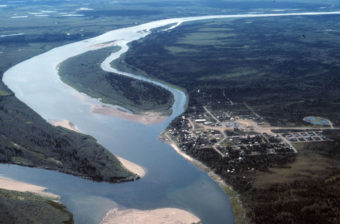
Aerial view of Ambler and the Kobuk River in the summer. (Photo courtesy of the National Park Service via UAF Gates of the Arctic Research Portal)
The state of Alaska’s investment authority board has agreed to put $35 million towards the controversial Ambler Road project. The funding is matched by Ambler Metals, the mining company looking to use the road to access mineral deposits in the region.
With the $35 million match from Ambler Metals, the $70 million infusion signals a major advancement in the development of the Ambler Road. The proposed project would run roughly 211 miles from the Dalton Highway to the Ambler Mining District in the Northwest Arctic Borough.
Ambler Metals CEO Ramzi Fawaz said the funding is for pre-development work on the project. He said the permitting process will start sometime in the second half of the year, and anticipates the process will take two to three years.
“Permitting is one of those activities that gets done in addition to the feasibility study and surveys and so on,” Fawaz said. “And that’s part of that we need to do and the team needs to do before we get to an investment decision on the road.”
The development agreement approved unanimously between the Alaska Industrial Development and Export Authority and Ambler Metals goes through December 2024.
Subsistence advocates have filed lawsuits over the road, concerned that construction would impact the migration of caribou, a staple of the local Inupiaq diet in Northwest Alaska. In its environmental assessment released last March, BLM officials noted potential impacts to wildlife migration and erosion as well as local water and air quality.
The process of getting a mine in the Ambler Mining District has garnered support from the Dunleavy administration and mining advocates, who say the project means high-paying jobs for Alaskans. Fawaz said they anticipate hiring more than 80 people for the field season work. Additionally, should construction be approved, another roughly 600 people would be hired for the construction of the road, and then about 400 for operations at the mine. Fawaz said Ambler Metals has been working with the local NANA Regional Native Corporation and the Northwest Arctic Borough in order to get locals employed.
“Our hope and our aim is to train and recruit as many as we can from the borough, from the region, from our neighbors, to participate in this work — both before we get to an investment decision and after,” Fawaz said.
Drilling at the Trilogy Metals Inc. copper-rich Arctic polymetallic deposit in Alaska’s Ambler Mining District. (Photo courtesy of Trilogy Metals Inc.)
With large deposits of gold, silver, lead and other minerals, Fawaz said the current projection is that the mine would last for 12 years. He said Ambler Metals hopes to find additional mineral deposits in the region to extend its lifetime to over 20 years.
Lois Epstein is an engineer and Arctic program director for the Wilderness Society, a conservation group that is one of the plaintiffs in a lawsuit over the road. She said that AIDEA’s board of directors was not transparent in their process for approving the funding. During their meeting Wednesday, the board was in executive session for several hours to discuss the project ahead of the vote, but those sessions aren’t open to the public. Epstein said the board spent very little time discussing the move publicly before returning to an executive session.
“So if you’re interested at all what kind of questions were asked, what kind of details they focused on, did they even pay attention to the public comment period … you have no idea,” Epstein said.
Epstein said environmentalists and some Alaska Native organizations have also critiqued the timing of AIDEA’s focus on the Ambler Road project, considering the COVID-19 pandemic which has financially impacted thousands of Alaskans.
“We think the biggest issue right now for the state is the pandemic and all the economic impacts that have happened,” Epstein said, “and to the extent that AIDEA could help mitigate those impacts, that’s what they should be focusing on. Not a long term project like the Ambler Road.”
Fawaz of Ambler Metals wouldn’t comment on the pending lawsuits beyond saying the company is pleased with the federal permitting work thus far, and believe they can operate responsibly in the region.
Close
Update notification options
Subscribe to notifications
Subscribe
Get notifications about news related to the topics you care about. You can unsubscribe anytime.